Back in May 2026, I had the lucky privilege of attending the advance opening of Natural History Museum London’s brand-new Jurassic Oceans, an exhibition devoted to Mesozoic marine life. I was really impressed, and here are thoughts…
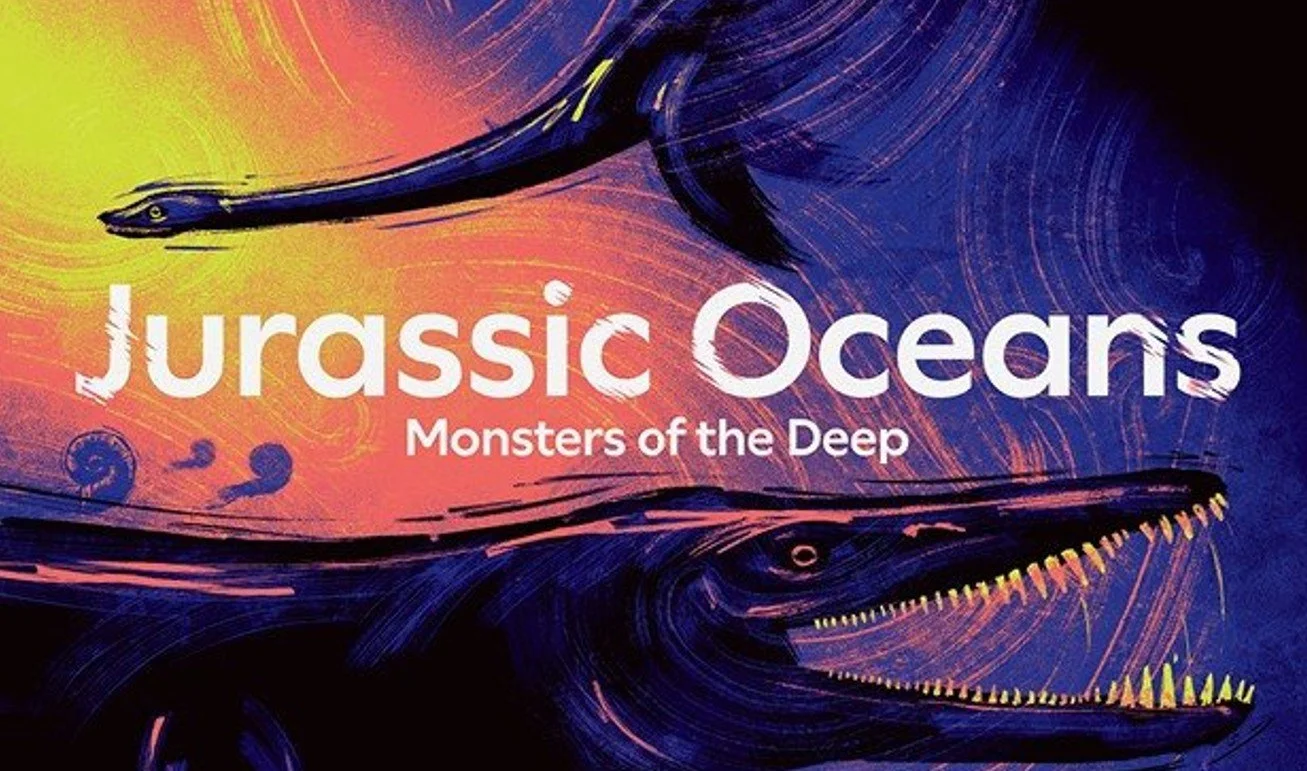
Caption: some of the excellent art created for the front end of the exhibition. I can’t find the name of the artist but will add it here when I do. From the NHM website.
First off, Jurassic Oceans closes in February 2027, so you don’t have much longer to go see it. This is a separately ticketed event: you don’t get free entry as per other parts of the NHM (get tickets here). Jurassic Oceans features a large number of fossils, ranging from ammonites and other cephalopods to fossil sharks, Mesozoic actinopterygians (ray-finned fishes), thalattosuchians (aka sea crocs), plesiosaurs and more. Highlights include the original Leedsichthys tail, a mounted replica of the Japanese plesiosaur Futabasaurus (the original of which I saw in Tokyo), and the German Rhacheosaurus specimen that includes a soft-tissue outline.
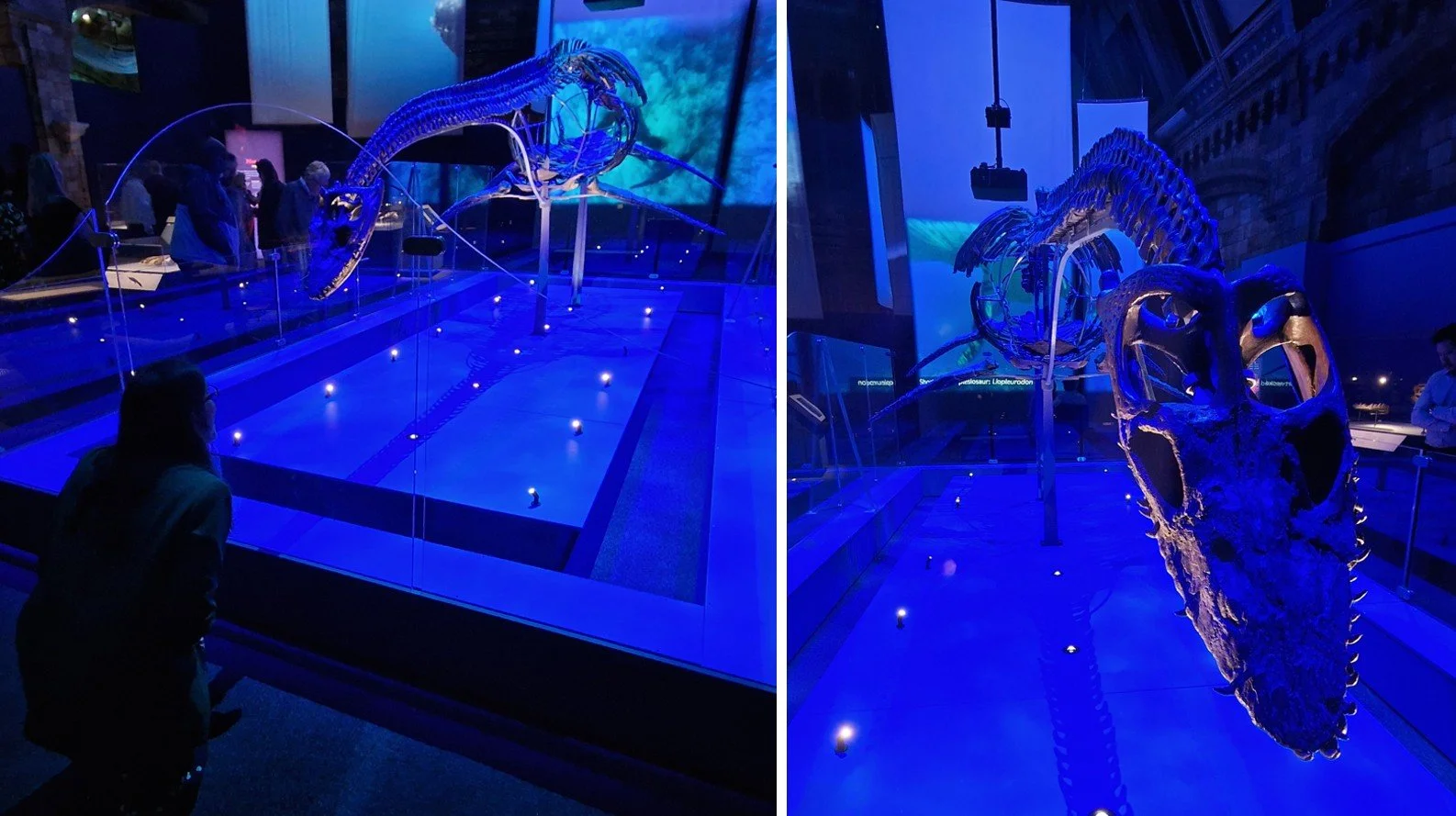
Caption: the Japanese elasmosaurid plesiosaur Futabasaurus, a centrepiece of the exhibition. At left it’s being examined by plesiosaur expert Aubrey Roberts, who worked as advisor for Jurassic Oceans. Images: Darren Naish.
You essentially travel through time from the Triassic toward the end of the Cretaceous, representative fossils and displays showcasing animals of the time. Yes, there are lots of superstars, but a good number of slightly more obscure animals too, among them temnospondyls (the Australian Paracyclotosaurus is on show; a specimen that used to be on display in the museum’s Hintze Hall) and thalattosaurs, my beloved (specifically, the Italian Askeptosaurus). I keep meaning to write here about thalattosaurs: I covered them at reasonable length in Ancient Sea Reptiles (Naish 2022) but there’s so much more to say.
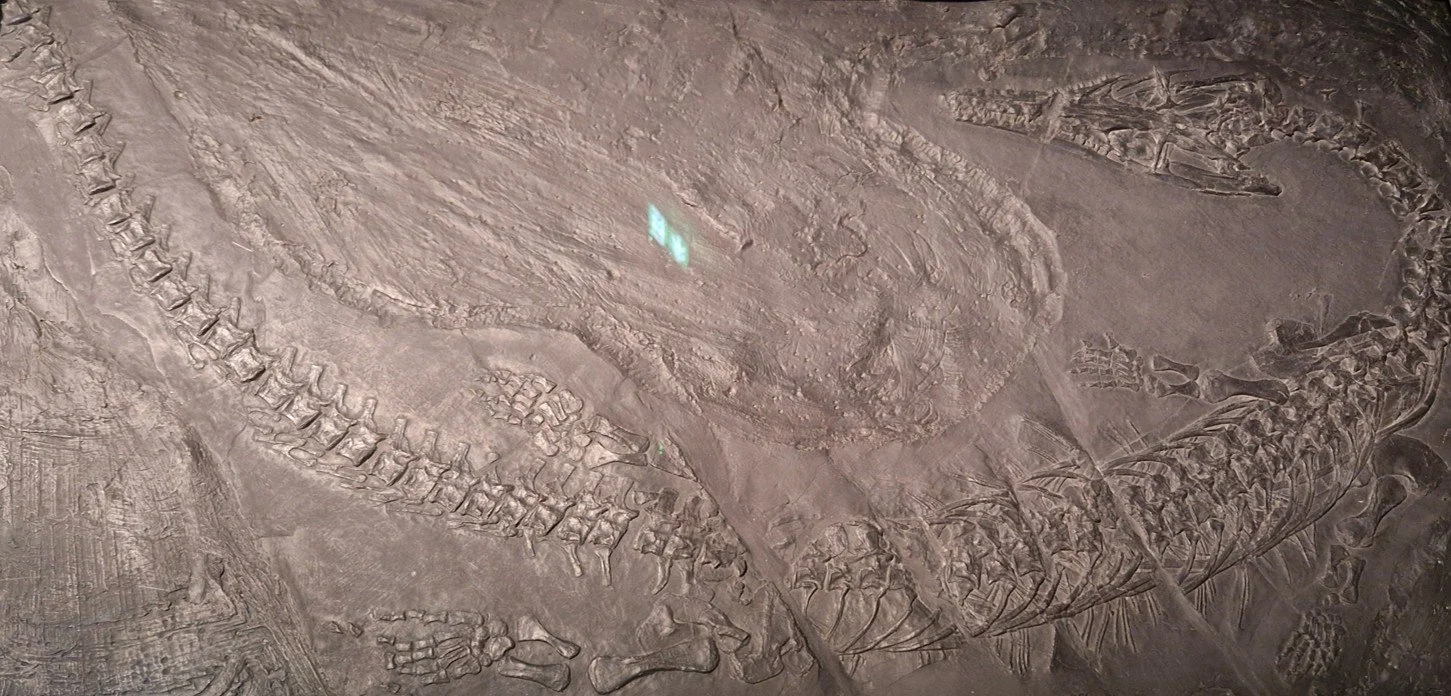
Caption: skeleton of the Italian thalattosaur Askeptosaurus, a relatively large, big-toothed member of the group but the one that’s generally encountered first in the literature. We feature a near-identical image in Ancient Sea Reptiles. Image: Darren Naish.
Much here was of special interest to me. Having mentioned Leedsichthys, some of you will know that this is one of the superstars of the Jurassic marine roster: an immense filter-feeding fish – exactly how immense has been the source of some dispute, of course (Martill 1986, 1988, Liston 2004, Liston & Noë 2004) – that lived alongside sea crocs, plesiosaurs and ichthyosaurs. I was part of the team that helped excavate a Leedsichthys known as Ariston back in 2002 (Liston 2006; here’s a relevant 2009 Tet Zoo ver 2 article), plus it’s always had some sort of connection to my writings and research on Jurassic marine reptiles and the ecosystems they inhabited. I had never seen any part of the original NHM specimen before (and I’m not the right age to have seen it back when it was on show at the museum’s old fish gallery), and here it was.
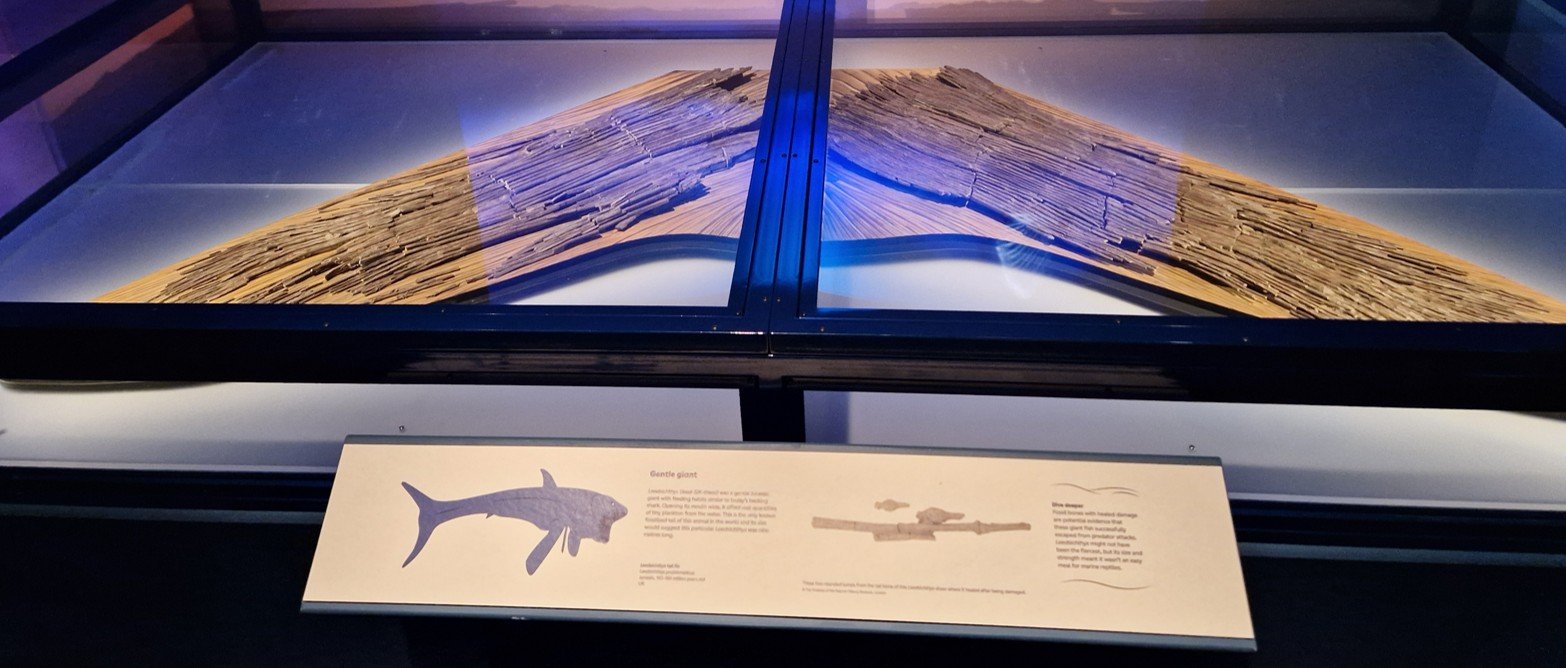
Caption: the giant tail of the Jurassic actinopterygian Leedsichthys from the Oxford Clay (specimen NHM P.10000). The tail has a span of 2.74 m. Remains of this animal suggest a length of 16 m. The tail used to be on show in the museum's old fish gallery, ripped out and dismantled during the 1960s or 70s. Image: Darren Naish.
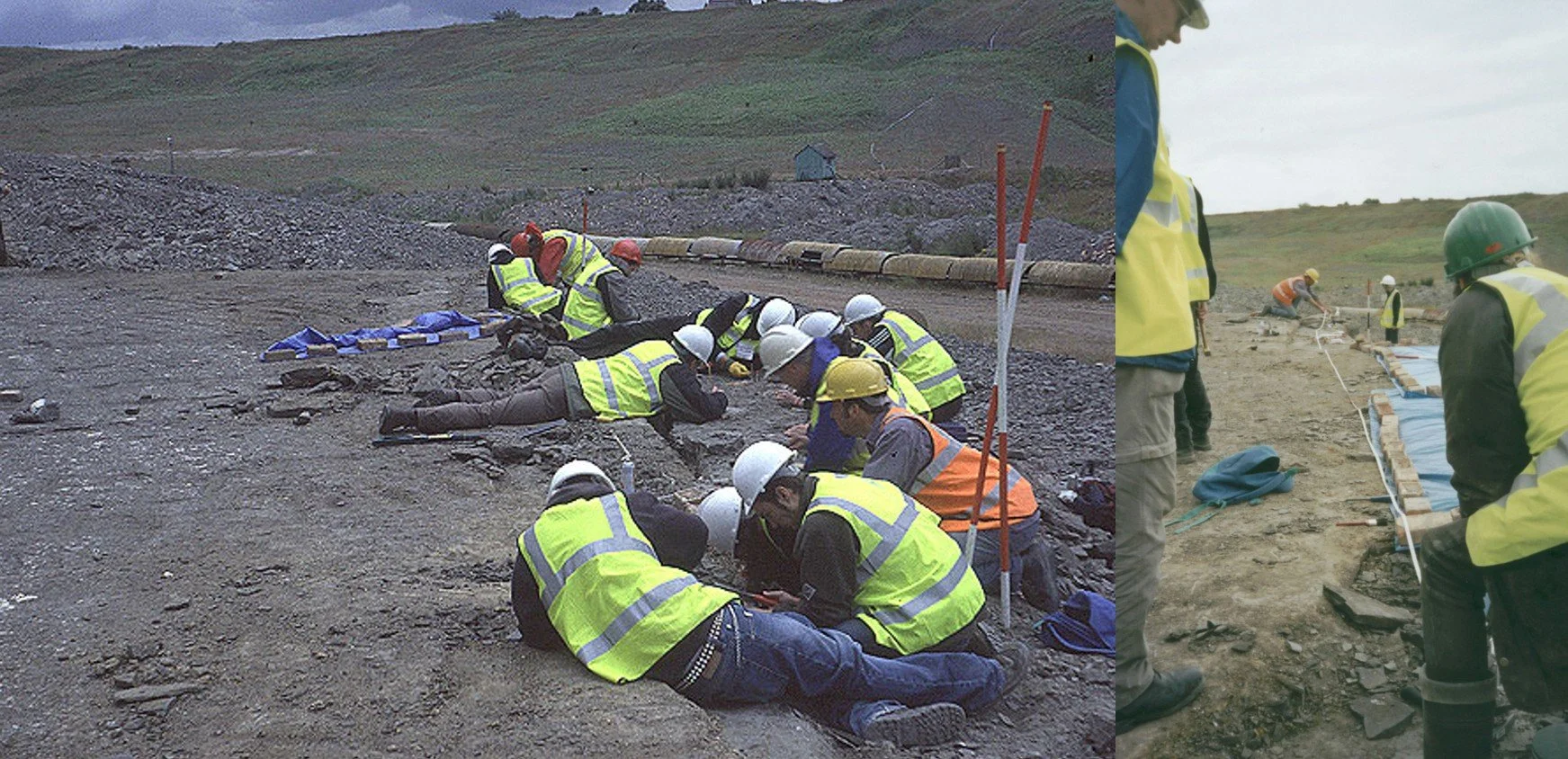
Caption: scenes from the 2009 Ariston Leedsichthys dig. At left, a set of us hard at work (I’m on my front in the middle of the image). At right, an effort to measure the extent of exposed fish. There was a lot of it. Images: Jeff Liston; Darren Naish.
Key sea croc specimens. Thalattosuchians, and specifically their subgroup the metriorhynchids, have been written about at Tet Zoo on several occasions, and one of the key things I’ve addressed in the past is what they actually looked like. I grew up with the ‘dolphin croc’ meme being the main representation of metriorhynchid appearance. But, no: articulated skeletons with soft tissue impressions show that they were not like this at all, and one of the key specimens is an articulated Rhacheosaurus from Germany. Great news… this exact specimen is on show in the exhibition! I was thrilled to see it.
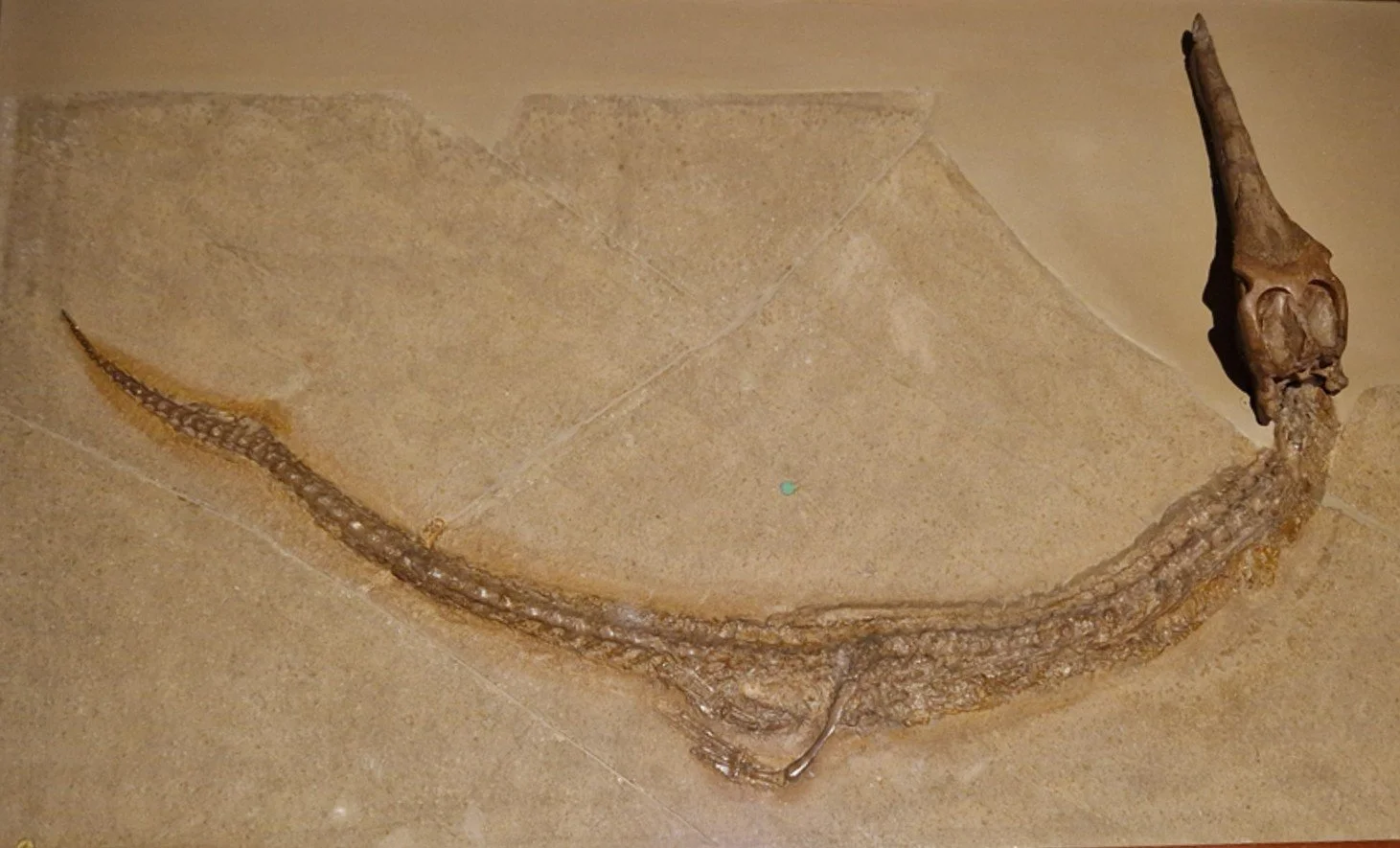
Caption: the Rhacheosaurus specimen referred to in the text. It’s not very big, being around 1 m long in total. This is a famous and historic specimen that’s been figured several times in the Mesozoic marine reptile literature. Image: Darren Naish.
Ichthyosaurs, plesiosaurs and more. Other thalattosuchians are on show too (including the full skeleton of the archaic form Pelagosaurus), as are several great ichthyosaur and plesiosaur specimens, including giant pliosaurid remains. I was really happy with the ichthyosaur coverage: 3D skulls, a life-sized life reconstruction, several entire skeletons on slabs, and some content on palaeobiology.
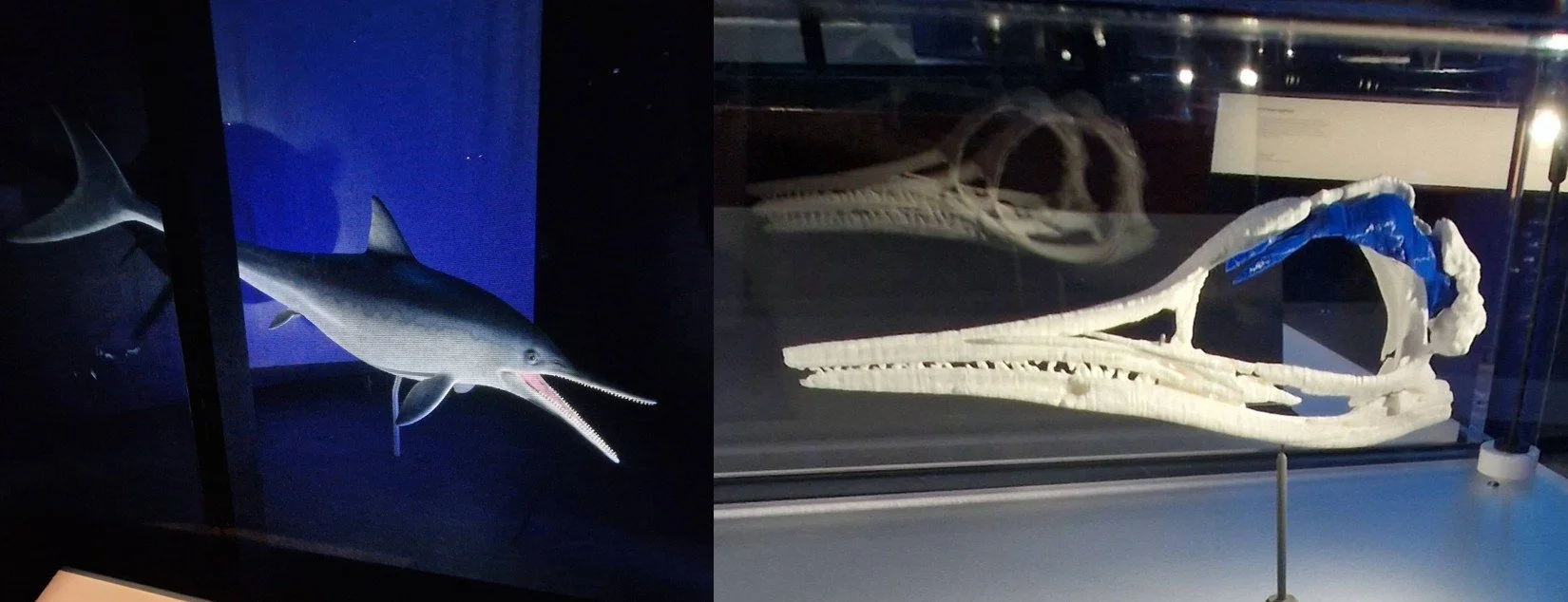
Caption: ichthyosaur items on show at Jurassic Oceans. A life-sized Ichthyosaurus model at left (lit and arranged in a way relevant to a feature about potential use of camouflage), and a 3D print of a Hauffiopteryx skull at right, showing (in blue) a brain endocast. Images: Darren Naish.
Mosasaurs also have representation toward the end of the exhibition. Right now is a very busy and exciting time if you’re interested in mosasaurs, a topic I covered in my marine reptiles talk at DinoCon 2026 and which I really must cover here at some point soon. I did at least cover some of this stuff in my 2025 article on the latest edition of Ancient Sea Reptiles, which is here.
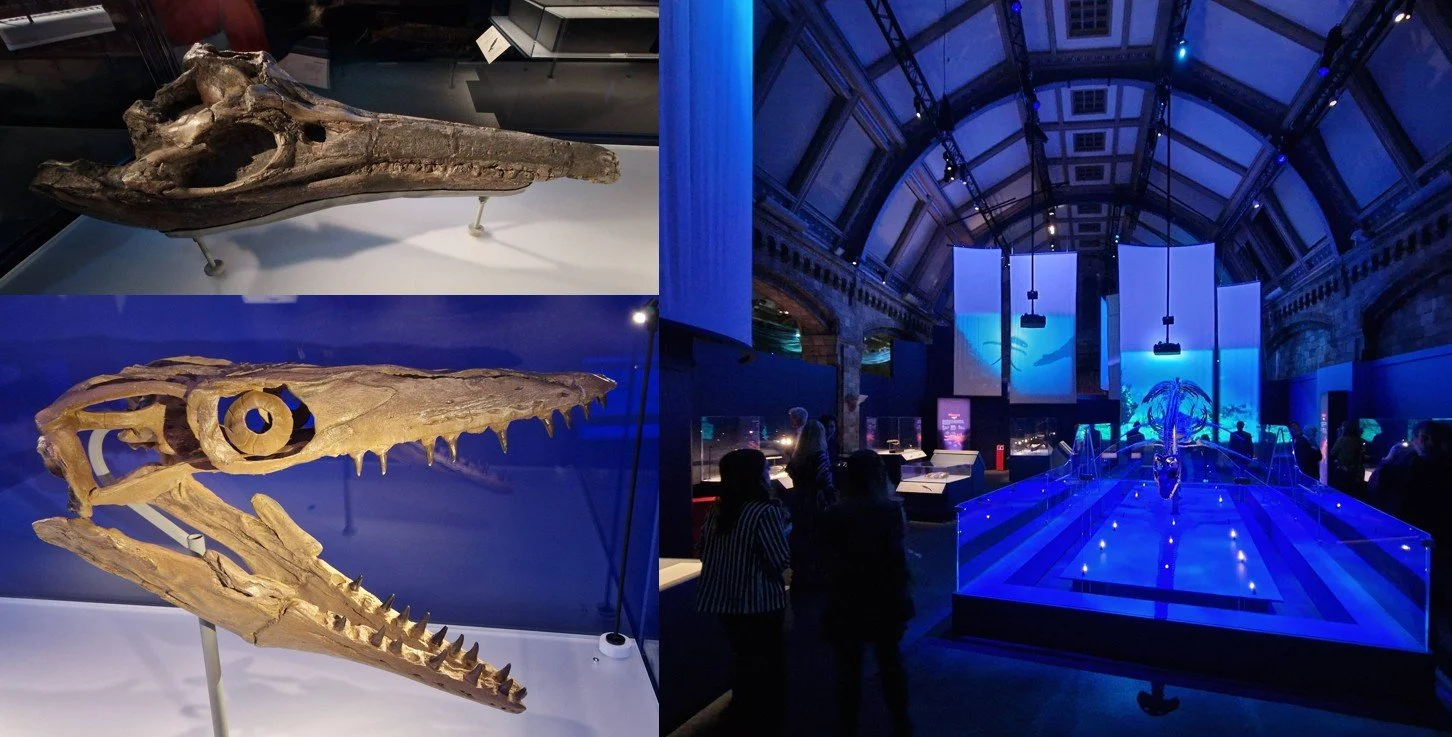
Caption: at left, ichthyosaur and mosasaur skulls on show in Jurassic Oceans. At right, a view of part of the hall space… so very blue. Images: Darren Naish.
Design, content, shop! The design overall is impressive, with great use of the tall space of the hall, a lot of moody blue lighting and giant, tall screens that show CG footage spliced together from various documentaries, including the original Walking With Dinosaurs, Planet Dinosaur and more.
The shop is really good (I already had all the toys they sold bar a weird rubbery mosasaur) and they had a number of my own Ancient Sea Reptiles on sale. A new book has been published specifically for the exhibition, titled Jurassic Oceans: Monsters of the Deep by Lottie Dodwell-Williams and Susan Holmes. I understand that Ancient Sea Reptiles continues to sell well, and that it’s seen as having a connection to this exhibition… as well it might, it being the best overview of Mesozoic marine reptiles currently put to print, he says humbly.
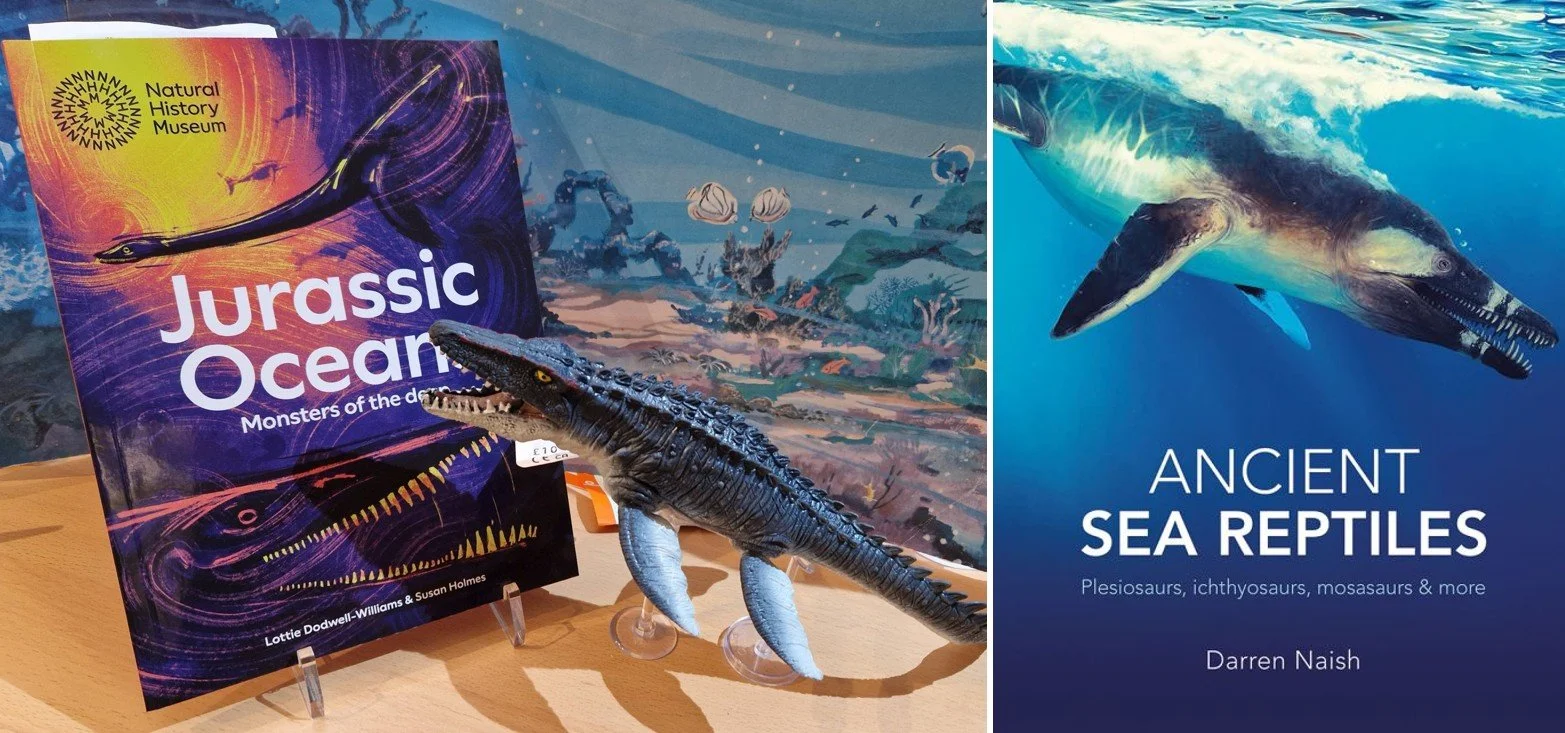
Caption: at left, items I obtained at Jurassic Oceans. At right, Ancient Sea Reptiles… buy it today. Images: Darren Naish.
Jurassic Oceans is open now and will remain so until February 2027. The website is here (there’s a lone generative AI image there, but this isn’t representative of any content within the exhibition). If you’re at all interested in Mesozoic animals, in ancient life, in prehistory or natural history or museum exhibitions in general, you totally should visit.
For previous Tet Zoo articles on Mesozoic marine reptiles, see…
The skin of ichthyosaurs, September 2008
Who made the giant Jurassic sea-floor gutters?, December 2009
Prediction confirmed: plesiosaurs were viviparous, August 2011
Can’t get me enough of that sweet, sweet Temnodontosaurus, January 2014
Plesiosaur Peril — the lifestyles and behaviours of ancient marine reptiles, March 2014
Ancient Marine Reptiles Had Absurd, Complex Nostrils, July 2014
‘Proto-Ichthyosaur' Sheds Light on Fish-Lizard Beginnings, November 2014
The Unique and Efficient 4-Flipper Locomotion of Plesiosaurs, August 2017
The Fall and Rise of Protoichthyosaurus, October 2017
The Ichthyosaurs of the Kimmeridge Clay, March 2021
History of the Iraqi Ichthyosaur, April 2021
Ancient Sea Reptiles Is Out Now, February 2023
Ancient Sea Reptiles Goes to Third Edition!, December 2025
Refs - -
Liston, J. 2004. An overview of the pachycormiform Leedsichthys. In Arratia, G. & Tintori, A. (eds) Mesozoic Fishes 3 - Systematics, Paleoenvironments and Biodiversity. Verlag Dr. Friedrich Pfeil (München), pp. 379-390.
Liston, J. 2006. From Glasgow to the Star Pit and Stuttgart: a short journey around the world's longest fish. Glasgow Naturalist 24 (4), 59-71.
Liston, J. & Noë, L. F. 2004. The tail of the Jurassic fish Leedsichthys problematicus (Osteichthyes: Actinopterygii) collected by Alfred Nicholson Leeds - an example of the importance of historical records in palaeontology. Archives of Natural History 31, 237-253.
Martill, D. M. 1986. The world's largest fish. Geology Today 2, 61-63.
Martill, D. M. 1988. Leedsichthys problematicus, a giant filter-feeding teleost from the Jurassic of England and France. Neues Jahrbuch fur Geologie und Paläontologie, Monatshefte 1988, 670-680.
Naish, D. 2022. Ancient Sea Reptiles. Natural History Museum, London.


