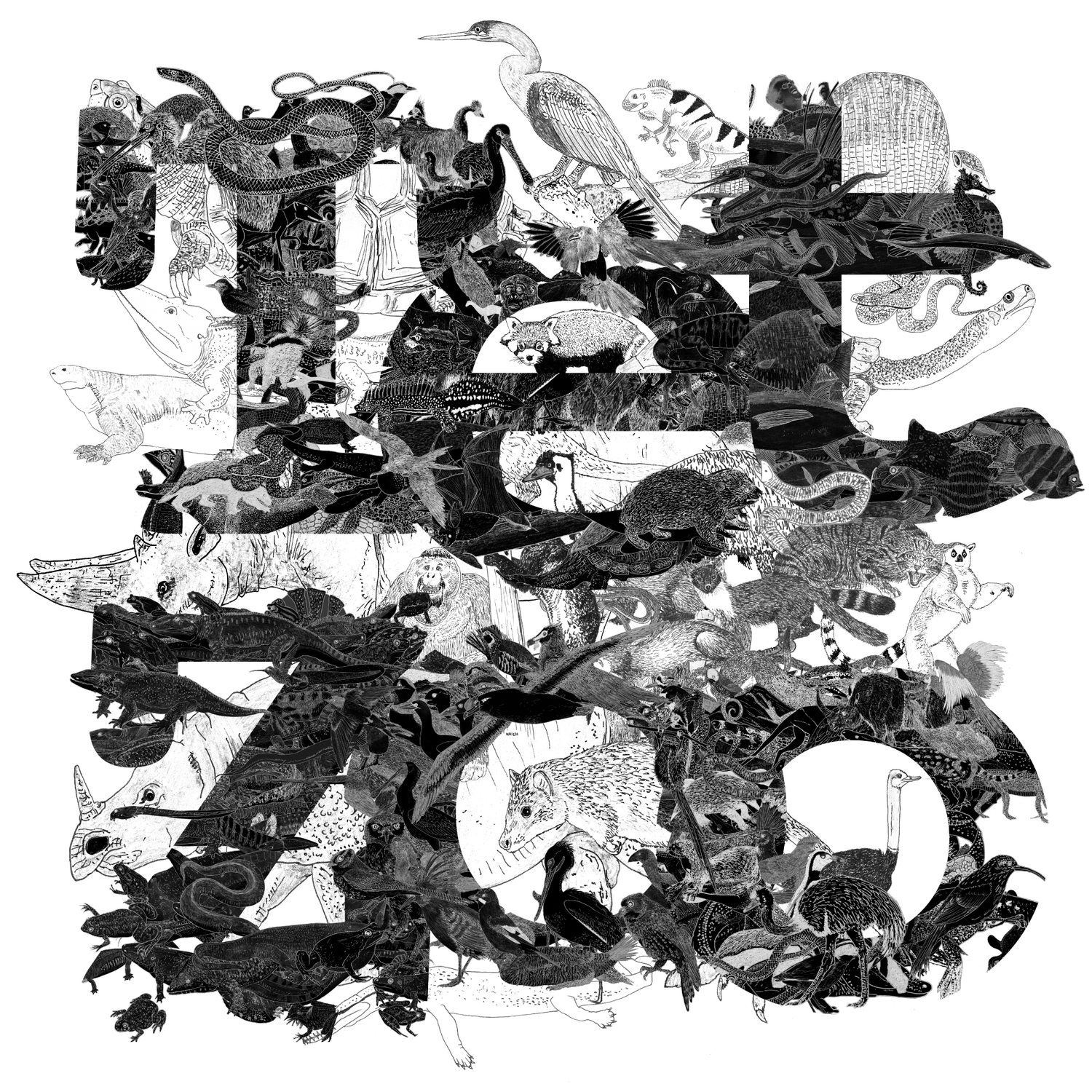
I feel the need to publish something new on rodents, and with no time to produce anything lengthy or all that complex, here are brief thoughts on one of my favourite rodent groups: voles!
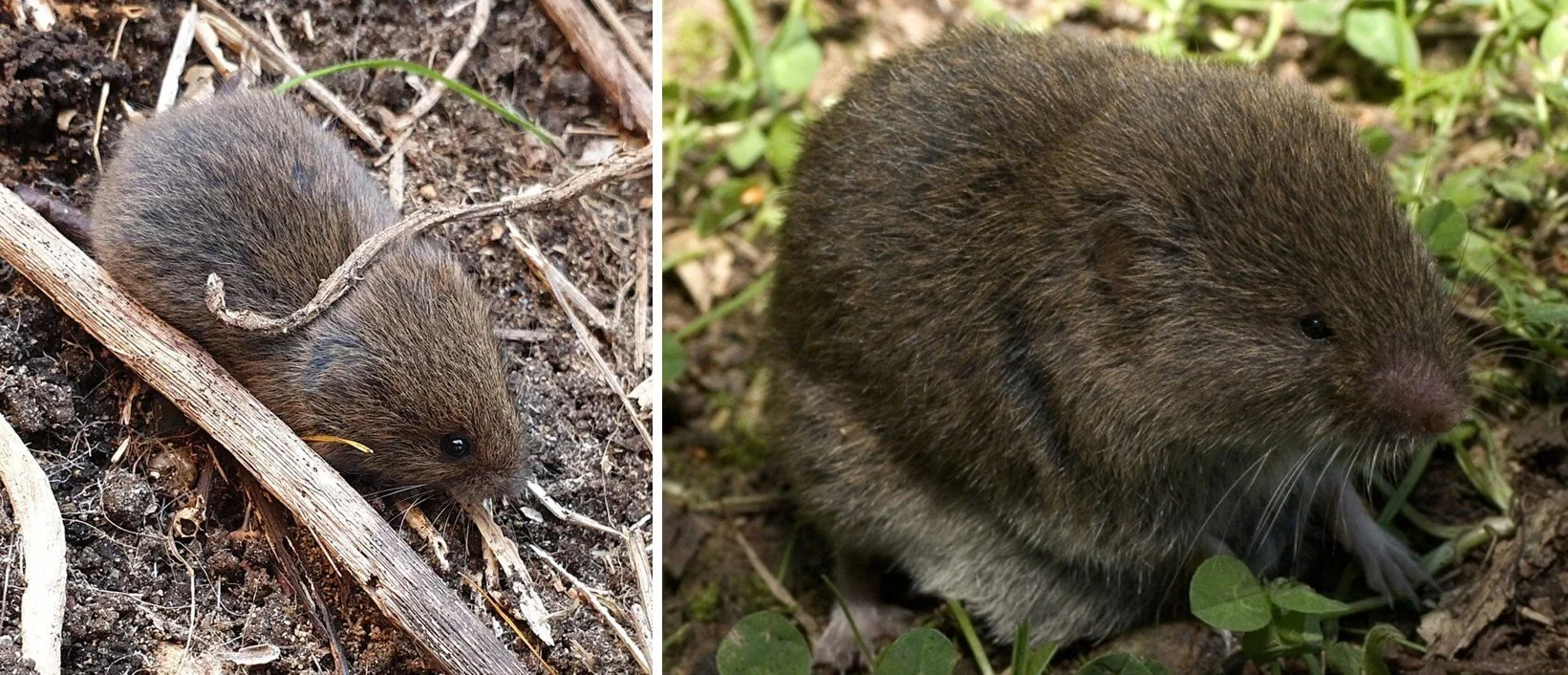
Caption: voles alive! At left, a Short-tailed field vole M. agrestis I encountered in rocky scrub at Lepe Beach, southern England. At right, Lusitanian pine vole M. lusitanicus, an Iberian endemic. Images: Darren Naish; José Ramón Pato Vicente, CC BY-SA. 2.5 (original here).
Voles (Arvicolinae or Arvicolidae), as a generalisation, are mostly small (on average, 10-11 cm long, with a tail of 3-4 cm), blunt-headed, short-tailed, herbivorous muroids. They’re predominantly animals of Northern Hemisphere forest floors, grasslands, steppes and rocky places, many constructing near-surface tunnels and burrows. Bog and marsh dwellers, and amphibious species, are part of the group too: the unusually large and long-tailed muskrats (Ondatra) are voles, as are the cold-adapted, tundra-dwelling lemmings (the subgroup Lemmini). Collared or varying lemmings (Dicrostonyx), which are a distinct group from true lemmings, are cold-adapted voles of North America and Eurasia that undergo colour change across the seasons and – uniquely – grow massive, double-pronged digging claws during the colder parts of the year.
This is a highly speciose group, with around 155 extant species classified in about 30 genera. They’re related to cricetids (hamsters, New World mice and kin) and included with them in the same ‘family’ by some authors. ‘Classic’ voles, at least here in Europe, include water voles (Arvicola) and field voles and their many relatives (Microtus). Those last two are familiar and widespread in Eurasian faunas and the fact that their massive populations have long been of significance to agriculture, and undergo great cycles of boom and bust, have made them the subject of substantial scientific study.
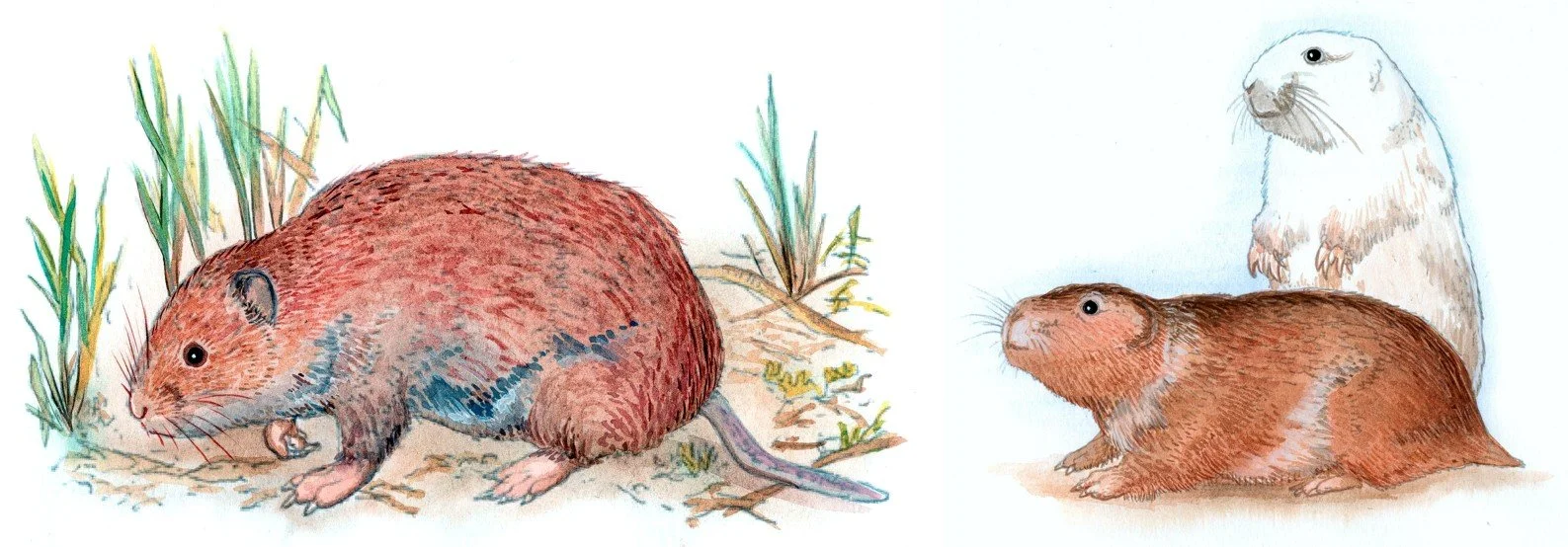
Caption: artistic depictions of (at left) a Phenacomys heather vole; at right, winter and summer looks for a Dicrostonyx varying lemming. Images: Darren Naish, colouring by Gareth Monger.
North America has a list of voles that are very unusual by Eurasian standards. Some are arboreal (the Arborimus tree voles) and some are inhabitants of upland heaths (the Phenacomys heather voles). I wrote about North America’s more distinctive voles in a 2014 article at Tet Zoo ver 3. Several different phylogenetic hypotheses have been published for voles, some of these showing collared lemmings, true lemmings and heather voles outside of a clade that includes muskrats and microtine voles (Chaline & Graf 1988, Chaline et al. 1999, Conroy & Cook 1999, Cook et al. 2004, Galewski et al. 2006).
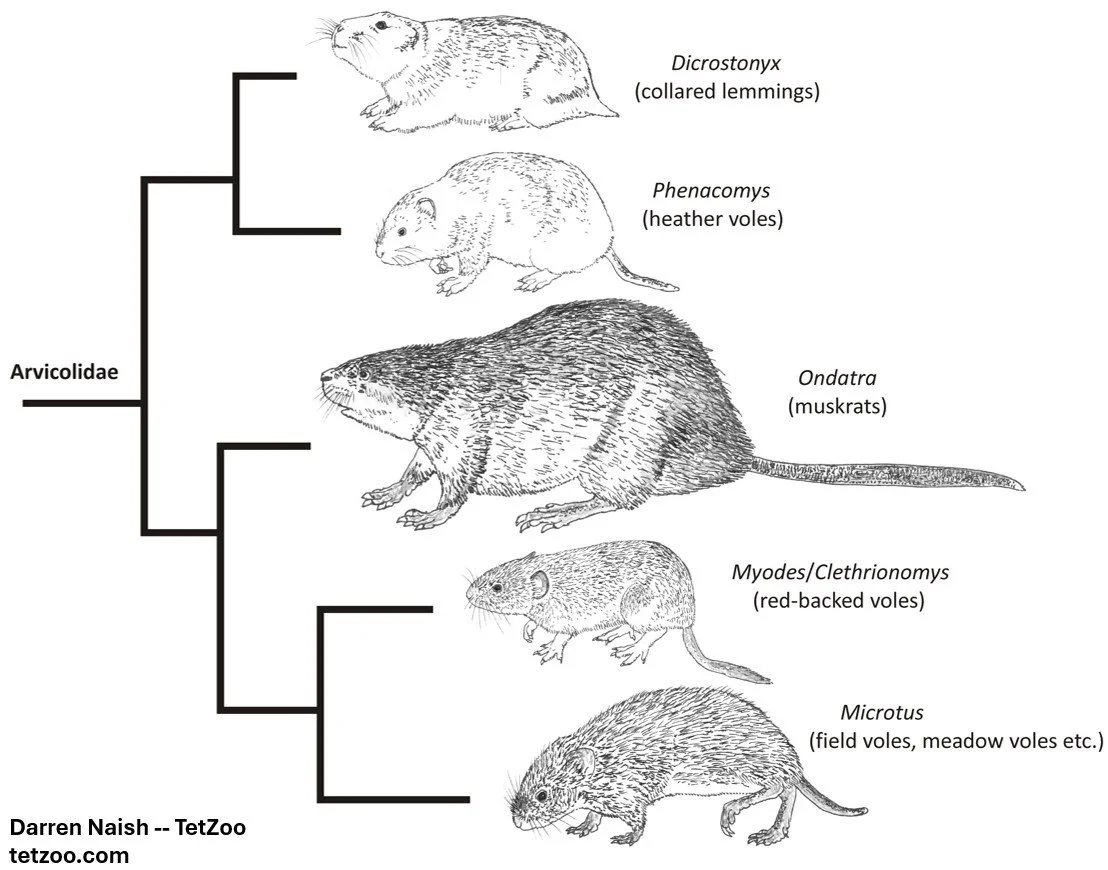
Caption: a simplified vole cladogram, this depicting a topology where heather voles and collared lemmings are outside the clade that includes voles like Microtus. Image: Darren Naish.
Voles have an excellent and complicated fossil record from the Miocene onwards. This involves numerous immigration events from Eurasia into North America; events that involve the opposite – the moving of North American groups into Eurasia – were evidently far rarer, maybe occurring just once in the case of collared lemmings. Triangular or T-shaped occlusal surfaces are typical of their teeth as is the presence of a distinctive muscle scar for the medial part of the masseter and a so-called ‘arvicolid groove’ on the mandible (Martin 2007). Changes in the abundance of certain lineages and the evolution of their teeth can be linked to climatic shifts and a trend towards hypsodonty is present with some species possessing rootless molars. Ondatra has an excellent North American fossil record with a series of forms demonstrating increasing body size, hypsodonty and tooth complexity.
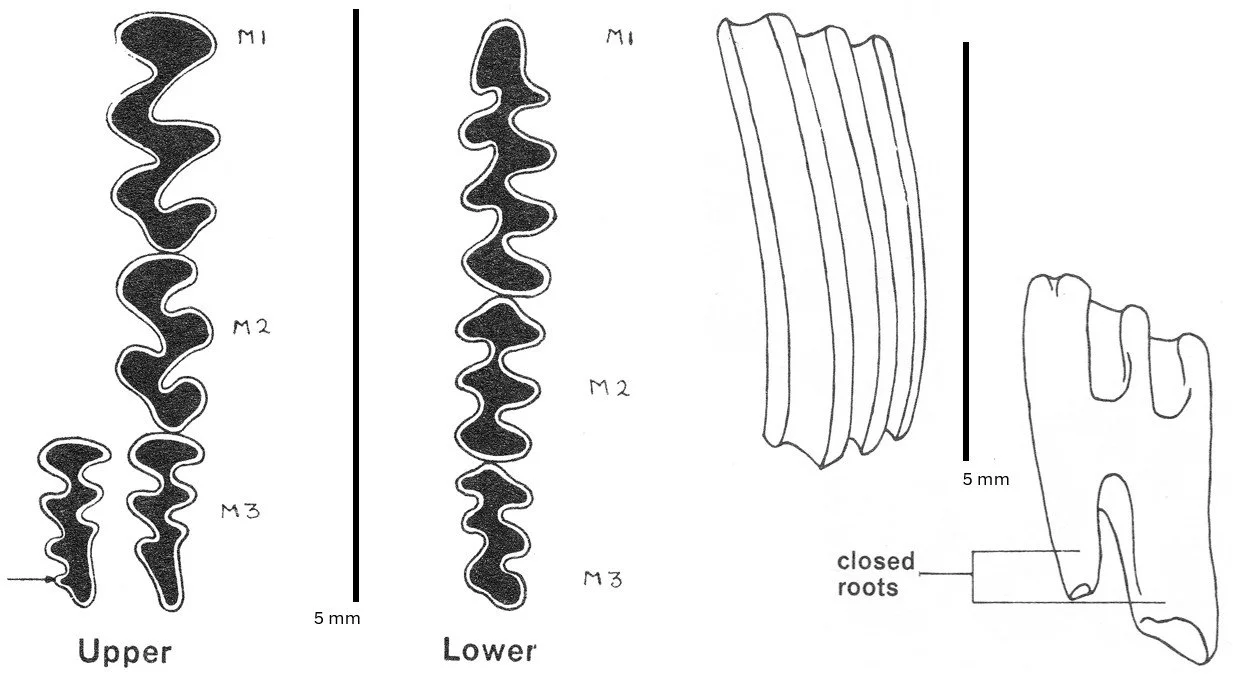
Caption: at left, upper and lower cheek teeth of a Bank vole Clethrionomys glareolus showing the zig-zagging form of the occlusal surfaces. At right, an open-rooted, constantly growing cheek tooth of a Short-tailed field vole M. agrestis on the left, and a close-rooted Bank vole tooth. Images: Lawrence & Brown (1967).
And that will do. There is lots on rodents in the Tet Zoo archives… as ever, mostly ruined by the downfall of ver 2 and 3. One day I might renovate it for republication here. Among those articles that are still worth checking out are…
Osgood, Fuertes, and mice that swim and mice that wade, March 2006
Australia, land of placentals (part I), December 2007
Australia, land of placentals (part II), December 2007
New, obscure, and nearly extinct rodents of South America, and… when fossils come alive, November 2008
Of vole plagues and hip glands, January 2014
North America: land of obscure, freaky voles, January 2014
A brief history of muskrats, September 2014
Cricetomyines: the African pouched rats and mice, November 2014
African Climbing Mice and the Congo Link Rat, October 2015
Meet the Shreats, July 2016
The Sigmodontines, March 2017
Cloudrunners and Other Cloud Rats of the Philippines, June 2020
Refs - -
Chaline, J., Brunet-Lecomte, P., Montuire, S., Viriot, L. & Courant, F. 1999. Anatomy of the arvicoline radiation (Rodentia): palaeogeographical, palaeoeocological history and evolutionary data. Annales Zoologici Fennici 36, 239-267.
Chaline, J. & Graf, J. D. 1988. Phylogeny of the Arvicolidae (Rodentia): biochemical and paleontological evidence. Journal of Mammalogy 69, 22-33.
Cook, J. A., Runck, A. M. & Conroy, C. J. 2004. Historical biogeography at the crossroads of the northern continents: molecular phylogenetics of red-backed voles (Rodentia: Arvicolinae). Molecular Phylogenetics and Evolution 30, 767-777.
Conroy, C. J. & Cook, J. A. 1999. MtDNA evidence for repeated pulses of speciation within arvicoline and murid rodents. Journal of Mammalian Evolution 6, 221-245.
Galewski, T., Tilak, M.-K., Sanchez, S., Chevret, P., Paradis, E. & Douzery, E. J. P. 2006. The evolutionary radiation of Arvicolinae rodents (voles and lemmings): relative contribution of nuclear and mitochondrial DNA phylogenies. BMC Evolutionary Biology 2006 6: 80.
Lawrence, M. J. & Brown, R. W. 1967. Mammals of Britain: Their Tracks, Trails and Signs. Blandford Press, Poole, Dorset.
Martin, R. A. 2007. Arvicolidae. In Janis, C. M., Gunnell, G. F. & Uhen, M. D. (eds) Evolution of Tertiary Mammals of North America, Vol. 2. Cambridge University Press, Cambridge, pp. 480-497.


