It’s probably impossible to write about the history of fossil hominin discoveries in Africa and not discuss, or at least mention, the Leakeys…
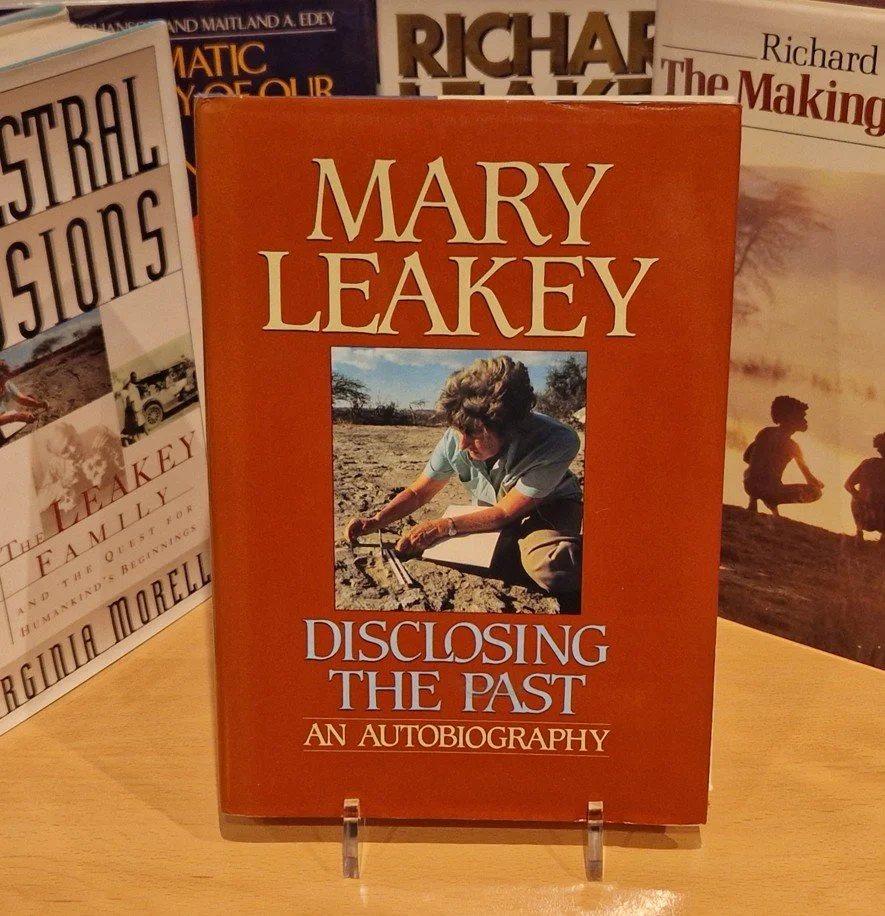
Caption: Mary Leakey’s 1984 book, the topic of the article here, with a few other relevant works in the background. I have accrued a great many books on fossil hominins and am slowly working my way through them. Image: Darren Naish.
While Louis Leakey (1903-1972) is the most famous, if not notorious, member of this family, it’s the highly accomplished Mary (1913-1996), his wife, that we’ll be looking at here. In 1984, when she was in her early 70s, Mary penned Disclosing the Past: An Autobiography (Leakey 1984). As part of my slow-burn look at volumes devoted to palaeoanthropology, I’ve recently been obsessing over this book.
Mary notes early on that the writing of autobiographies is something of a Leakey trait, and it’s no trivial matter that Louis began this task when he was just 33 years old. Thanks both to her association with Louis – initially as an assistant, then through marriage – and her later status as an independent researcher with her own work programme, Mary was involved across much of her life with archaeology and has connections to a great many interesting discoveries and hypotheses. I looked forward to reading about these and wasn’t disappointed. The book is eminently readable and contains a vast amount of information.
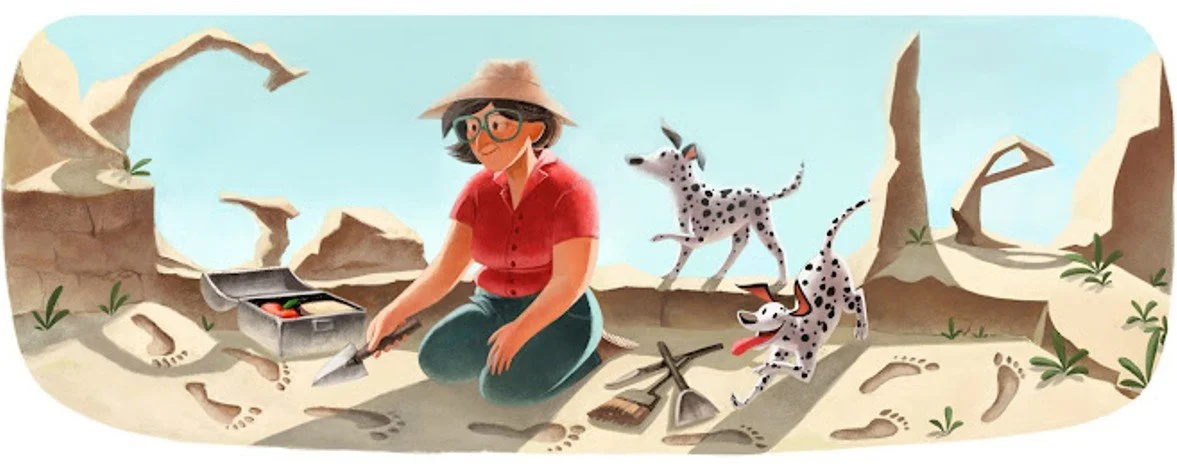
Caption: Mary Leakey has had a small amount of fame, and has appeared on stamps, as a TV guest, and on the covers of various books. In 2013 - in celebration of the date of her birth - Google released a Doodle devoted to her work and life. You can read a bit about its backstory and creation here.
Early chapters dwell on Mary’s childhood, much of which involved London and part of it France. Her father’s occupation as a painter I think gave the family a bohemian, perpetually mobile life that must have involved financial fits and starts, though it’s hard from a modern perspective to understand how people claiming to have no money might be able to own homes in Kensington and France. As might be predicted for a person with such a background, Mary lacked a stable school life and was forever in and out of education, much of this Catholic. It’s also clear that she was a rebel, on occasion hiding in the boiler room to avoid lessons and on another causing an explosion in a chemistry class. A bold and adventurous streak is demonstrated by her adoption of gliding as a hobby.
Meeting Louis, and a career in archaeology. Mary (née Nicol) first met Louis Leakey in 1934 after being introduced to him by archaeologist Gertrude Caton-Thompson, best known at the time for her work on stone tools excavated at the Fayoum in Egypt. Caton-Thompson, Mary noted, “was the epitome of that remarkable breed of English ladies who for archaeology’s sake and by determinism, skill, expertise and endurance achieve discoveries of major and permanent importance” (Leakey 1984, p. 39). Mary had produced illustrations for Caton-Thompson’s book The Desert Fayoum and it was the quality of this work that resulted in the introduction, since Louis was in search of an illustrator for Adam’s Ancestors (Leakey L. 1934), a book that was to have numerous editions over the years. Louis was married (apparently unhappily) at this time to Frida, and Mary was taken by Louis to meet her in Cambridge.
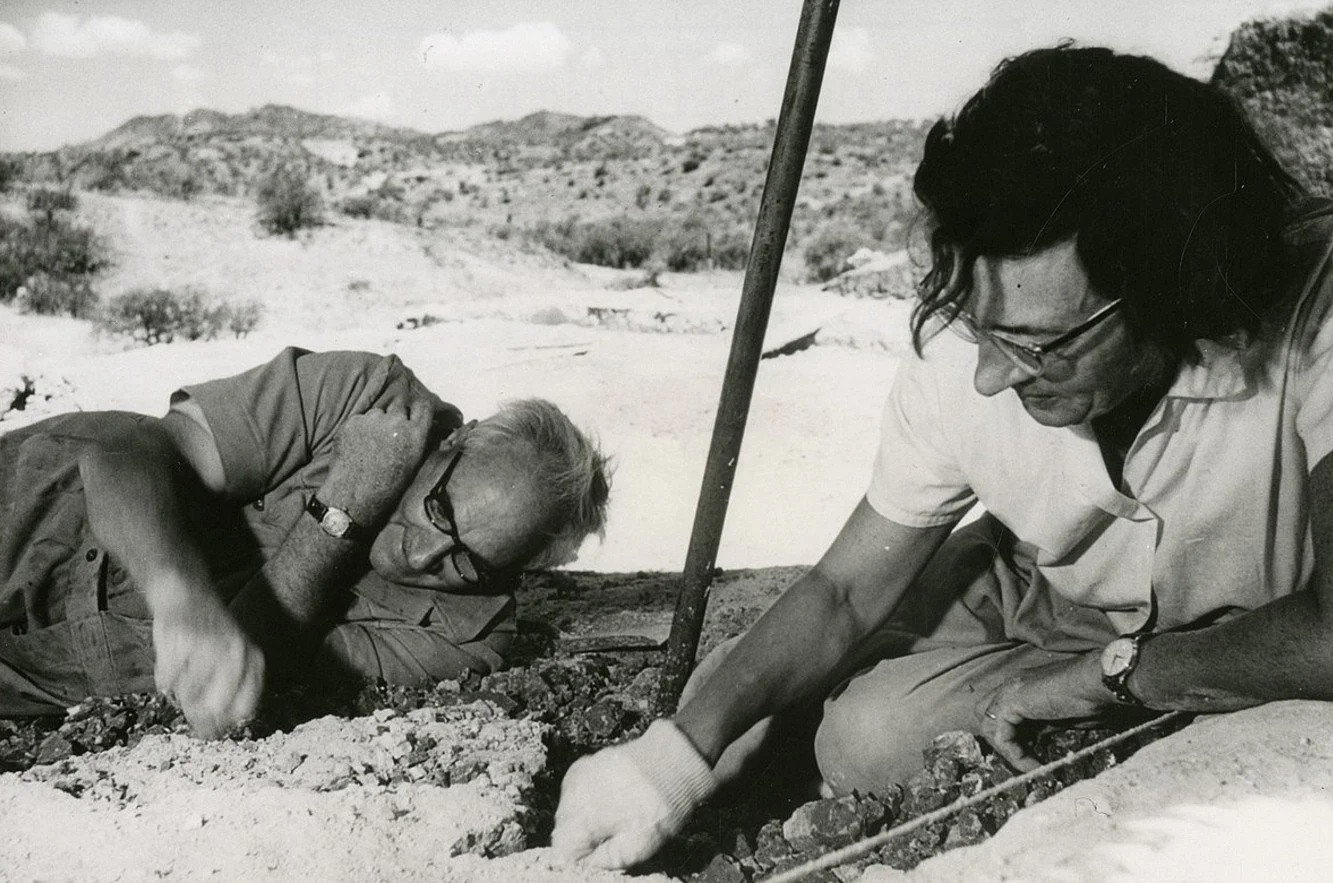
Caption: this photo showing Louis and Mary working in the field, I think from the 1960s, obviously isn’t relevant to their early life together in the 1930s and 40s. Image: Smithsonian Institution, public domain (original here).
By this time (the early 1930s), Mary was already involved in archaeology of her own volition having attended courses in geology at University College, London and in archaeology at London Museum. Here, she attended lectures by R. E. M. Wheeler (later, Sir Mortimer Wheeler) and of interest is her comment that “I can’t help wondering whether many of the achievements in archaeological discovery and methodology that are so often attributed to him did not rightly belong to his charming and extremely able first wife, Tessa” (Leakey 1984, p. 37).
Mary soon assisted and even directed excavations at Meon Hill, Hembury, Swanscombe and Jaywick (near Clacton). Swanscombe’s famous hominin was found there by visiting amateur archaeologist A. T. Marston in 1934. The Jaywick excavations were successful too and Mary, working with Kenneth Oakley, published her results on this locality in 1937, this being her first publication (Leakey 1984, p. 49).
Louis was involved at some level in various of these excavations and in fact planned to study and resolve questions surrounding the ‘Clactonian’ industries of the Early Palaeolithic, though Mary reports that he never completed nor published this work (Leakey 1984, pp. 48-49). Louis was a remarkable man – I don’t just mean this in a positive sense – and a vast quantity has been written about him, much of it by himself. His relevance to Mary’s life of course means that he warrants at least some coverage in my article here, though I should note that I’m reading additional works on the Leakeys and will return to a discussion of Louis in time.
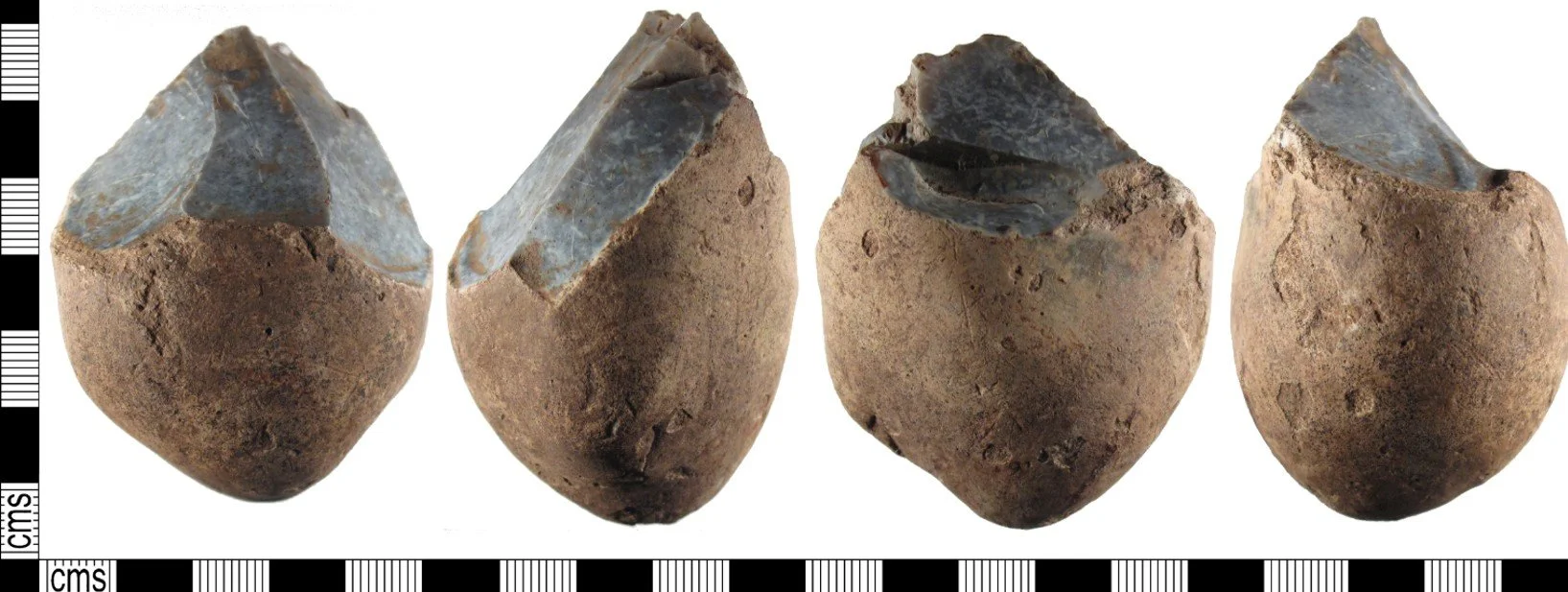
Caption: Clactonian sites yield distinctive Lower to Middle Palaeolithic tools, among them flint ‘choppers’ like this. Image: Sussex Archaeological Society, Stephanie Smith, CC BY-SA 4.0 (original here).
To Olduvai. It would have been during this English fieldwork that Louis first introduced the topic of Olduvai Gorge in Tanzania to Mary, a location with massive potential for Palaeolithic finds that might be important in global terms, not just East African ones (Leakey 1984, p. 49). Louis had been raising money to excavate there and wanted Mary to come along, and this she did, travelling there with her mother in 1935. In Zimbabwe, she had her first view of African rock art and described the memorable impression it had (Leakey 1984, p. 52).
Hominin remains identified as conspecific with the Asian species Homo erectus had only recently been found at Olduvai, as had the fossil antelope Phenacotragus recki (it’s Antidorcas recki today). A primate tooth found at Laetoli thought at the time to be that of a cercopithecid monkey later turned out to be that of a hominid. But, overall, the deposits weren’t as rich as hoped. Louis thought that the hippos of Ngorongoro didn’t belong to Hippopotamus amphibius but might be a surviving population of the especially big, ‘pop-eyed’ Pleistocene form H. gorgops. A long trek was made in order to discover a skull and thus test this possibility, but once one was found the ‘late-surviving H. gorgops hypothesis’ was no more.
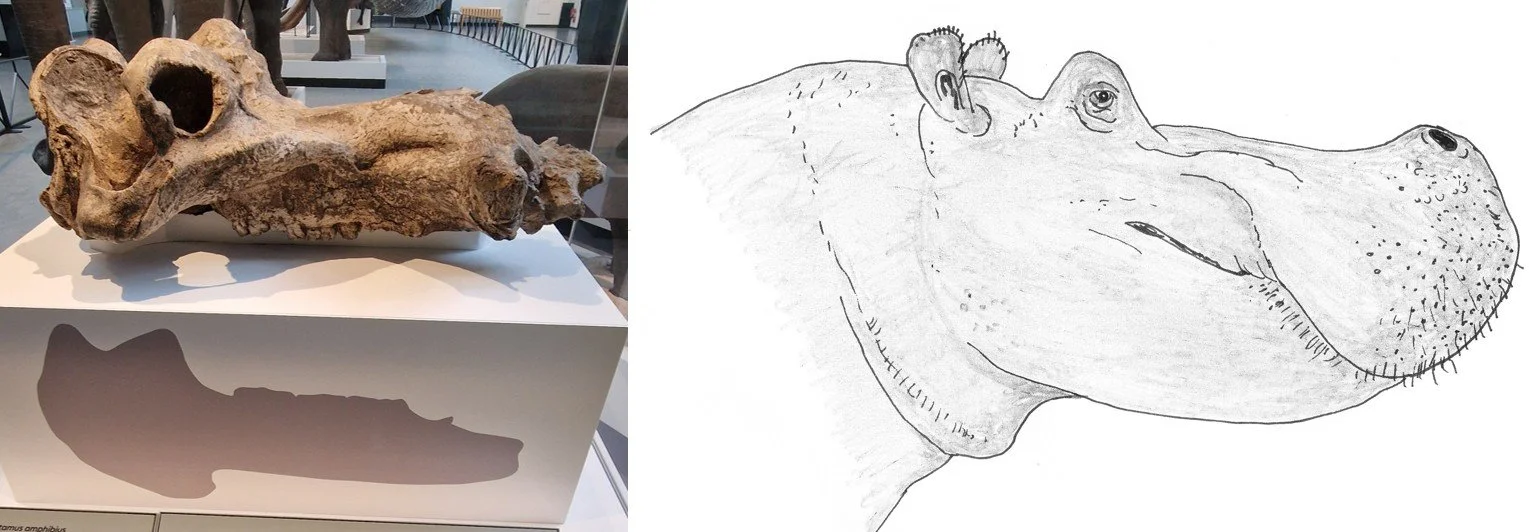
Caption: hippos have a fascinating fossil record that involves Europe and Asia as well as Africa, and if you’ve been visiting Tet Zoo for long enough you might recall my article on this topic. At left, an Olduvai Gorge fossil of the giant extinct Pleistocene species Hippopotamus gorgops at the Natural History Museum, London. At right, a life reconstruction of this species. Images: Darren Naish.
Wildlife dangerous and not. Fieldwork in the African countryside of course involves the occasional encounter with wildlife, and tales of lions and other animals are peppered throughout the book. Some make for awkward reading, in particular one where a former student of Louis’s, now the local District officer, so disliked the presence of a local lion pride that he went and shot the whole lot. Mary expressed her disgust at this. There are also accounts of snakes being killed after entering premises. By the 1940s, Mary was a mother (first to Jonathan, then Richard, then Philip) and baby Jonathan was nearly killed by swarming army ants. Visiting geologist Robert Shackleton was bitten by a puff adder but survived after Mary ran two miles to the car to retrieve the serum they’d bought with them, leaving a very young Jonathan and her dog Janet with Shackleton to do this.
An aspect of Mary’s life that I can’t approve of concerns her habit of letting her pet dalmatians run off and do whatever they liked in the bush. At least some people saw these unfamiliar black and white beasts in the field and reported them to officials as a new species of predator (Leakey 1984, p. 205), not realising that they were exotic pets allowed to roam free. Like most pet dogs and cats given free roam, their time was of course mostly spent hunting, and Mary mentions more than once the fact that she and colleagues had to locate the dogs and bring them back to camp. This also, of course, presents substantial danger to the lives of the pets themselves and it’s unsurprising that Mary mentions the loss of dogs to snakebite and another to a lion.
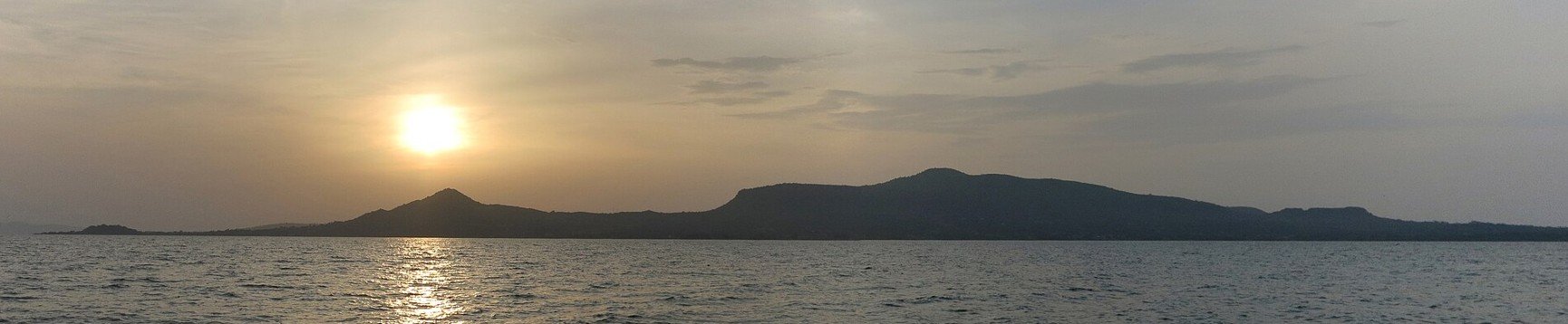
Caption: Rusinga Island, Lake Victoria, Kenya, is a familiar location if you’re familiar with late Cenozoic African faunas. Here’s what it actually looks like, as seen in panoramic view from the south-east. Image: Küchenkraut, CC BY-SA 3.0 (original here).
Mary’s serious commitment to keeping and breeding Dalmatians is demonstrated by her and Louis’s founding, in 1949, of the Dalmatian Club of East Africa (Leakey 1984, p. 113). Mary and Louis were evidently very serious about keeping and showing these dogs and both had roles in the East African Kennel Club.
Also of interest is that the Leakeys kept hyraxes (both rock and tree hyraxes) as pets, basically by just capturing them in the wild and then getting them used to human (and domestic canine) company. A number of interesting anecdotes about the keeping of hyraxes are included. An eagle owl was also kept as a pet after being rescued as a chick and then there are the duikers and other antelopes, genets, bat-eared foxes and snakes.
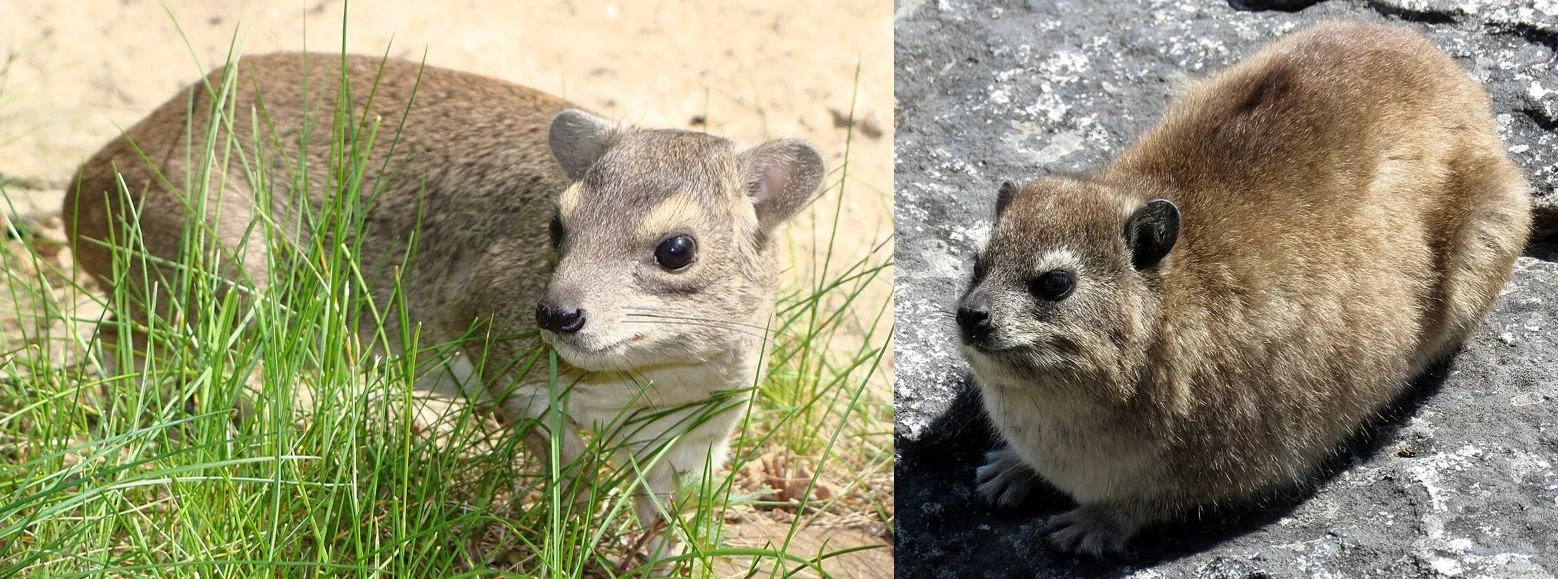
Caption: hyraxes are fascinating animals, and they’ve recently become familiar to a massive, new audience thanks to the popularity of certain social media accounts (waa-waa!!). I plan to write about them at length and never have. The animal at left is a Bush hyrax Heterohyrax brucei; that on the right is a Rock hyrax Procavia capensis. Images: JaySef, CC BY-SA 3.0 (original here); Prosthetic Head, CC BY-SA 4.0 (original here).
Crocodiles presented a danger at the waterside Rusinga Island locations, and Mary describes Louis’s solution to this: “when we were all ready to bathe he would fire both barrels of a shotgun into the water” (Leakey 1984, p. 102).
African archaeology and phantom thumps. Discovery sites excavated during the 1930s and 40s include Hyrax Hill, a burial site and prehistoric shoreline, and Mount Olorgesailie in the Rift Valley, a site so rich in stone tools that it was made into an open-air museum. While working at Hyrax Hill, Mary felt a hard thump on her shoulder, caused by an unseen assailant, and interpreted this as displeasure from a local spirit. I’ve heard tell of various ghostly encounters like this. I’ve twice received prominent ‘phantom thumps’ myself, once on the shoulder and once on the back of my calf. The second one caused impressive bruising, and I assumed initially that someone had kicked me or hit me with a ball. No, these were strains caused by overloading an insufficiently warmed muscle. I reckon that most such events can be explained this way.
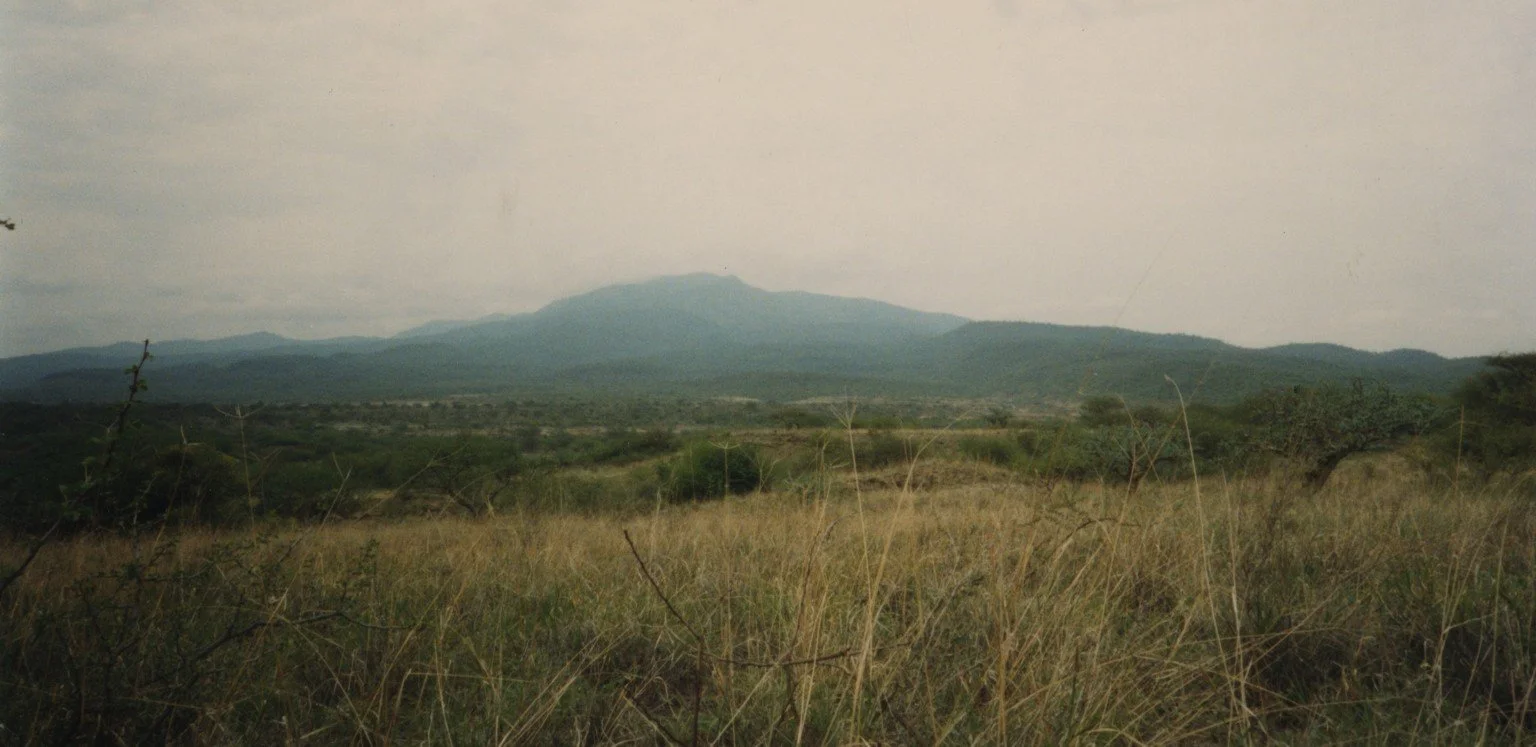
Caption: an image that gives a good idea of what the countryside near Mount Olorgesailie looks like, as of 1993. Image: Rossignol Benoît, CC BY-SA 3.0 (original here).
Another interesting character mentioned in passing is Joy Adamson, the famously popular author of Born Free and other works, whom Mary got to know through Joy’s marriage to Peter Bally at the Coryndon Museum (meaning that she was Joy Bally at this time). Joy was, apparently, “not a sympathetic personality, nor particularly easy to get on with”, but Mary did admire her genuine love of animals and hard work in raising funds for their benefit (Leakey 1984, p. 79).
Additional archaeological work of the 1940s led to Mary’s work in west Kenya on ‘dimple-based’ Iron Age pottery accrued by Archdeacon Owen, thought connected to a southward expansion of the Bantu. Similar pottery was later recovered from elsewhere in the continent (Leakey 1984, p. 86). Here’s your regular reminder that texts on the history of humanity and archaeology in general mostly do a poor job of explaining the events of Africa once you get to the evolution of modern humans, something that contributes to the idea that Africa is, and has been, a backwater where little to nothing happened. Archdeacon Owen was a champion of native rights and other causes who “would get down on his knees and pray for better luck”. He’s said to have deliberately buried a Proconsul skull after finding it. Its discovery, he feared, was at odds with the Old Testament story of creation (Leakey 1984, p. 86).
Rusinga Island’s fossils. The Miocene fossil sites of Rusinga Island in Lake Victoria became gradually better known during the 1940s. Among these, remains of the (supposed) hominoid Proconsul were considered the most exciting, a partial skull found by Mary in 1948 being among the best ever found (Leakey 1984, p. 98). Some of the fossils concerned here are no longer included in Proconsul but now belong to Ekembo, a taxon split from Proconsul by McNulty et al. (2015). Anyway, additional fragments, collected in 1947 but not studied until the 1960s by Martin Pickford, proved to be from the very same specimen.
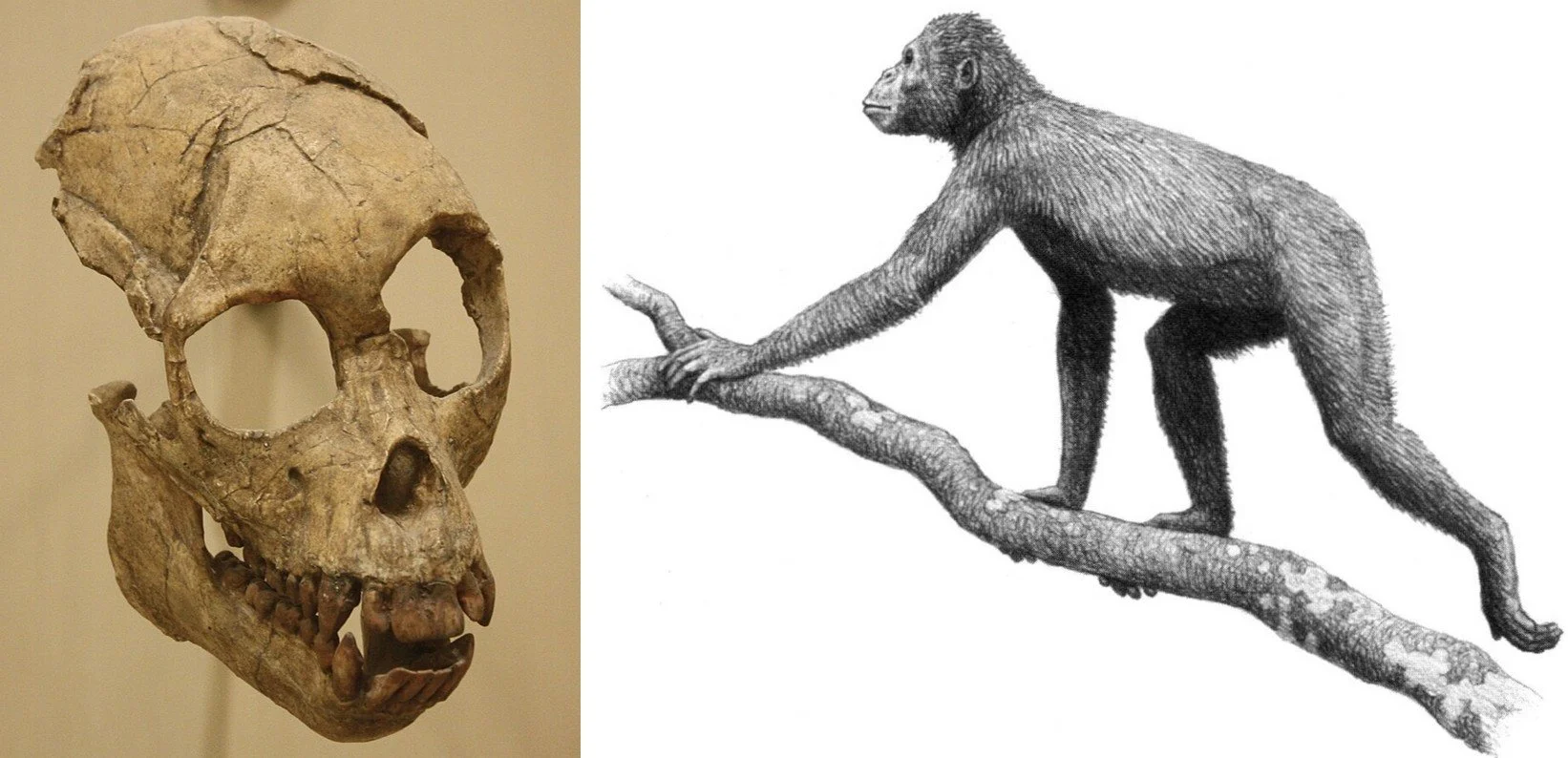
Caption: several species have been included within Proconsul and the taxonomy of the genus is quite complicated. I haven’t taken the time to sort out which Proconsul taxon Mary was writing about, but the skull on the left is that of the type species P. africanus, this being a specimen on show at the American Museum of Natural History, New York. At right, a life reconstruction of P. africanus by Mauricio Antón, emphasising the superficially cercopithecid-like proportions of this animal. Image: Ryan Schwark, public domain (original here); Mauricio Antón, CC BY 4.0 (original here).
An important benefactor of the Leakey’s research in Rusinga was British-American businessman Charles Boise, whose name (I think pronounced boy-see) you’ll recognise due to the 1959 naming of Zinjanthropus boisei in his honour. While in France during the 1950s, the Leakeys had a private after-hours tour of the famous Périgord and Lascaux caves and were able to take Boise with them. This trip and others encouraged Boise to fund the Leakey’s work, and palaeoanthropology in general.
Such was international interest in Mary’s significant Proconsul specimen that she hand-carried it by way of a free flight offered by BOAC (the ancestor of British Airways) to England. Here, it was studied by William Le Gros Clark in Oxford, the great expert in primate evolution at the time and heavily involved in these Miocene investigations, before being loaned – yes, loaned – to the British Museum in London. The fate of this specimen is a long story, since Richard (the second of Mary’s three sons) later aimed to retain it for the National Museum in Kenya, only to be told by the British Museum that it hadn’t been loaned but gifted. This story does, however, end with the specimen back in Kenya in 1982 (Leakey 1984, pp. 100-101).
Later Rusinga finds included fossils of rhinos, rodents, arthropods, a tree ant nest and a remarkably complete lizard head that Mary described as preserved with its “tongue hanging out” (Leakey 1984, p. 103). I recognise this as a description of the gerrhosaurid described by Richard Estes in 1962 (Estes 1962).
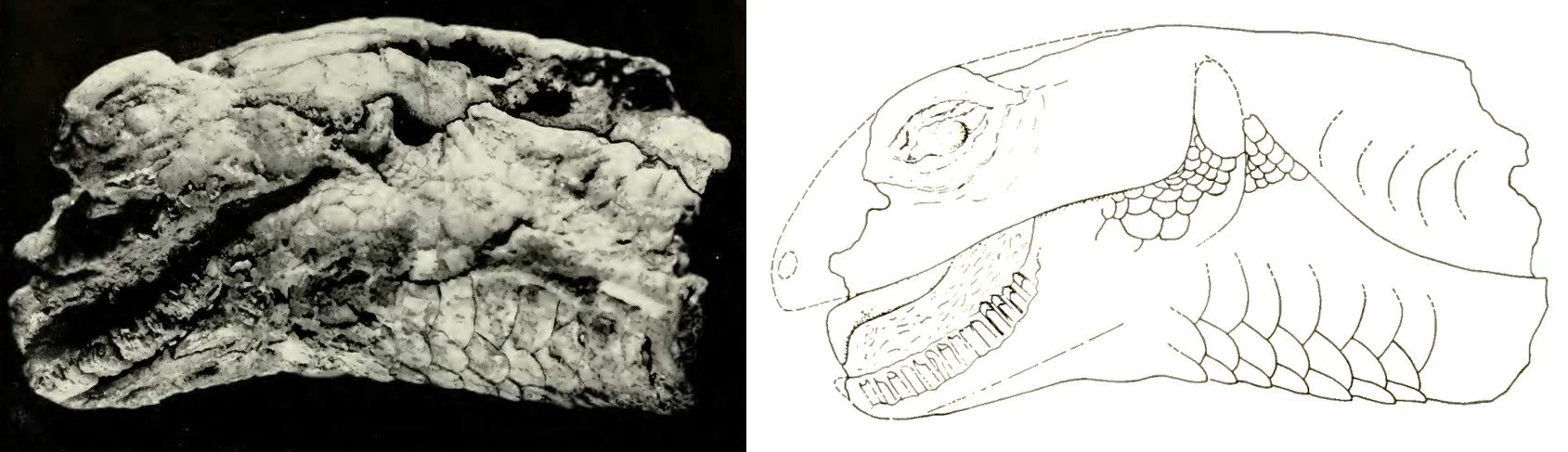
Caption: the remarkably well-preserved gerrhosaurid lizard head and neck from Rusinga Island, as described by Estes (1962). Estes proposed that it should be referred to the extant Gerrhosaurus and perhaps even to the modern species G. major (he had it as ‘cf G. major), and authors since have supported this, so far as I know... though G. major is now Broadleysaurus and excluded from Gerrhosaurus. The scales, teeth, left eye and tongue are preserved, in part replaced by calcite. Images: Estes (1962).
Louis’s amazing productivity is documented by the fact that he wrote his second autobiography (White African) in 1936 in addition to another book – Stone Age Africa – in the same year. If the title White African seems odd, it’s related to the fact that Louis was recognised as a member of the Kikuyu people and very much saw himself as one of them. Included among the Kikuyu was the anti-colonial Mau Mau movement. Louis was a Mau Mau opponent, writing two critical books of 1952 and 54 on this subject, and working with the Keynan government to gather intelligence and broadcast propaganda. I, of course, know nothing proper of Kikuyu culture nor what it was like to be Louis Leakey so will withhold further comment. But for Mary and her family, this must have been concerning, since it put them at risk of terrorist attack.
Mary’s work on rock art. Mary’s interest in and study of African rock art is a constant throughout the book. Despite plans during the 1950s, neither Mary nor Louis were able to raise the funds needed to produce a large and lavish book of the sort the subject deserved, and such wasn’t achieved until 1983 with the publication of Africa’s Vanishing Art (Leakey 1983). There is today widespread awareness of the fact that climate change, vandalism and other factors are affecting the persistence of ancient rock art. Things weren’t quite as bad in the 1950s but there was awareness of rock art deterioration, and efforts were made to record and reproduce the art as well as protect it.
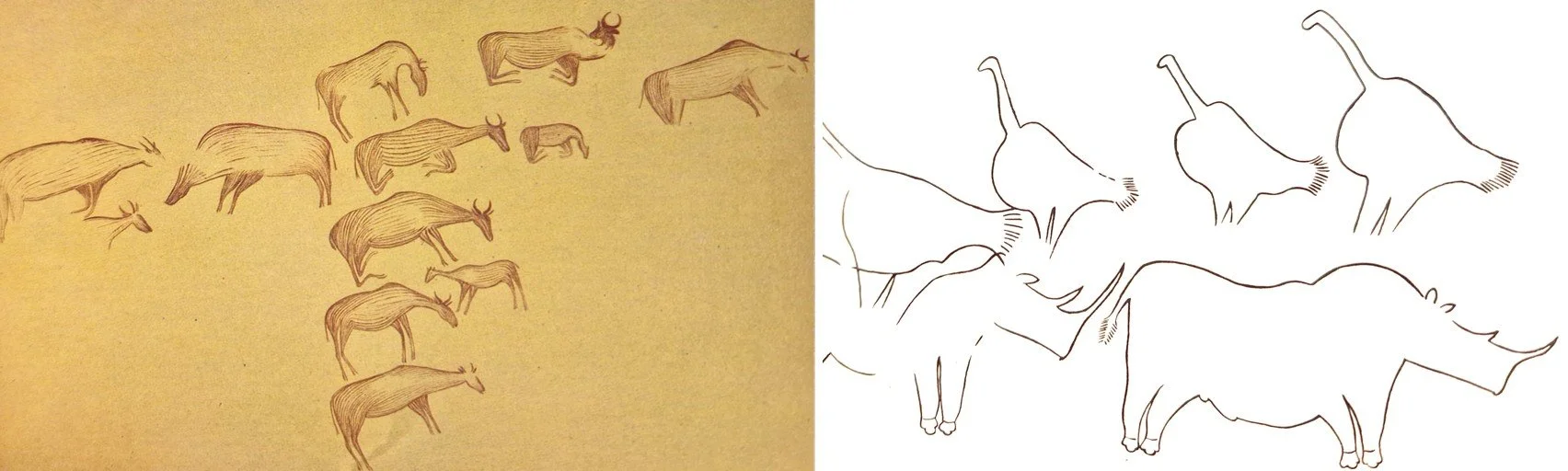
Caption: as is so typical of rock art, much of that studied and recorded by Mary involves astute and often brilliant observation… though some things are schematic or even symbolic and not meant to be technically accurate. At left, the ‘hartebeest frieze’ of the Kondoa region, Tanzania, showing animals grazing, feeding and ruminating. At right, ostriches and white rhinos at Kisese in Tanzania. Images: Leakey (1984).
How might people “record and reproduce” rock art? Tracings were made on large cellophane sheets, then transferred to drawing paper. The images were then reconstructed on moulded, artificial rock surfaces for museum display. As for protection, the local Warangi people had great interest in rock art and were paid to oversee it (Leakey 1984, p. 109). Mary mentions especially extravagant, very special art that existed at a rock shelter whose location was kept secret. She was never able to see it, let alone locate it, as is appropriate.
Across her recording efforts, 186 sites were catalogued, 43 of them with good art. Together, they featured over 1600 illustrated figures. As is the case for so much rock art across the ancient world, the images reveal a good understanding of form, anatomy and behaviour when it comes to non-human animals, combined with what are assumed to be exaggerations made for artistic effect. One notable example concerns a kudu with 11 horn spirals (Leakey 1984, p. 106).
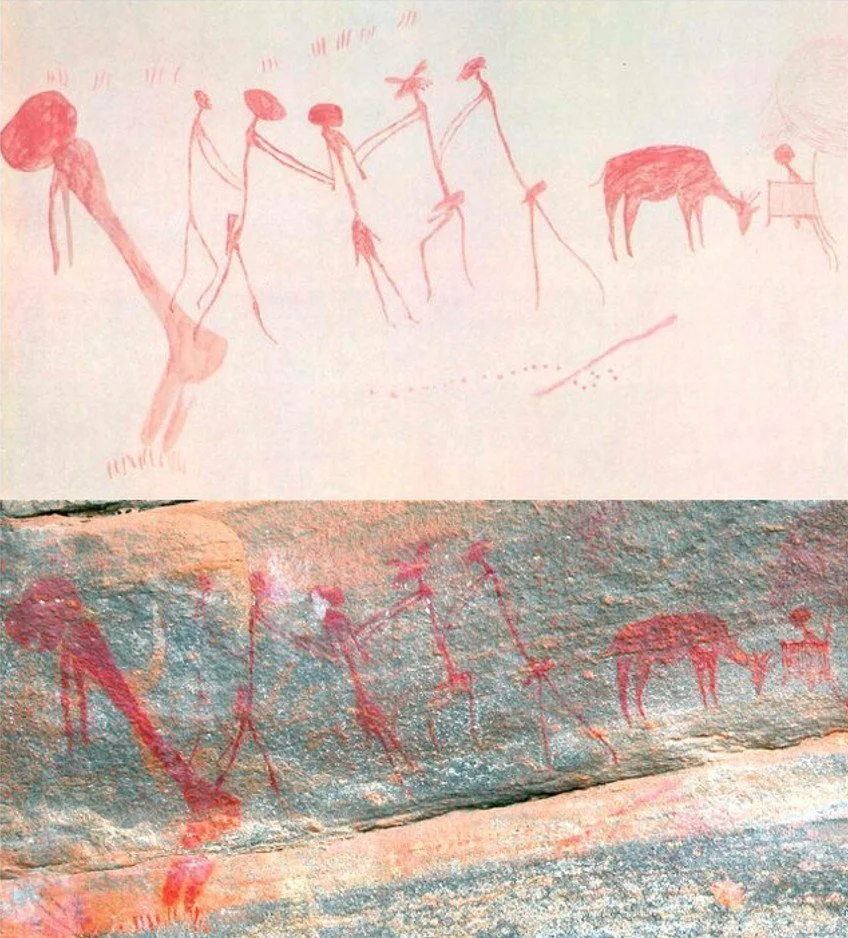
Caption: some effort to date the rock art studied by Mary (and other scientists) since her primary contribution was published in the 1980s does exist, and Bwasiri & Smith (2015) explained the various difficulties inherent to this field. This image from their article shows Mary’s interpretation of a scene above, and their photo of the actual panel below. I think it’s clear that her illustration is highly accurate. How the scene should be interpreted is another matter (Bwasiri & Smith 2015).
‘Zinj’ is found. The 1950s were also the time when Mary and Louis made significant improvements in understanding the stratigraphy and chronology of the sediments of Olduvai Gorge, this work showing that the lower beds there were much older than previously thought.
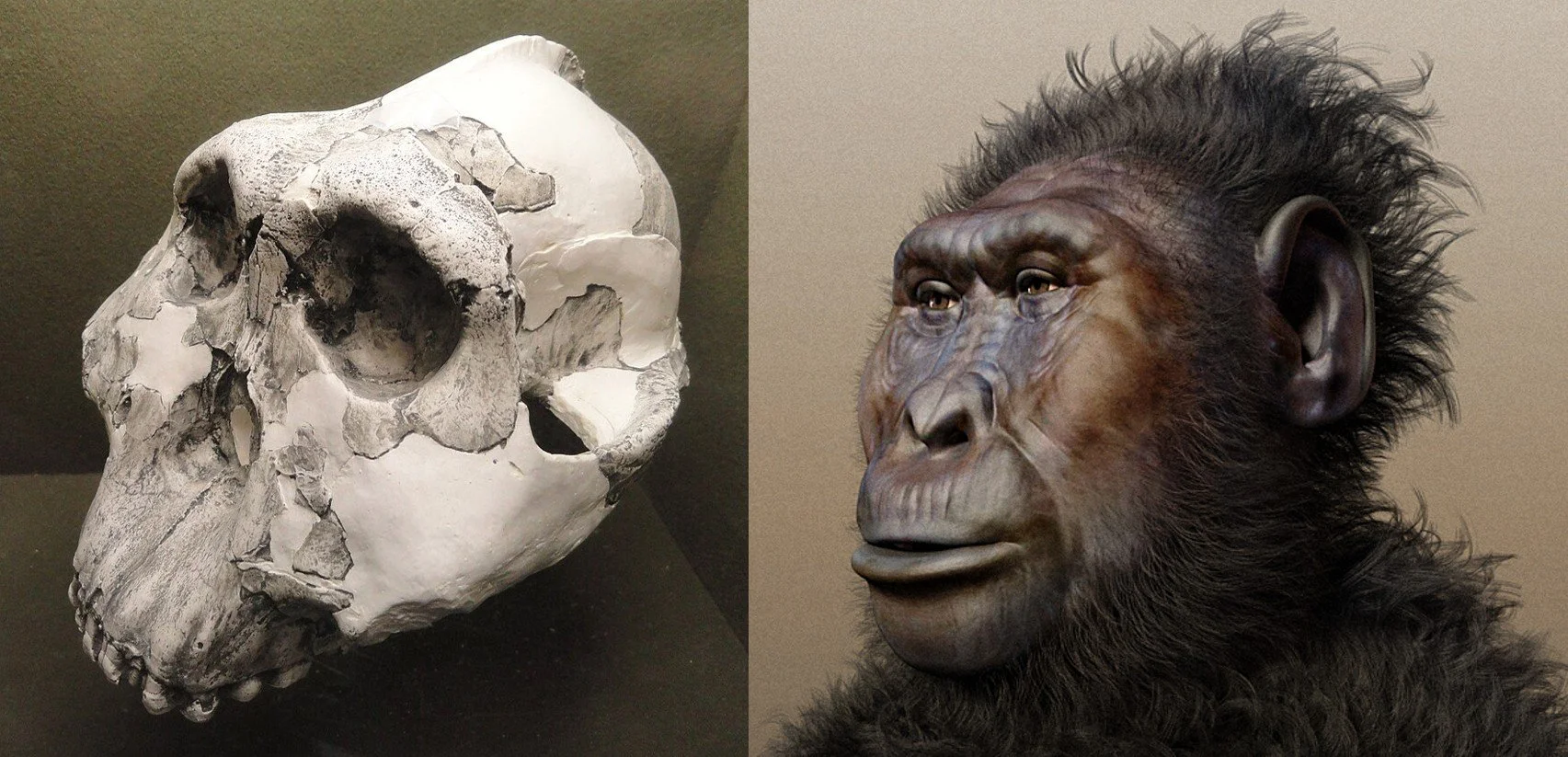
Caption: at left, one of the many casts now in existence of the Paranthropus boisei holotype OH5, this one on show in the Springfield Science Museum, Massachusetts, USA. At right, life reconstruction of this species by Cicero Moraes and based on a 3D scan of the skull by Dr. Moacir Elias Santos. Images: Daderot, public domain (original here); Cicero Moraes, CC BY-SA 4.0 (original here).
While exploring a site there during July 1959, Mary noticed an unusually thick chunk of bone from the mastoid region of a hominid skull (Leakey 1984, pp. 120-121). This was the first discovery of the remarkable animal soon to be named Zinjanthropus, known today as Paranthropus boisei. I find it a bit remarkable that Louis “was sad that the skull was not of an early Homo, but he concealed his feeling well and expressed only mild disappointment” (Leakey 1984, p. 121). Louis believed that australopithecines were not part of the evolutionary lineage leading to Homo sapiens but a side branch, and he thus held out hope for the discovery of Homo-type animals as old as the oldest australopithecines (Leakey 1984, p. 123).
‘Zinj’ – published in Nature in 1959 by Louis alone (Leakey L. 1959) – inspired massive international interest and led to the winning of new financial support. Other palaeoanthropologists had the chance to examine the actual specimen when the Leakeys hand-carried it by plane, much as Mary had her famous Proconsul specimen, to the Third Pan-African Congress held at Kinshasa (then Léopoldville) in what is today Democratic Republic of the Congo. Doubts were already expressed about the placement of the specimen in its own genus, and Phillip Tobias – gifted by Louis the task of co-producing a more detailed study – was one of several to suggest allocation to Australopithecus. Mary says that Tobias was also responsible for the moniker ‘nutcracker man’ and first used it at the Kinshasa meeting (Leakey 1984, p. 125).
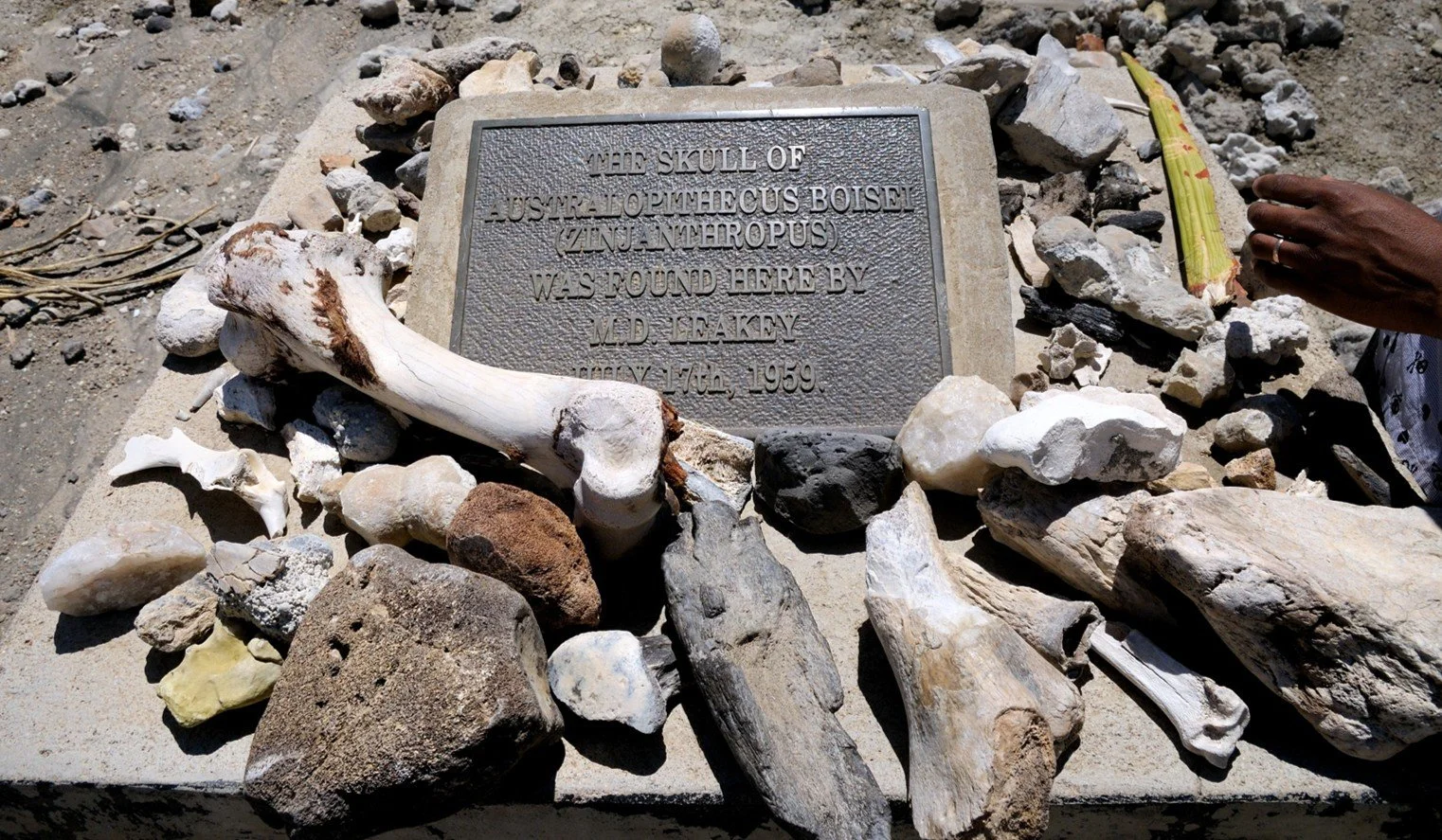
Caption: the discovery of the original Paranthropus boisei skull was deemed a sufficiently notable event that this special plaque was erected in Olduvai Gorge, Tanzania (this is the metal version; it had a predecessor made of what I assume is marble). As you see from this 2012 photo, people have taken to using it as a collection point for fossils, interesting rocks, bones and such. Image: George Lamson, CC BY-SA 2.0 (original here).
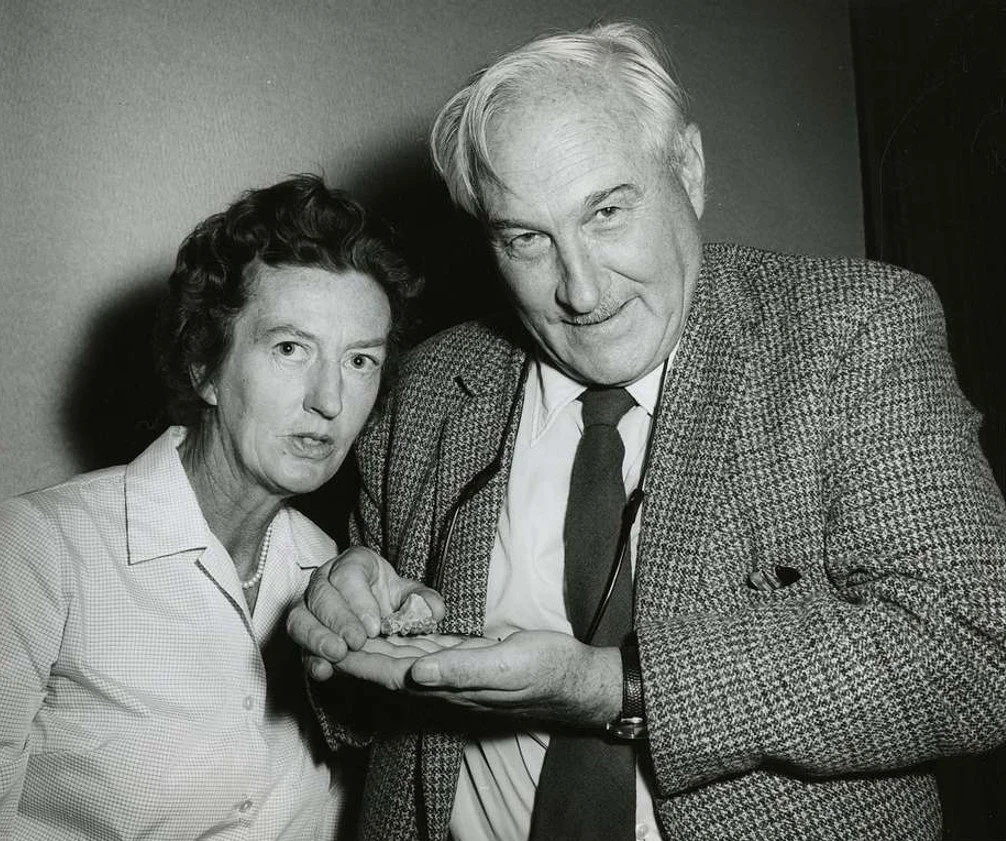
Caption: Mary and Louis in 1962, and thus photographed at a point between the discovery of Zinjanthropus and the publication of Homo habilis. I’m not entirely sure which (probable) hominin fossil Louis is holding, but several photos showing Mary, Louis and this fossil were taken, so it was evidently newsworthy. Image: Smithsonian Institution Archives, public domain (original here).
Hello ‘Homo’ habilis. Additional remarkable finds were made at Olduvai during the early 1960s when parts of a more gracile, larger-brained but contemporary species were recovered. This was ‘handy man’, a creature that seemed to conform to the ‘early Homo’ that Louis hoped to discover, and of interest is that Louis apparently refrained from formally including it within Homo until he, Phillip Tobias and John Napier were ready to publish it in Nature in 1964 (Leakey 1984, pp. 127-128).
The name ‘Homo habilis’ was suggested by Raymond Dart but doubts about the inclusion of this animal within Homo – a well-known point of contention among specialists over recent decades – were expressed immediately by Le Gros (Leakey 1984, p. 128). Mary reflects on this point later in the book, her argument being that the larger brain size and association with diverse tools made inclusion within Homo more likely than an australopithecine suggestion. An interpretation I was previously unaware of is the argument (not attributed to a specific person) that H. habilis was “an advanced form of Australopithecus africanus” (Leakey 1984, p. 214). An additional notable find was made soon afterwards, this time of a skull identified as Homo erectus.
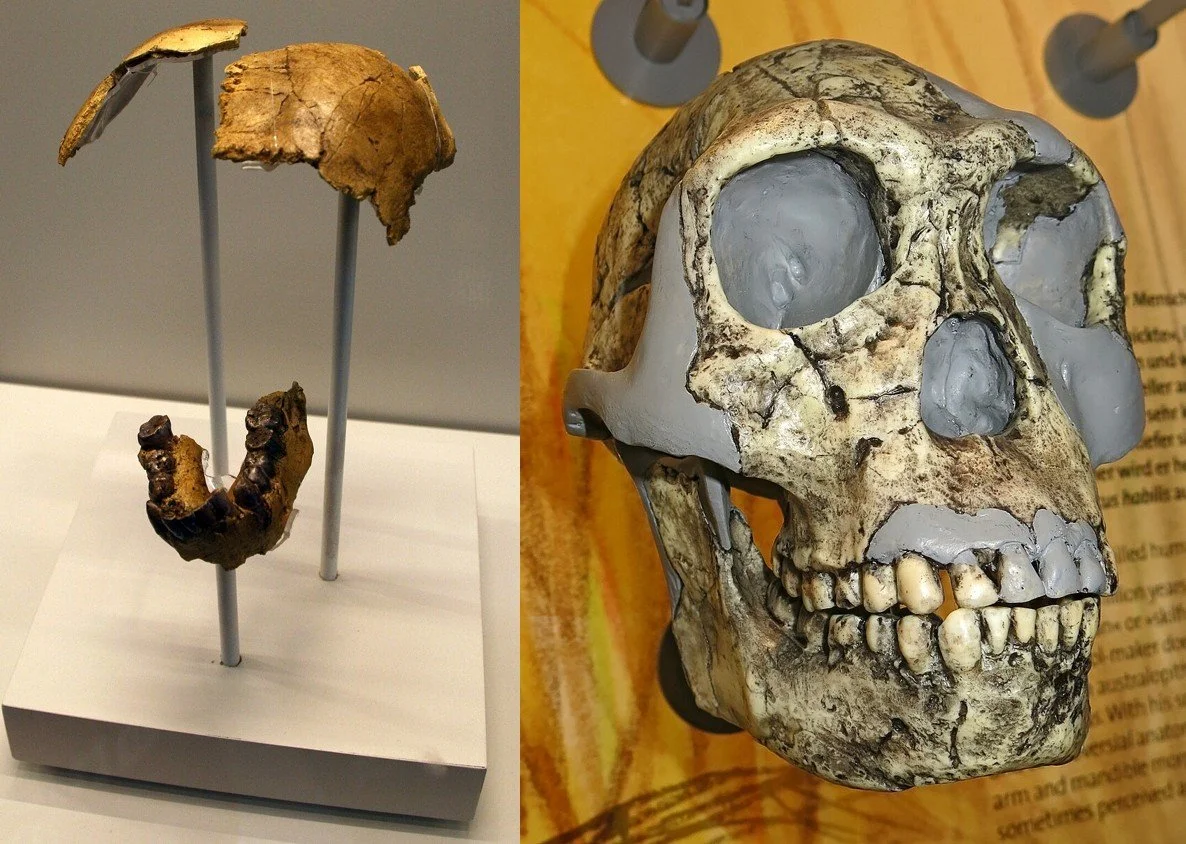
Caption: at left, a cast of the type juvenile individual of Homo habilis (OH-7), a mandible with dentition and parietal bones (an upper molar and hand bones were recovered as well), as displayed at Museo Arqueológico de Regional de Madrid. At right, the Koobi Fora (Kenya) specimen KNM-ER 1813 discovered in 1973, referred to H. habilis and integral to arguments that this taxon was sexually dimorphic. Images: Nachosan, CC BY-SA 3.0 (original here); Don Hitchcock, CC BY-SA 4.0 (original here).
The Pleistocene proves longer, and to have started earlier, than thought. One of many debates to occur among specialists across the time these discoveries were being made and interpreted was that concerning the age of the respective sediments. In 1960, geophysicist Jack Evernden from Berkeley visited Olduvai with plans to carry out potassium-argon dating, work that was then carried forward by Garniss Curtis. The results indicated that the Pleistocene was much longer in duration than the Leakeys had thought, the deeper parts of the Pleistocene being perhaps a million years older than considered beforehand (Leakey 1984, p. 131).
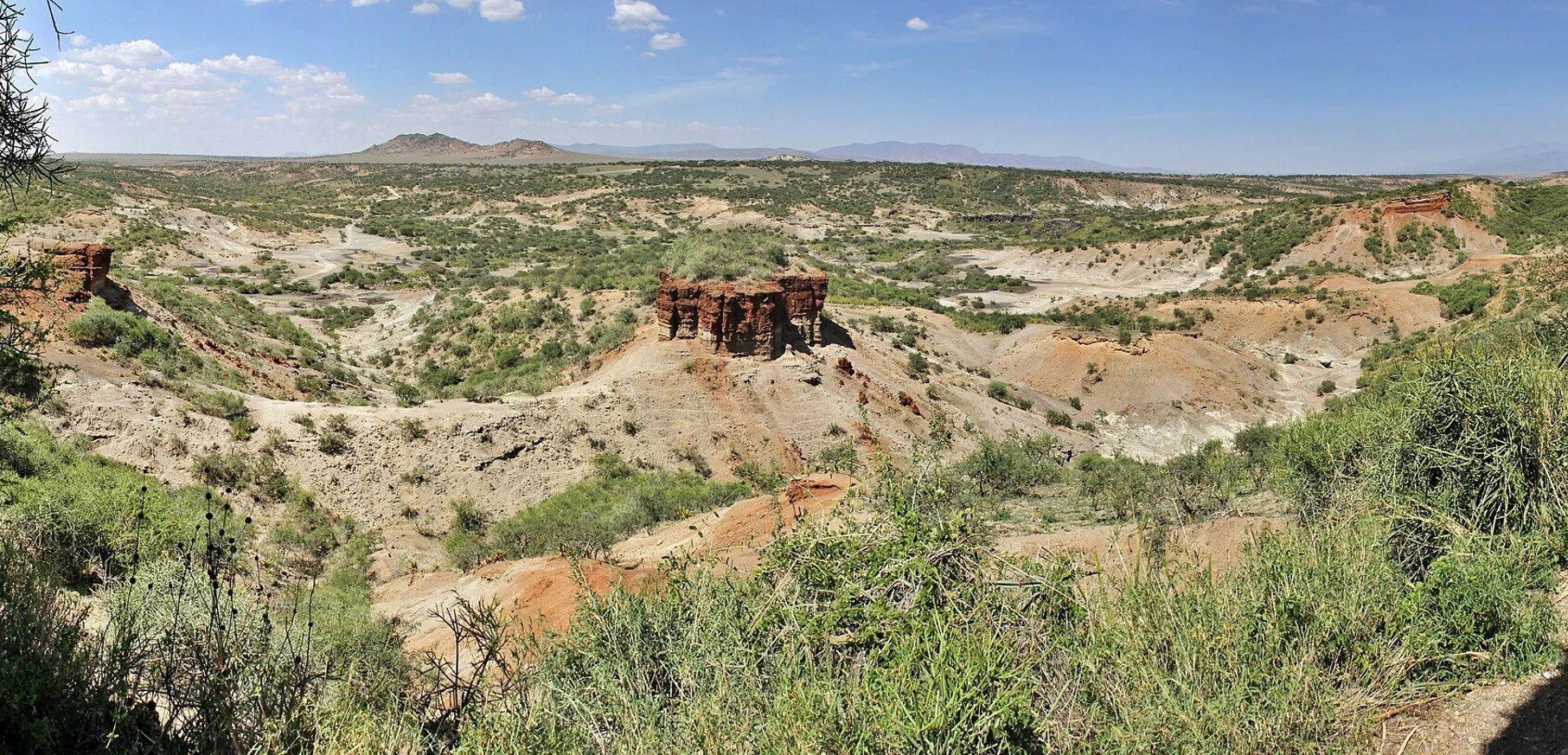
Caption: Olduvai Gorge as it looked in 2011. Exposed and actively eroding sedimentary layers are good for fossils, assuming of course that those layers contain a reasonable number of them. Almost 100 Pleistocene hominin fossils have been discovered at this location. Image: Mike Krüger, CC BY-SA 4.0 (original here).
Mary explains how this was controversial for a time, it meaning that the fossils that the Leakeys were working with were potentially far more distant, in evolutionary terms as well as chronological ones, from modern humans than they’d been thinking. Incidentally, the mention here of Evernden and Curtis ties the Olduvai story to that of another book I discussed here in 2025, Garniss Curtis, Carl Swisher and Roger Lewin’s 2000 Java Man: How Two Geologists Changed the Course of Human Evolution. You can read my article on that book here. That book explains how Louis so disliked the idea that Zinj might be almost two million years old than he “refused to believe dates that Garniss and Evernden produced for other fossils”, since “the dates did not jibe with what Louis wanted or believed” (Curtis et al. 2001, p. 19).
Louis’s decline. As is clear already, Louis Leakey was a major part of Mary’s life from the 1930s onwards. But the period extending from 1968 to 1972 marks one of a decline both in their relationship and in Louis’s health and faculties. Mary describes Louis’s growing competition with Richard, his own son, as well as his “disastrous” association with the Calico Hills discoveries of the Mojave Desert (Leakey 1984, p. 142). These involved numerous chert fragments, suggested to be human-made artefacts, and thought by Louis to perhaps be 80,000 years old. Mary disagreed not just with this interpretation but with everything about how the work was being carried out, and when Louis arranged a conference devoted to discussion of the site she felt that those who should have provided condemnation were holding back due to their sympathy for someone who, by now, was quite ill.
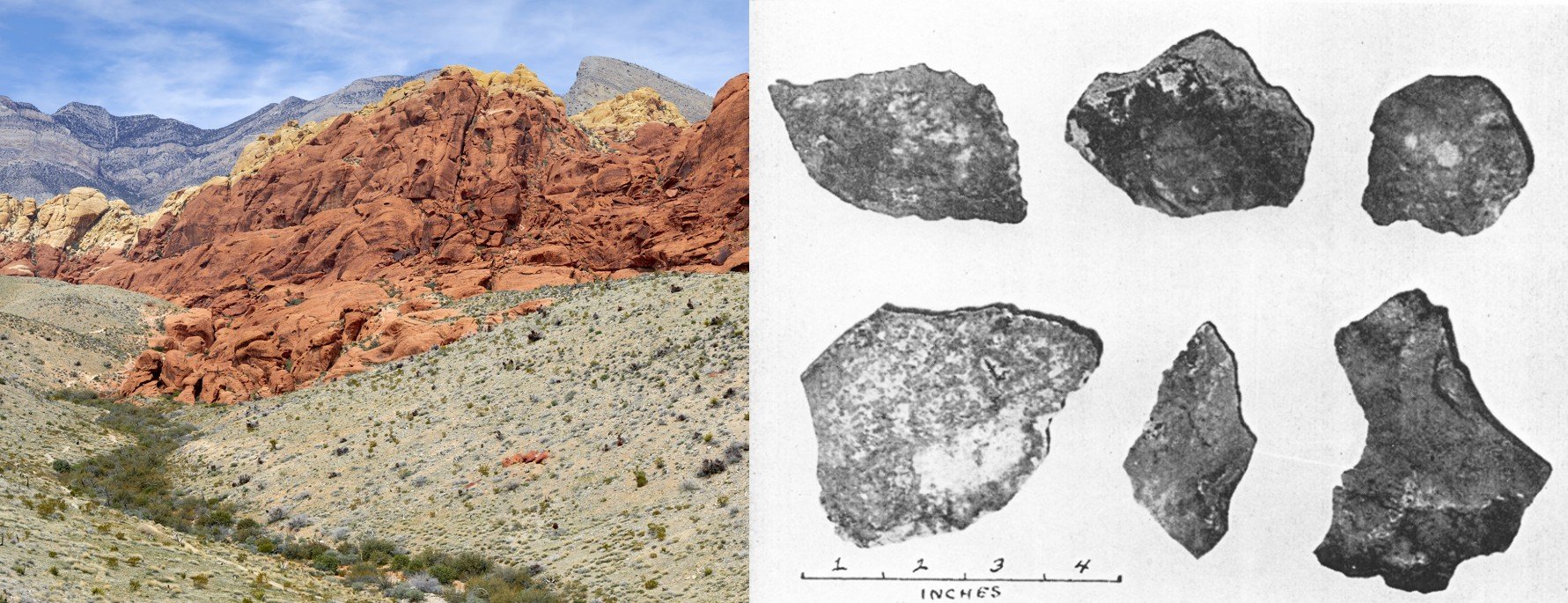
Caption: the Calico Hills story is fascinating and, in part, a case of people fooling themselves into thinking that the ‘evidence’ they had was far better than it was. At left, Calico Hills at Red Rock Canyon National Conservation Area. At right, a selection of the alleged hominin-made lithics from the site, from a 1938 publication but taken from Dempsey (2009). Images: Frank Schulenburg, CC BY-SA 4.0 (original here); Dempsey (2009).
Mary and Louis also disagreed on whether they should accept honorary degrees offered by the University of Witwatersrand in South Africa. Louis believed that these should be rejected in protest of apartheid. Mary thought that to do so would be a snub to a university that was doing what it could to fight against apartheid already, and to the colleague who had arranged these awards, Philip Tobias. Mary ultimately accepted the degree, and Louis was furious.
Towards the end, Louis was beset by health problems and continued to push himself too hard, never taking appropriate time to recover. For a while, he was cared for by Vanne Goodall, Jane’s mother, and he died in 1972.
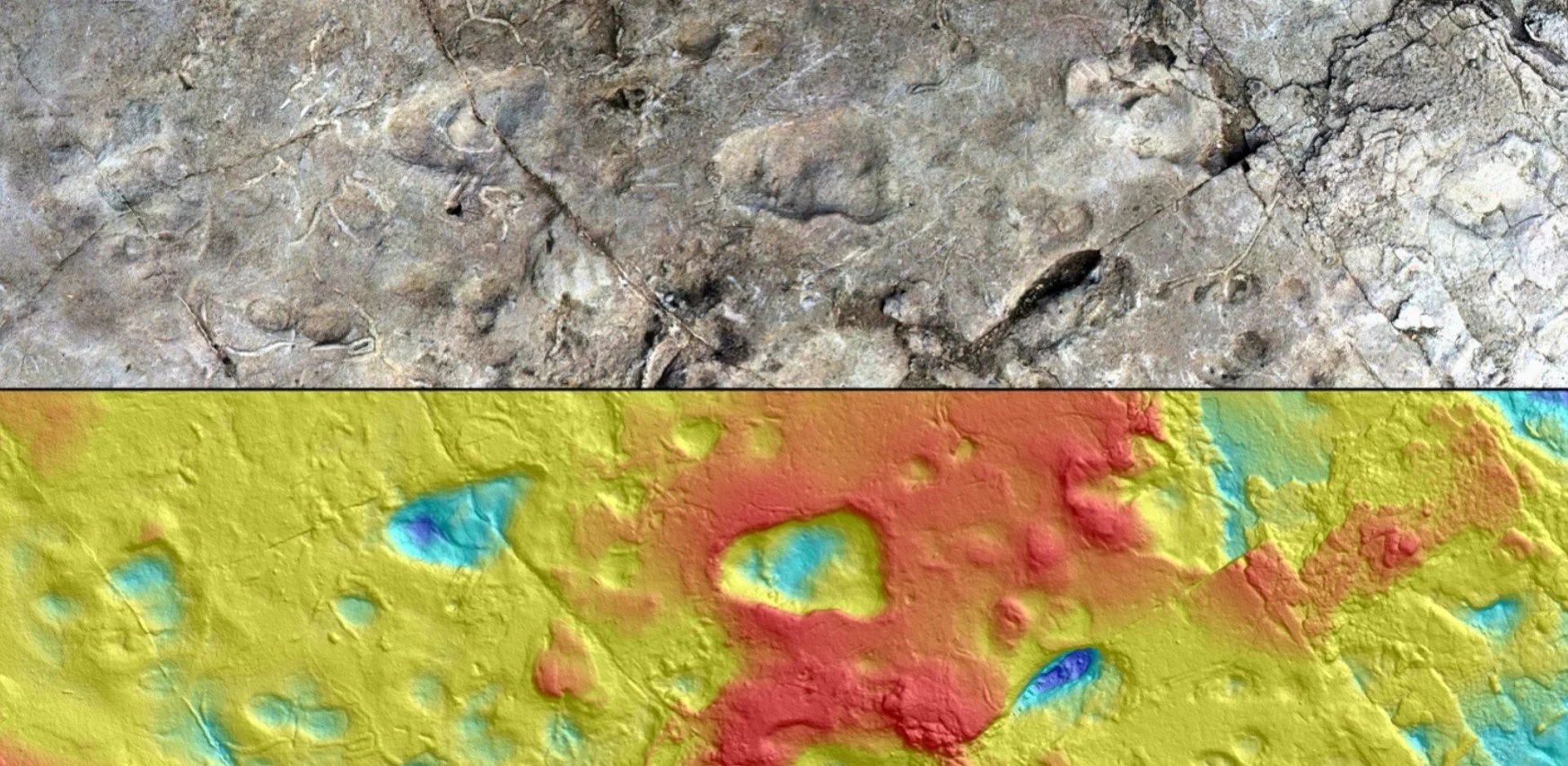
Caption: the ‘site A’ hominin footprints of Laetoli, thought for a while to be those of a bear but now regarded once again as those of a hominin bigger and more robust than the taxon that made the majority of hominin footprints at the site. These show, at top, an image obtained via photogrammetry and, below, a contour map generated from a 3D surface scan. Image: McNutt et al. (2021).
The Laetoli tracks. Much else occurred in the 1970s, an event of international interest being the 1976 discovery of the Laetoli footprints. These included not just the famous ones made by hominins, but those made by numerous other animals too. Hadza hunters were used in the identification of these. An interesting controversy concerned the identification of the four ‘site A’ footprints that might have been created by a hominin but were suggested by some to be bear tracks, and here Mary takes time to remind readers that bears – not ordinarily associated with Africa bar the Atlas bear of the far north and, err, the semi-mythical Nandi bear I suppose – were a feature of the east African biota at this point in prehistory. Mary’s identification of the site A tracks as those of hominins has recently been vindicated, this work showing that ancient Laetoli was inhabited by two hominin taxa at least (McNutt et al. 2021).
By 1979, the more famous Laetoli hominin trackway, an impressive 24 m long and involving the footprints of three individuals, had been discovered. Such was the global importance of this site that plans were made to preserve it, initially via the creation of another open-air museum. This didn’t work out due to the remoteness of the site, so the decision was made to preserve the tracks and rebury the entire layer using river sand and plastic sheeting.
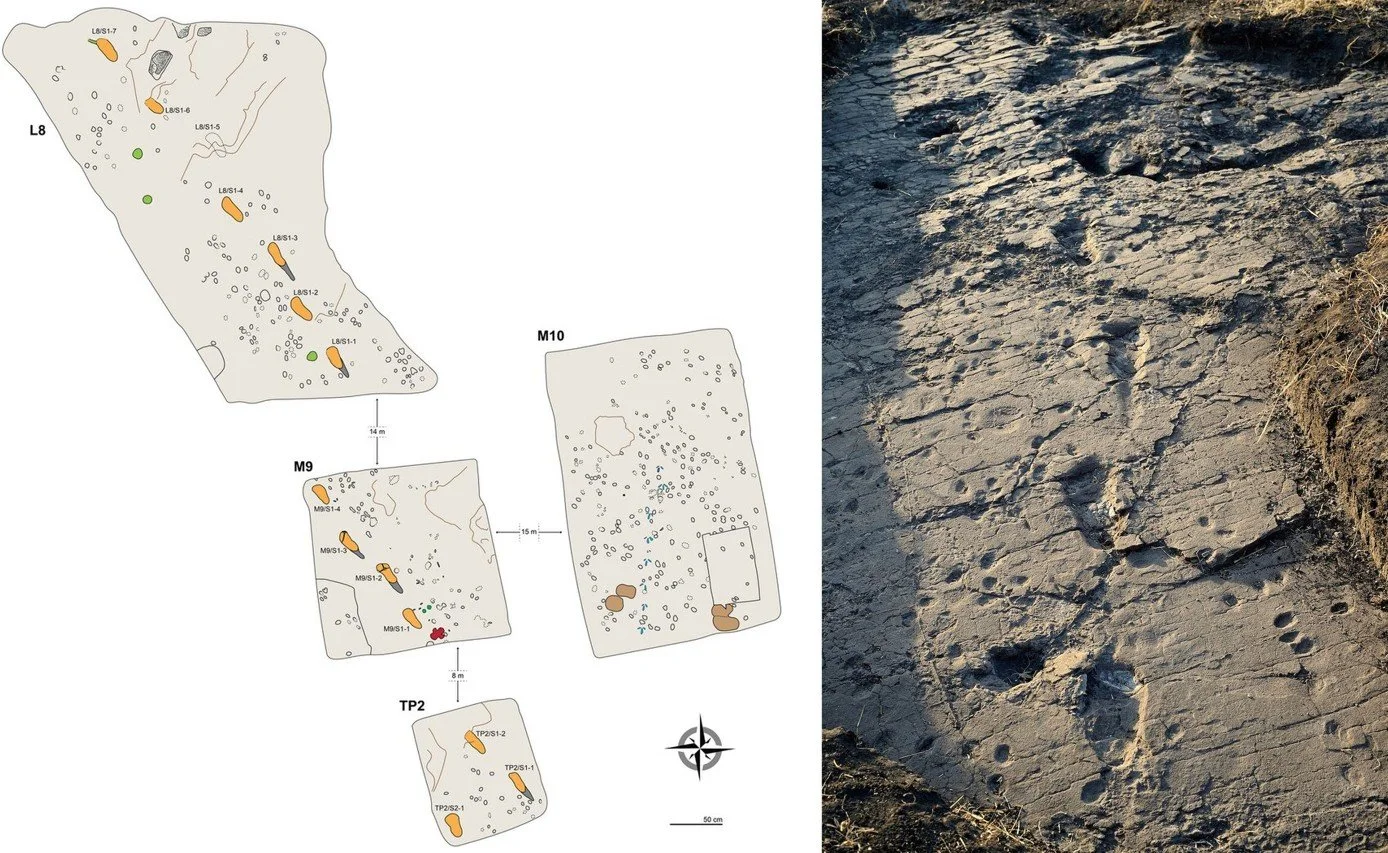
Caption: at left, Laetoli footprints as preserved at Site S, showing impressions left by hominins as well as horses, rhinos, giraffids and guineafowl. The grey areas at the rear of the hominin footpints are heel drag marks. At right, a photo of one of the most famous sections of the Site S trackway. Footprints made by small horses and other animals are on the same bedding plane. Images: Masao et al. (2016), CC BY-SA 4.0.
Hadar, the ‘first family’, and Lucy. An especially interesting set of discoveries relative to Mary’s finds and research concerns the 1974 finding in Hadar, Ethiopia of Lucy by Donald Johanson, and the ‘first family’ in 1975. I was aware of some disagreement between Mary and Johanson, and Tim White too, over what happened next, but this was the first time I’ve read anything halfway lengthy about it.
Mary’s opinion was that the Hadar hominin fossils were substantially superior to those from Laetoli, and not from the same species. The Laetoli remains were not just found more than 1600 km away from Hadar but were around half a million years older. So she was unhappy with Johanson’s decision to use a Laetoli mandible – the LH4 specimen that Mary discovered in 1974 – as the holotype for Australopithecus afarensis, so much so that she asked to be removed from the authorship of the paper that named this taxon, this being Johanson et al. (1978) (Leakey 1984, p. 182). These comments aren’t unique to Mary’s book, by the way: there’s a complex to and fro in the technical literature on these matters (Johanson & White 1979, 1980, Day et al. 1980, Leakey & Walker 1980, McHenry & Corruccini 1980).
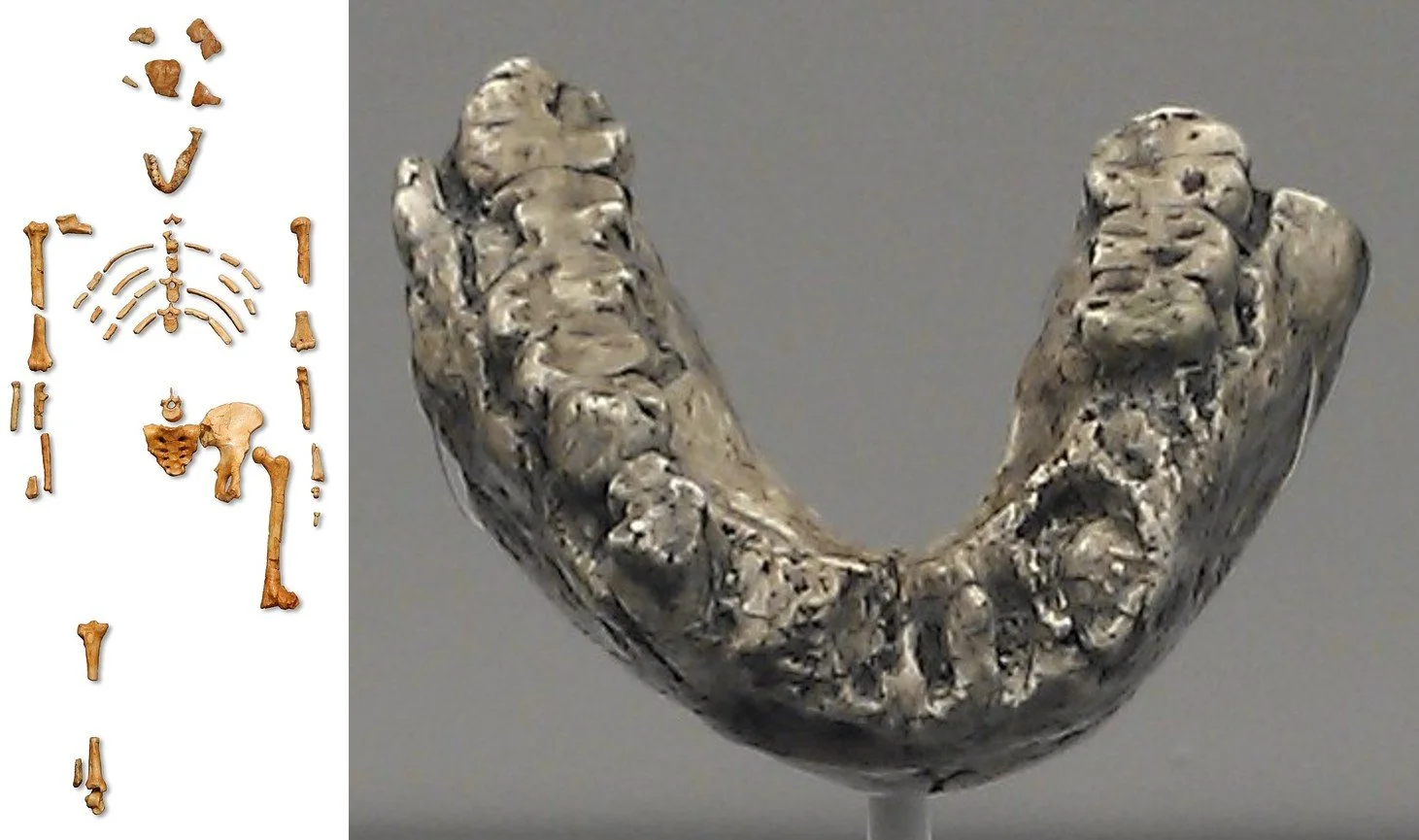
Caption: at left, a cast of the Australopithecus afarensis ‘Lucy’ skeleton Al 288-1 at Museum National d’Histoire Naturelle, Paris. At right, a cast of the LH4 A. afarensis holotype mandible from Laetoli, on show in a temporary exhibit at the Museo Arqueológico de Regional de Madrid. Images: 120, CC BY 2.5 (original here); Nachosan, CC BY-SA 3.0 (original here).
Mary also expressed her disagreement with the Johanson et al. view that A. afarensis held an ancestral position for later australopithecine species and Homo as well. She also took issue with comments made in Johanson and Maitland Edey’s 1981 book Lucy: the Beginnings of Humankind – she noted that her book is the only place where she can do it – and pointed out that quotes reported therein as historical events can only be fictional, since neither author was there to hear them. You may recall from earlier Louis Leakey’s apparent disappointment at Zinjanthropus being what it was, rather than the key Homo species he was hoping it might be. Johanson and Edey have it that Louis said that Zinj was “nothing but a god-damned robust australopithecine” on seeing the find. These words do have something of a Hollywood flair, but the fact is that they were never said (Leakey 1984, p. 183). Johanson and Edey’s book on Lucy is on my reading list, so I’ll be returning to this topic in time.
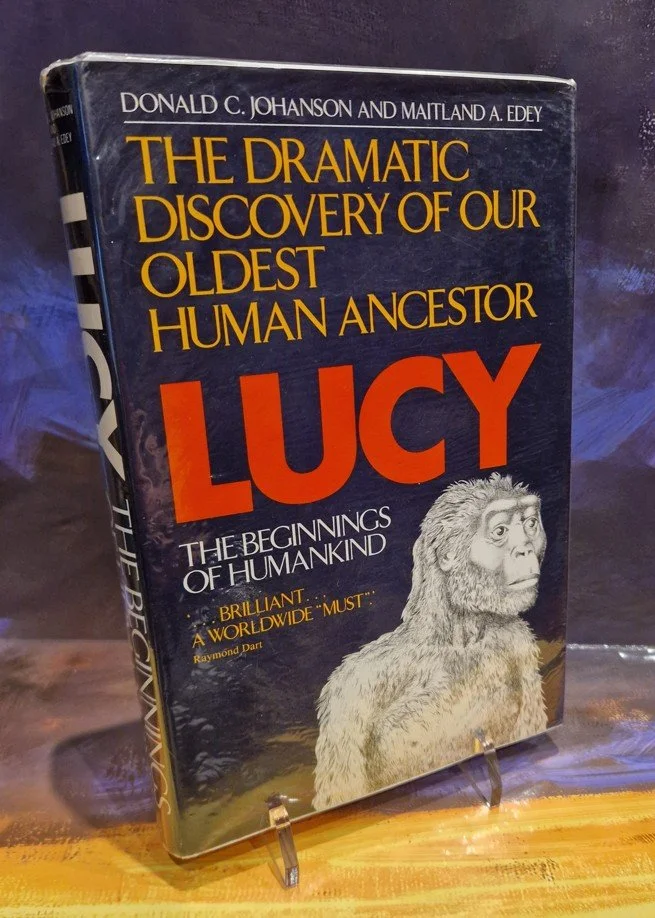
Caption: a 1981 edition of Donald Johanson and Maitland Edey’s Lucy: The Beginnings of Humankind. It’s an attractive book with a good number of photos and diagrams, but it contains points of fact that were contested by Mary Leakey.
20 million years of research. It goes without saying that the contribution of the Leakeys to palaeoanthropological research, and our understanding of prehistory in general, has been vast. Mary ended her autobiography by summarising the main discoveries she was involved in and what they mean for the big picture overall.
On that note, it’s almost unfathomable today to think that someone could perform the important and lasting studies she did with respect to such an incredible range of topics, these involving Miocene hominoids or near-hominoids like Proconsul, Pliocene and Pleistocene australopithecines, paranthropines and other stem-humans, and archaeological work on ancient humans, and on their art and artifacts in Africa as well as Europe.
Mary died in 1996, aged 83, and I think that this book does a good job of charting her life and work. I really enjoyed reading it and gaining so much insight into this important phase in palaeoanthropological history. There are, as stated earlier, other books on and by the Leakeys, and I’ll be writing about them too, in time.
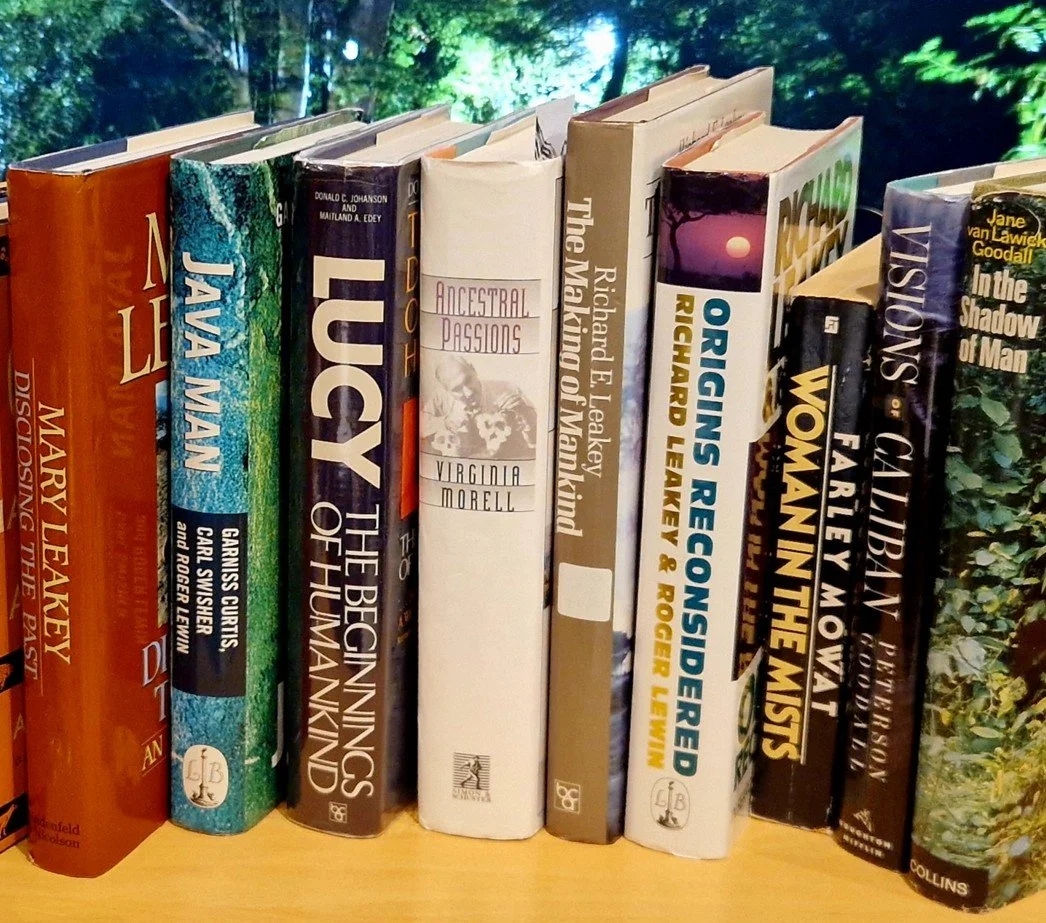
Caption: certain of the books discussed and mentioned here, plus others connected to the life and work of the Leakeys. Yes, that includes work on living great apes, since the authors of those volumes have connections to Louis Leakey. Image: Darren Naish.
For previous Tet Zoo articles on hominins and other hominids, see…
Zihlman’s ‘pygmy chimpanzee hypothesis’, October 2012
Why Humans Are Important to Studies of Primate Diversity, July 2014
The Cautious Climber Hypothesis, March 2019
Piltdown Man and the Dualist Contention, March 2023
Curtis, Swisher and Lewin’s Java Man of 2000: Hominin-Themed Books, Part 1, March 2025
Refs - -
Bwasiri, E. J. & Smith, B. W. 2015. The rock art of Kondoa District, Tanzania. Azania: Archaeological Research in Africa 50, 437-459.
Curtis, G., Swisher, C. & Lewin, R. 2001. Java Man: How Two Geologists Changed the History of Human Evolution. Little, Brown and Company, London.
Day, M. H., Leakey, M. D. & Olson, T. R. 1980. On the status of Australopithecus afarensis. Science 207, 1102-1103.
Dempsey, P. J. 2009. Calico – the Olduvai Gorge connection. Society for California Archaeology Proceedings 22, 1-13.
Estes, R. 1962. A fossil gerrhosaur from the Miocene of Kenya (Reptilia: Cordylidae). Breviora 158, 1-10.
Johanson, D. C. & White, T. D. 1979. A systematic assessment of early African hominids. Nature 203, 321-330.
Johanson, D. C. & White, T. D. 1980. On the status of Australopithecus afarensis. Science 207, 1104-1105.
Johanson, D. C., White, T. D. & Coppens, Y. 1978. A new species of the genus Australopithecus (Primates: Hominidae) from the Pliocene of Eastern Africa. Kirtlandia 28, 1-14.
Leakey, L. 1934. Adam's Ancestors: The Evolution of Man and His Culture. Metheun & Co., London.
Leakey, L. 1959. A new fossil skull from Olduvai. Nature 184, 491-493.
Leakey, M. 1983. Africa’s Vanishing Art: the Rock Paintings of Tanzania. Doubleday, Garden City, New York.
Leakey, M. 1984. Disclosing the Past: An Autobiography. Weidenfeld and Nicolson, London.
Leakey, R. E. F. & Walker, A. 1980. On the status of Australopithecus afarensis. Science 207, 1103.
McHenry, H. M. & Corruccini, R. S. 1980. On the status of Australopithecus afarensis. Science 207, 1103-1104.
McNulty, K. P., Begun, D. R., Kelley, J., Manthi, F. K. & Mbua, E. N. 2015. A systematic revision of Proconsul with the description of a new genus of early Miocene hominoid. Journal of Human Evolution 84, 42-61.


