Today is the day….
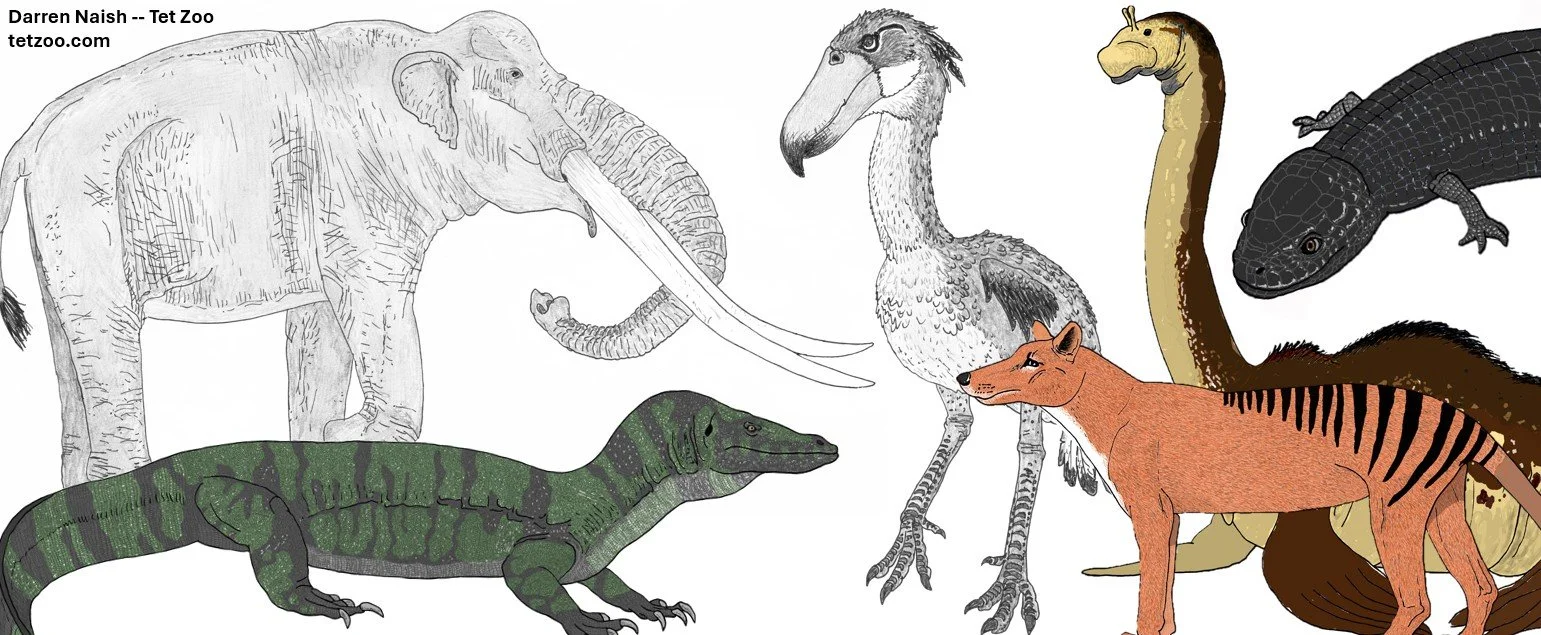
Caption: a montage of animals that had relevance of one sort of another to my 2025…. proboscideans, varanids, phorusrhacids, marsupials, and cryptids like long-necked seals and tatzelwurms. Images: Darren Naish.
The blog Tetrapod Zoology – connected in some way to just about everything that’s happened in my professional life since the mid-2000s – has now been in operation for an absurd twenty years. Two. Decades. At the risk of lapsing into grotesque melodrama, I have the same feeling I get when attending a funeral… albeit without the melancholy… how did we get here already; how did so much time pass by?
2025 might have been the busiest year of my life; a lot happened. It was, however, primarily structured around four Big Events. The year was also punctuated by several publications, including the books Mesozoic Art II and the third edition of Ancient Sea Reptiles, as well as both popular and technical articles. I gave seven talks (in Bournemouth, Southampton, Portsmouth, Lyme Regis, Worthing, Aberdeen and Glasgow), travelled to Spain (by ship) and Scotland (by rail) but was otherwise mostly limited in my adventures to southern England.
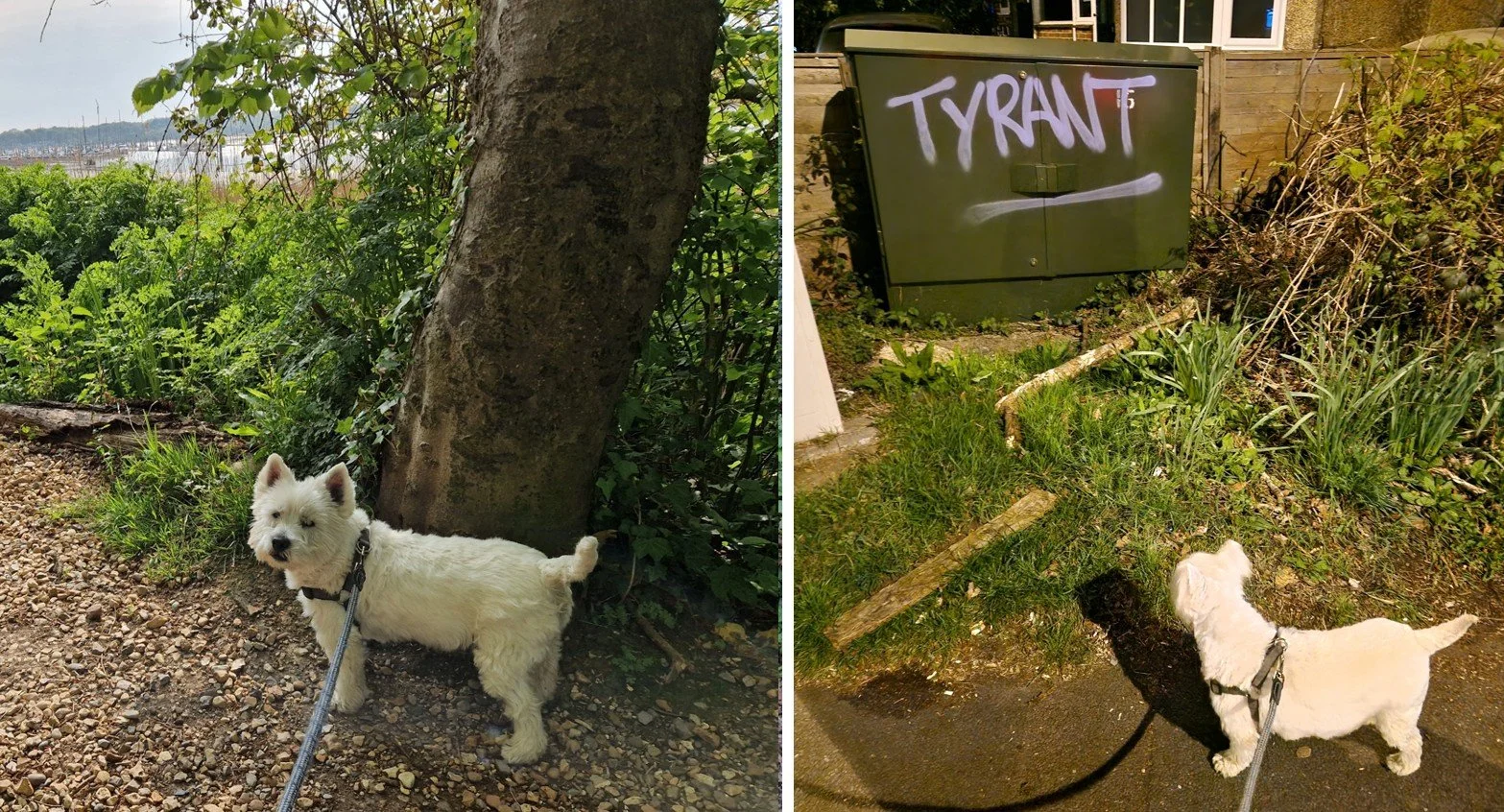
Caption: Teddy the West Highland terrier is my companion on at least some excursions about the south of England. He’s a good boy but is afflicted by a list of ailments. As you’ll know if you’ve seen his comments on social media, he’s also a sage and vociferous commentator on the current sociopolitical state of the United Kingdom and the lamentable nature of its built environment. Images: Darren Naish.
Prologue. In this very long article – the first of at least two celebrating 20 years of Tet Zoo – I look back at 2025 as part of my regular annual reviews. As ever, the article could very well be seen as tremendously self-absorbed and self-congratulatory. But, hey, no-one else is gonna do it for me, so put up, shut up or go away, the internet is a big place.
In my 2024 review (published here in January 2025), I mentioned the existence of “[a] huge number of things … that I can’t talk about”. But now that 2025 has passed, I can talk about those things, and in fact they’re the main events relevant here. I should say to start with that 2025 began with me gainfully employed at the BBC’s Natural History Unit, specifically on the third season of Prehistoric Planet for Apple TV. More on this later.
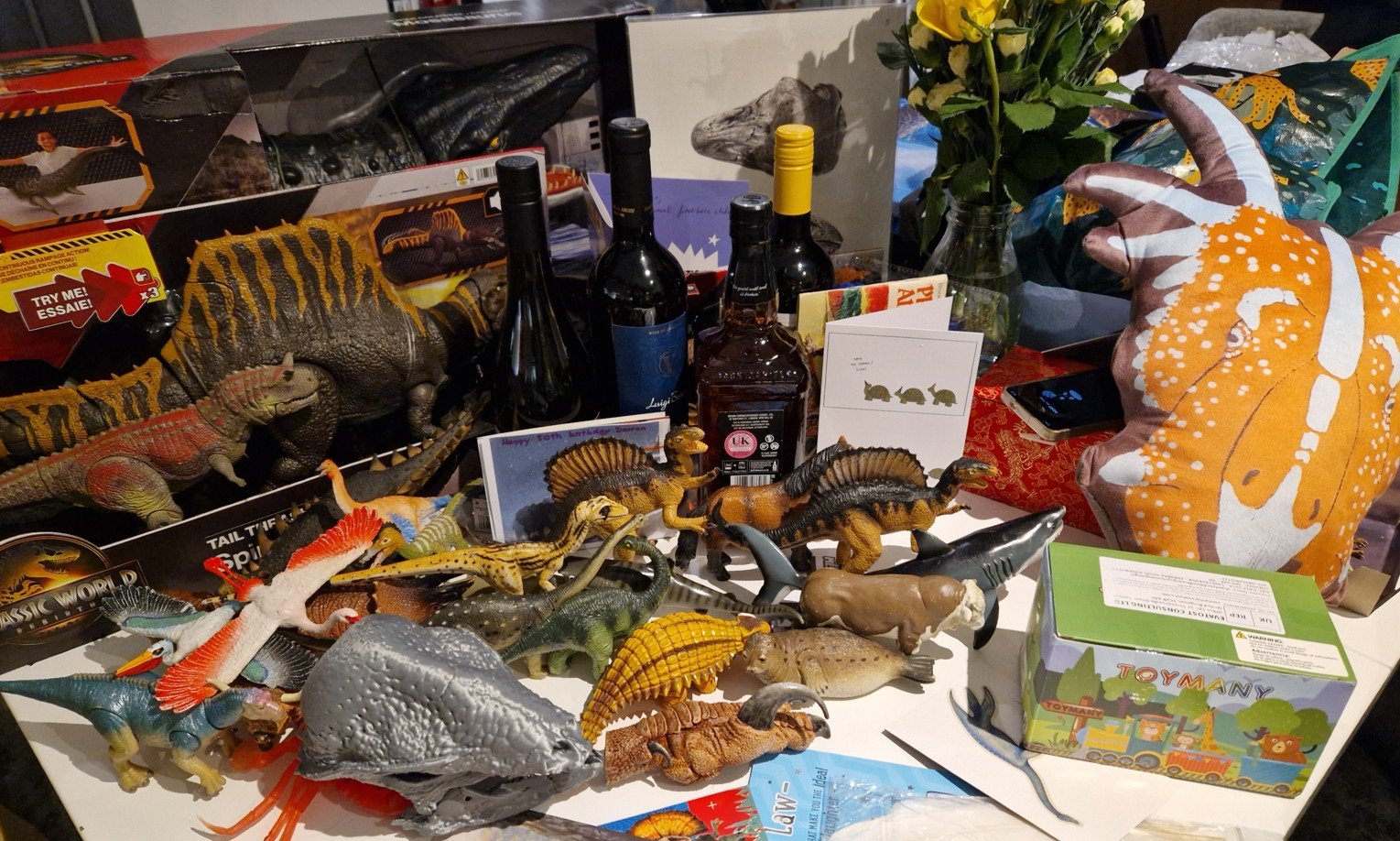
Caption: 2025 included one of those milestone birthdays for myself, and here’s a view of some of the material accrued as a consequence of that event. It might be obvious how well known it is that I am clandestinely assembling a collection of animal figures, models and toys. Image: Darren Naish.
The start of 2025. 2025 was marked by a great many interesting discoveries concerning Mesozoic animals – yes yes, just as all the years are – and I had reason to write about some of these at Tet Zoo and elsewhere. My first article of this sort was on the unusual, long-handed Mexican ornithomimosaur Mexidracon and appeared at Discover Wildlife (it’s here). January also saw release of the Tet Zoo podcast episode that John Conway and I recorded at TetZooCon back in September 2024, that one being the last TetZooCon ever. It’s not a particularly good episode; we spoke about the suggested dicynodont identification of the La Belle France rock art image in South Africa (I totally don’t buy it) and the fact that Greg Paul wasn’t able to join us. On the subject of the Tet Zoo podcast – since we have a massive listenership, somewhere in the millions donchaknow – it’s not officially dead, it’s just that John and I have incompatible schedules. Also in January, I wrote an endorsement for C. M. Kösemen’s book All Tomorrows. I began consultancy work on Kevin Miguel’s Mesozoic Life Stories: River of Giants docuseries project.
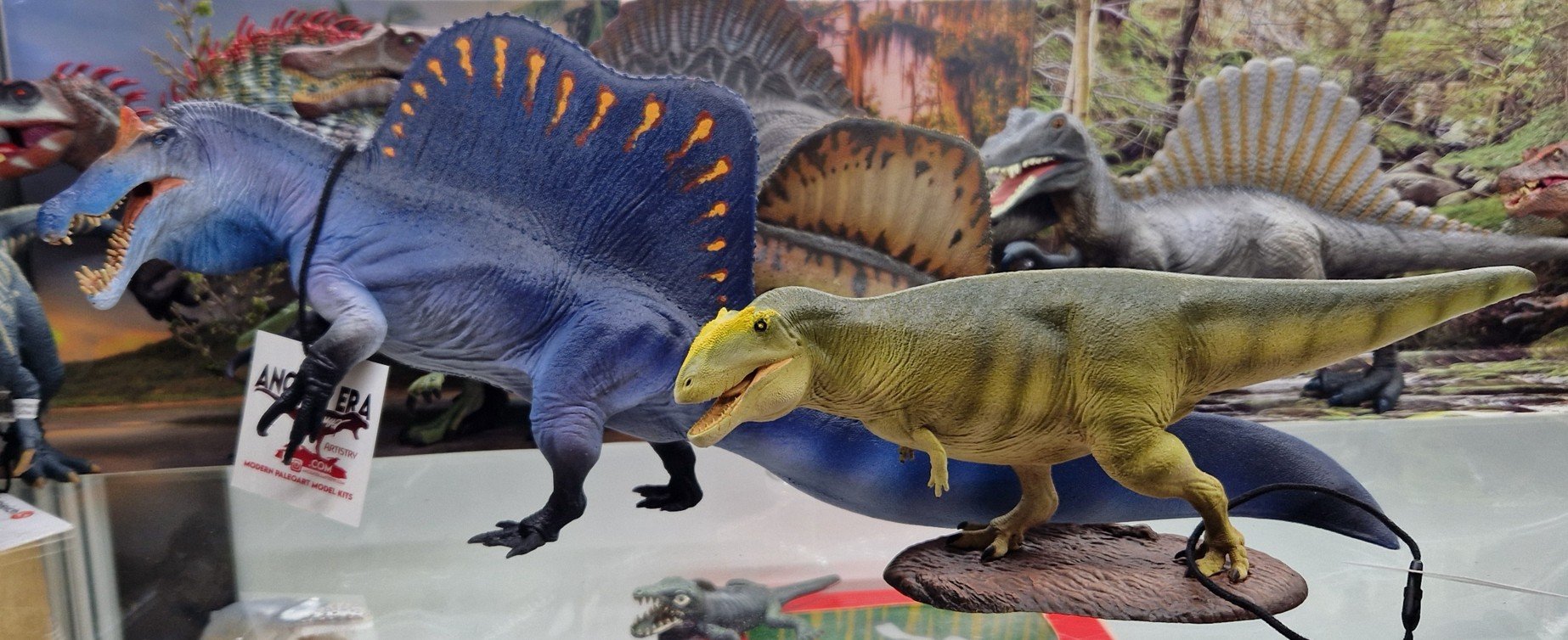
Caption: yeah, you’re gonna be seeing a lot of figures, models and toys in this article. The Spinosaurus at left, named Seti, and the green Carcharodontosaurus at right, named Amon, are limited edition backer rewards for the Mesozoic Life Stories: River of Giants project. Image: Darren Naish.
A brief review of Neil Frost’s cryptozoological doorstop of a book (Fatfoot: Encounters With a Dooligahl) was published at Tet Zoo in February and I also published thoughts on Tama Zoological Park in Tokyo, a zoo I visited in Japan in 2024. I’m always literally years behind in my zoo review series and am perpetually aware of how much unpublished content I have on the zoos and wildlife parks I’ve visited.
Spawnwatch, Don Lessem, the CFZ Cryptozoology Summit. February is spawnwatch season here, so I again reported events as seen from the recently renovated big pond. I’m looking forward to seeing what happens in early 2026. Will there be more frogs and more clutches of spawn, or less, and will the ever-present free-roaming pet cats be a problem? We will see.
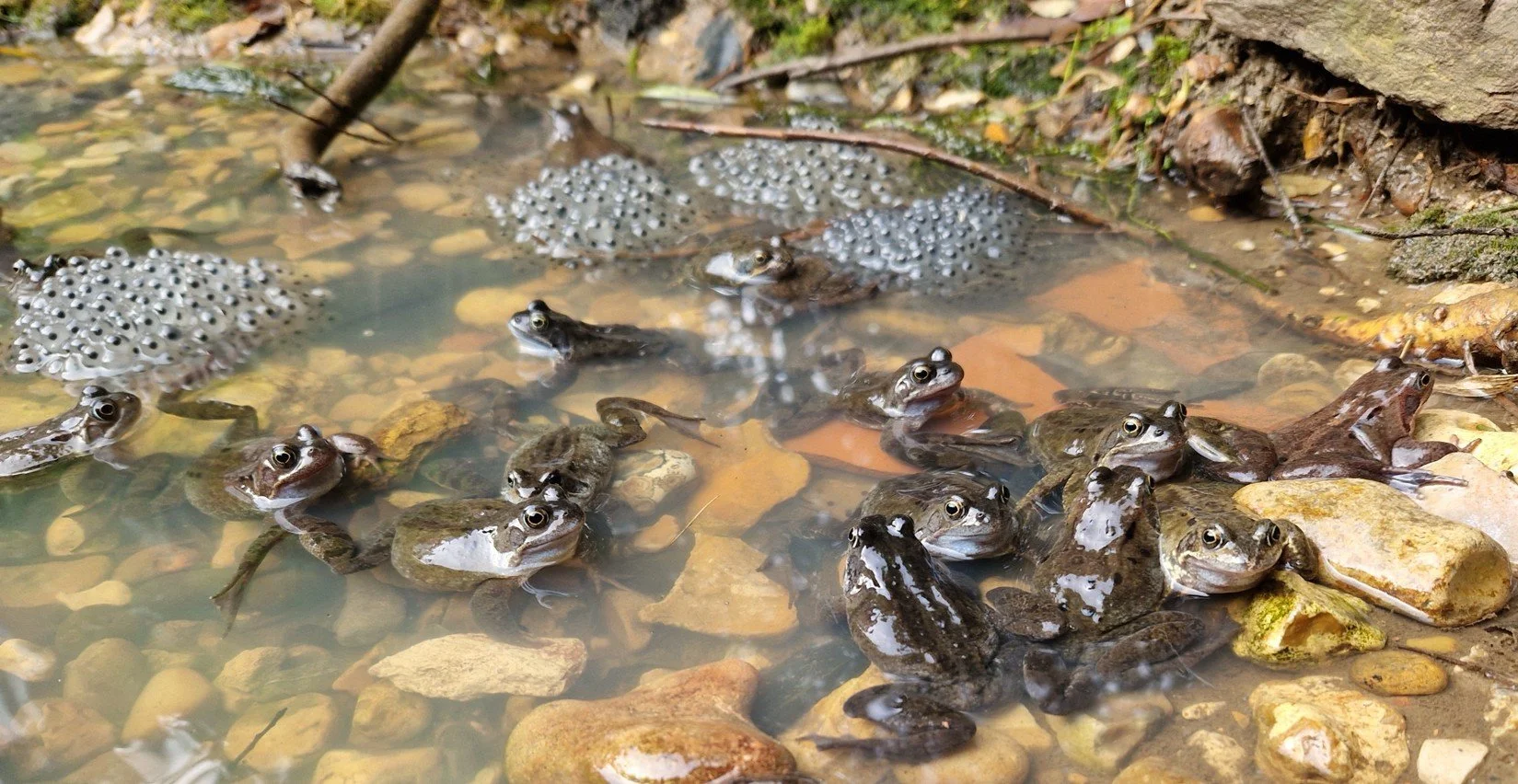
Caption: Common frogs Rana temporaria in the shallow end of pond 2 during early February 2025. We ended up with 17 clutches for that year and I will again be keeping track of things in 2026. Image: Darren Naish.
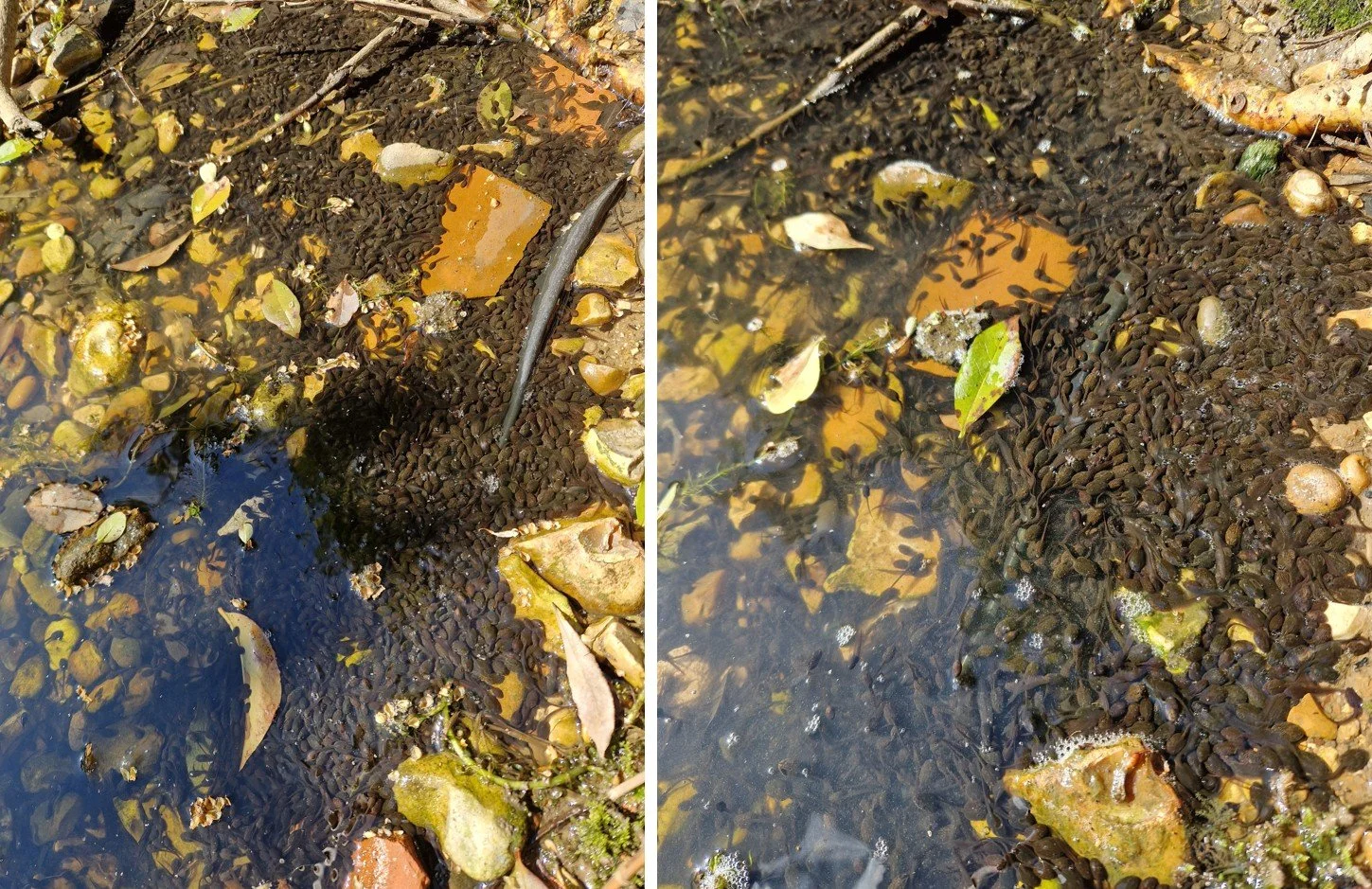
Caption: Common frogs certainly benefit from large, very shallow areas and will preferentially spawn in water less than 10 cm deep. As is obvious from these images, the tadpoles pack into the shallows to absorb solar heat . These photos are from late March 2025. Images: Darren Naish.
Over the years I’ve worked on occasion with author, consultant and Dinosaur Society founder Don Lessem, and in January 2025 I had the opportunity to meet him while he was visiting London. Don signed books I threw in front of him and I also asked him about his time as consultant for Jurassic Park (the only movie in that franchise I care about or am interested in). More on the Jurassic films in a minute.
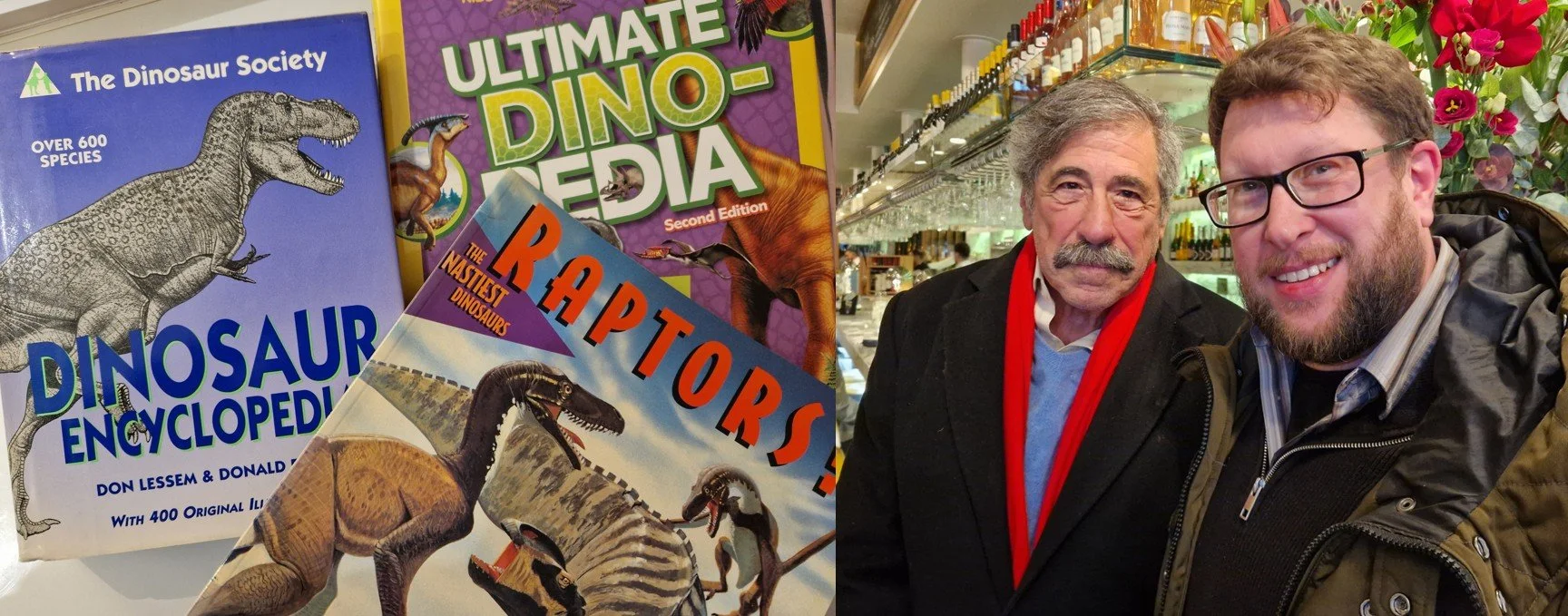
Caption: if you paid attention to dinosaur-themed books from the 1990s, 2000s and up to modern times, you’ll be very familiar with the work of Don Lessem. It was great to hang out in person during early 2025. Images: Darren Naish.
Regular readers of this blog will know of my ever-present interest in cryptozoology, and at this point I’m just as interested in the ideas promoted by the cryptozoologists themselves as I am in the putative items of cryptozoological focus (Naish 2016, 2022). In February I met up with British cryptozoologists Jon Downes and Richard Freeman at Jon’s residence – the CFZ or Centre for Fortean Zoology – in Woolfardiswarthy (pronounced Woolsery!) in north Devon. I needed info from both for a book project. We also spoke about giant fosa*, the status of cryptozoology, and rewilding in the UK. Some of our discussion is online here.
* Following advice from colleagues who work in Madagascar, I’m switching from the spelling ‘fossa’ to ‘fosa’.
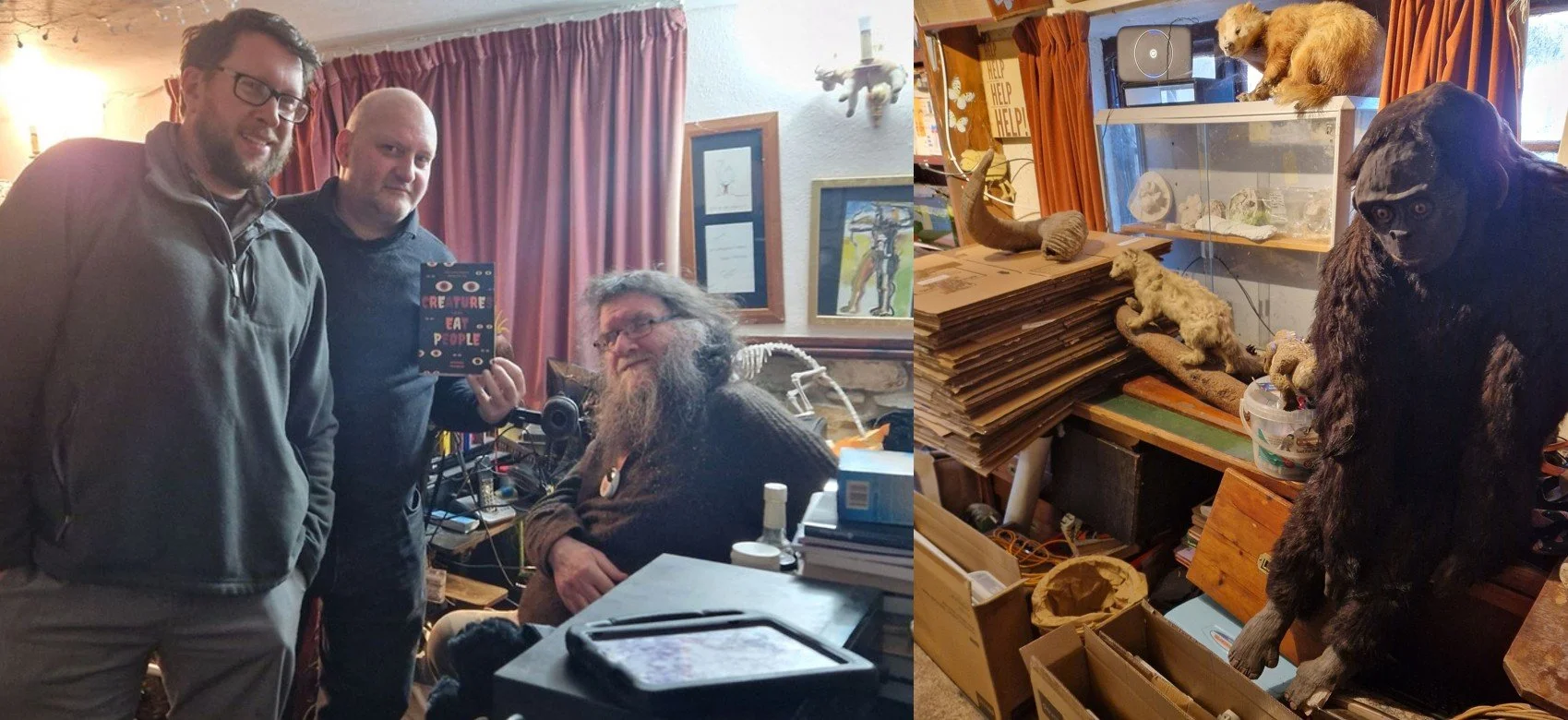
Caption: let me say, as I so often do, that you can be super interested in mystery animal research without being a ‘believer’. I cherish the time I spend with other people involved in cryptozoology, wherever they are on the ‘believer’-’sceptical’ spectrum. Here I am at the CFZ in Devon with Richard Freeman (holding his 2024 book Creatures That Eat People) and (seated) Jon Downes. At right, a view within the old CFZ office, various relevant items on show. Images: Graham Inglis, Darren Naish.
Tom Jackson’s Dorling Kindersley book Eyewitness Animal (Jackson 2025) arrived at Tet Zoo Towers in February. It warrants mention because the extinct animals section includes a short bit about me and a photo of me sat next to the Bone Clones Gigantopithecus skull. Finally, some recognition.
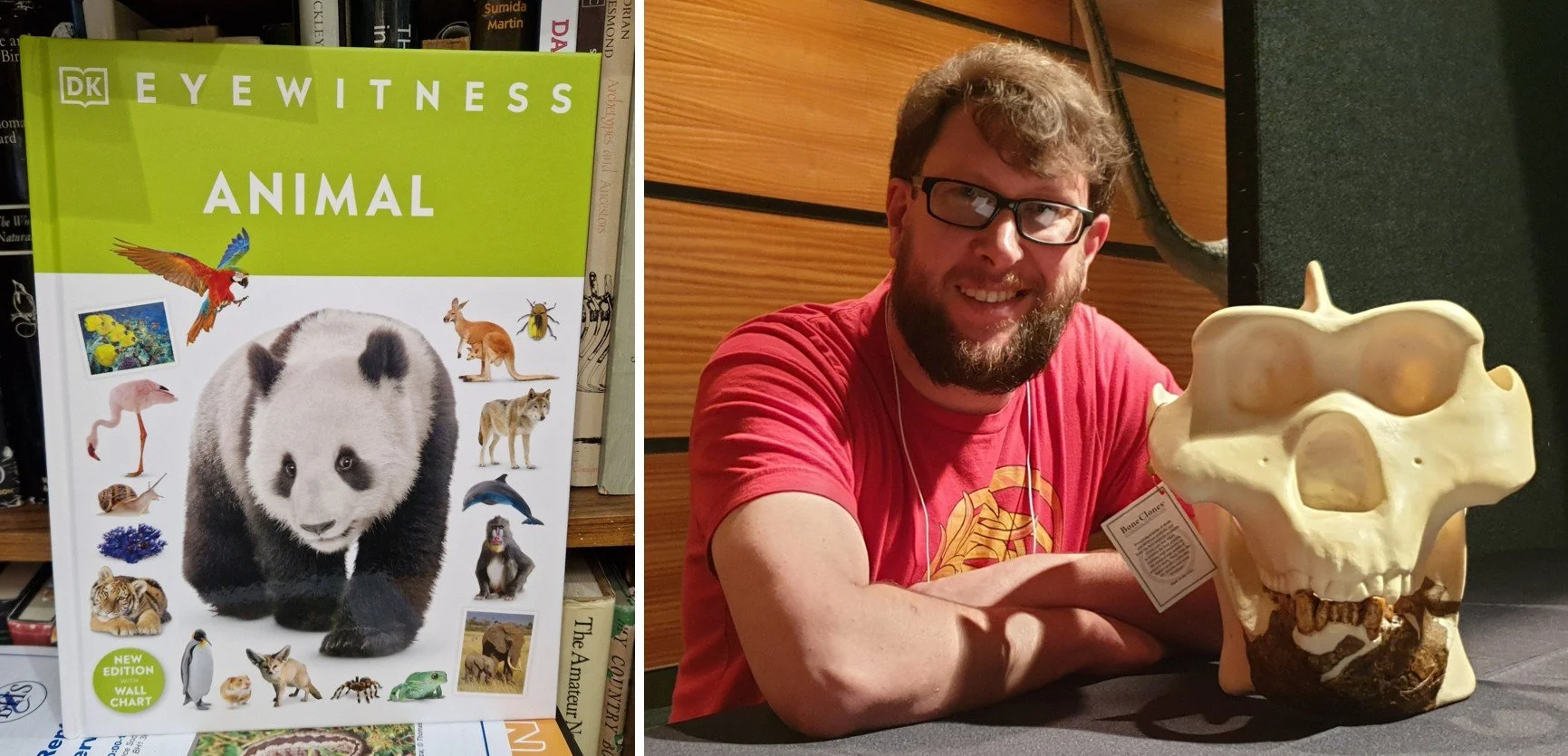
Caption: the 2025 DK Eyewitness Animal. The image at right is featured therein; it was taken at the Society of Vertebrate Paleontology meeting in Brisbane in October 2019, but I regret that I don’t have a record of who took it. This wasn’t, of course, the only Gigantopithecus-relevant event of 2025…
Goodbye BBC, goodbye Bristol. March was my final month at the BBC’s Natural History Unit (NHU). I made a special homage to Bristol Museum and Art Gallery: if I’m not working in Bristol anymore, I won’t be visiting it so often… folks, make the most of your local museums and other visitor attractions while you can. Being based at the NHU – and working in particular on big-budget shows about prehistoric animals – has been a dream job, the most insane privilege. Having this excellent job has been a major obstacle to other things, since I’ve had to decline or delay numerous projects and other jobs. But that’s a very niche complaint, and finishing there was truly the end of an era. I’ve had the most fantastic time at the NHU since starting there in 2017 and have met the most incredible set of people, many of whom are now lifetime friends.
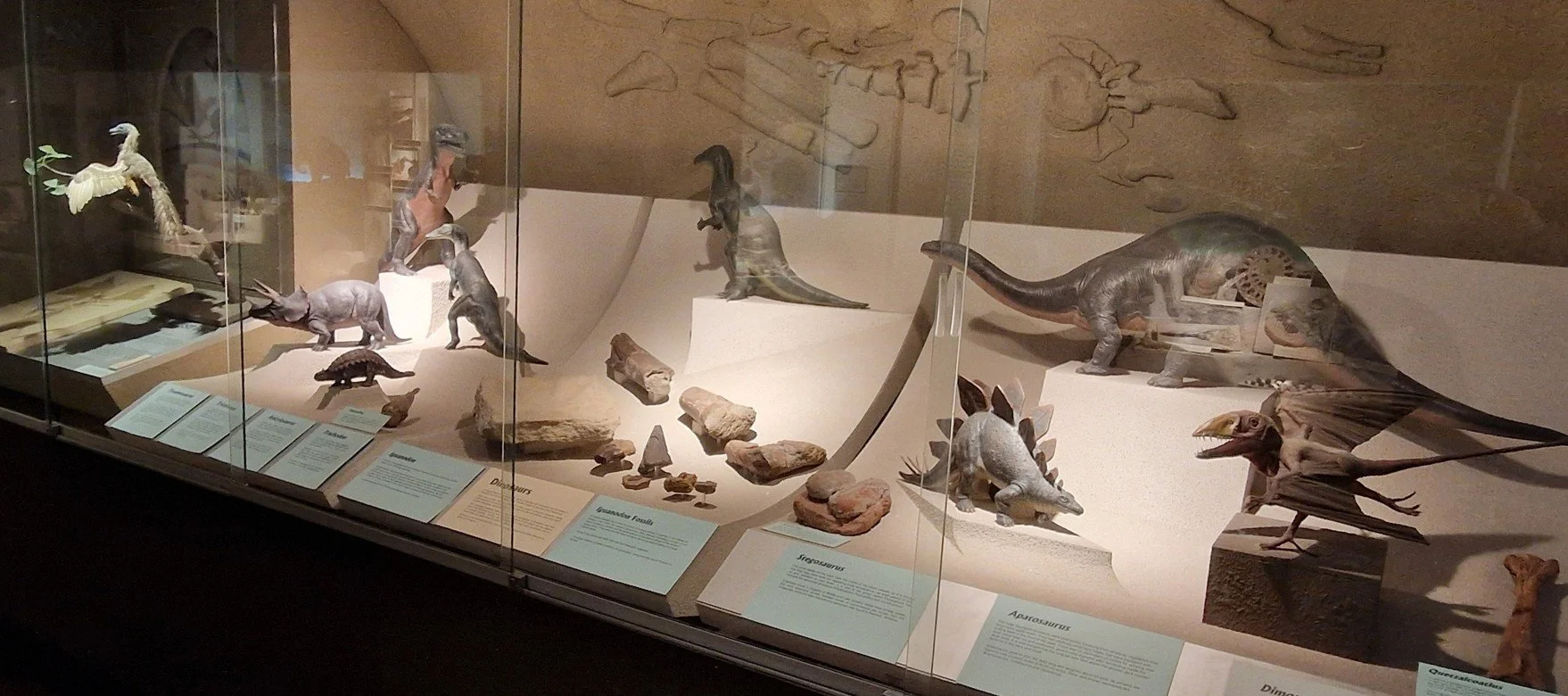
Caption: Bristol Museum and Art Gallery is home to a massive number of historically interesting items. The vintage dinosaur models here, made by Alan Braddock, are familiar to many as they were featured on postcards released commercially during the 1970s. The Archaeopteryx model at far left has appeared in several books and on TV, as has the stop-motion Aardman Animations stop-motion Dimorphodon at right. A replica azhdarchid humerus is visible at extreme right. Image: Darren Naish.
I also have vast nostalgia attached to my time at the ramshackle Broadcasting House in Whiteladies Road (during my tenure, we moved out and went to the new, more sterile premises in Bridgewater House). In addition, I’m happy that I had the chance to see people, places, facilities and even archive film associated with NHU projects that had a major impact on my younger self… key episodes of Wildlife on One, the David Attenborough 1970s series Fabulous Animals, The Velvet Claw… I could write a whole book on the behind-the-scenes work involved in the making of all three seasons of Prehistoric Planet. Maybe that opportunity will arise one day, maybe it won’t.
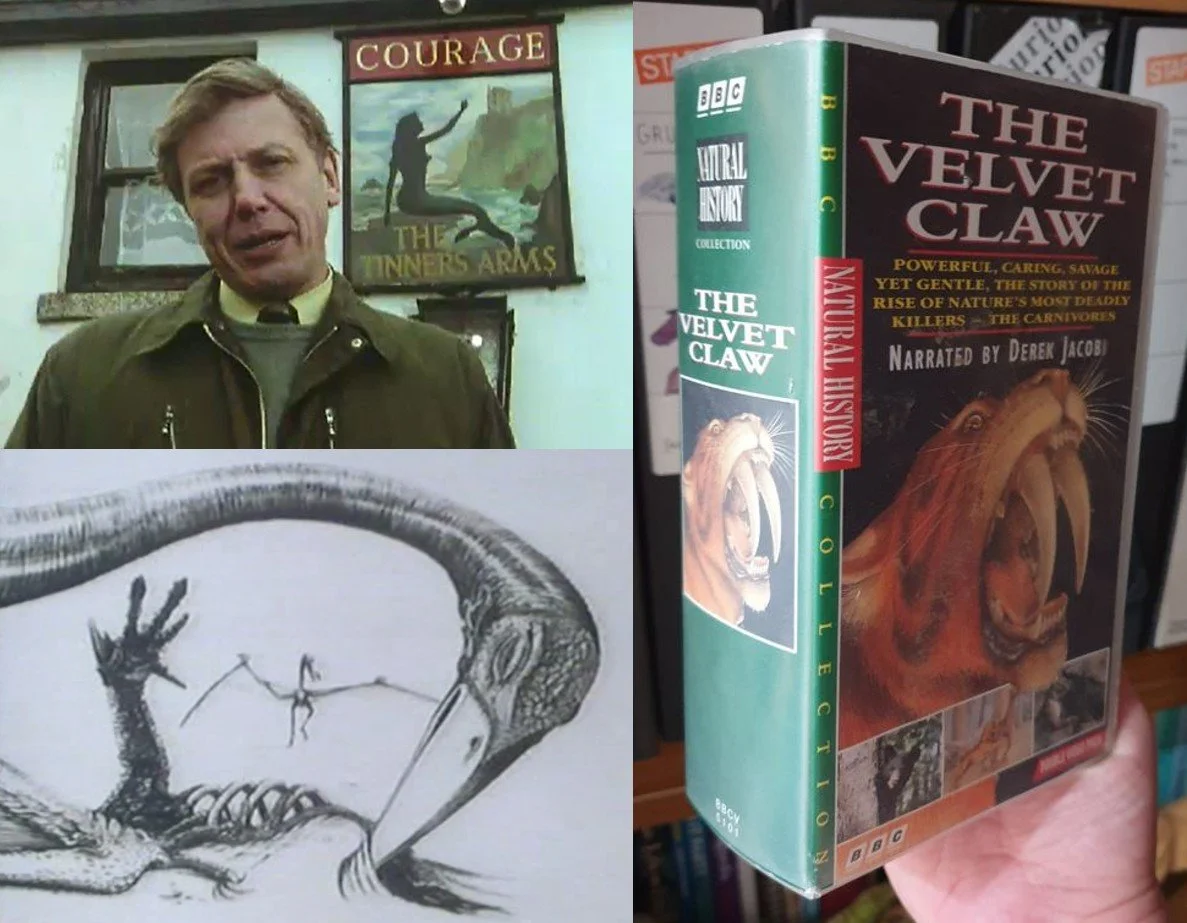
Caption: the older I get, the more interested I am in documenting and discussing the things that inspired me when I was young. Back in the 1970s, 80s and 90s, the BBC Natural History Unit produced some of the most excellent, influential pieces of media on those subjects I’m interested in. The images here relate to Sir David’s Fabulous Animals, and an early outing of stork-faced Quetzalcoatlus from the Wildlife on One film Pterodactyls Alive! At right is my cherished VHS set of The Velvet Claw.
Tet Zoo on Monster Hunter. March also saw the release of a few videos I made during January for PC Gamer on Monster Hunter. This was all part of a ‘reality check’ series PC Gamer does where a given expert watches game footage and then says what they like, what they don’t like, and how things do or don’t align with their knowledge. I’m not a gamer – I don’t want to spend more time on computers than I already do – but I’m at least aware of this franchise due to its appearance in pop culture, plus I went to the trouble of sitting through the 2020 movie.

Caption: PC Gamer created a nice little desk-top display for my appearance on ‘reality check’, and I even had genuine opportunity to use that model T. rex skull. Image: PC Gamer.
The creatures of the Monster Hunter games represent a mashup of fossil species (dinosaurs especially), living animals, and mythical dragons and other beasts. A huge number of things could be said about each and every one of them. Watch the PC Gamer review here on YouTube. A second video about Elden Ring – a game less relevant to my interests – was recorded at the same time but not released until April (it’s here on YouTube). Elden Ring is based more around high fantasy and magic and less on creatures, but there are dragons, snake monsters and so on.
Also in March, the digital version of my article on reviewing books appeared in Historical Biology (where I’m now book reviews editor); the hardcopy version appeared in December (Naish 2025a). DinoCon 2025 tickets went on sale during the month. At some point during the early months of 2025, Arturo García, a Chilean artist based in Santiago who does great palaeoart, asked me an interesting question: if all my model animals were melted down and turned into a new one, what would it be? Answer: a hypothetical giant flightless bat. And thus…
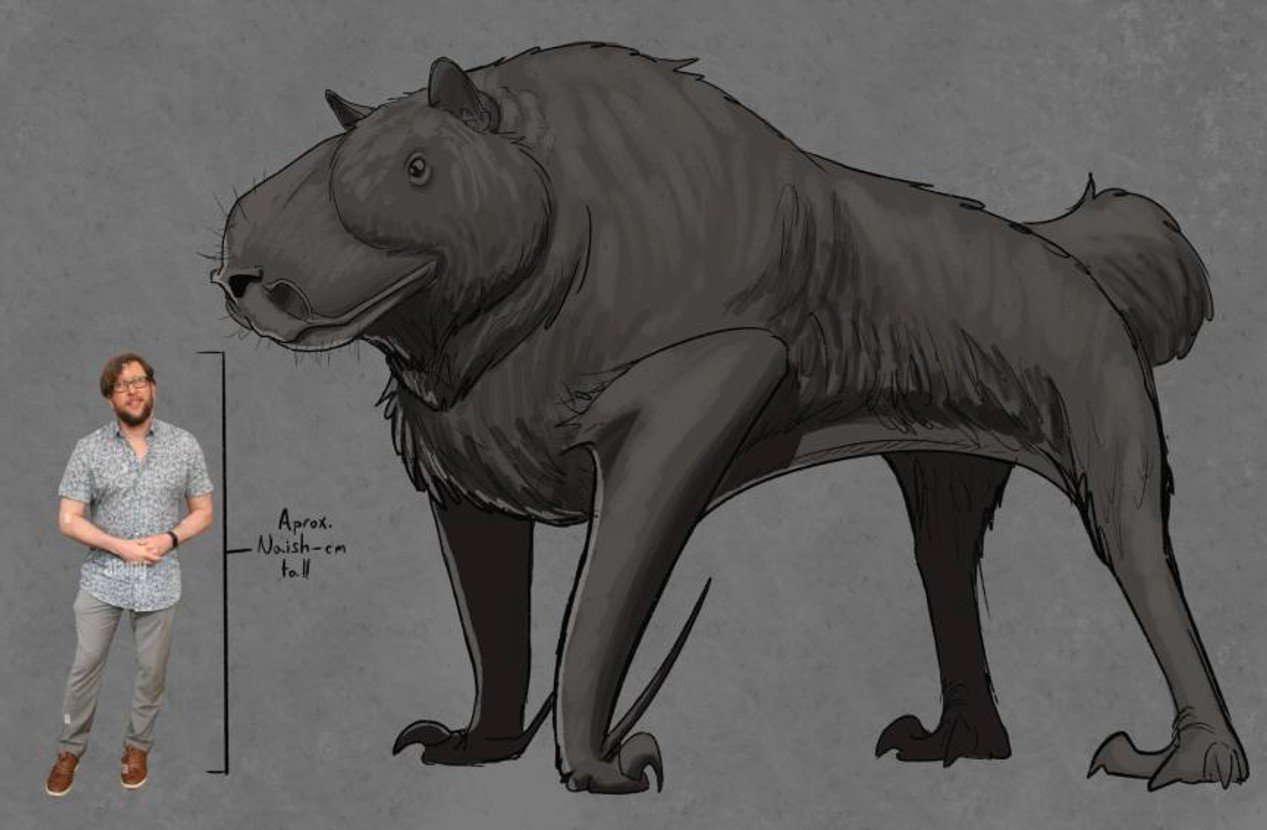
Caption: a giant flightless bat as depicted by Arturo García, with one standard Naish unit for scale. Image: Arturo García.
In pursuit of newts. Observational work involving wild amphibians occurred in March when Phil Budd of the Southampton Natural History Society, Helian and I again visited the ponds in the north of our city to monitor the situation. Remember that the UK has a tiny number of native amphibian species, this being just three newts, two toads and two frogs. A very active area of research concerns the occurrence, distribution and spread of invasives. Do we have the fast-spreading, ecologically flexible Alpine newt Mesotriton alpestris in the Southampton area? We couldn’t find them in 2024. But this time… success. They’re here, they’re easy to find, and it looks like they’re becoming more abundant. We will continue to monitor the situation.
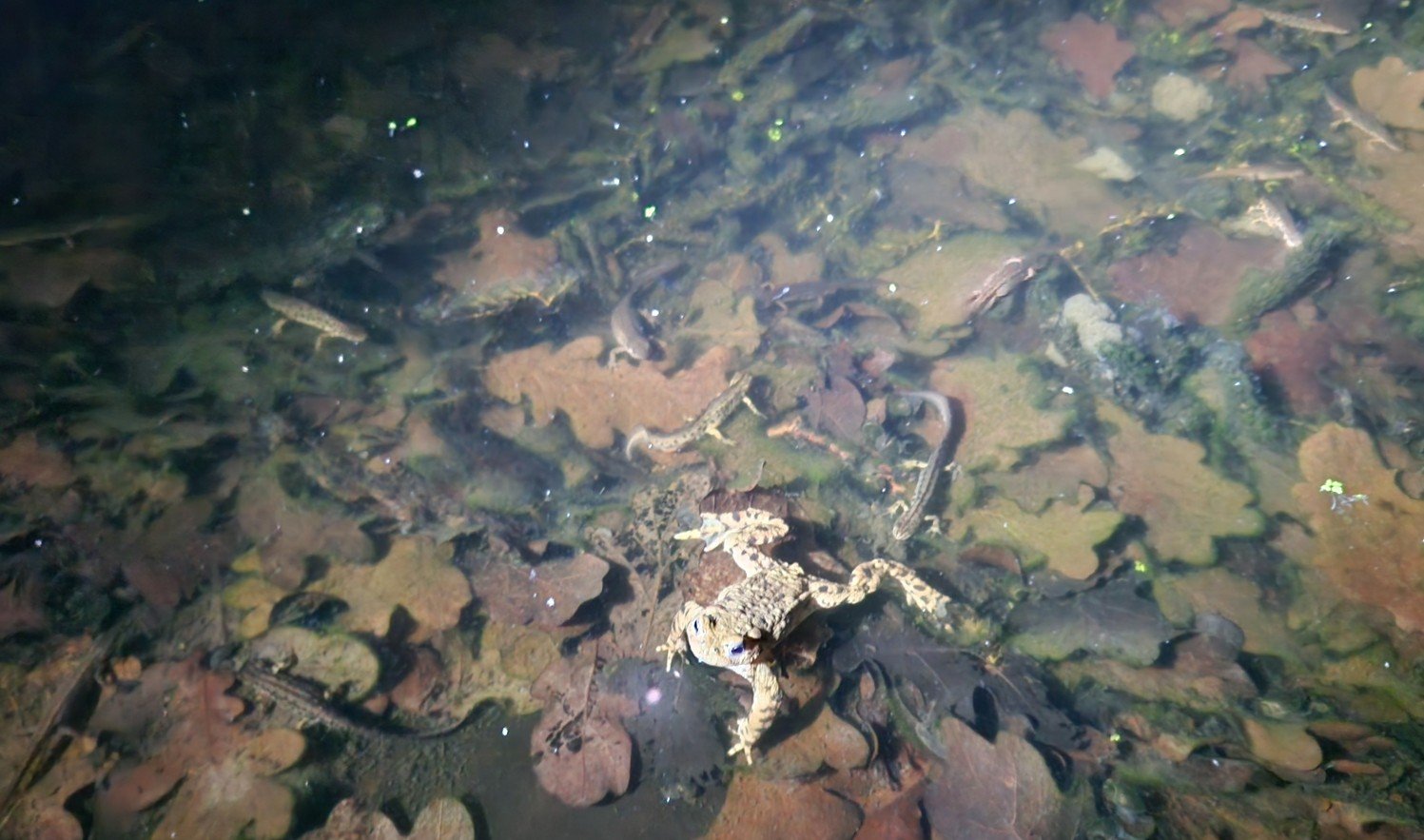
Caption: a shallow pond in the north of Southampton, surrounded by marsh and heavily vegetated land and hence good for amphibians. A single male Common toad Bufo bufo is visible here, as well as numerous male and female Smooth newts Lissotriton vulgaris. Image: Darren Naish.
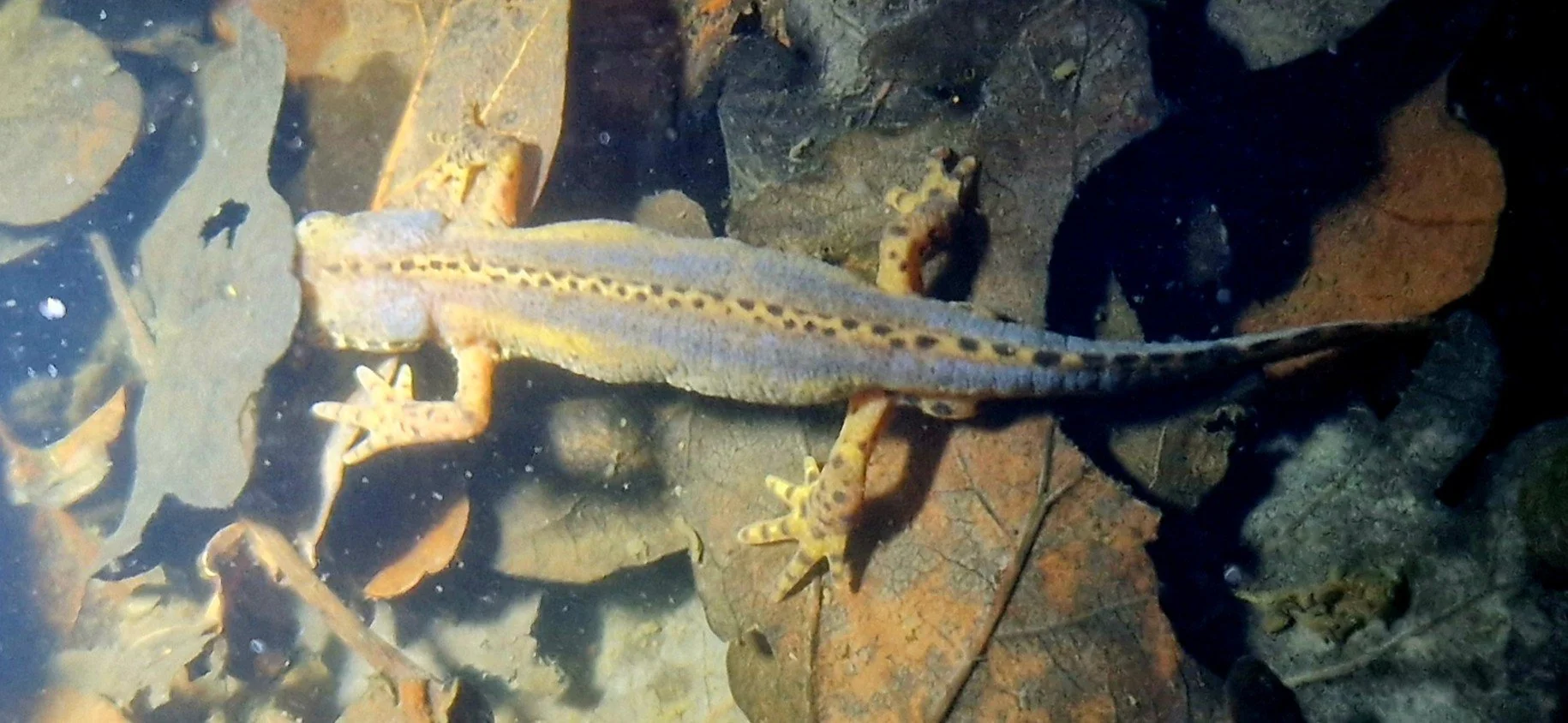
Caption: and here’s one of the animal we were looking for, a male Alpine newt. This animal has a complex taxonomic history and, after being named Ichthyosaura for a while (a very annoying name), is – as of 2025 – back in Mesotriton. It doesn’t appear especially close to the other newts we have in the UK (Lissotriton and Triturus), instead being close to the group that includes fire-belly Cynops newts and kin. Image: Darren Naish.
The Palaeontology in Public book launch event, organised by Chris Manias of University College London, happened in London in late March; there were talks on fossil plants, Crystal Palace, the history of palaeoart and more. I was part of a panel that also featured Natalie Lawrence (author of the 2024 book Enchanted Creatures: Our Monsters and Their Meanings), Pleistocene expert Victoria Herridge, and world-renowned palaeontologist Professor Michael Benton. I got my first look at Mark Witton’s very impressive Princeton University Press book King Tyrant.
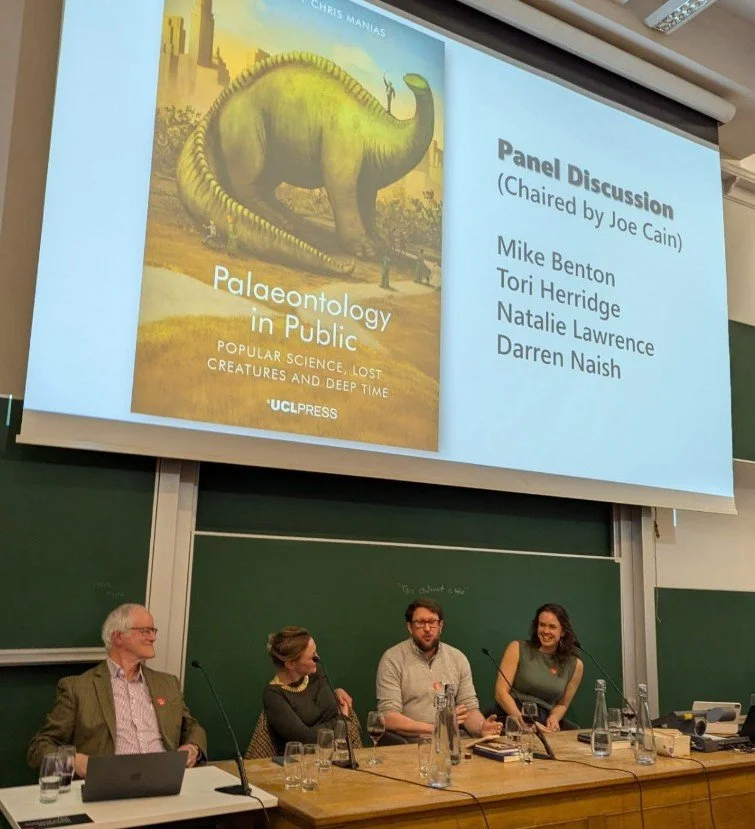
Caption: a scene from the Palaeontology in Public Panel Discussion of March 2025. Left to right: Michael Benton, Tori Herridge, Darren Naish, Natalie Lawrence. Image: Elliott Edwards, used with permission.
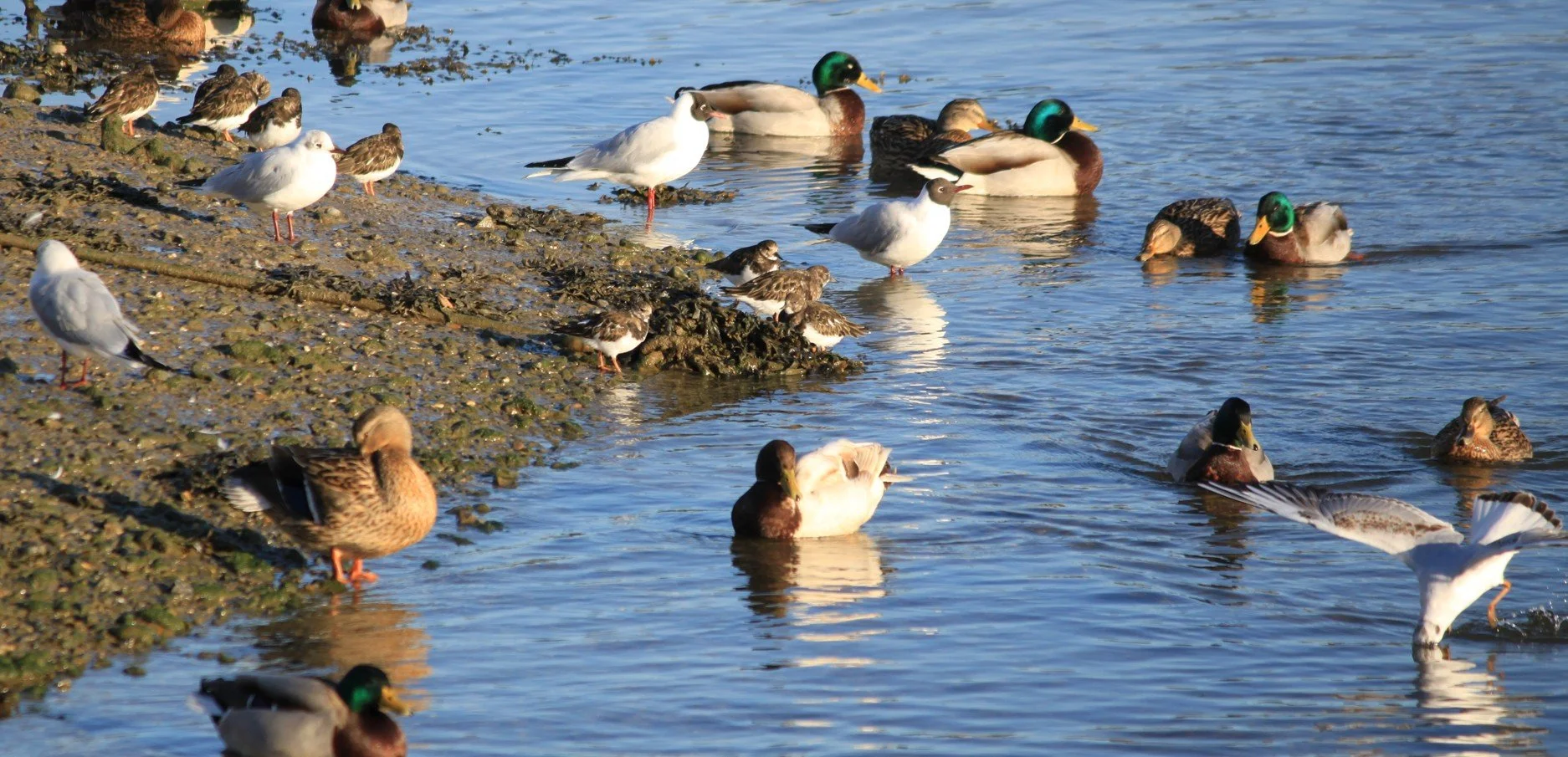
Caption: a March 2025 scene from Titchfield Haven, a SSSI on the banks of The Solent, southern Hampshire. I really like the composition of this scene. We can see Black-headed gull Chroicocephalus ridibundus, Ruddy turnstone Arenaria interpres and Mallard Anas platyrhynchos. Image: Darren Naish.
I published another Discover Wildlife article in March, this one on the two-fingered therizinosaur Duonychus (it’s here). I also visited the Bournemouth Natural Sciences Society to talk on Mesozoic marine reptiles, all part of my continuing promotion for Ancient Sea Reptiles.
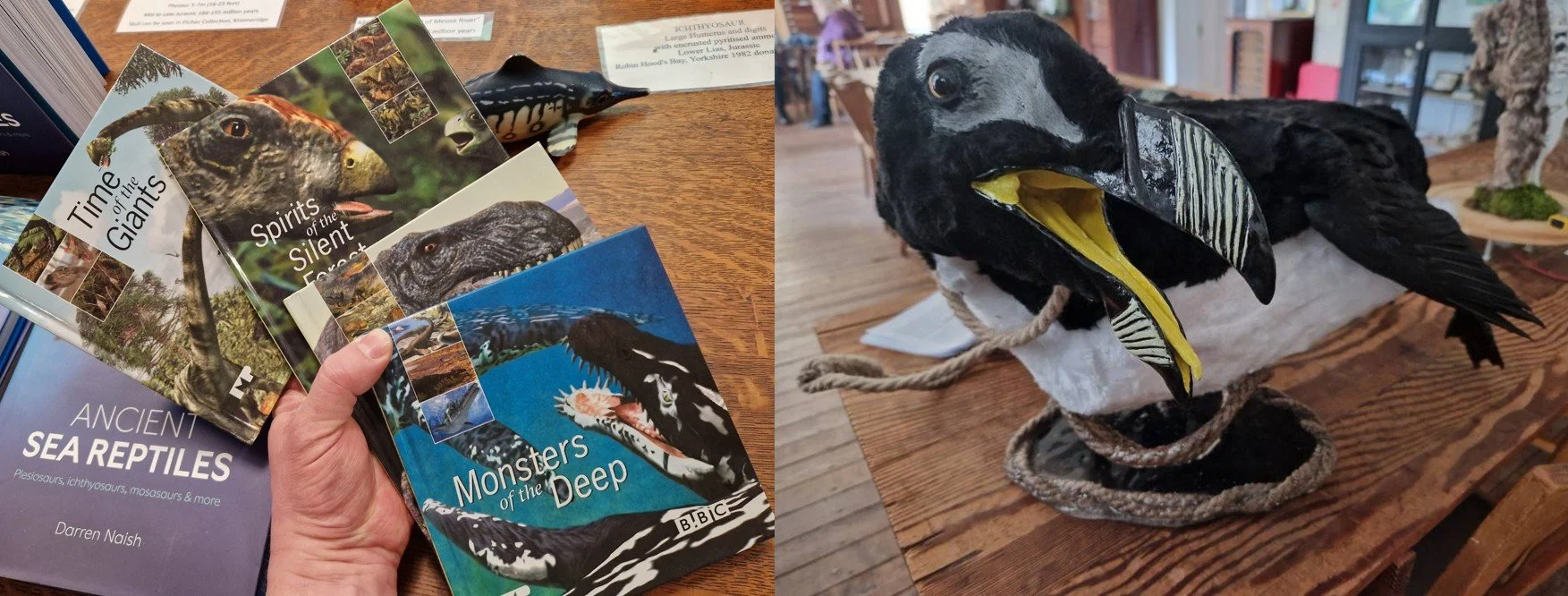
Caption: my marine reptile talk at the Bournemouth Natural Science Society (BNSS) in March 2025 resulted in some interesting things being encountered. Prior to that time I didn’t know that Dougal Dixon had published a series of books made for Walking With Dinosaurs 1999 (thanks to Brandon Mason for bringing them along). At right, a model Great auk Pinguinus impennis on show at BNSS at that time. Images: Darren Naish.
Mokele-mbembandwagon, redux. I was also quoted in a Popular Mechanics article on mokele-mbembe, this one titled ‘‘Dinosaur’ sightings are on the rise in the Congo. Could this legendary creature realty exist?’ and written by Jordan Smith. Therein, my words were used alongside those of Eddie Guimont and Loren Coleman. A longer, more authoritative article, again quoting me, appeared in New Lines Magazine during April; this one is titled The Congo’s Dinosaur of Discord and is by Ryan Biller. In both cases, I repeat the same stuff about this phenomenon I’ve been saying for a while: that the idea of ‘living sauropods in the Congo’ is related to an erroneous and romanticised late 1800s and early 1900s notion of ‘backwater prehistoric Africa’ mixed with adventure ‘lost world’ fiction and the cultural impact of sauropod skeletons in museums (Naish 2016).
In addition, there isn’t much good reason to think that people in the relevant regions have seen ‘living sauropods’ at all. Sure, they have myths and stories about giant dangerous animals, but Europeans have erred in connecting these with sauropods. If people have seen weird animals, I like reminding people that very large softshell turtles and big pythons are endorsed as real and findable within the cryptozoological literature.
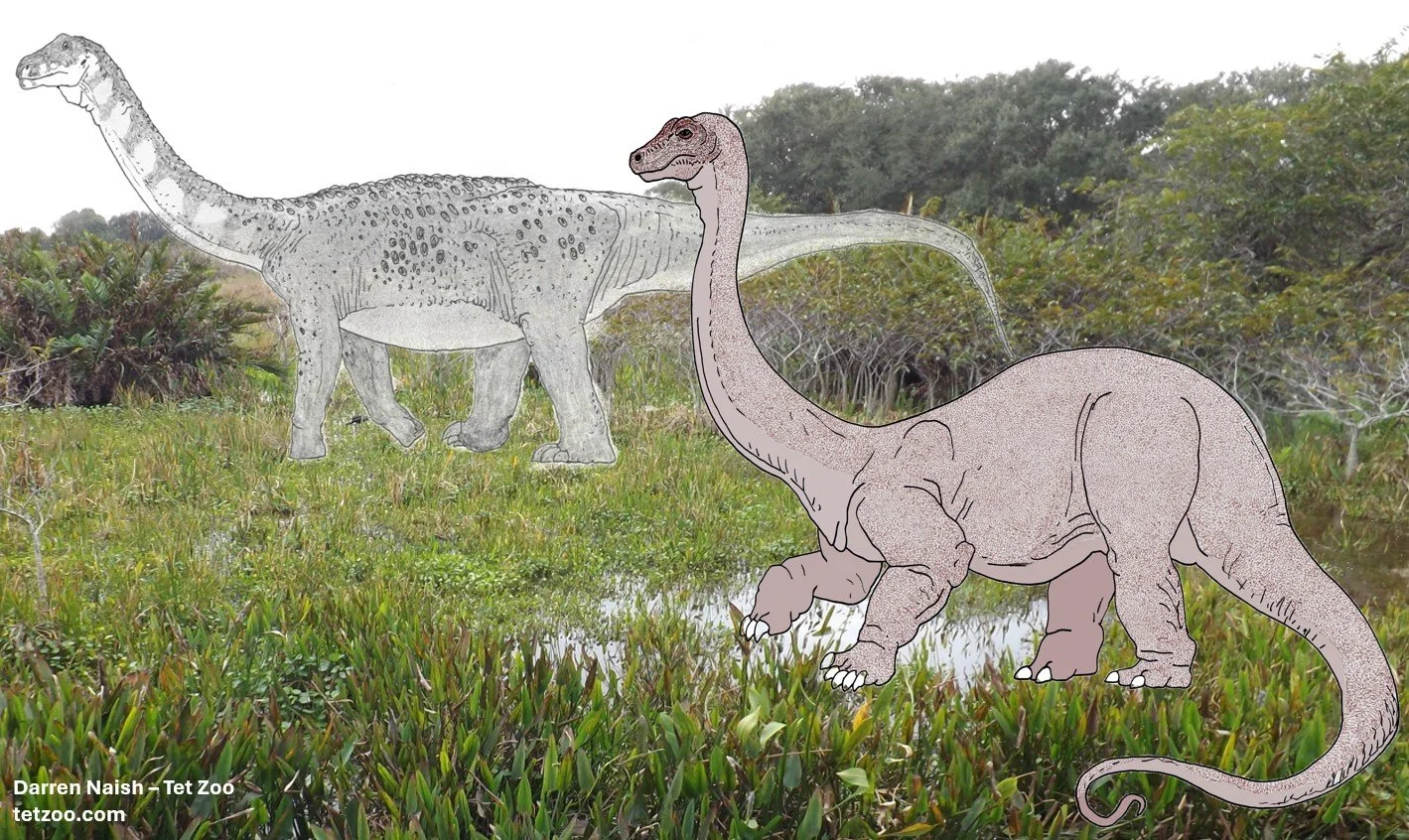
Caption: you can’t modernize the Westernized, cryptozoological concept of the mokele-mbembe, not that there’s been much effort to do so, because it is, and always will be, linked to an anachronistic cartoon view of what the ‘Dark Heart of Africa’ was meant to be like more than a century ago. The animal at rear here is a modern view of a saltasaurid titanosaur; at right is the mokele-mbembe as generally imagined, right out of a 1901 encyclopaedia. Image: Darren Naish.
The whole mokele-mbembe thing is now self-perpetuating both as Congolese people work as canny guides and assistants to foreign wannabe adventurers and while wannabe adventurers and self-styled explorers – who never do work of any value bar writing popular books and doing podcast interviews – larp their way through the region in an effort to confirm what they already think is true. This has been going on since the 1980s and the subject is now so tarnished that we’ll probably never understand what the phenomenon was based on originally... assuming, of course, that it was based on anything. What’s weird is that there’s currently a resurgence of interest in the idea that mokele-mbembe is (a) real and (b) worth searching for, and very similar articles keep appearing. Sharon Hill wrote about this during March 2025 and used the term ‘mokele-mbembandwagon’ for this new bout of interest.
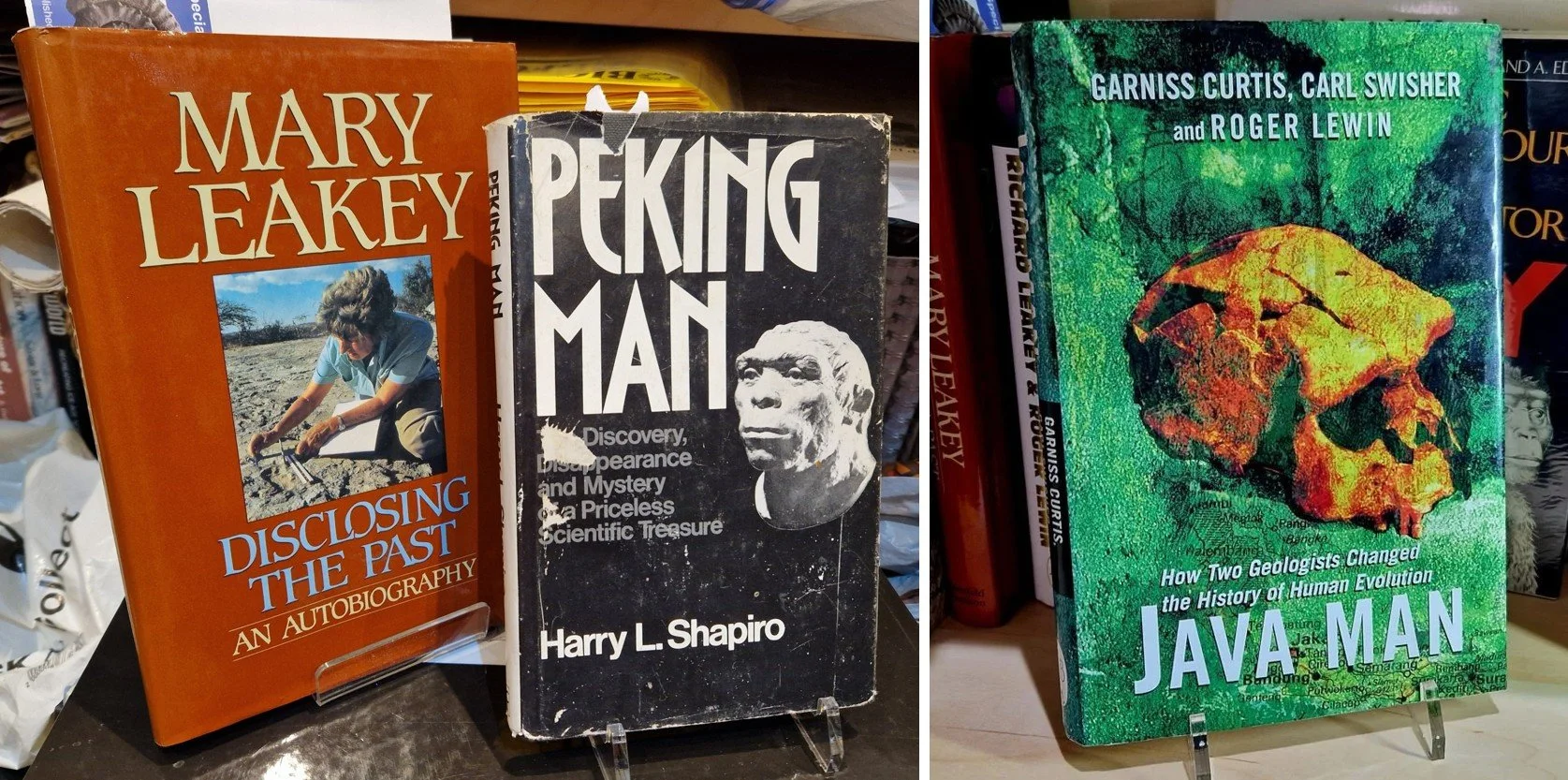
Caption: there are a great many books on fossil hominids, and I’m gradually working through the ones that I own. Due to be covered here next are Mary Leakey’s 1984 biography, and Harry Shapiro’s Peking Man of 1975. Curtis et al.’s Java Man was discussed here at Tet Zoo. Images: Darren Naish.
On fossil hominids, sea monsters and Prehistoric Planet megathreads. Moving to something wholly different, I’ve been meaning for years to start writing about the massive number of palaeoanthropological books I’ve accrued, many of which cover the same discoveries, discussions and hypotheses albeit from different perspectives. I made a start on this in March with my article on Curtis et al.’s Java Man of 2000. Other Tet Zoo articles are coming in the series. I’m working my way through books on the Leakeys (of which there are many) as well as others on the supposed presence of Homo erectus in Africa. Remember that H. erectus was first named from Java… how did we arrive at the view that it was present throughout virtually the whole of the Old World, persisting for millions of years?
A review of a book more directly relevant to my own research – Adrian Shine’s A Natural History of Sea Serpents – was also published in March, as was a recycled article on the Southern sea lion Otaria byronia/Otaria flavescens, one of my favourite pinnipeds. I also published (both on the increasingly problematic site known as Twitter and at the Tet Zoo patreon) long-form thoughts on the Oceans episode of Prehistoric Planet 2. Better late than never (the series aired in May 2023, approximately two years earlier).
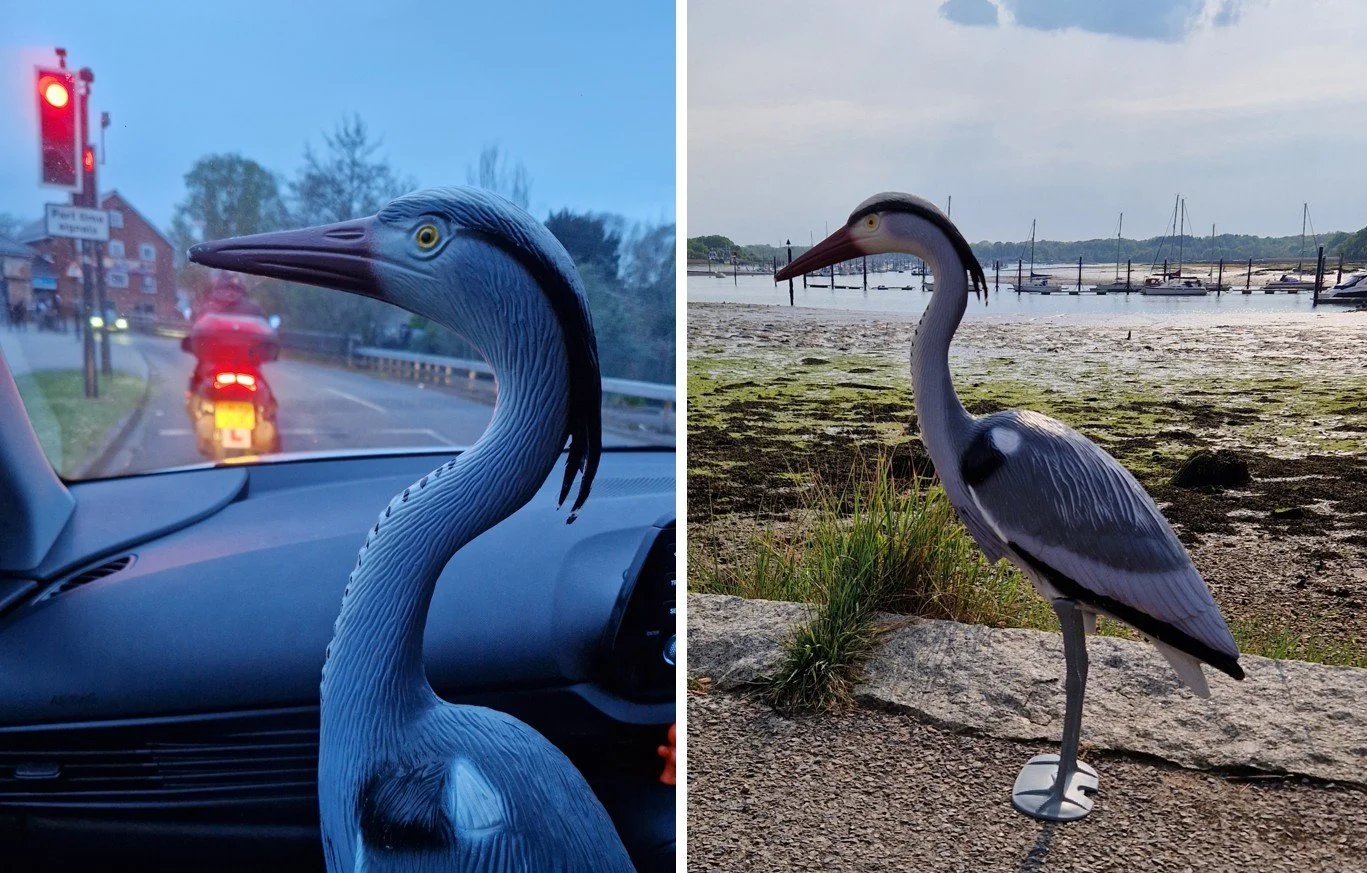
Caption: I’m a simple man, and for long have I hoped to own my very own life-sized plastic heron. That dream was realized in April 2025. I took the heron with me on various adventures about the place, and here it in in the car, and near the shore in Swanwick, near the River Hamble. Images: Darren Naish.
SpecZoo, marine reptiles, the Heuvelmans project, a dinosaur book. Ever aiming to rescue old material from the previous versions of Tetrapod Zoology (the ScienceBlogs and Scientific American years), I revamped and republished two articles on speculative zoology during April, one my 2013 interview with Dougal Dixon and one my review of the 2015 book Demain, les Animaux du Futur.
Luke Muscutt and I hung out with marine reptile fossils (and replicas of them) in London, this being relevant to the next step in our work on plesiosaur swimming behaviour. Like all academic projects, this is slow-burn and taking forever, but I promise we’ll return to it in time. On the subject of slow-burn projects, progress continued on my Cryptids of Bernard Heuvelmans project, the results again appearing at patreon. Increasing workload during the year meant that I had to temporarily abandon that project. I cannot express how frustrating this is. Maybe I’m trying to do too much.
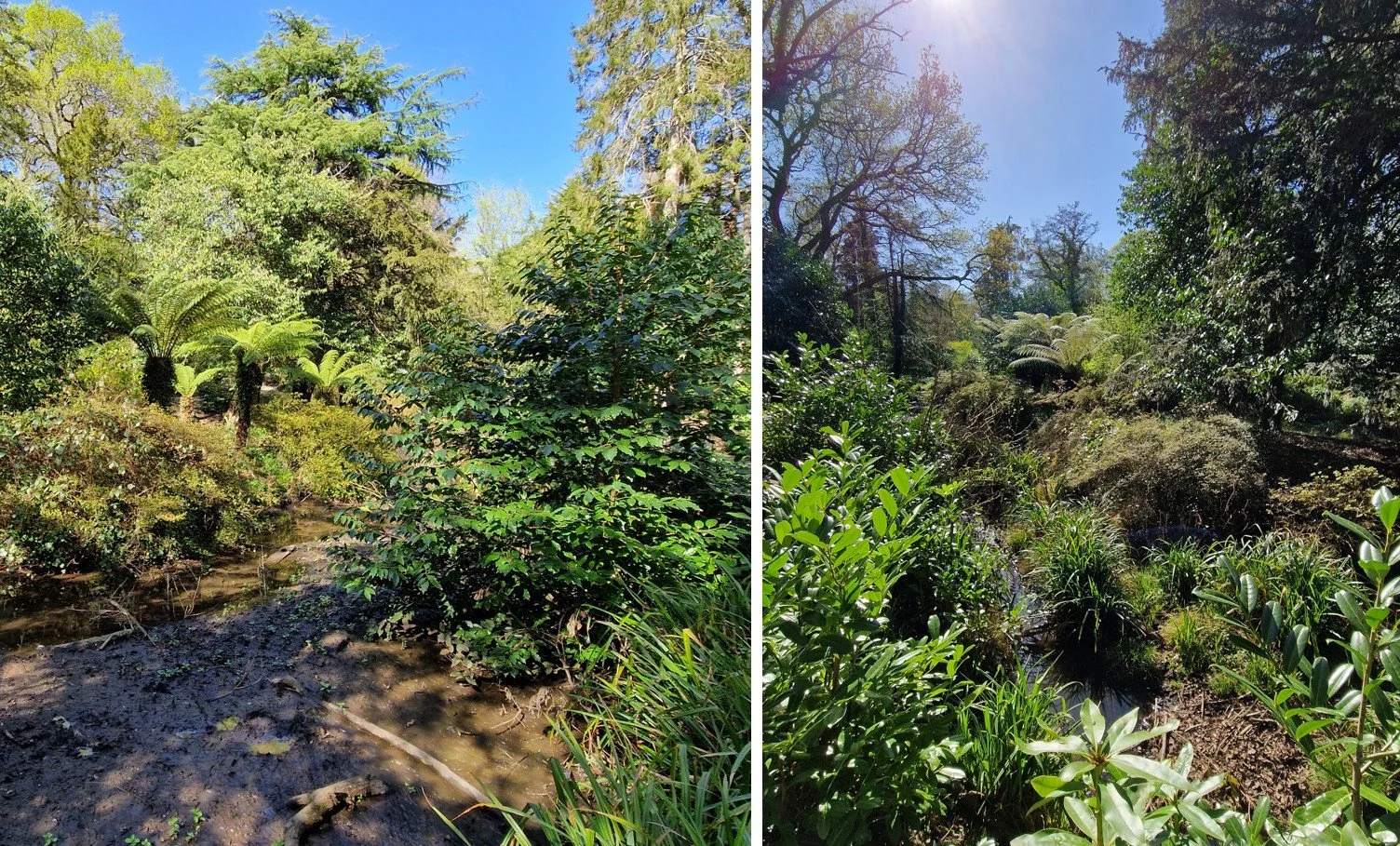
Caption: images from a visit to Holly Hill Woodland Park (Fareham, Hampshire) during April 2025. Pictures like this do a god job of reminding people who don’t live in the UK how incredibly mild and warm our climate is despite our far northern latitude. Note the (non-native) tree ferns. Images: Darren Naish.
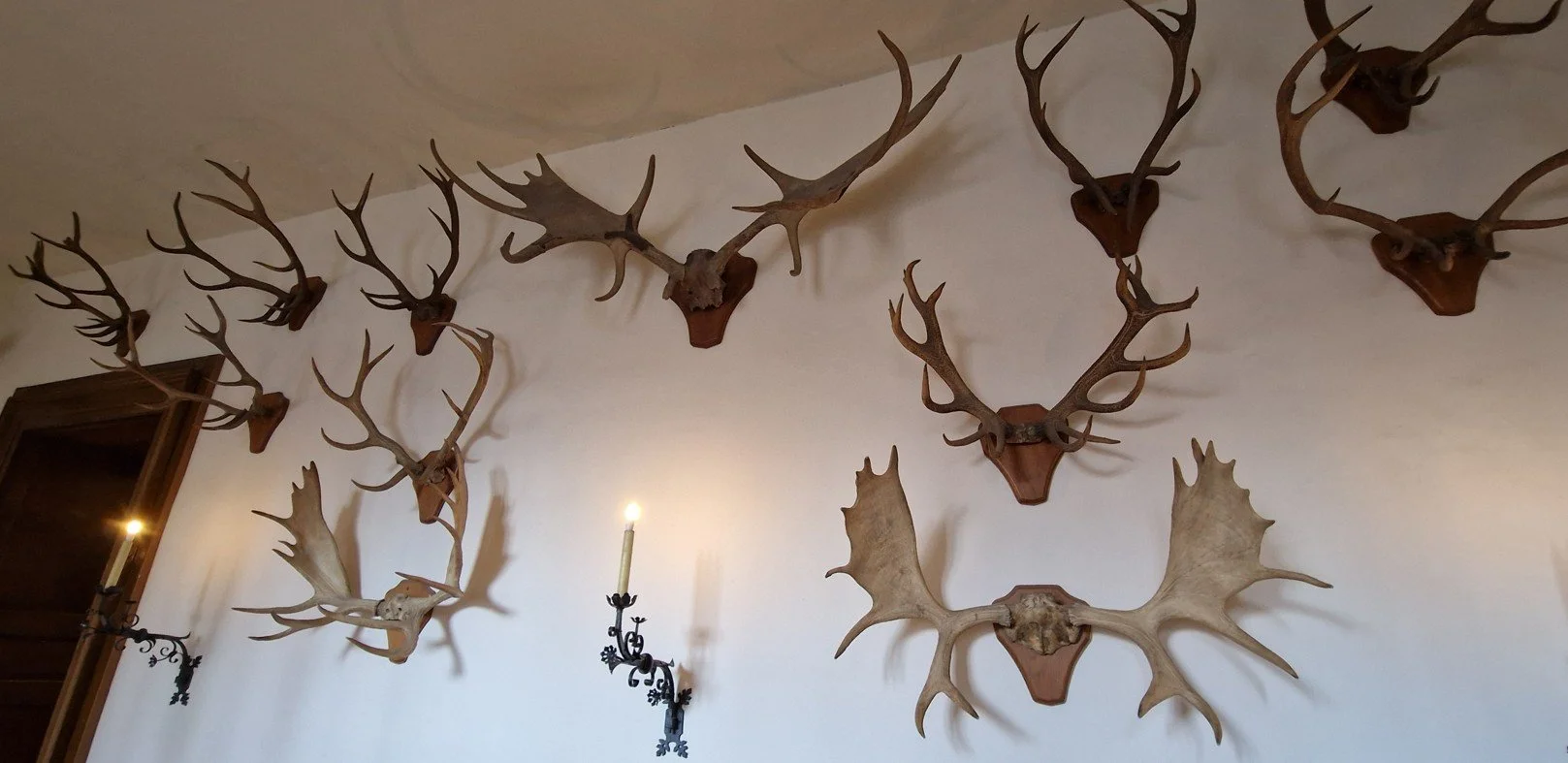
Caption: I visited Blenheim Palace during April 2025, and it turned out to be home to several things of TetZooniverous interest, among them this antler display. These mostly belong to Red deer Cervus elaphus but there’s Moose Alces alces here too. The big surprise, though, is the Megaloceros set in the middle. Image: Darren Naish.
TikTok and taxonomic trolling. And so to May… the month in which I started a new venture, namely a TikTok account (TetZooTowers_collection) devoted to model and toy animals. We started with Star Wars creatures for May 4th but later began going through Spinosaurus toys in rough chronological order. These do a good job of charting changing views on thoughts about this animal, but to hear the full story on that you’ll need to watch the series… which currently exists as 47 separate episodes and is still incomplete! I gave more talks, firstly at God’s House Tower in Southampton and given to accompany the Hidden in Stone exhibition organised by my colleague Neil Gostling, and then for the University of Portsmouth’s Palaeo Society. Both talks were on dinosaurs and given to accompany a signing of Dinopedia, my Princeton University Press book (buy it direct from me here).
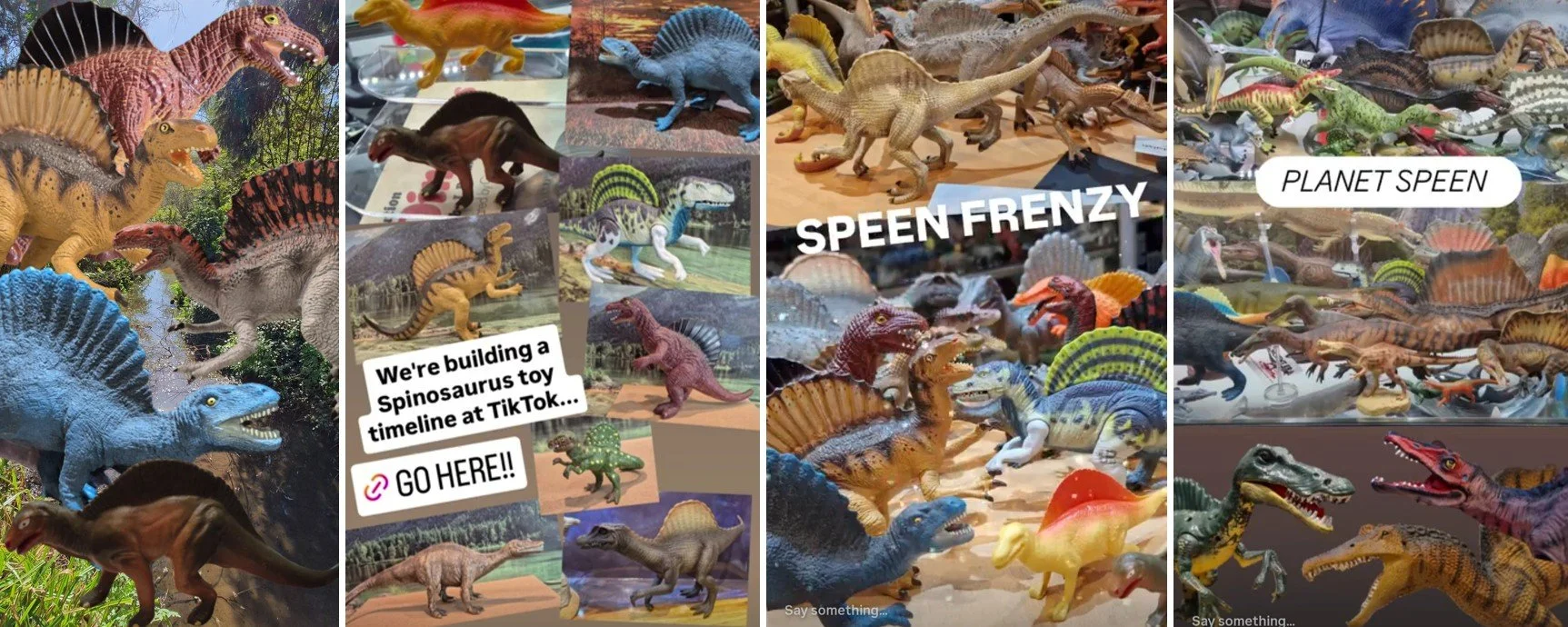
Caption: a montage of screengrabs (showing Instagram stories) that give some idea of the content online at the TetZooTowers_collection TikTok, everything here being related to spinosaur figures.
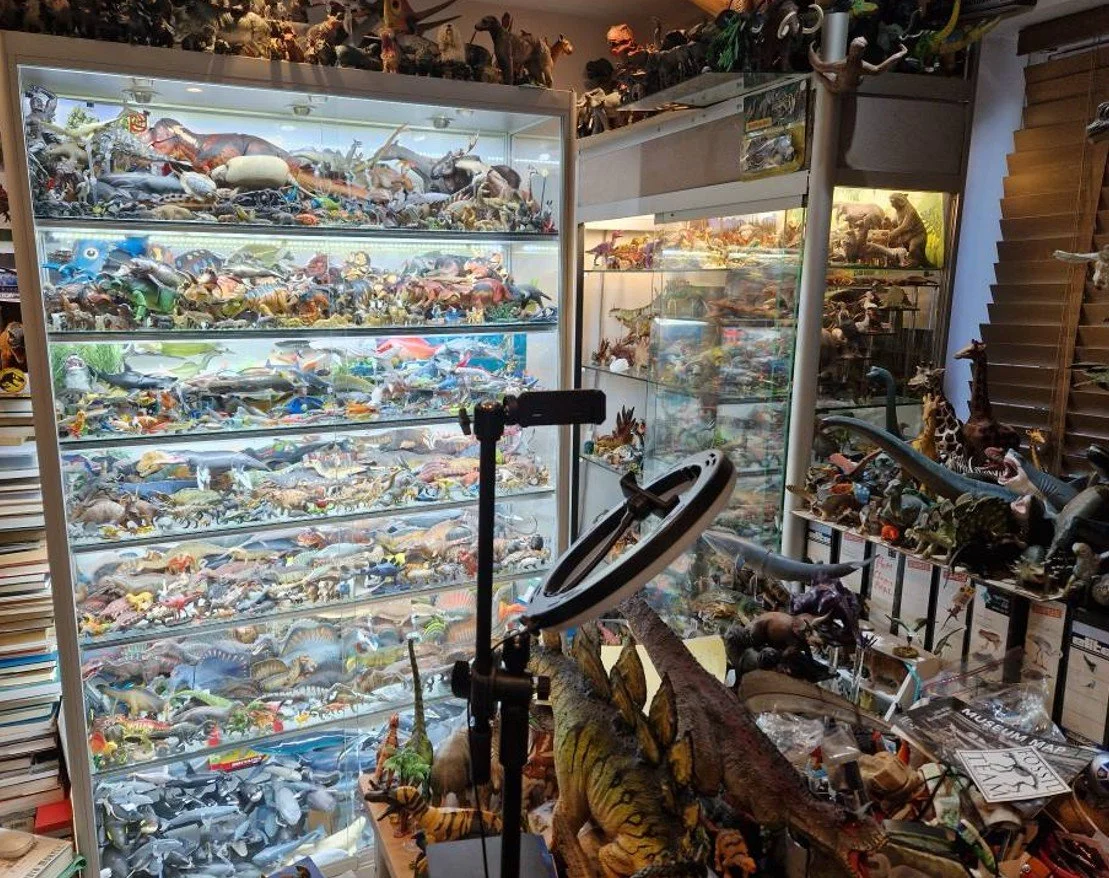
Caption: the studio area… yeah, let’s call it a studio area… that we work with for the TetZooTowers_collection TikToks. I continue to hold out hope that I might one day obtain a larger house and hence eventually have the collection on proper display. There’s no hope of that today and most of it is in storage boxes. Image: Darren Naish.
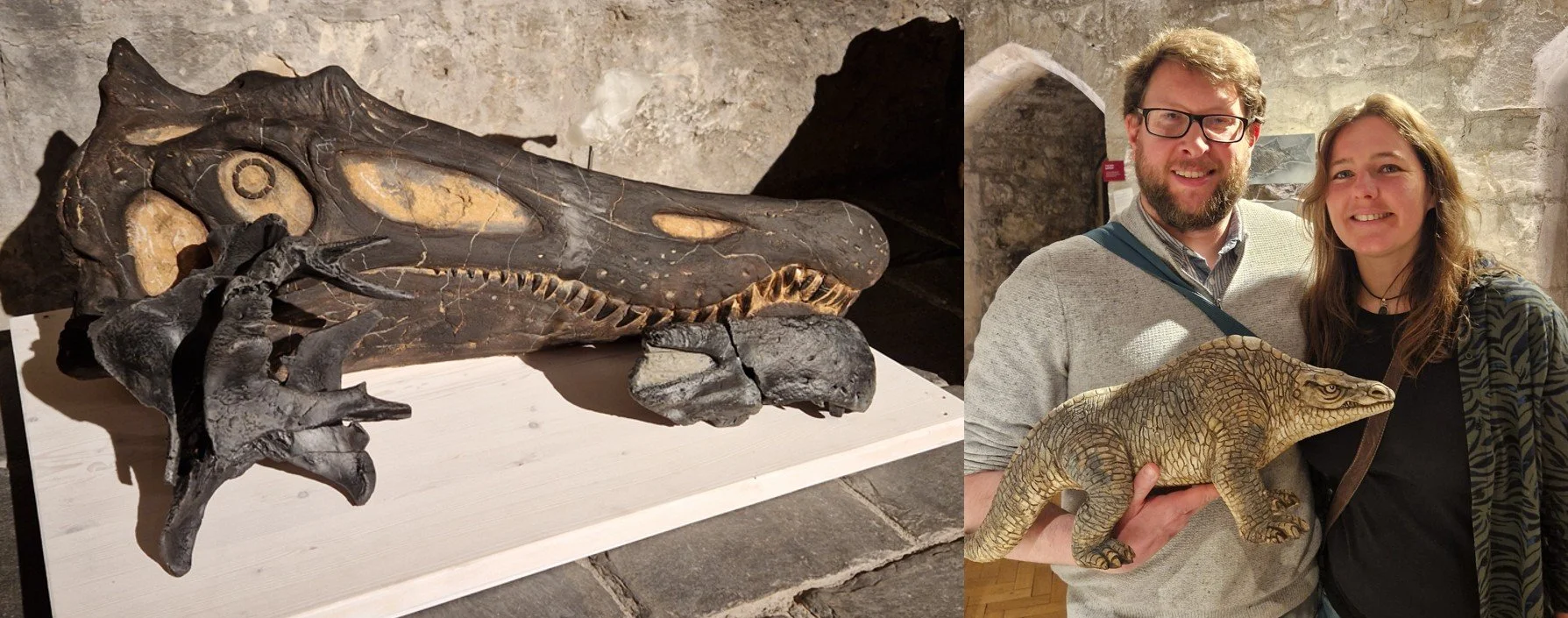
Caption: scenes from the opening of Hidden in Stone at God’s House Tower, Southampton, during April. Part of the exhibition focuses on the spinosaurid work published by Chris Barker, Neil Gostling, myself and others, so at left we see a reconstructed baryonychine skull together with casts of the Ceratosuchops holotype. At right, myself and Karen Fawcett with her brilliant Crystal Palace Megalosaurus model.
A niche topic covered here at Tet Zoo on a few occasions concerns taxonomic vandalism, the event in which rogue researchers take to publishing their own scientific names for populations or specimens they consider distinct. I’ve contributed to multi-authored articles on the issue before (Rhodin et al. 2015) but have never published a stand-alone piece on it… until May, since the new issue of The Biologist, released that month, includes my article on this topic (Naish 2025b). The online version is here. Palaeornithologist Hanneke Meijer visited the University of Bournemouth here in southern England and we caught up, giving me an opportunity to get my SVP dodo monograph signed. Only another three editors to go.
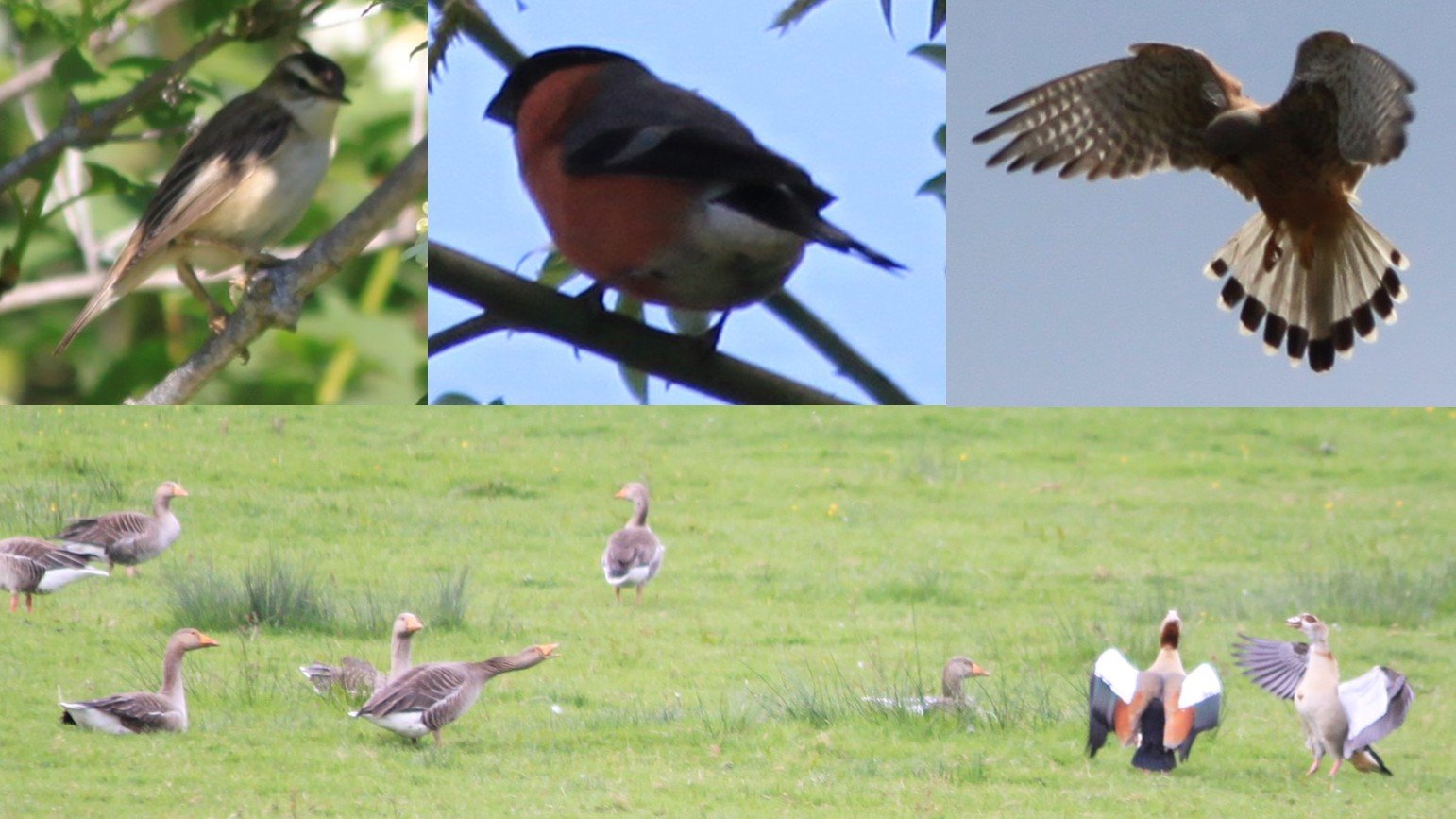
Caption: mediocre bird photos taken on a trip to Fishlake Meadows Nature Reserve during May 2025. Top row, left to right: Sedge warbler Acrocephalus shoenobaenus, Bullfinch Pyrrhula pyrrhula, Common kestrel Falco tinninculus. Greylag goose Anser anser and Egyptian goose Alopochen aegyptiaca are having an altercation in the photo below. The Egyptian goose isn’t a goose at all, but a tadornine duck. Images: Darren Naish.
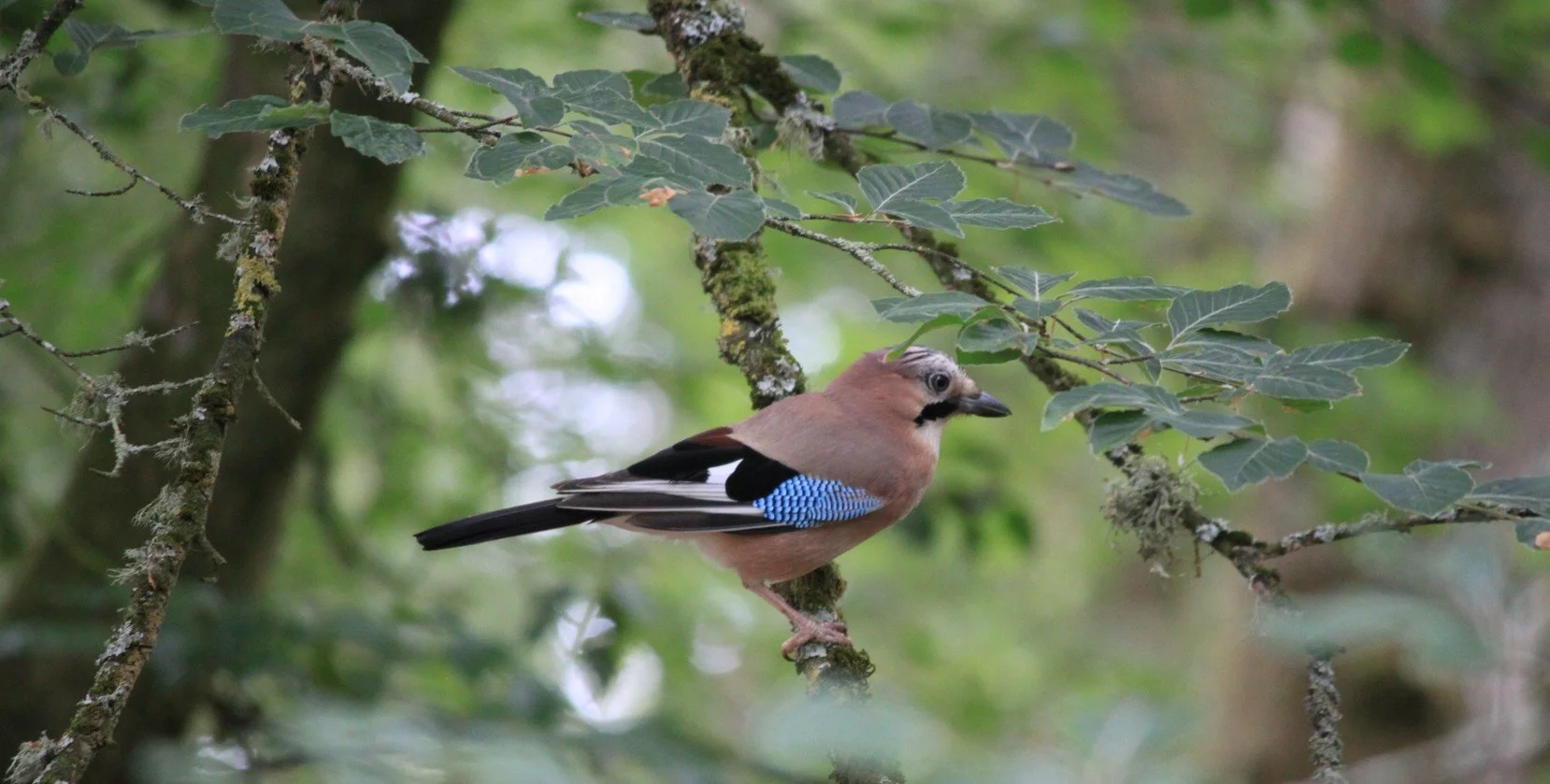
Caption: Eurasian jay Garrulus glandarius photographed in the New Forest during June 2025. Jays are on that list of bird species that were like mythical animals to me as a young person… animals that I knew from books but had no hope of ever seeing in real life. Today I see them on regular occasion and know that they’re findable wherever the habitat is right. Woodpeckers and nuthatches are also on that list. Image: Darren Naish.
More cryptozoology-relevant content was released in June when I participated in an interview for Barnaby Jones’s Monsters on the Edge podcast, the episode being titled ‘It’s a Dinosaurs World’. My main points will be familiar to those who’ve read my stuff: we covered the prehistoric survivor paradigm, claimed sightings of many-humped sea monsters and more. It’s here on YouTube.
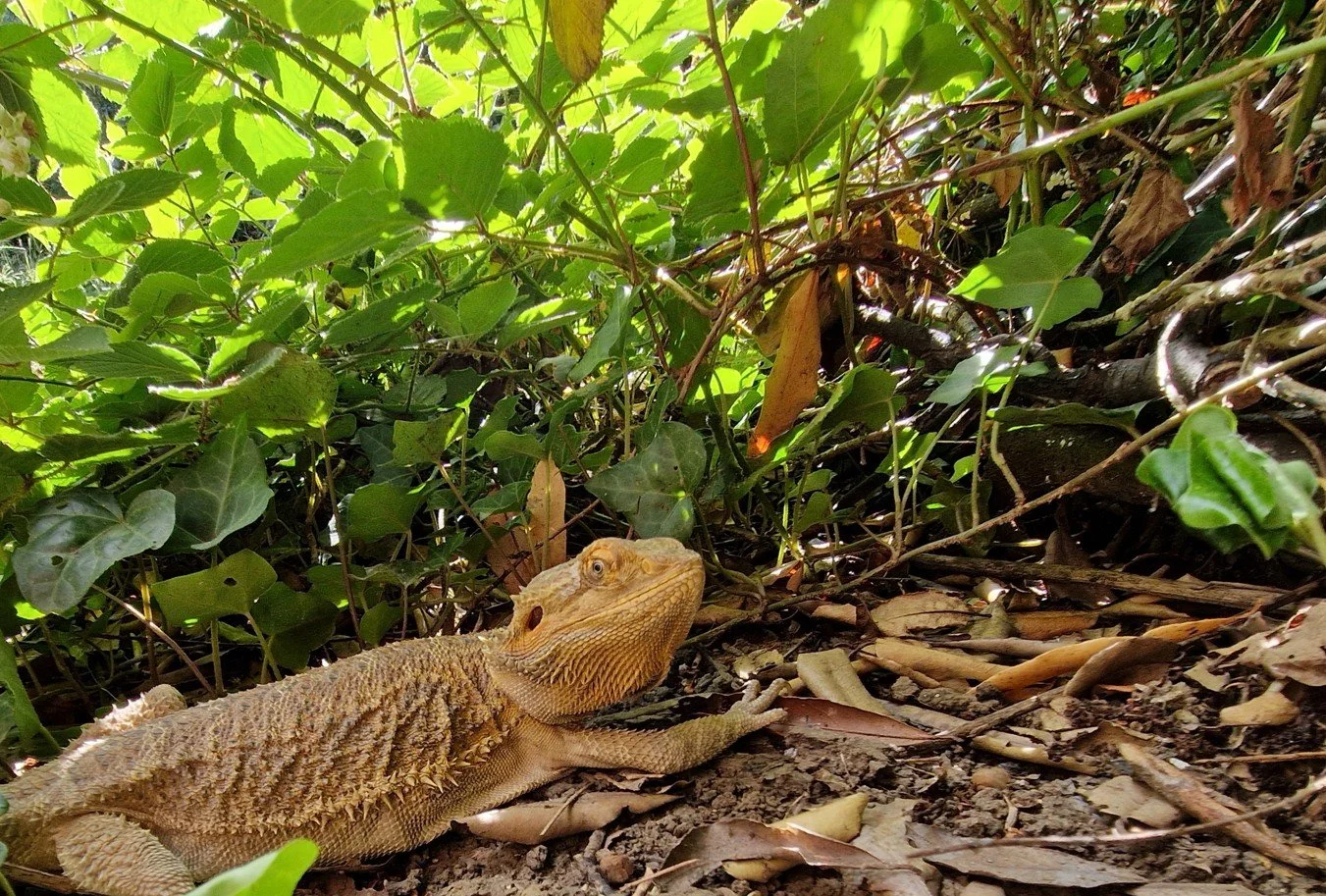
Caption: Flame the bearded dragon remains a prominent fixture of my domestic life, and I do what I can to give her interesting experiences and opportunities. Here she is among the undergrowth in our front garden during the summer. Image: Darren Naish.
The Lyme Regis Fossil Festival 2025. June’s big event, however, was the Lyme Regis Fossil Festival. As I’ve said on previous occasion, this has increased over recent years in size and complexity such that it’s now the UK’s premier palaeontology-themed event. There was a time when the Fossil Festival basically involved a single, small marquee, occupied by fossil dealers, and nothing else. Ok, there were a couple of evening social events but that was it. That contrasts massively with the situation of today: events span most of the length of the town, tens of vendors are present in giant marquees and various buildings, and numerous authors, scientists, artists, film-makers and others give talks and presentations.
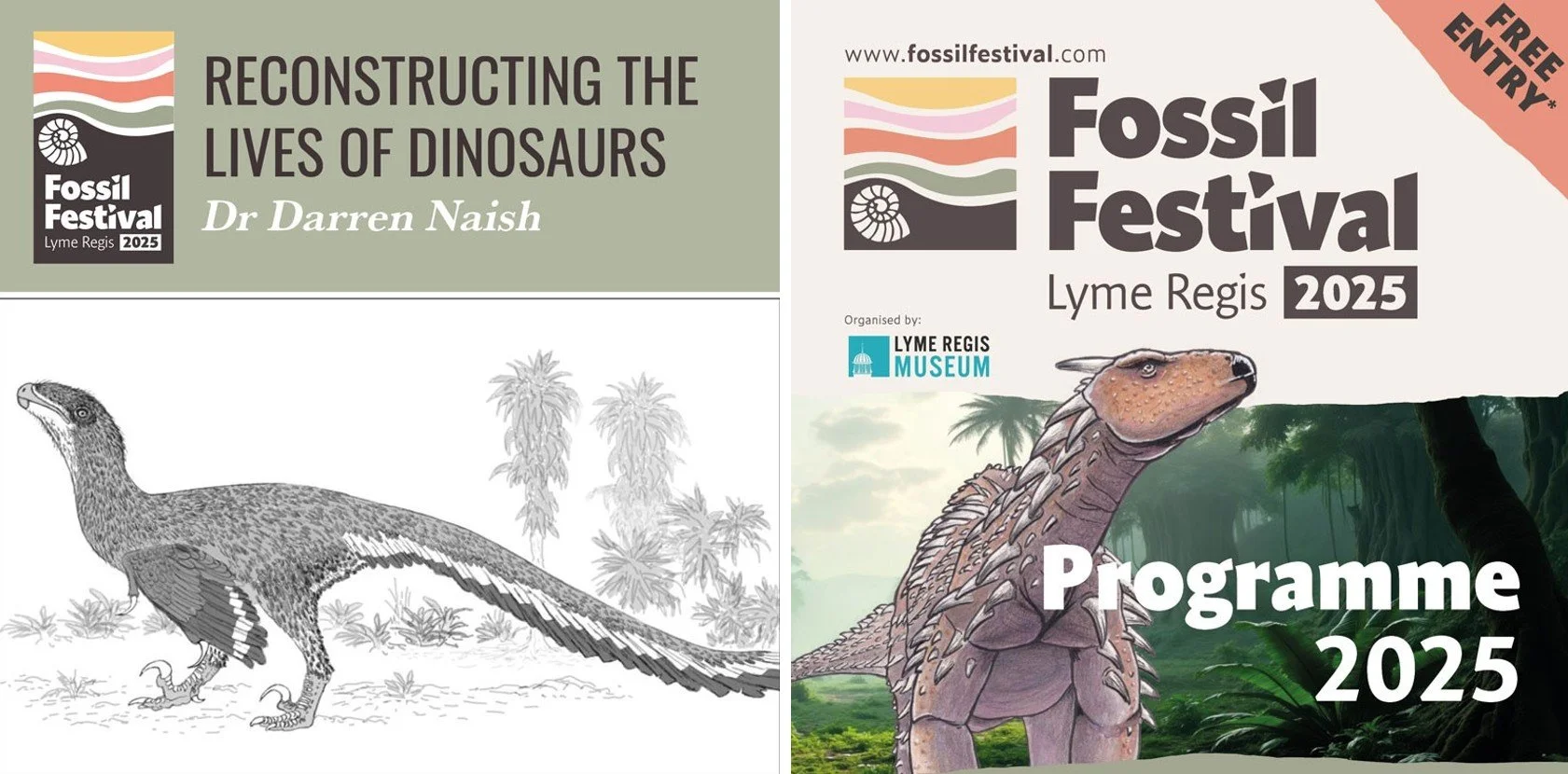
Caption: promotional imagery created for the 2025 Fossil Festival, featuring art by me (at left) and by Lee Brown (of leebrownpaleoart) at right. They have done such a great job of making this an enormous, and enormously fun, annual event.
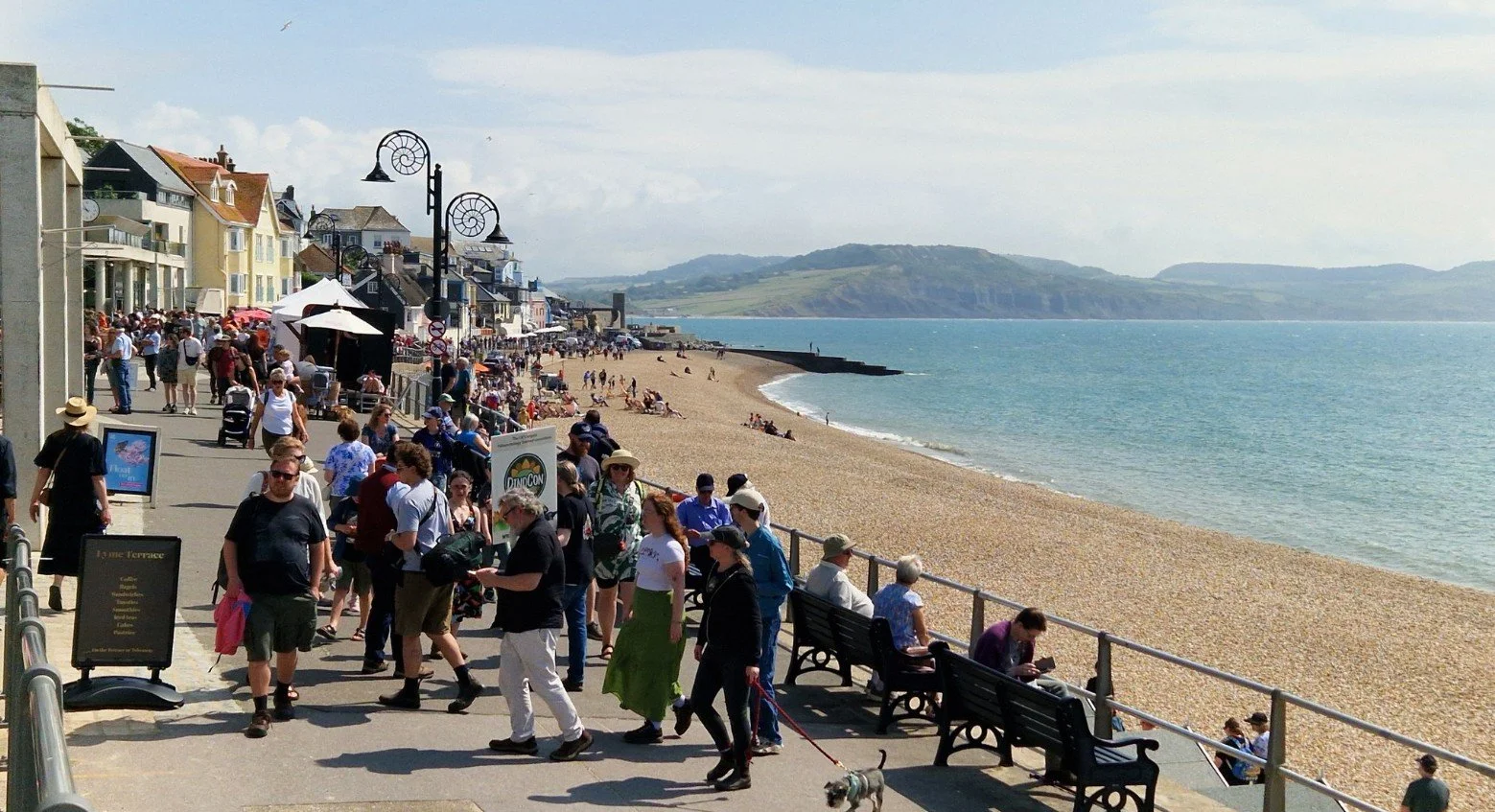
Caption: view of the Lyme Regis promenade, looking east, and giving some loose idea of the huge number of people that visit and attend during the course of the weekend. You should be able to see Nathan and a DinoCon sign in the middle of the image. Image: Darren Naish.
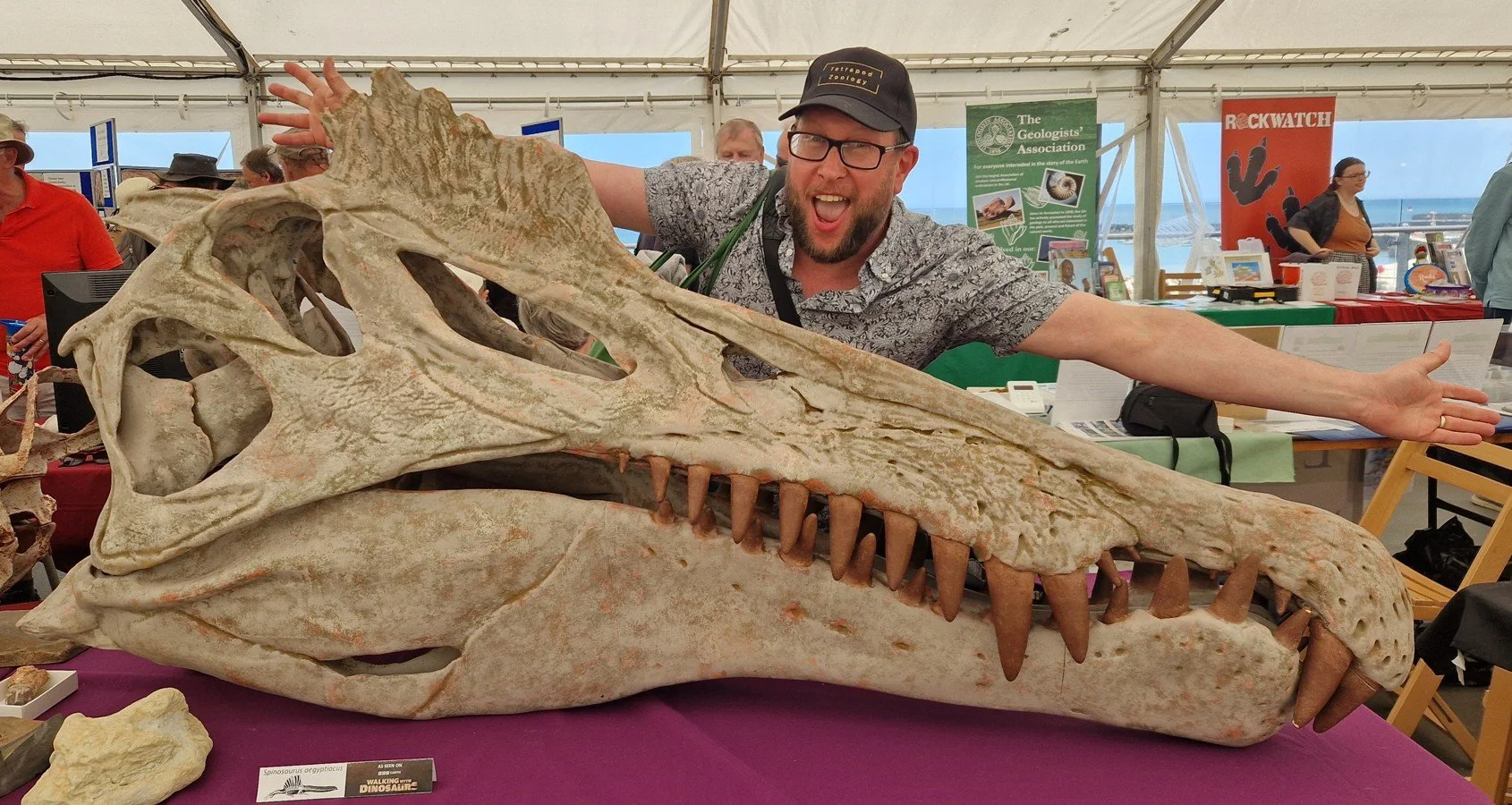
Caption: oh dear; me being subtle and low-key in demonstrating enthusiasm for Spinosaurus. This replica skull was brought to the Fossil Festival by the University of Portsmouth team. Note the little promo card for the Spinosaurus-themed episode of Walking With Dinosaurs 2025.
I gave my Dinopedia-related dinosaur talk again (‘Reconstructing the Lives of Dinosaurs’) but my efforts to sell books were thwarted by my phone and SumUp machine refusing to talk to each other. I’ve learnt from this mistake and now only use the SumUp phone app. The Fossil Festival was the ideal event for DinoCon promotion, so Nathan, Annie, Mike and I (the core DinoCon team) handed out leaflets, waved placards about and spoke to potential stall-holders.
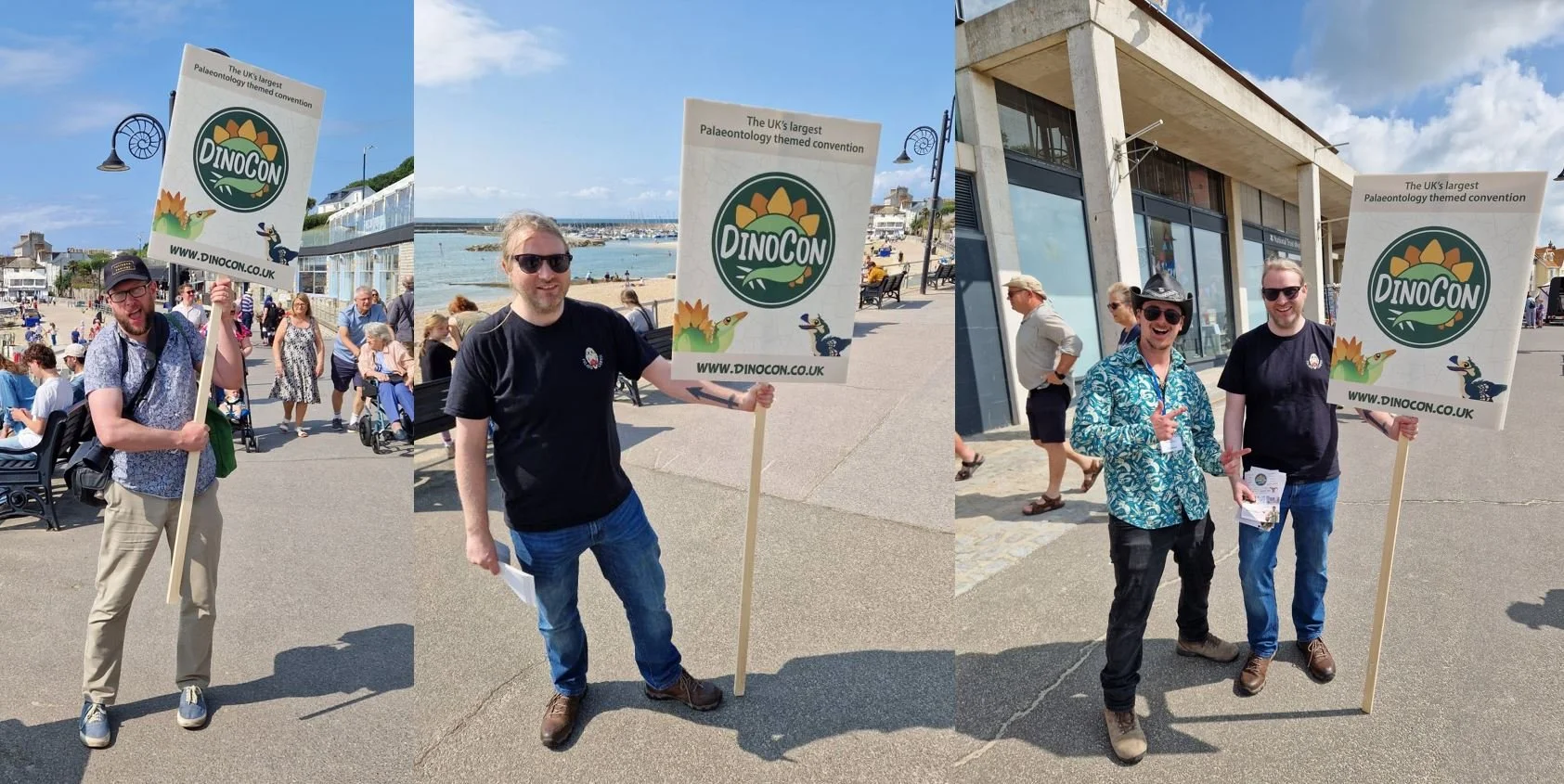
Caption: Darren and Nathan holding the DinoCon placard, with (at far right) Lyme Regis palaeontologist and museum worker Kieran Satchell in attendance too.
In London, I finally made time to look at the palaeontological garden at the Natural History Museum (NHM). My main reason for visiting was to catch up with Steve Zhao at Sandbox VR, since a job I had from early in the year concerned consultation for the brand-new Age of Dinosaurs VR experience, created in partnership with the NHM and due to go live in early 2026. I also travelled to Worthing to talk to the West Sussex Geological Society about dinosaurs and sell copies of Dinopedia again, and met up at the Grant Museum of Zoology with Michael Mills (aka Professor Flint). In late June, Natalia Jagielska and I spoke about Natalia’s section in Mesozoic Art II in an open-to-everyone zoom event. The book wasn’t officially out until September but I and others had received our copies by then.
Caption: the Sandbox VR immersive experience Age of Dinosaurs goes live in early 2026. We've done what we can to make it technically right, but it's tremendous fun too and we can't wait for you to see it. We’re pleased to have the support of NHM London in promotion. Image: (c) Sandbox VR.
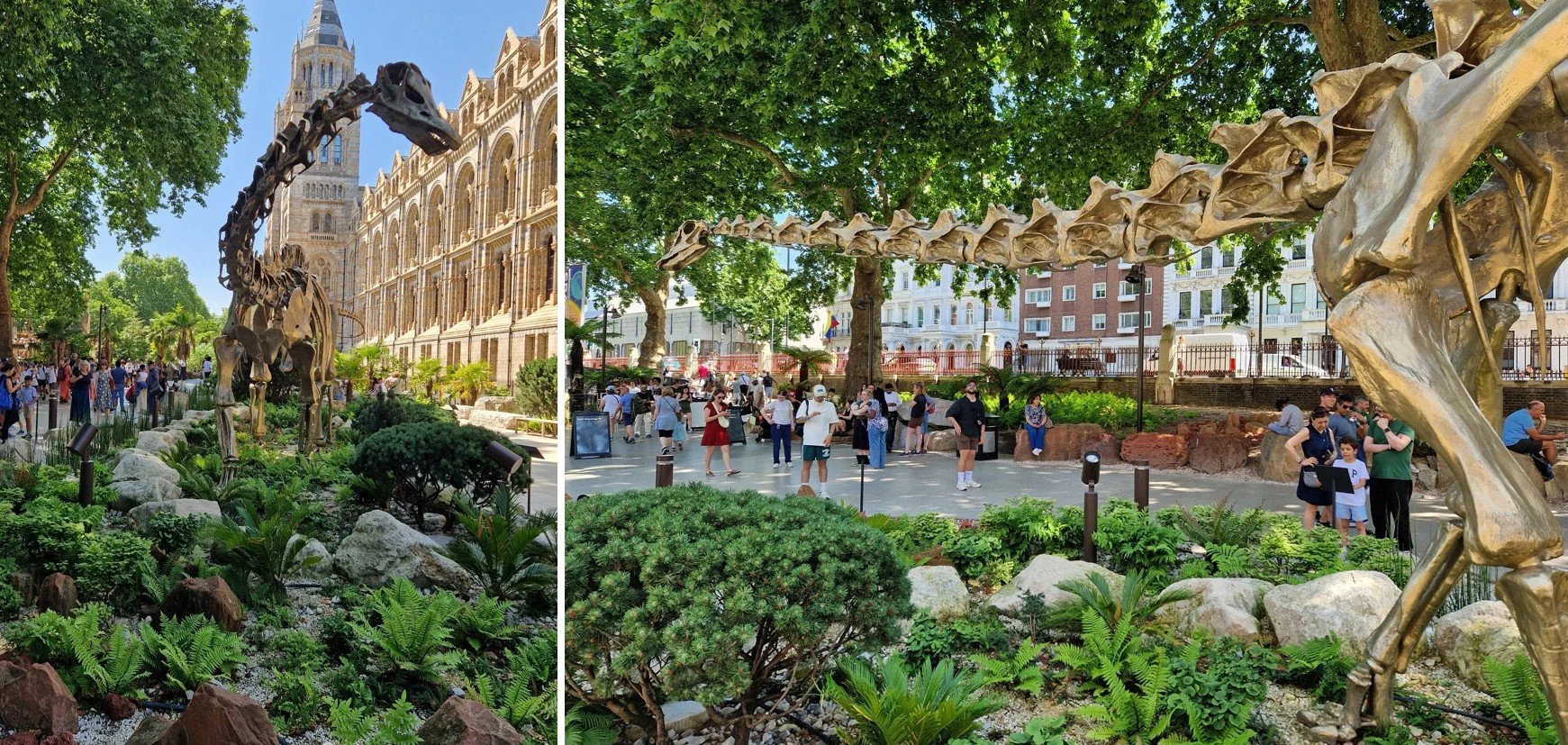
Caption: Fern the bronze Diplodocus, on show in the gardens at NHM London, is a beautiful and spectacular thing. The gardens as a whole are a great addition to what’s already one of London’s best visitor attractions. Images: Darren Naish.
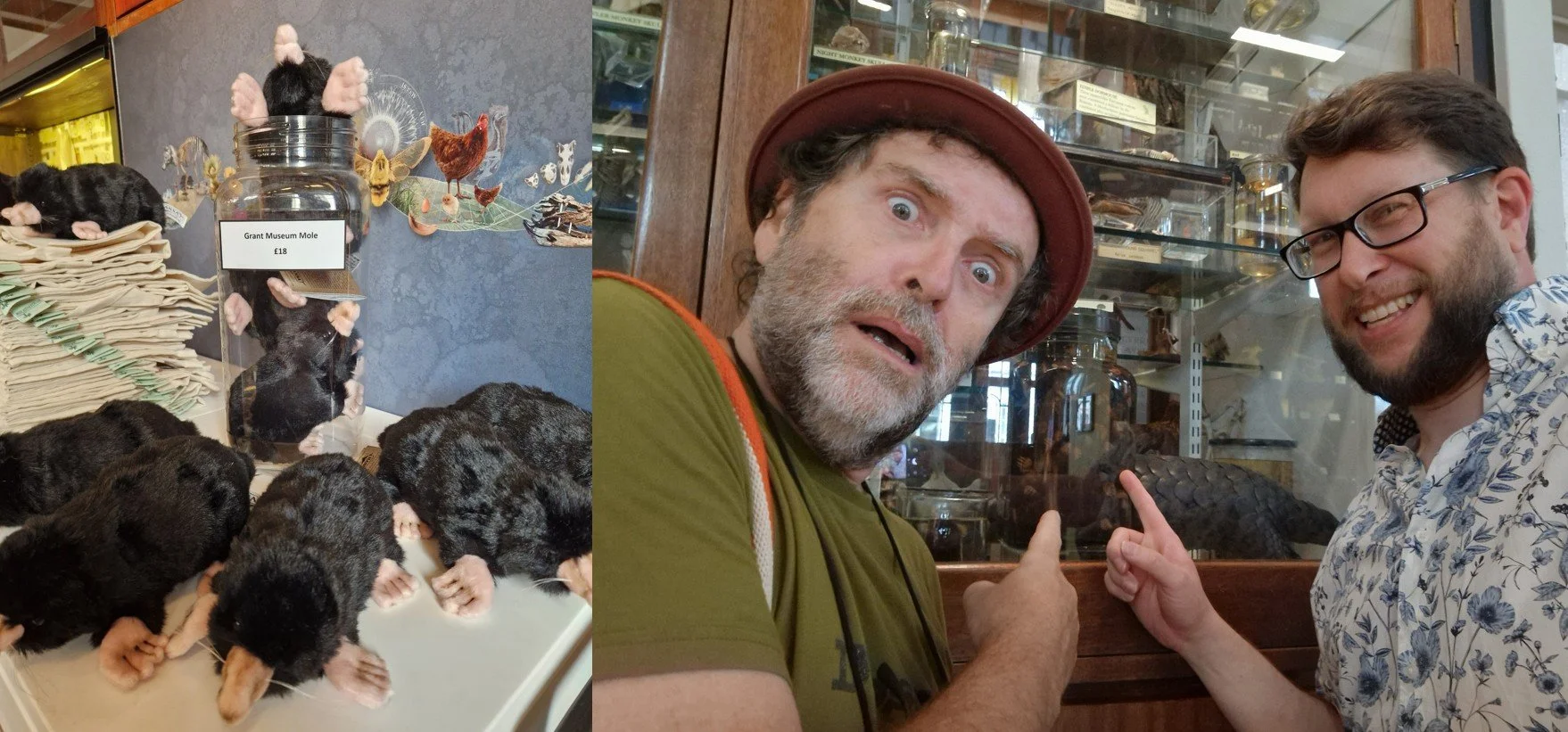
Caption: the Grant Museum in London is notable for many things, but one of them is its jar of moles. It’s so famous that the museum sells cuddly moles and a ‘moles in a jar’ badge. At right, myself and Mike Mills with said famous far. Images: Darren Naish.
A diversion on Jurassic World Rebirth. A weird thing happened at the start of July when Toni (my wife) and I attended, by invitation, a Jurassic World Rebirth event at The Barbican in London. The event itself wasn’t great, basically a series of team tasks that had only the flimsiest of connections to the movie and its animals, but I much enjoyed exploring the Barbican Conservatory, a huge tropical house surrounded by brutalist architecture. Getting to meet the brilliant Dolores Aquilops puppet was a highlight, as was my first look at the new toys released to accompany the movie. They’re pretty fun, even if they have nothing to do with science or real Mesozoic animals at this point.
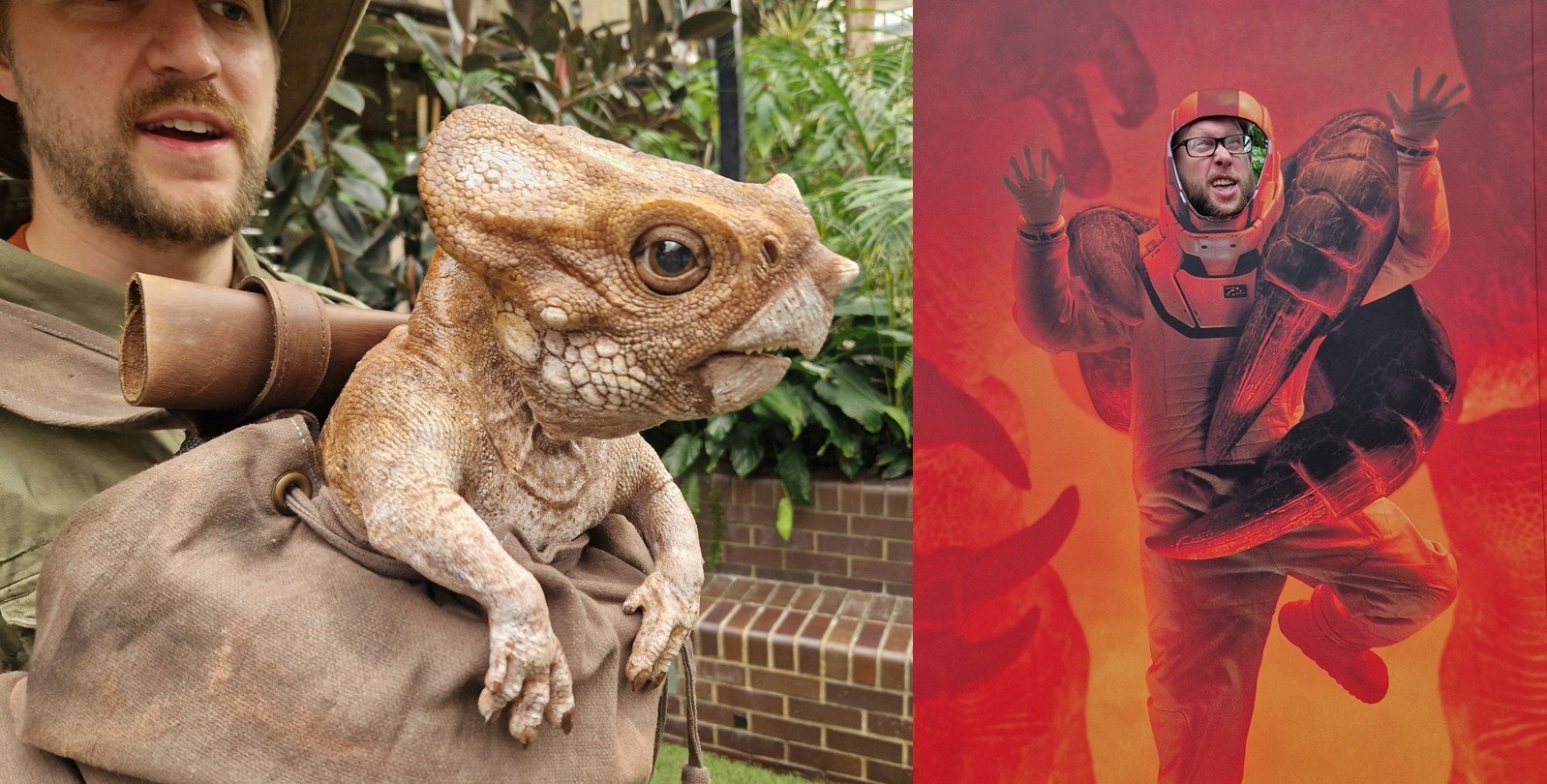
Caption: the brilliant Delores puppet at left, with human companion too. At right, my efforts to form an affectionate bond with a rancor monster didn’t end well, I guess I need to cut down on the snickers bars. Images: Darren Naish; Toni Naish.
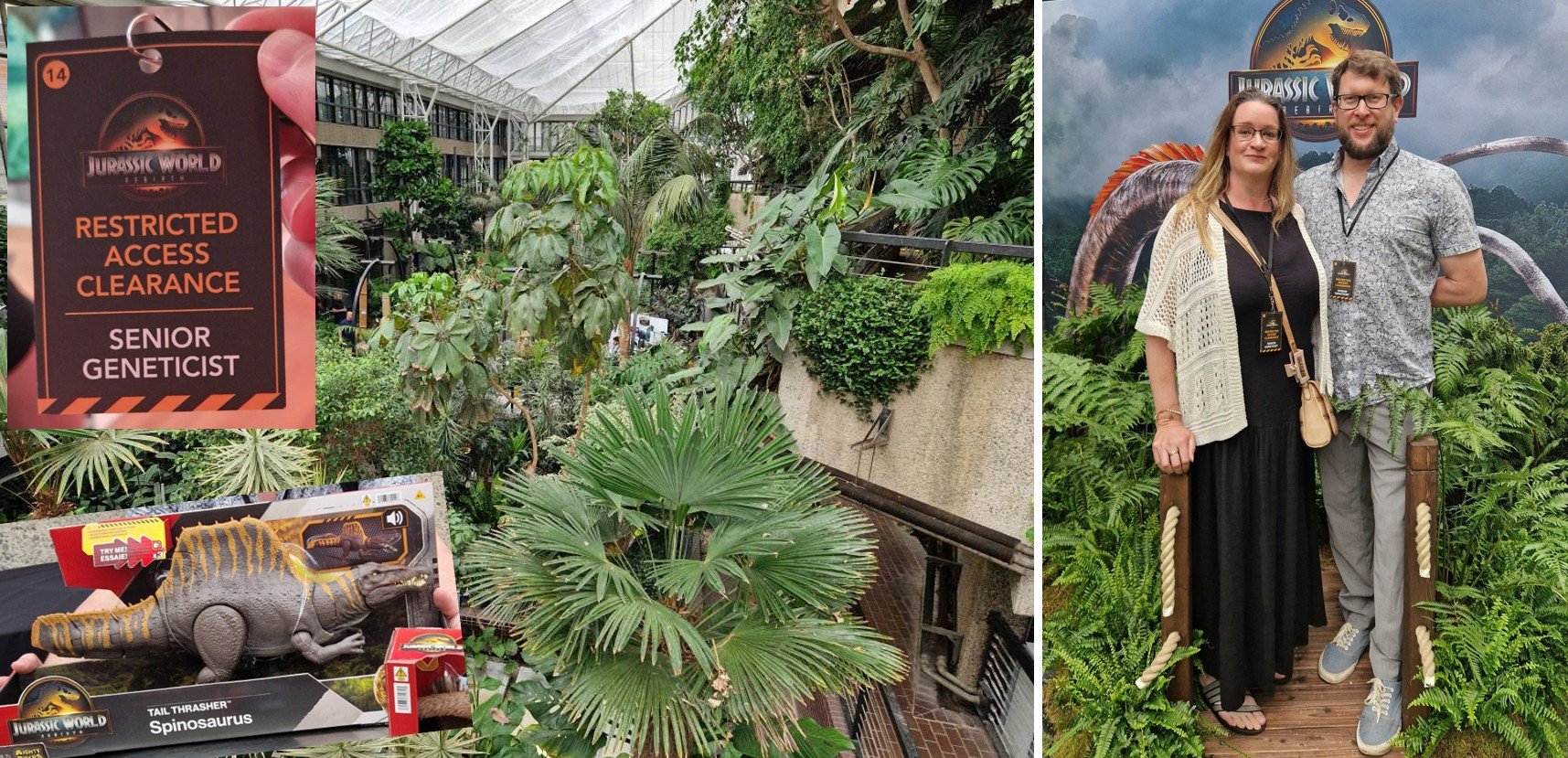
Caption: scenes from the Jurassic World Rebirth event at the Barbican. I was later to obtain one of those tail-thrashing Spinosaurus figures for myself (a 2025 birthday present). Images: Darren Naish.
Jurassic World Rebirth includes a sequence showing a T. rex swimming, itself based on content from the book Jurassic Park (and planned for a time to be included in Jurassic Park the original film). Season 1 of the Apple TV series Prehistoric Planet also featured a swimming T. rex, this one most certainly not connected to Jurassic Park but merely to the fact that animals of all sorts are good swimmers (I can say “most certainly” because Paul Stewart and I devised this sequence during the making of the series). A consequence is that a few articles on the ‘Could T. rex really swim?’ issue appeared… one of which involved input from myself. This is interesting for people who haven’t thought about this idea before, but familiar in view of previous discussions on dinosaur behaviour.
Big Event Number 1: Discovering Dinosaurs at Lightroom London, King’s Cross. And so we come to the first of 2025’s Big Events, namely the July 7th opening of the Discovering Dinosaurs show at Lightroom London. Lightroom is an immersive visitor attraction, somewhat like a planetarium but where you enter a giant square exhibition space and experience a movie-length show as visuals and film is projected on the walls (and floor) around you.
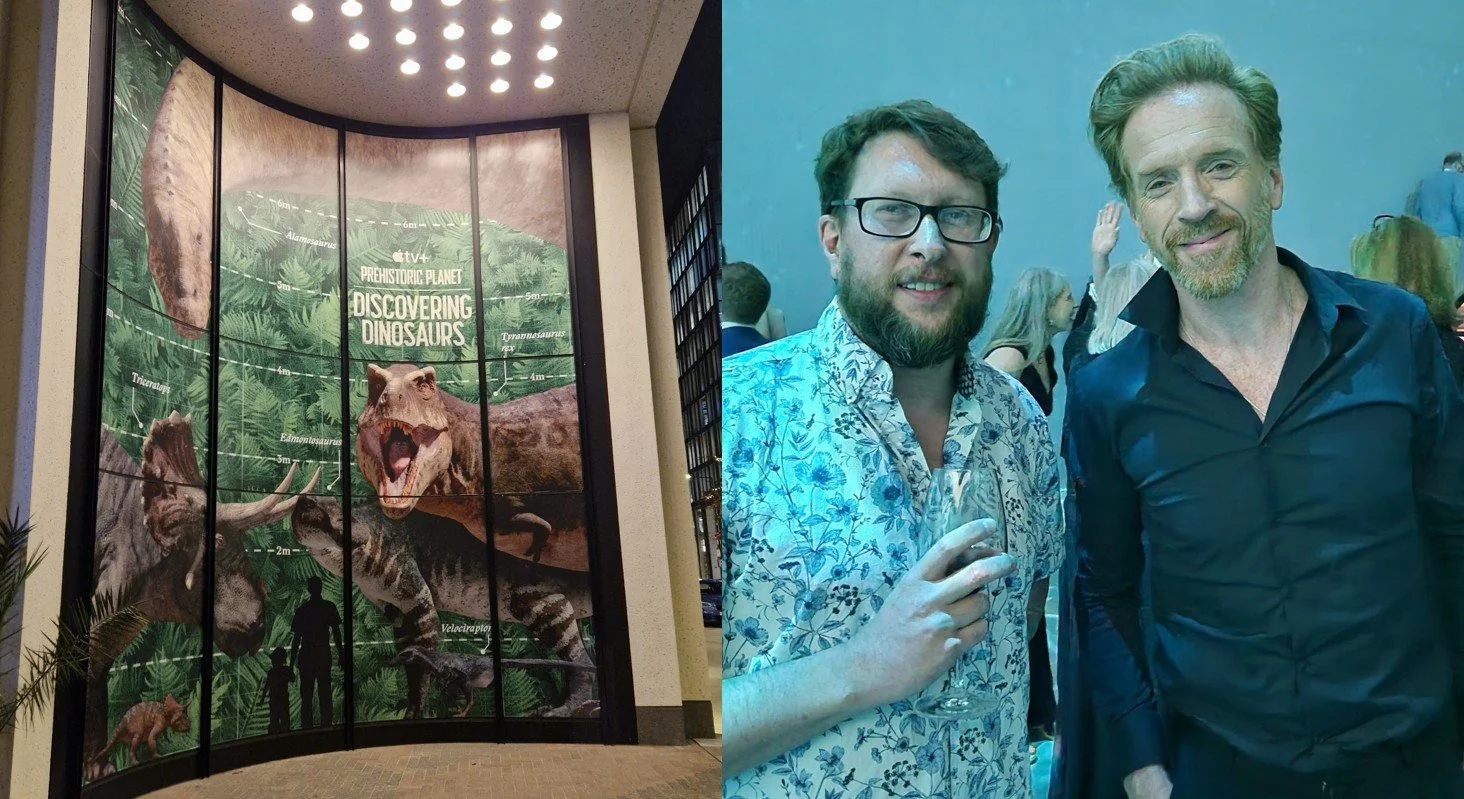
Caption: Lightroom London gives you more than one opportunity to see the Prehistoric Planet dinosaurs at life-size, both outside (as here) and as part of the event. At right, me with actor Damien Lewis, the show’s narrator. Damien was one of several celebs at the opening event in July. Billie Piper was there too but I didn’t talk to her. Images: Darren Naish; Mary Gunton.
When I joined the team in April, Lightroom was showing Moonwalkers, an event devoted to lunar discovery and exploration narrated by Tom Hanks. I was blown away by the trouble the team had gone to in obtaining visuals, info and segments of film, and oh boy did it deliver in terms of immersion. Well, a similarly grand and immersive event was constructed for Discovering Dinosaurs, the whole thing being a spin-off of the Apple TV / BBC Studios show Prehistoric Planet.
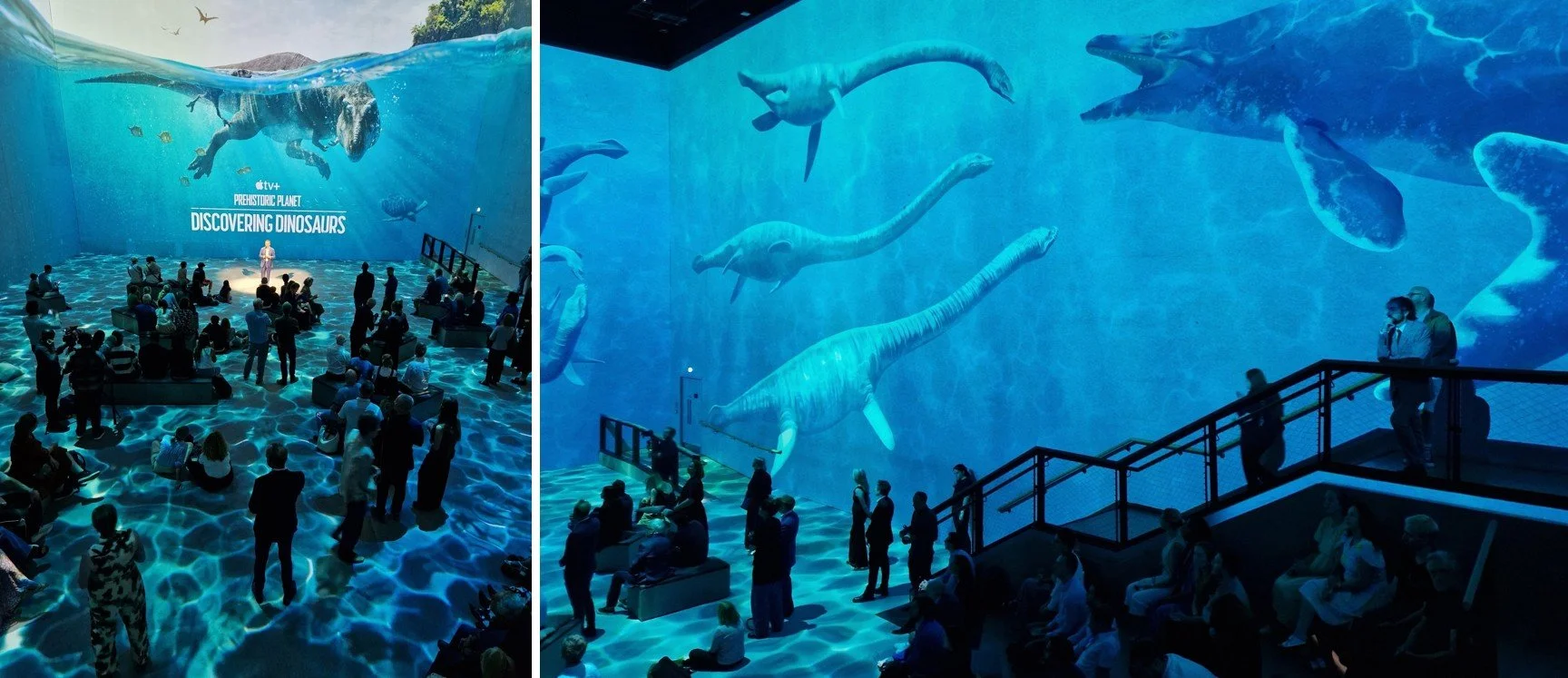
Caption: scenes from one of several Lightroom London events I went to, these from July 2025. The show features scenes and stories from Prehistoric Planet seasons 1 and 2 but a large quantity of novel material was produced specially for it, including entirely new sequences and fantastic art. Images: Darren Naish.
If you have any interest in being surrounded by life-sized dinosaurs (and Cretaceous marine reptiles and pterosaurs) in a brilliant and educational event, or if you’re a Prehistoric Planet super-fan, you just have to visit. Involvement with Discovering Dinosaurs occurred throughout 2025 and I’m thrilled with how it turned out. The Discovering Dinosaurs official brochure features an article I wrote (Naish 2025c).
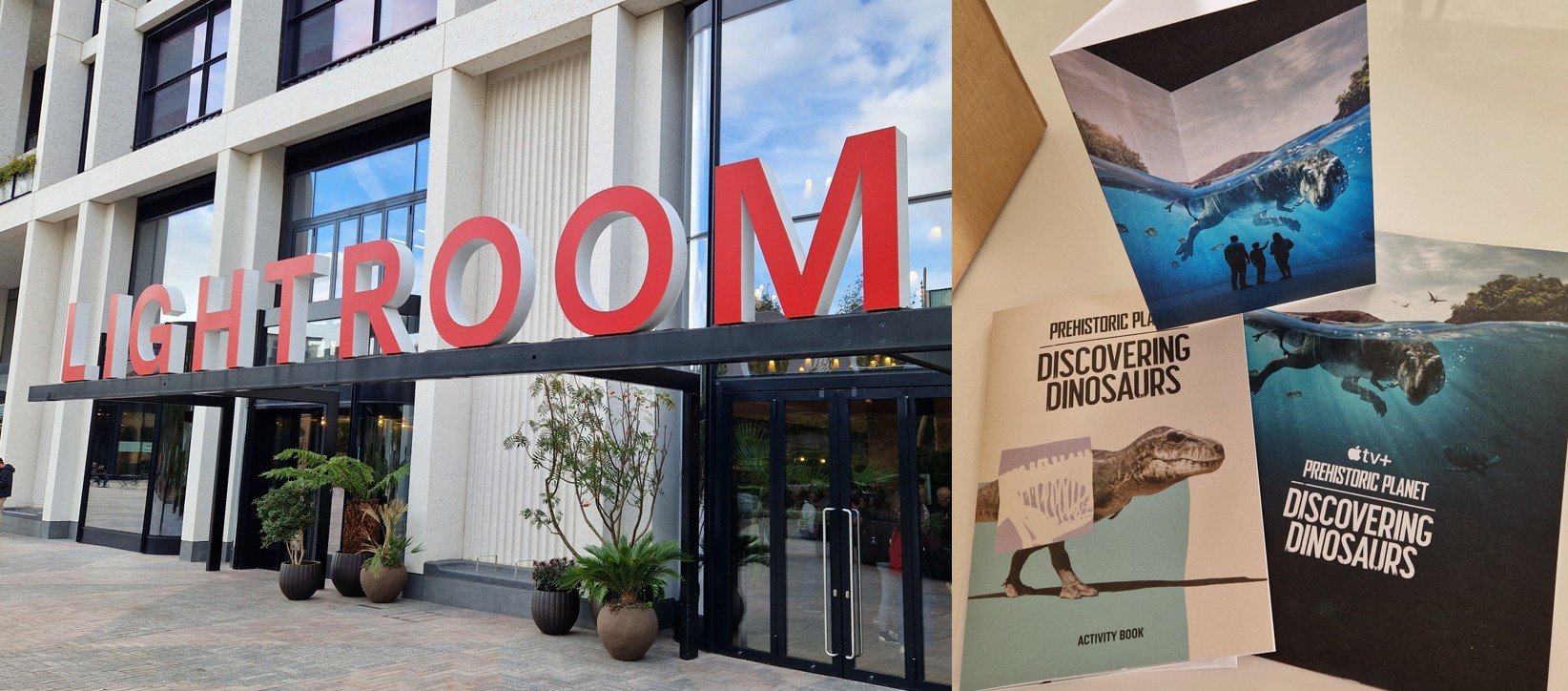
Caption: the Lightroom London entrance at Lewis Cubitt Square, King’s Cross. At right, literature that accompanies the event. Learnt about Lightroom London and Discovering Dinosaurs at their website here. Images: Darren Naish.
Cetaceans, tapejarids, sea reptiles. I participated in another ORCA sea safari across the Bay of Biscay in July. As ever, we saw a good amount of wildlife, cetaceans and seabirds in particular. For a detailed account see the Tet Zoo article here. The discovery of phytoliths in a Cretaceous tapejarid pterosaur was a big deal for those of us interested in pterosaur biology and I covered it at Tet Zoo during July 2025, in part because some of the commentary echoed points I made in an unpublished article I wrote on this group back in 2010.
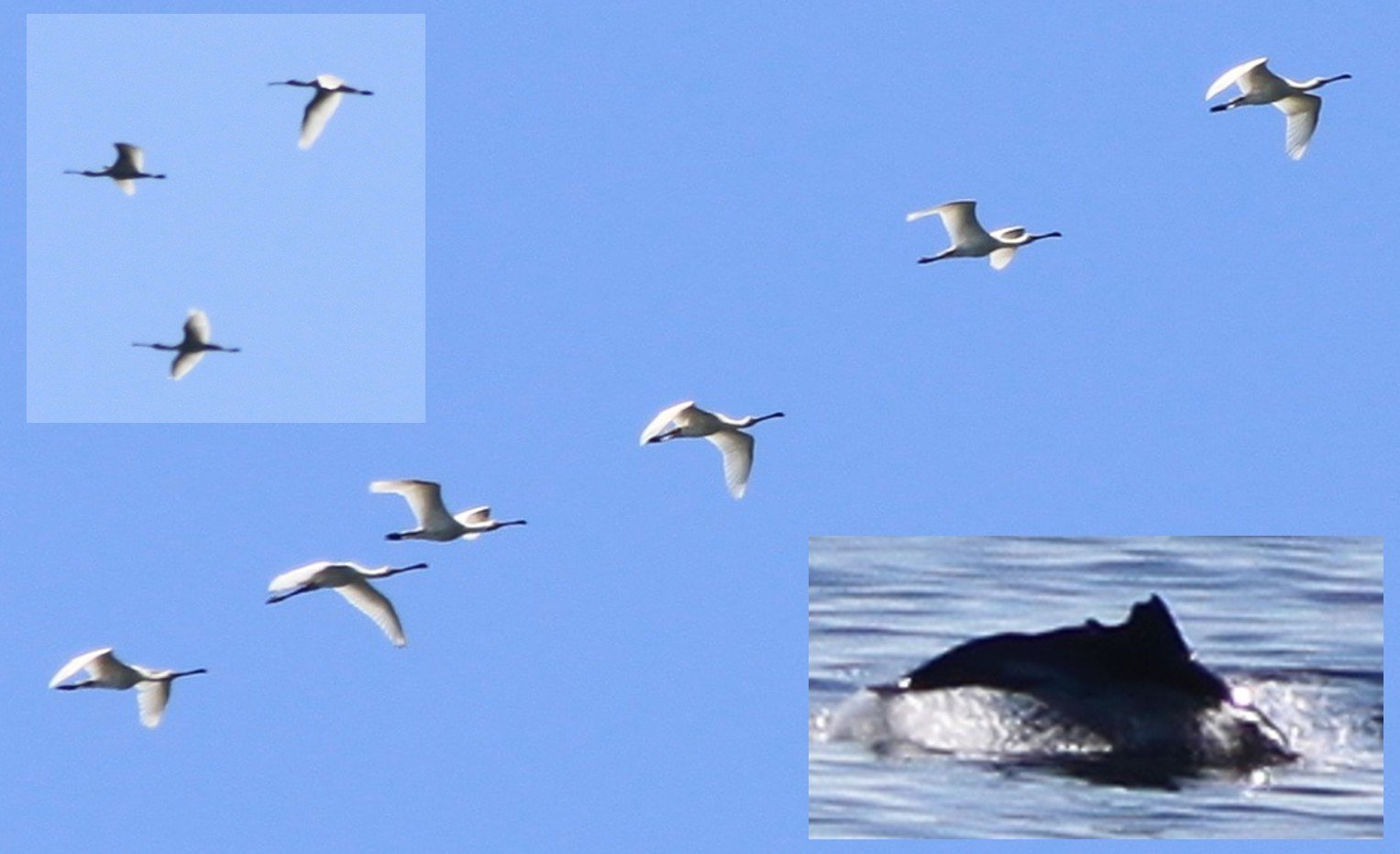
Caption: the ORCA sea safaris are all about cetaceans, of course. But we see other animals too, and here are a number of Eurasian spoonbills Platalea leucorodia seen near the Spanish coast, and a poor photo of a tuna hunting out at sea. Images: Darren Naish.
The Japanese language edition of Ancient Sea Reptiles appeared in late July, the first non-English version to see print. I’ve said before what a big personal deal it is when I see versions of my books published in other languages: the sad fact is that this is something that authors have zero control over. You basically wait for publishers in other countries to approach your own publisher. Japan always comes through on this front, and I admire the Japanese here not just for their interest in the science but also in the attention to detail with respect to design.
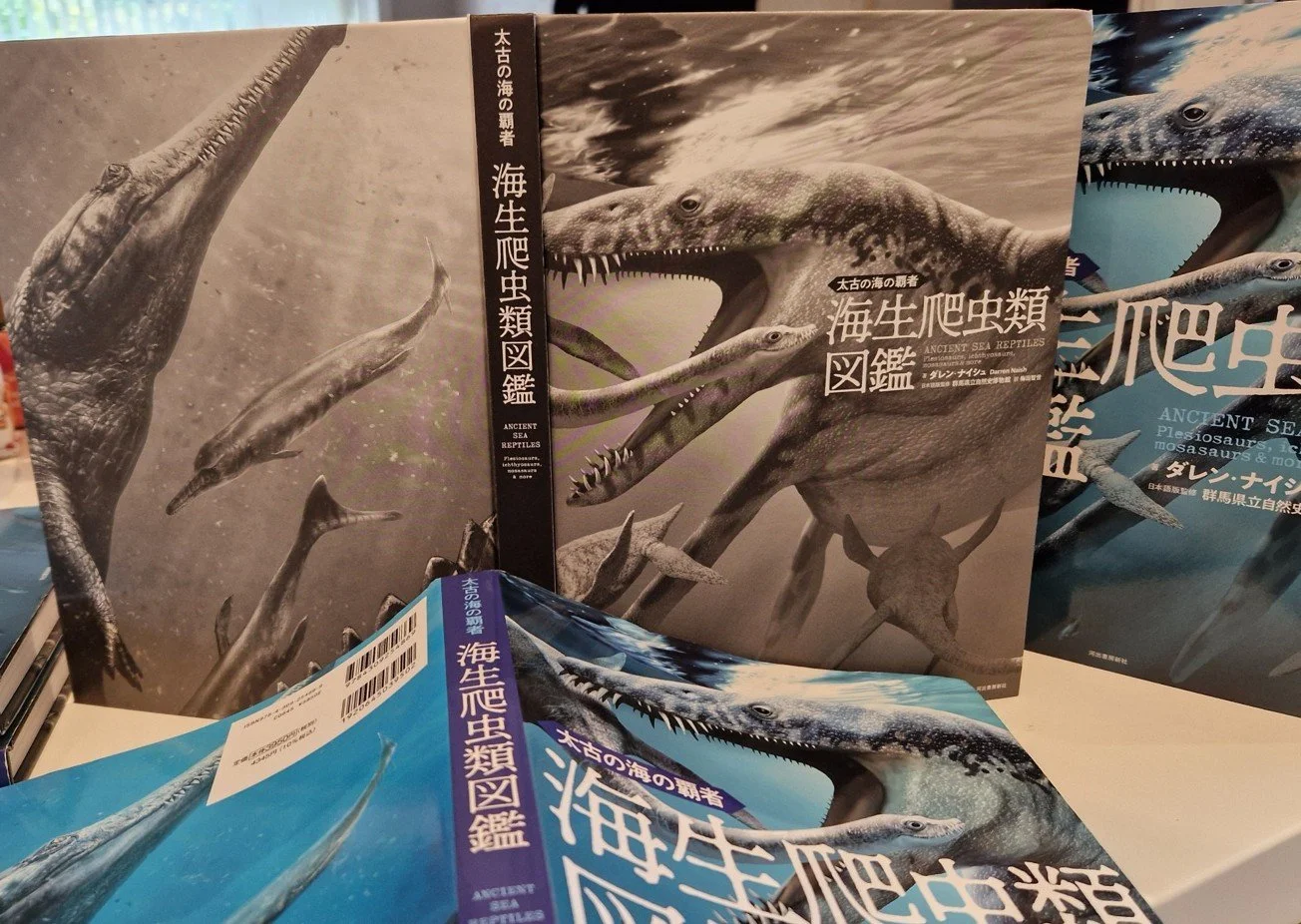
Caption: the 2025, Japanese edition of my Ancient Sea Reptiles. The fact that art appears on the hardboards beneath the dustjacket is a great feature. The art here is by Jaime Chirinos (the plesiosaur-themed image) and Davide Bonadonna (the thalattosuchian-themed image). Image: Darren Naish.
A cluster of events occurred at the end of July. Apple TV announced, at last, the existence of a third season of Prehistoric Planet, one devoted to the Pleistocene. Tet Zoo ver 4 – the version you’re visiting now – celebrated its seventh birthday on July 31st, this being a mini-introspective of adventures in these here parts. And I appeared as a guest on another podcast, this time Things Visible and Invisible. It was pitched as a general discussion of cryptozoology and (when released in September) was titled ‘Can Science Explain Legendary Creatures?’. It’s here at YouTube.
At The New Dinosaurs book launch. August started with my attending the launch of the second, 2025 edition of Dougal Dixon’s The New Dinosaurs, hosted at Waterstones at Gower Street, London. Dougal spoke about the book’s backstory and contents with Ross MacFarlane, a research development specialist at the Wellcome Collection. Several people interested in both dinosaurs and SpecZoo attended and here’s where I learnt that models depicting various creatures from TND and other Dixonian projects were in exist and soon to be on sale.
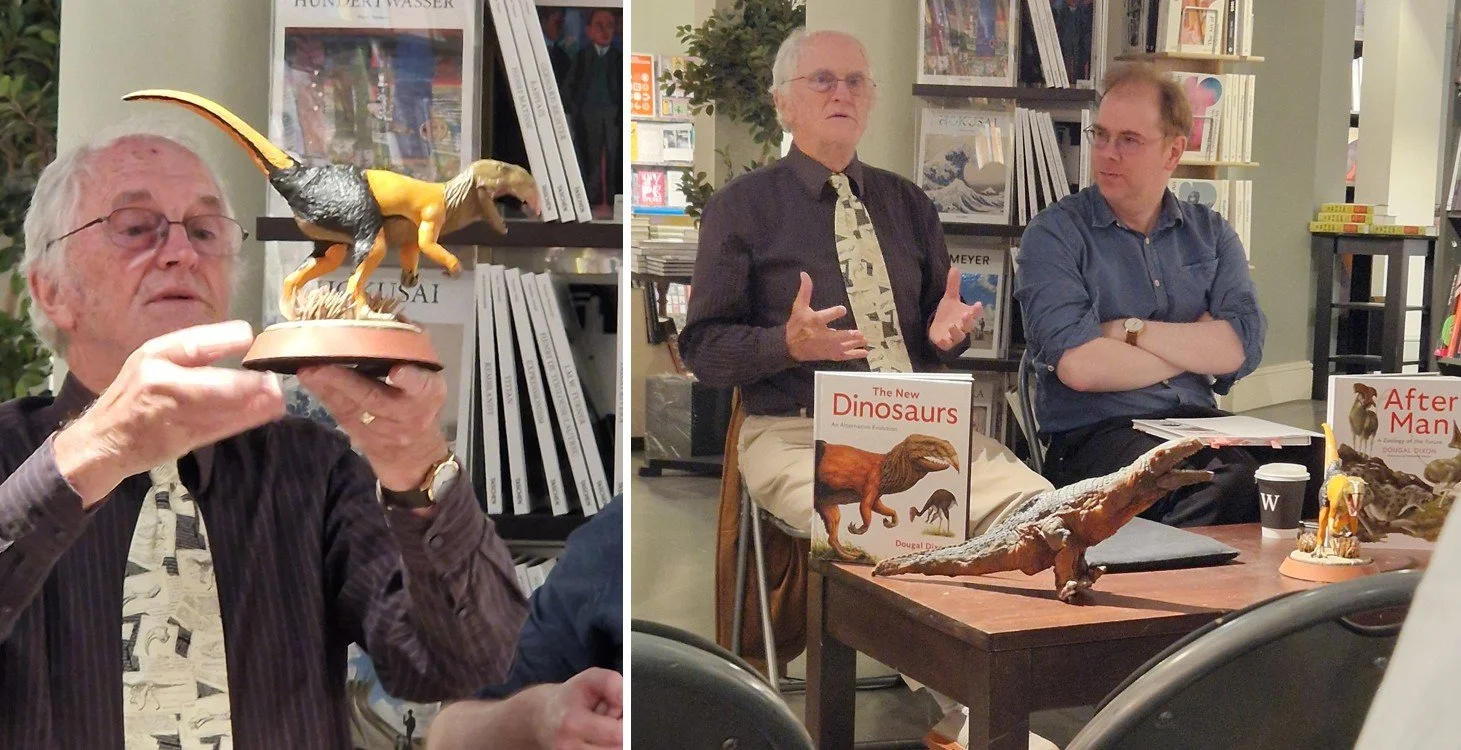
Caption: scenes from the August 2005 launch of the second edition of Dougal Dixon’s The New Dinosaurs at Gower Street, London. The Cutlasstooth model was made by EXEtinct. The gentleman leading the event with Dougal is Ross MacFarlane of the Wellcome Collection. Images: Darren Naish.
My review of Graham Weedon and Sandra Chapman’s 2022 book Ichthyosaurs From the Early Jurassic of Britain was published in Historical Biology (Naish 2025d).
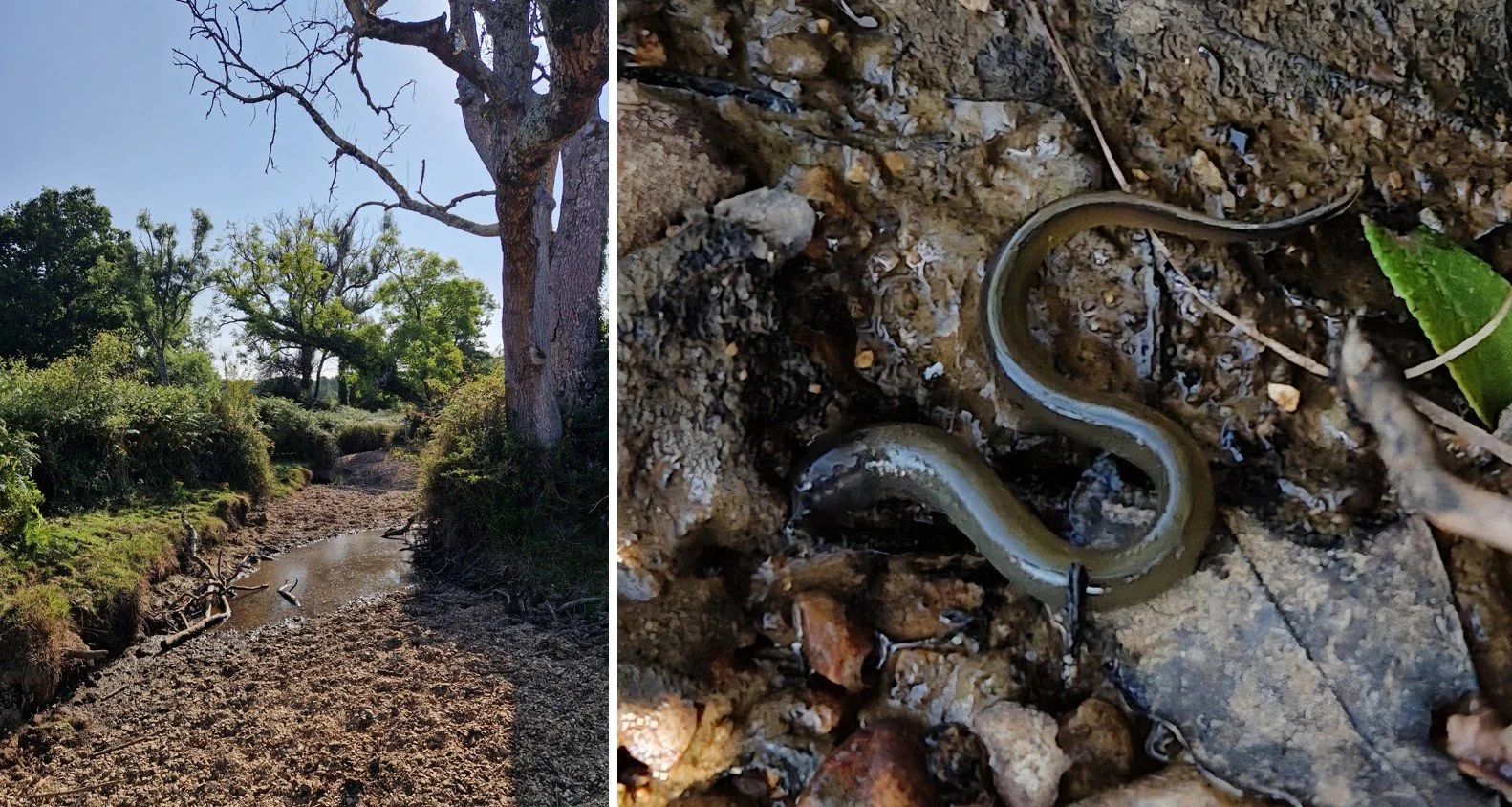
Caption: an August 2025 trip to the New Forest, during which deer, birds and Viviparous lizards Zootoca vivipara were seen. But the most surprising wildlife observation? At the edge of a pool (a drying tributary of Mill Lawn Brook), I saw a small, eel-like fish. I thought it was an elver but it wasn't translucent, and the obvious eye, dark dorsum, and gill slits show that it was a European brook lamprey Lampetra planeri. It was tiny, only about 6 cm long. Images: Darren Naish.
Big Event Number 2: DinoCon 2025. A big part of my life over the past 11-ish years has been the running of a big, London-based zoology convention – TetZooCon – that is itself a spinoff of this blog. As mentioned above, TetZooCon came to an end in 2024 and plans for its descendant – DinoCon – were announced at the last TetZooCon. To cut straight to the chase, the first ever DinoCon happened at the University of Exeter during August, and it was a massive and heartening success. The publication of my write-up of what went down was delayed for a few months and didn’t appear until October: it’s here. It should be obvious that DinoCon 2025 went well enough that we’re doing it again, the 2026 meeting happening at Hilton Birmingham Metropole on July 25th and 26th. Tickets are due to go on sale very very soon, so keep an eye on our social media accounts and our website.
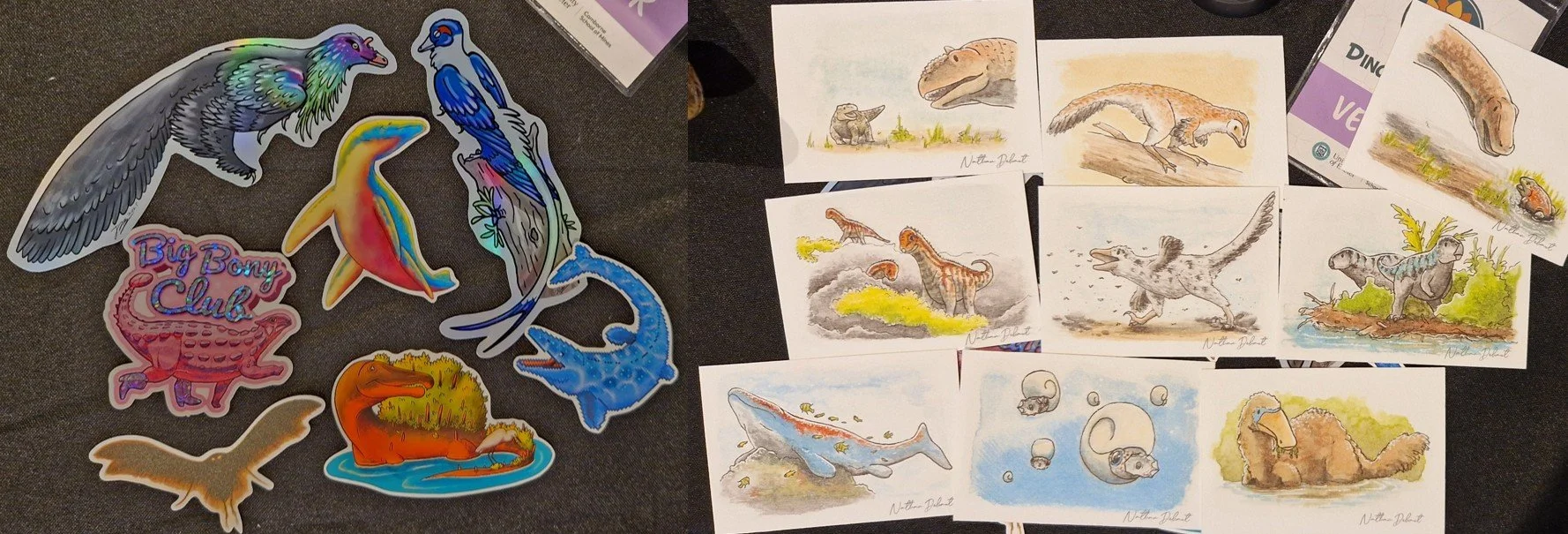
Caption: just a little of the Mesozoic-themed art I picked up at DinoCon 2025. An excellent range of stickers and miniature pieces of art. I hope you can see the ‘Big Bony Club’ ankylosaur sticker by Speed Thief (aka Sean Hennessy), a hit bit of merch. Image: Darren Naish.
Reviews of DinoCon 2025 appeared at Geek Ireland, SV-POW!, The Inquisitive Biologist, Furahan Biology And Allied Matters, EXEtinct, Raptormaniacs and other places too. Tom Fishenden created a brilliant video on the event which you can view here at YouTube.
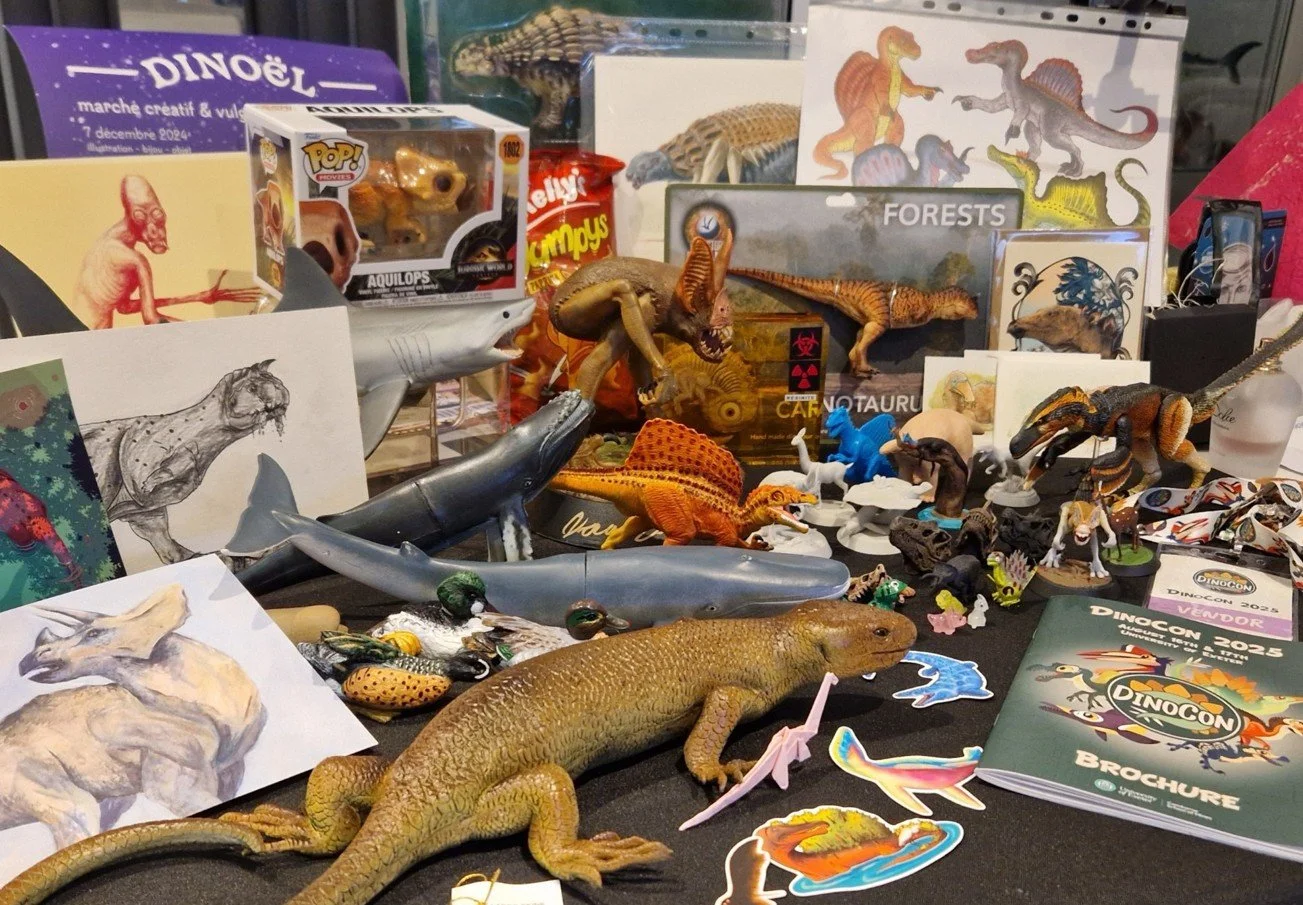
Caption: an anonymous person’s DinoCon 2025 haul. Look at all those sweet sweet acquisitions. Image: Darren Naish.
Snake Summer and Monsters of the Deep in Scotland. Regular readers will be aware of Monsters of the Deep (MotD), a museum exhibition I co-curated for the National Maritime Museum Cornwall at Falmouth, and which revolves around European myths about sea monsters and our scientific discovery of the deep sea. After finishing its run in Cornwall, MotD went to Chatham Historic Dockyard in Kent for 2023, but things there came to an end in November of that year. What next? Scotland! Yes, Scotland, specifically Aberdeen Art Gallery.
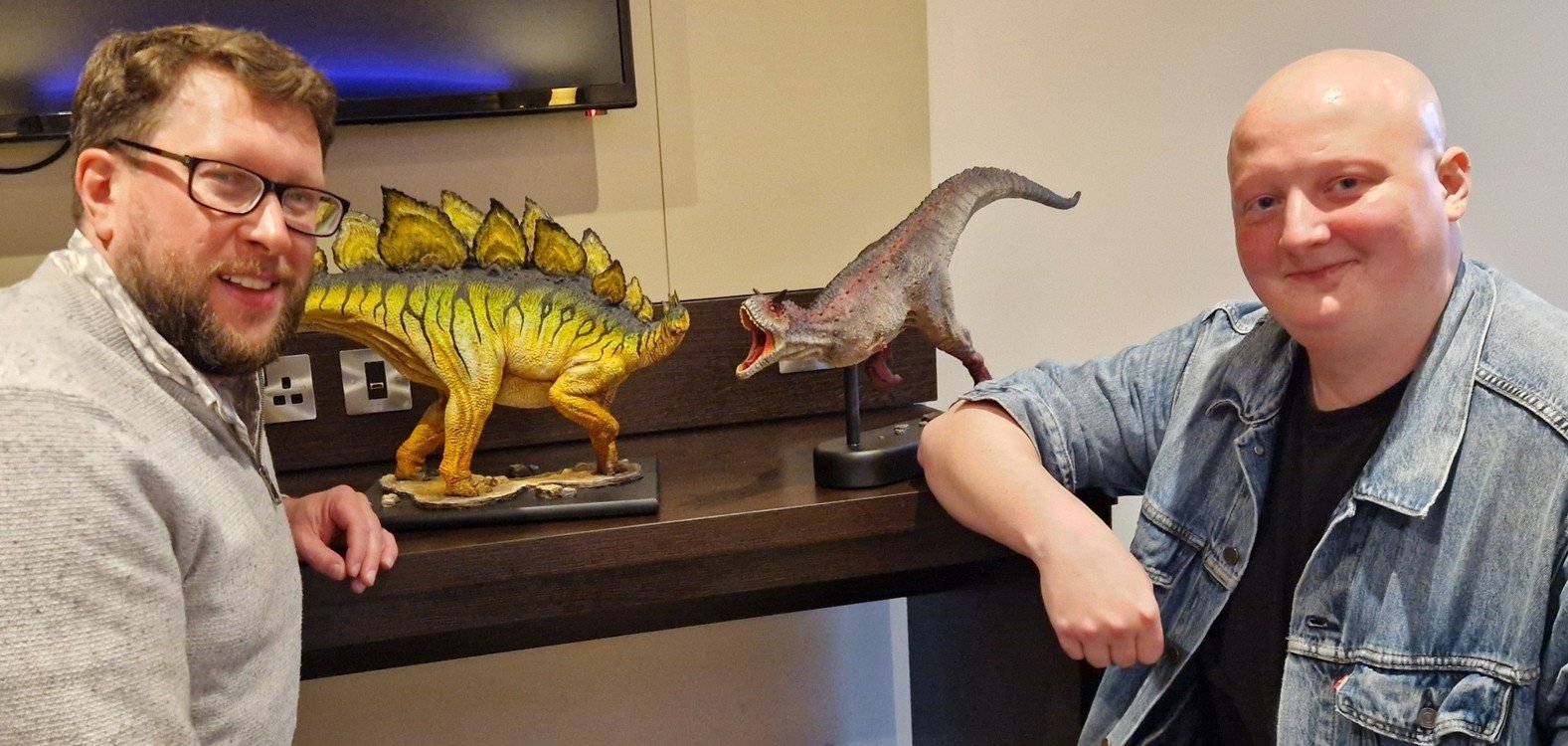
Caption: while in Glasgow, I met up with David Armsby (at right) and successfully obtained these amazing Stegosaurus and Carnotaurus models.
And thus, during late August and early September, I travelled about Scotland, my first stop being Glasgow city centre where I had errands to run. One was catching up with film-maker and artist David Armsby and here’s how I came to possess two of the giant dinosaur sculpts that David makes as part of his creative process. Words cannot convey how pleased I was to obtain these, but I knew that getting them north to Aberdeen and then aaaaall the way back south to Tet Zoo Towers – a distance of around 1100 km – would be quite the chore. I took big suitcases and a ton of packaging. Both survived the trip with no breakages except for a single hoof tip on the stegosaur.
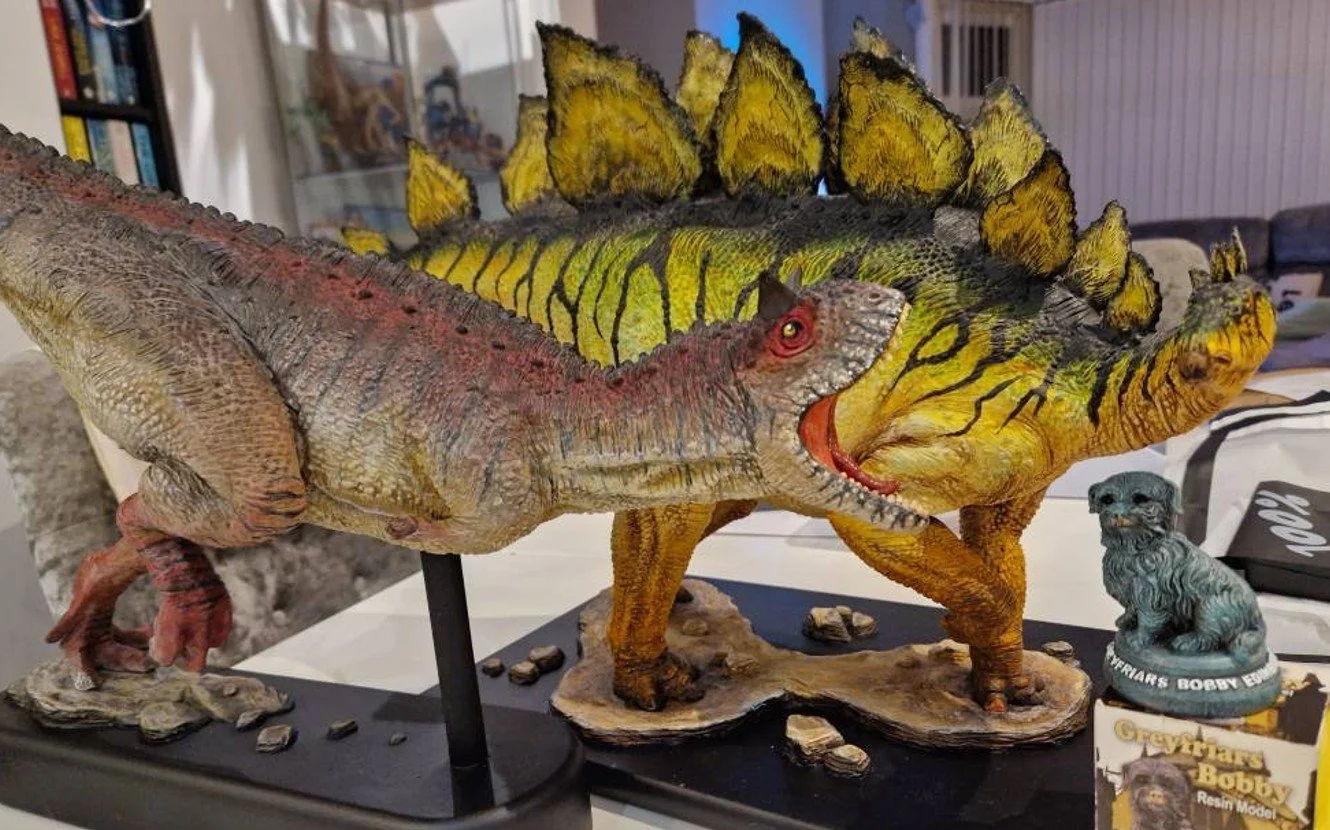
Caption: the Armsby Carnotaurus and Stegosaurus safe in their new home, Tet Zoo Towers. You might just be able to see the broken hoof on the left hand of the stegosaur (since repaired). I also picked up a Greyfriars Bobby model, because how could I not. The actual statue (which is in Edinburgh, not Glasgow) has been featured at Tet Zoo in the past. Image: Darren Naish.
At the Hunterian Zoology Museum, Glasgow, I attended the Snake Summer event organised by Will Tattersdill and Jordan Kisler, this occurring due to 2025 being Year of the Snake. The museum is also home to a famous alleged snake specimen, the holotype of Bothrodon pridii. I gave a talk linked to my Heuvelmans project and discussed giant snakes, cryptids like the African crowing crested cobra, and ultimately the Japanese tsuchinoko and winged and flying snakes. It’s incredible how many snake-themed myths and stories there are, a fact relating to the impact snakes have had on human culture and tradition. A write-up, summarising my thoughts on mythical and mystery snakes in general, was published in Fortean Times in December (Naish 2025e). Snake Summer explains why I republished my Crowing crested cobra article, first released at Tet Zoo back in 2011, here in September.
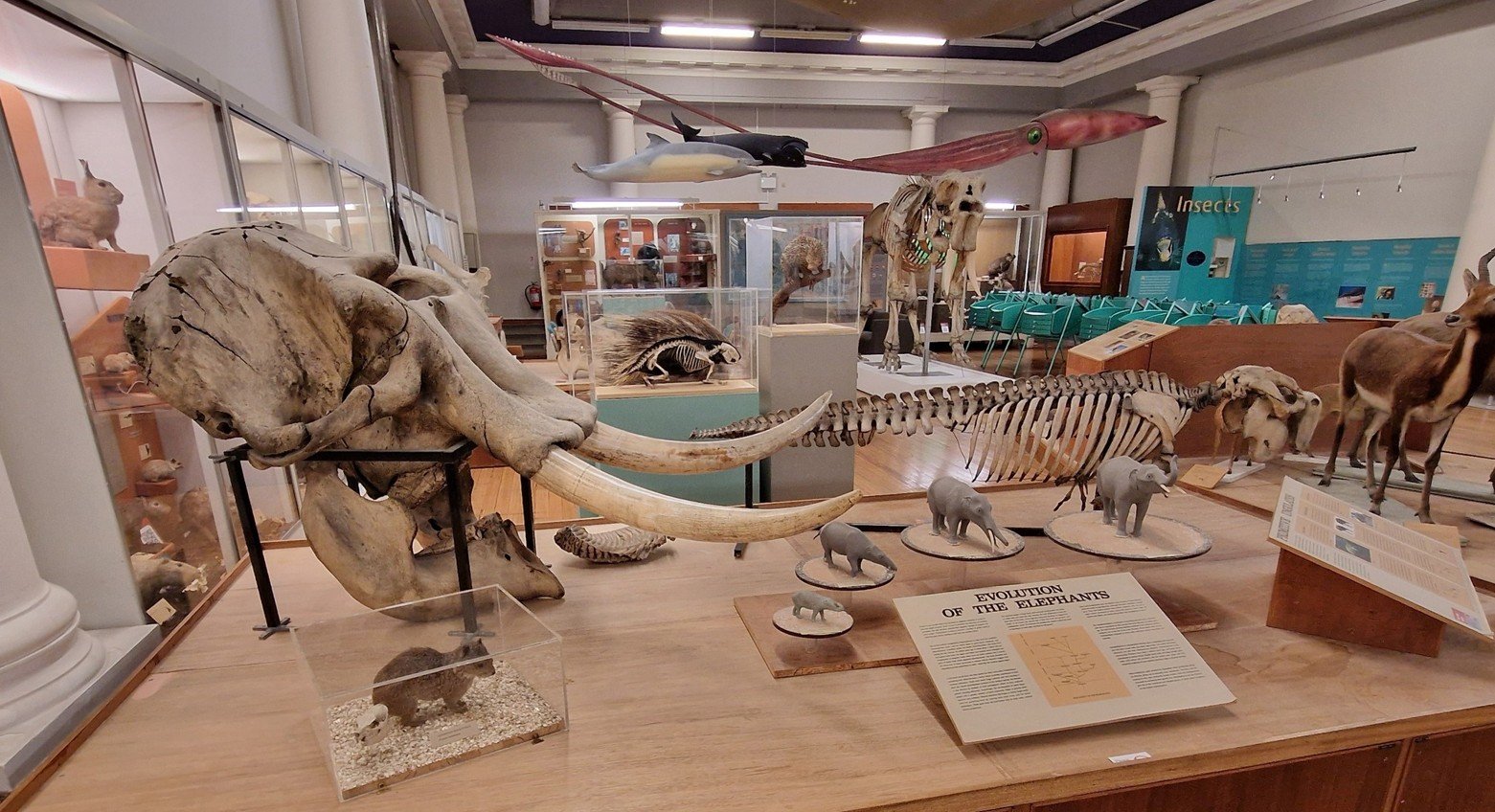
Caption: a view across the main hall of the Hunterian Zoology Museum, a trove of wonders. It includes notable and historically interesting arthropod, fish, reptile, bird and mammal specimens and owes its existence to the bequest of Dr William Hunter’s collection to the University of Glasgow in 1807. Image: Darren Naish.
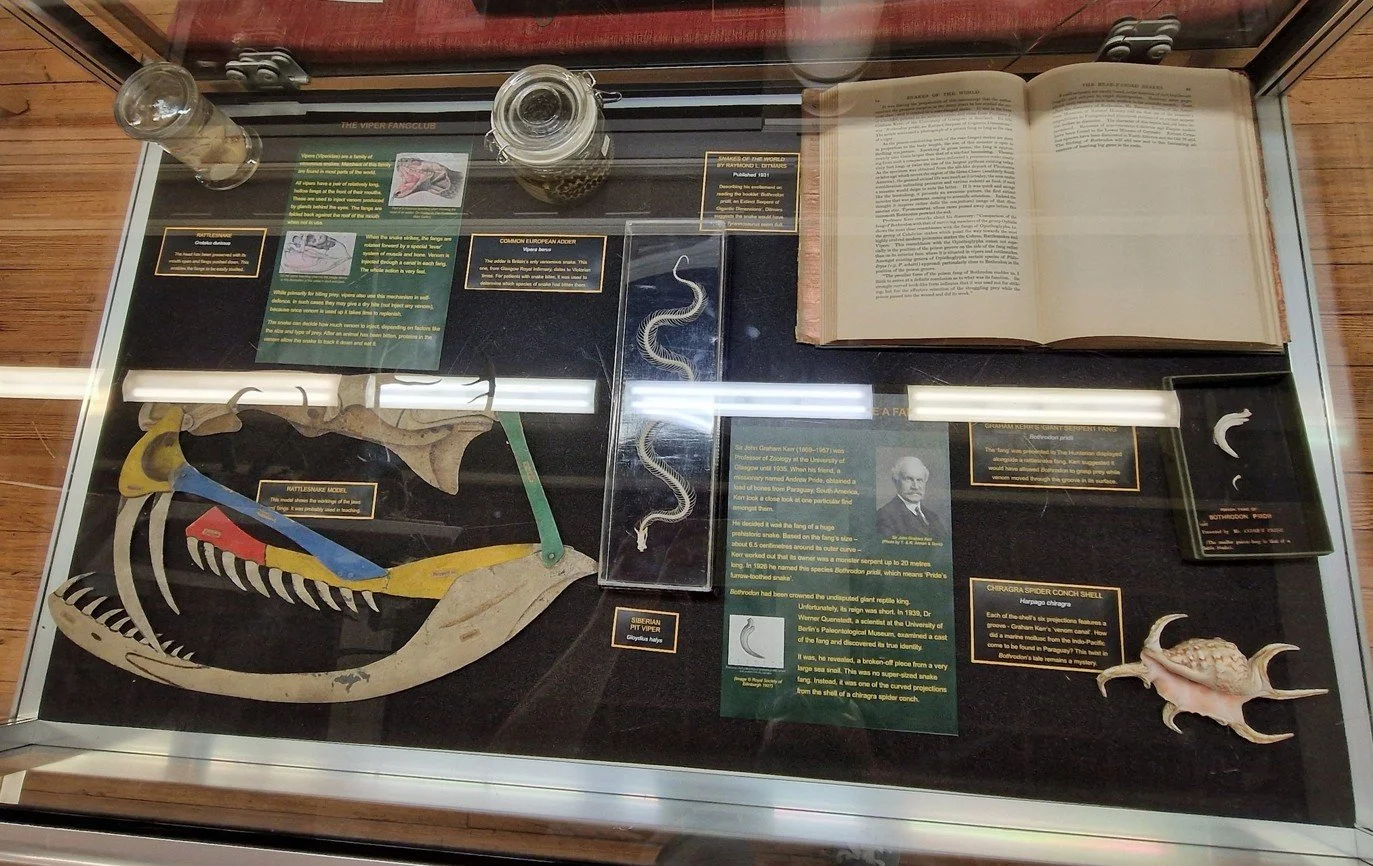
Caption: the Bothrodon pridii display cabinet at the Hunterian Zoology Museum. B. pridii was named by John Graham Kerr in 1926 for a giant fang 6.5 cm long, identified as that of back-fanged snake around 20 m long. You can see the specimen at middle right here. Alas, it turned out to be one of the finger-like outgrowths of a Chiragra spider conch Harpago chiragra. Image: Darren Naish.
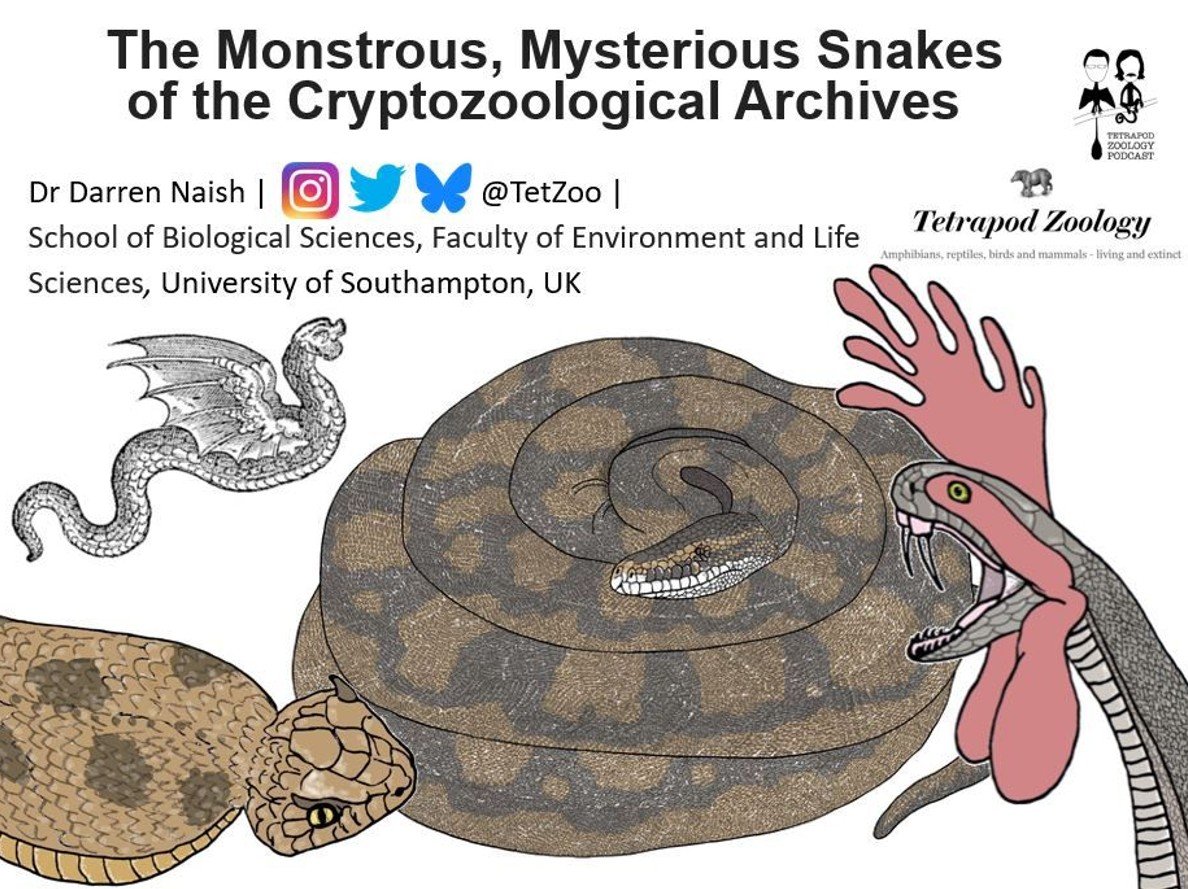
Caption: cover slide for my snakes talk, featuring several of the cryptids I’ve illustrated for the Heuvelmans cryptids project…. plus an antiquarian image of a European flying snake.
I then travelled to Aberdeen to see Monsters of the Deep in its new home. It’s a good fit at Aberdeen Art Gallery and it’s always interesting to see how a venue has modified an exhibition to make it work within their space. I gave another talk – Sea Monsters Past and Present – before doing an Ancient Sea Reptiles book signing. An article discussing the Monsters of the Deep exhibition is in review at a publication.
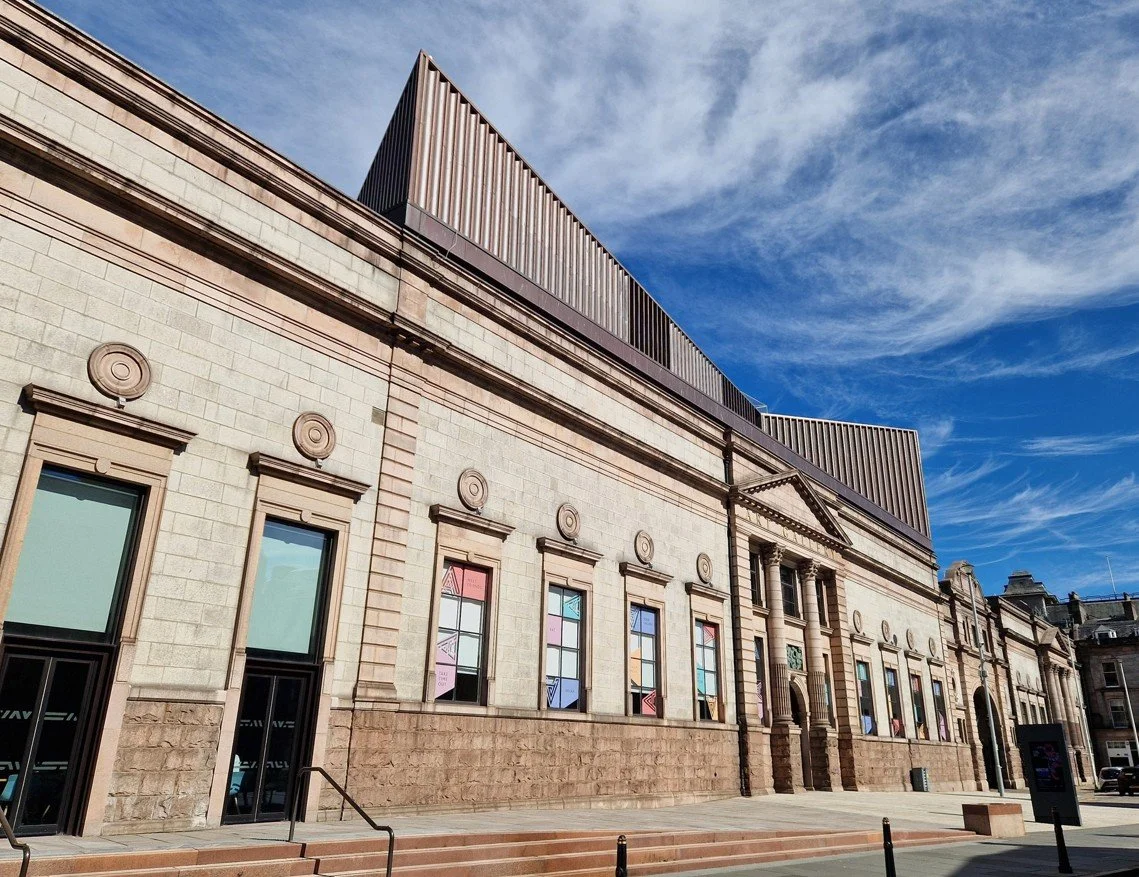
Caption: Aberdeen Art Gallery is a grand, spectacular building with really impressive indoor spaces and an amazing view from the roof balcony (where the cafe is). Aberdeen itself is a fascinating city with a lot of grey, blocky architecture that almost has an eastern European vibe. Image: Darren Naish.
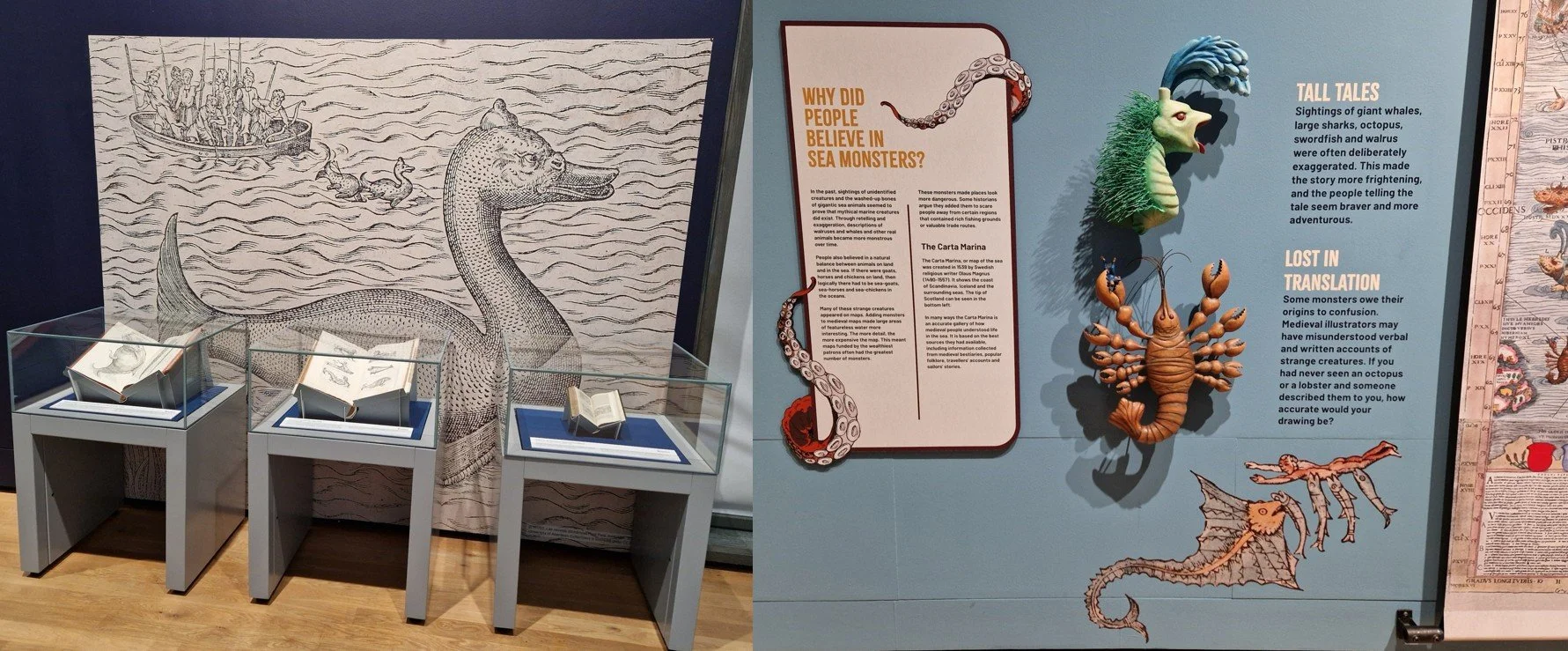
Caption: part of the Monsters of the Deep exhibition on show at Aberdeen Art Gallery in September 2025, this being segments of the part devoted to historical manuscripts and the sea monsters of Olaus Magnus’s Carta Marina of 1539. Images: Darren Naish.
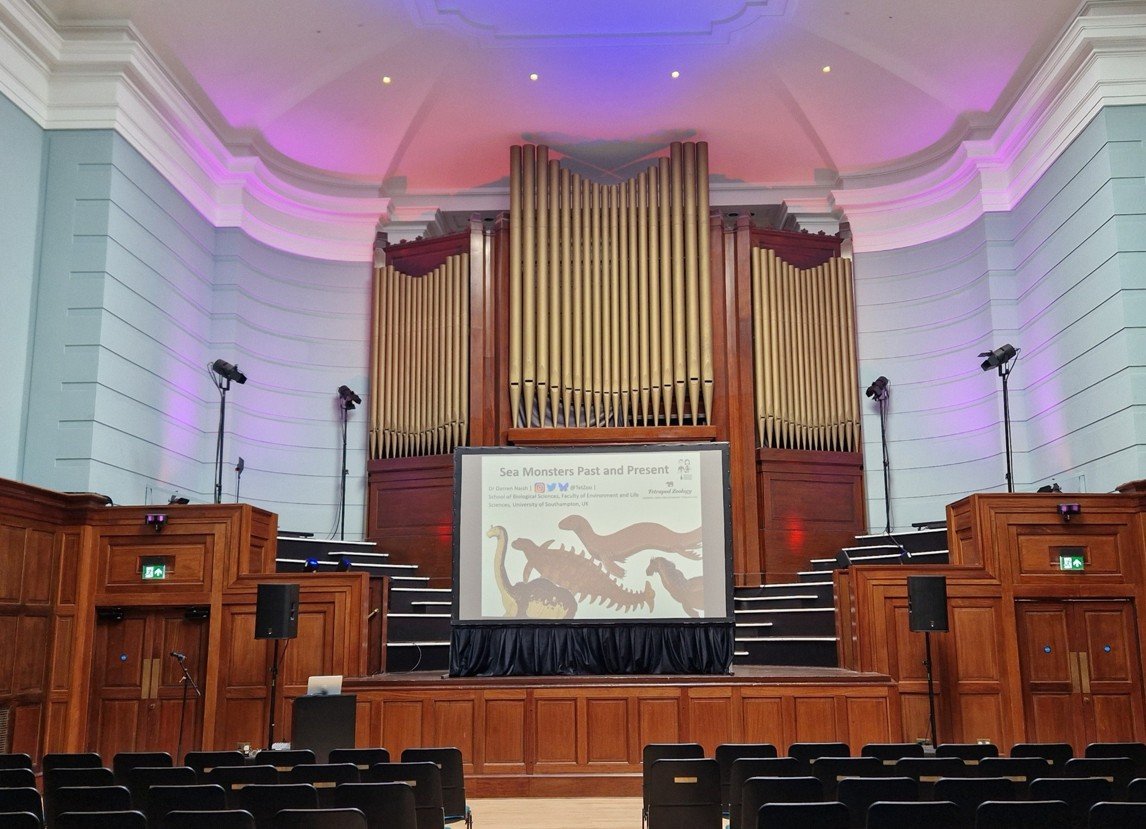
Caption: do enough public speaking, and you will get to deliver orations from spectacular spaces. My September 2025 talk at Aberdeen Art Gallery occurred in Cowdray Hall, home of an enormous upright chamber organ. Image: Darren Naish.
An article that took a good long while to piece together – one on the speculative possible existence of hybrid Mesozoic dinosaurs – was published here in September. The remarkable Early Cretaceous pachycephalosaur Zavacephale was out by September, and I published a Discover Wildlife article on it… it’s here. And the new megaraptoran Joaquinraptor was covered by me there as well.
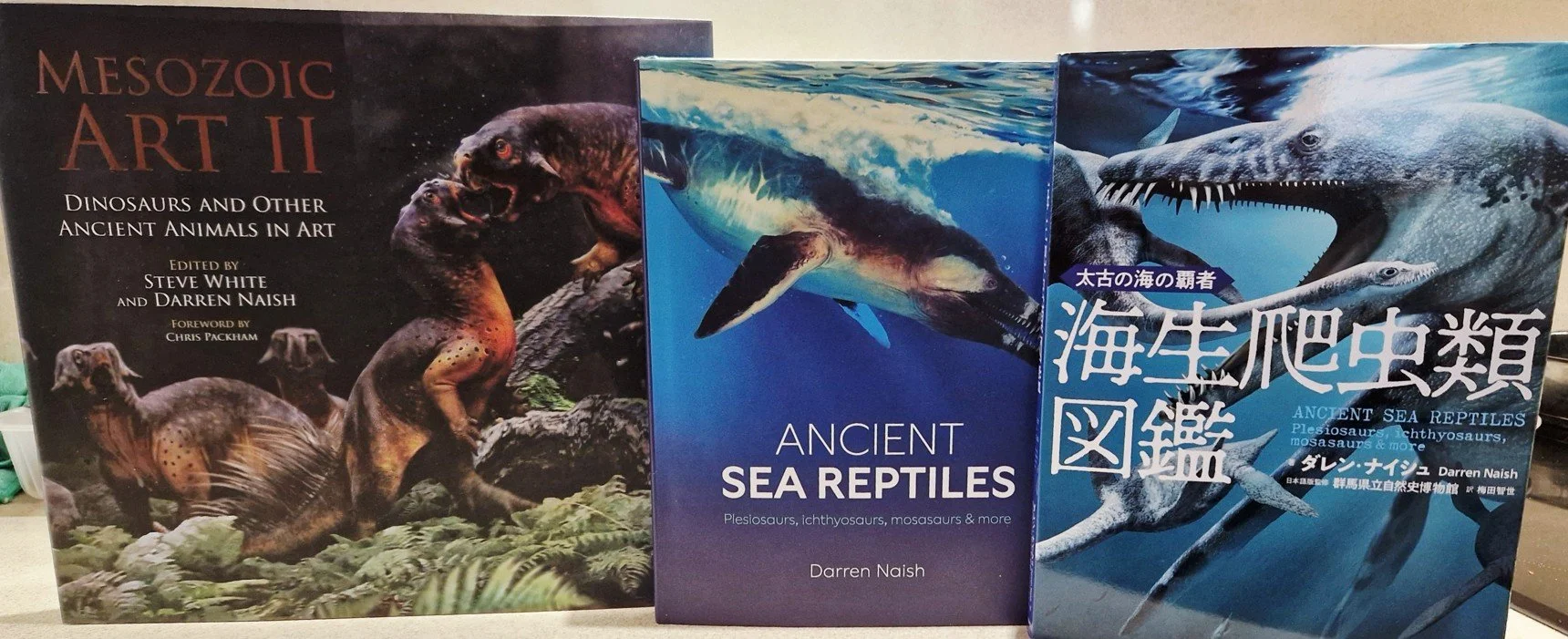
Caption: the main books I had out in 2025. Mesozoic Art II, and the third and Japanese editions of Ancient Sea Reptiles. Image: Darren Naish.
Big Event Number 3: Mesozoic Art II. The big, beautiful, art-themed book Mesozoic Art, published by Bloomsbury in 2022, was enough of a success that the decision was made to do a follow-up. And so it was that part of 2025 was taken up with the assembling and writing of the bigger sequel volume Mesozoic Art II (White & Naish 2025), release of which happened in late September. I wrote about it here. We’re showcasing technical and artistic excellence in modern palaeoart, but are also doing what we can to represent the creators of this work with respect to geography and diversity.
Doing these books is not easy and the main push to get them done always coincides with maximum workload at my end. Whatever, we work hard and we get things done. Steve and I spoke at private and public events and I was also able to donate an advance copy for the DinoCon auction. A Love in the Time of Chasmosaurs episode on the book (ep 44) was released in October and an online discussion event organised and hosted by Karim Zanaty can be seen here on YouTube.
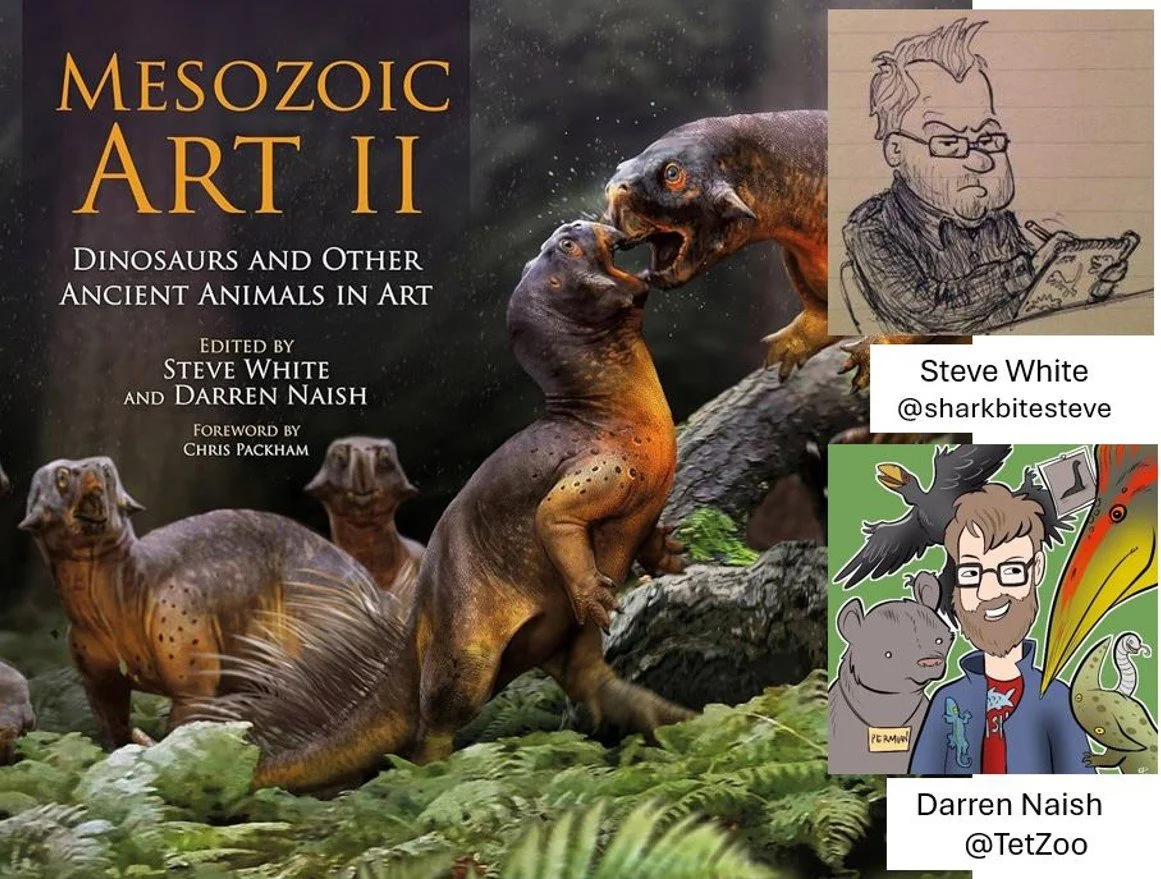
Caption: cover slide from one of the several events on Mesozoic Art II. The art on the cover of the book is by the amazing Anthony Hutchings, who I’ve now worked with on several occasions (the results of a new collab are due out soon).
Also on publicity, I appeared as a guest on the Terrible Lizards podcast hosted by Dave Hone and Iszi Lawrence, this time on Mesozoic marine reptiles as part of my promotion of the third edition of Ancient Sea Reptiles (Naish 2025f). That book was out by this time but I didn’t get to announce it at Tet Zoo until December. I screwed up on a few technical things in the Terrible Lizards episode, wrongly stating that the only ichthyosaur group to persist from the Triassic into the Jurassic were the thunnosaurs… I meant the parvipelvians, the group that includes temnodontosaurs in addition to the thunnosaurs. We all make mistakes when discussing things on the fly. More Ancient Sea Reptiles promotion happened in October when I spoke about the same topic for the Portsmouth Palaeo Society. The hardcopy version of my paper on Brian Ford’s Too Big To Walk appeared in October (Naish 2025g), meaning that this should now be cited as a 2025 paper, not a 2024 one (the paper one replaces the original digital release).
The Colour of Dinosaurs. Also in October, I attended The Colour of Dinosaurs at MAST Mayflower Studios in Southampton, a made-for-kids blend of science advocacy and theatre, with tons of music. It revolves around the work of palaeontologist Jakob Vinther, who plays himself, but also emphasises the diversity of its human cast and different approaches to colour and thinking. I really enjoyed it and found it equally fun, moving and informative. Fossils star too, as does the brilliant Psittacosaurus model made by Bob Nicholls. I liked the show so much that I purchased the soundtrack through Bandcamp, and I owe thanks to Jacob Vinther for bringing the event to my attention.
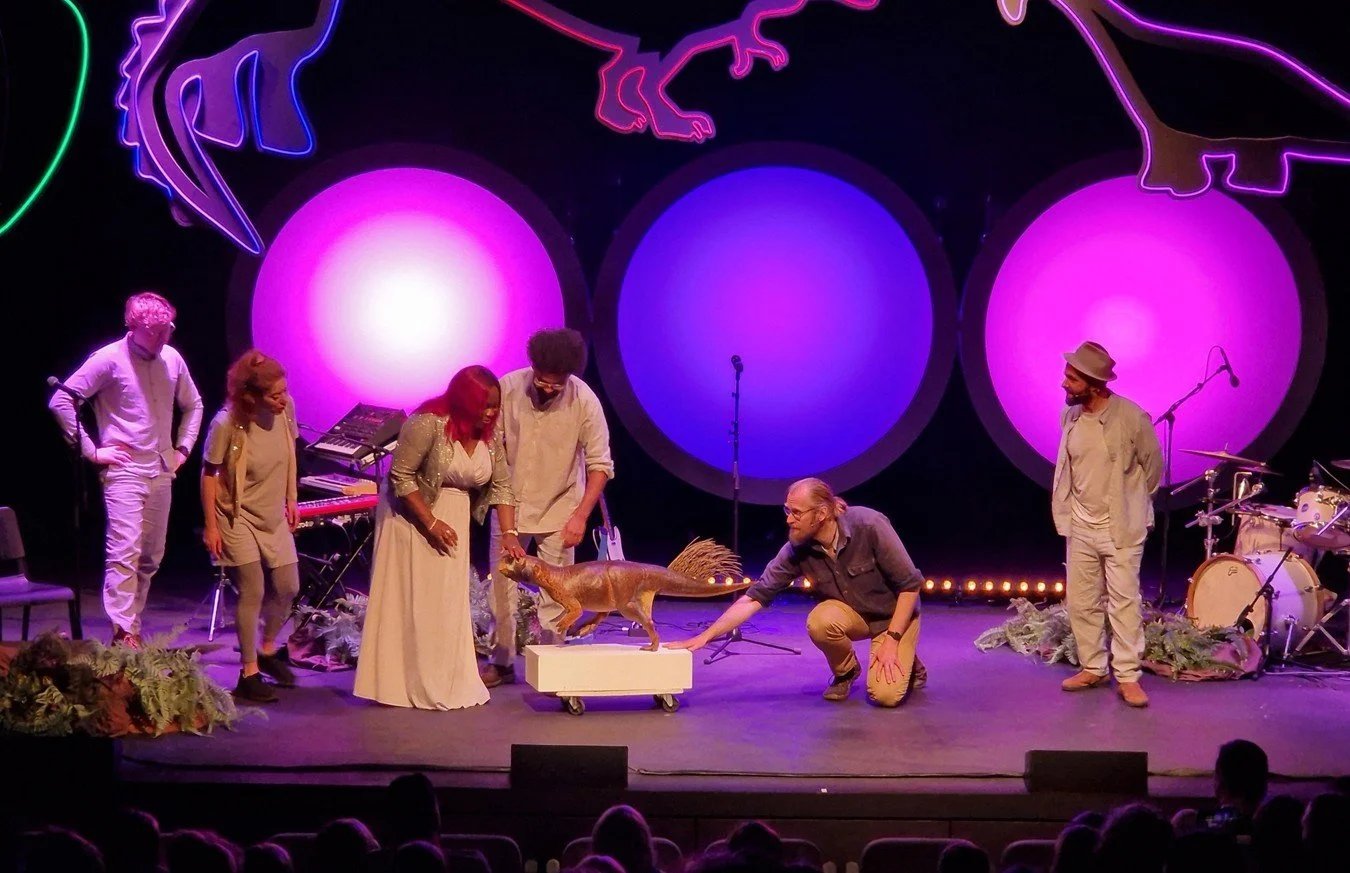
Caption: a scene from The Colour of Dinosaurs, taken in October 2025 and during the Southampton part of its run, in which Jacob presents the Bob Nicholls Psittacosaurus model to his musician colleagues. Image: Darren Naish.
Dark Folklore. Another event revolving around Ancient Sea Reptiles then happened as Toni and I travelled to Porthtowan in north Cornwall for the first ever Dark Folklore Festival, organized by Rob Vickery. I spoke about Sea Monsters Past and Present (the same talk I’d given at Aberdeen) and sold more copies of Ancient Sea Reptiles. The whole thing was a brilliant mix of West Country weirdness, storytelling, live music and monstrous shenanigans. I enjoyed it immensely and am very much planning to attend the next one. We used the trip as an excuse to visit Bodmin, Mount Hawke and other places of cryptozoological relevance.
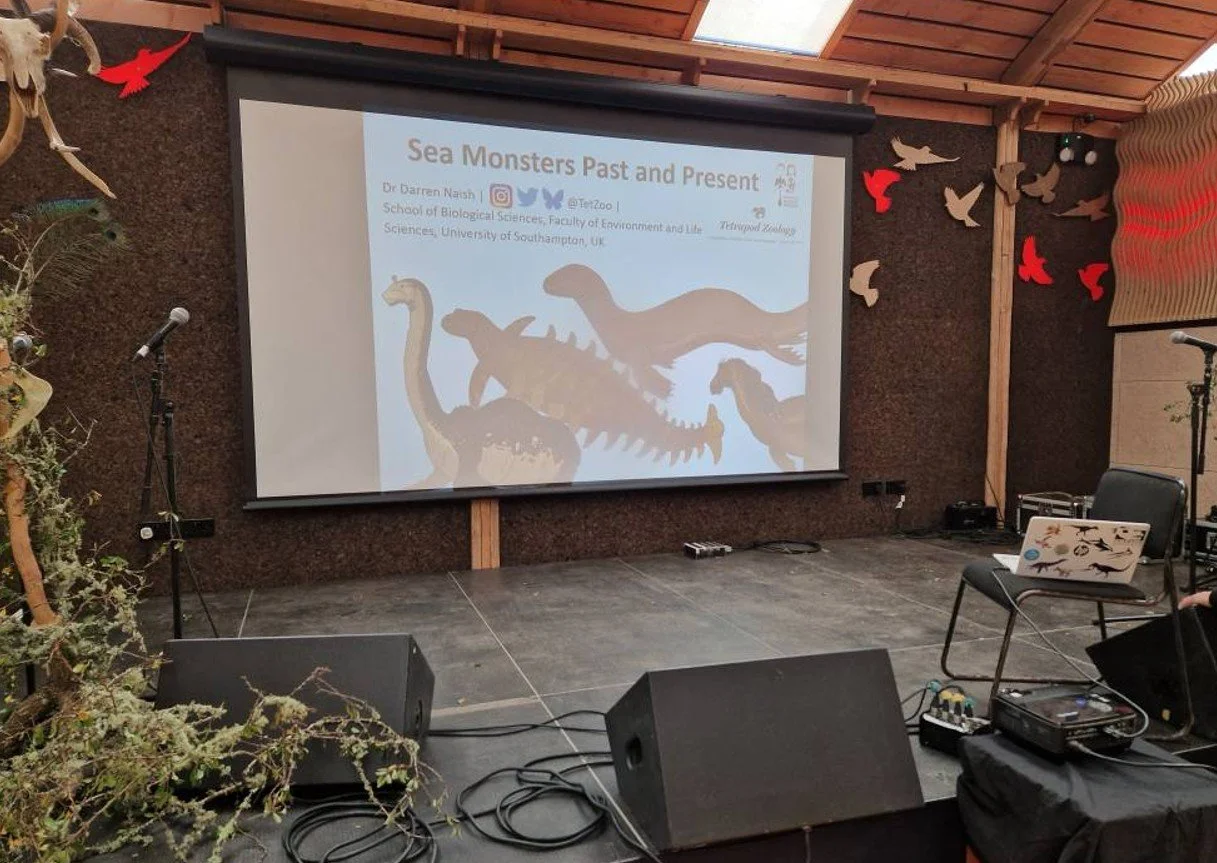
Caption: yes, another ‘sea monsters’ talk, this time at the Dark Folklore Festival in Porthtowan, Cornwall. The talk combines discussion of cryptozoology and the ‘prehistoric survivors’ idea with what we know about relevant fossil animals, in particular Mesozoic marine reptiles and basilosaurid whales. Image: Darren Naish.
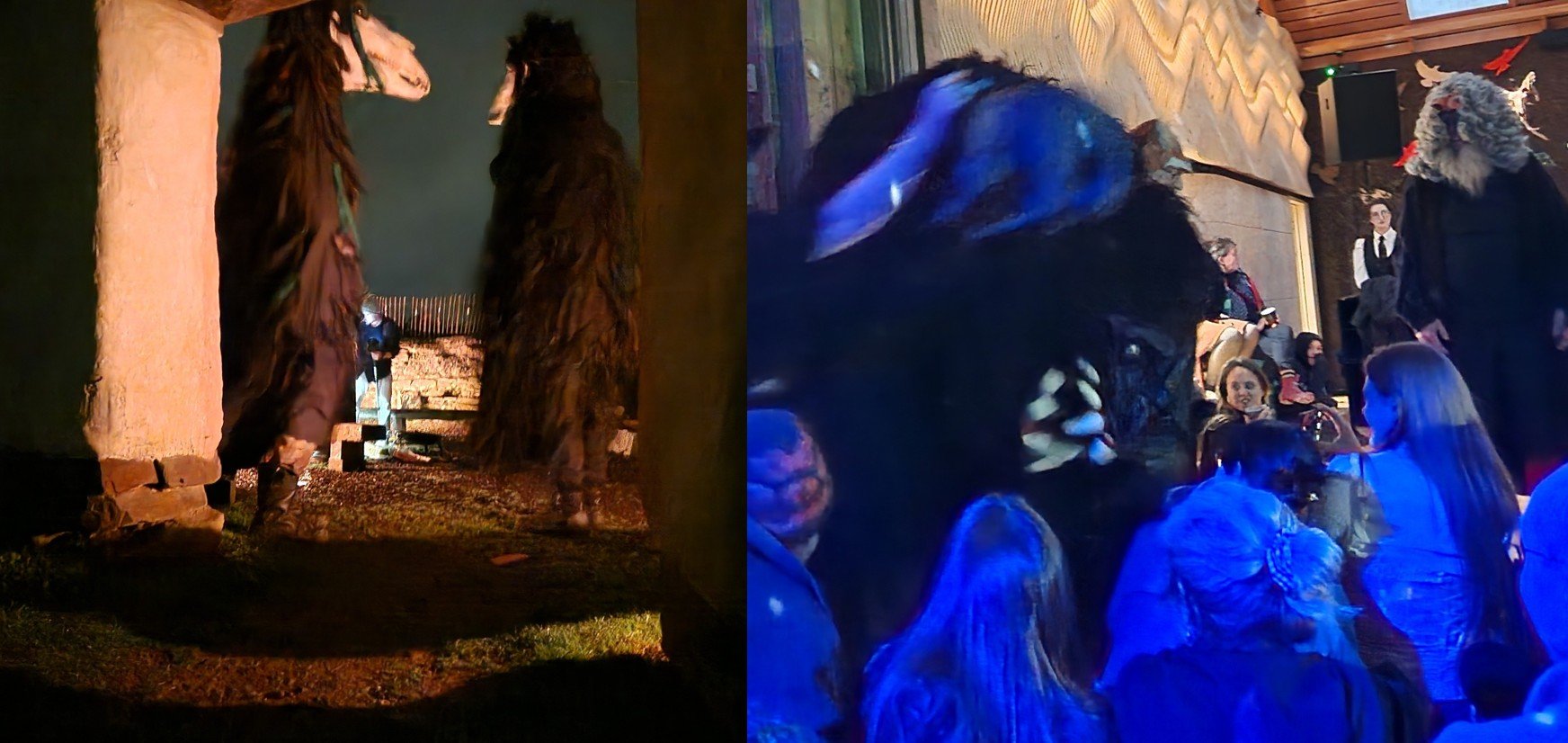
Caption: select scenes from the 2025 Dark Folklore Festival. I attended a ritual, camped on site, listened to fantastic live music, and had a great time. Definitely planning to attend the next one if I can. Images: Darren Naish.
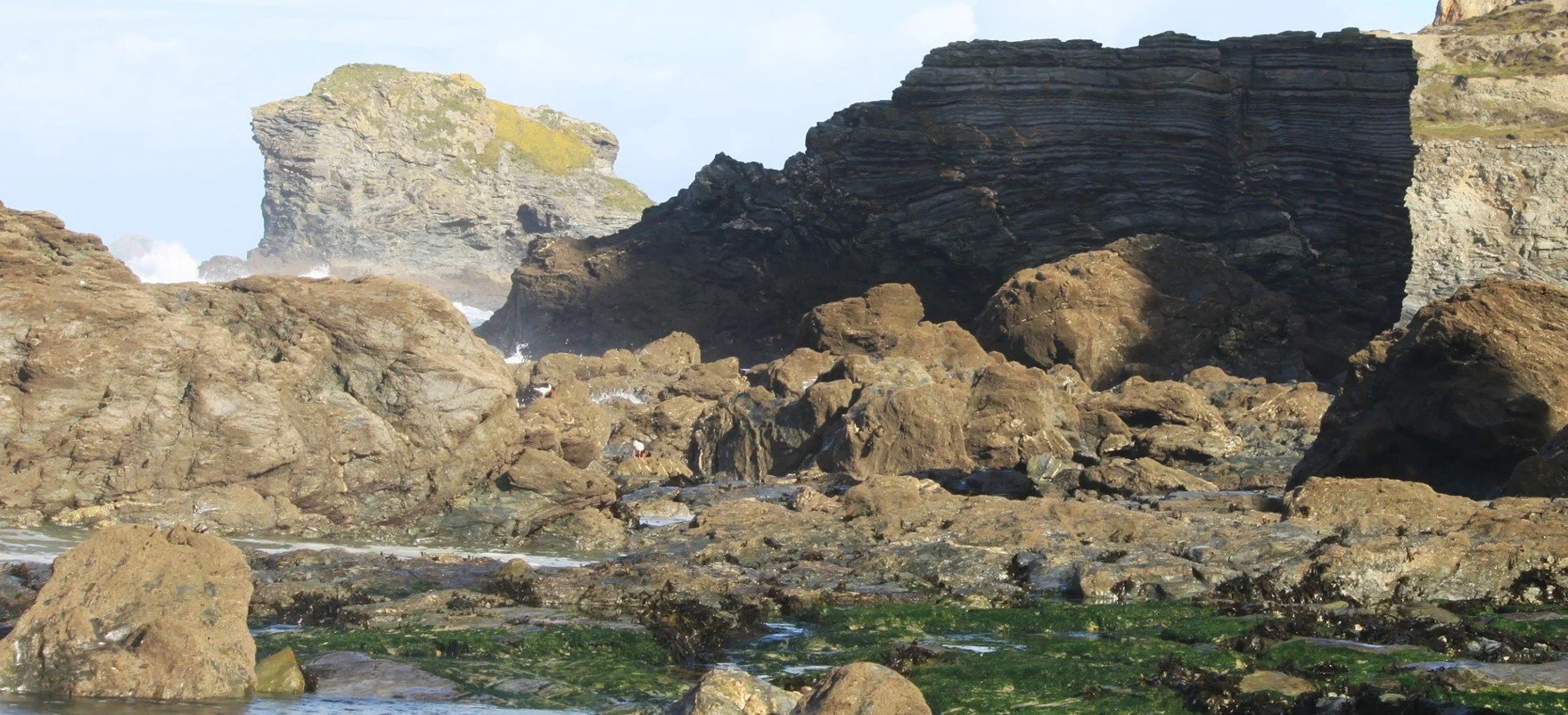
Caption: the UK has some incredibly exciting and picturesque coastline, and Porthtowan on the north coast of Devon is notable for its ferociously rocky scenery. Here’s an image from our October 2025 trip. Image: Darren Naish.
Also on monsters, late October saw the release of the IFLS (I ****ing Love Science) YouTube movie on the Loch Ness Monster. I was interviewed for this – I’ve lost count now of how many Nessie-themed interviews I’ve done for film and TV – and I do quite like the final product, which you can watch here.
Palaeoart in Birmingham. Something really fun happened in early November, specifically as part of the 85th annual meeting of SVP (the Society of Vertebrate Paleontology), held at the International Convention Centre (or ICC) in Birmingham (UK). It’s rare for SVP meetings to be held in the UK (I think this is only the second time) so I tried my best to attend. Speaking as someone who’s been running conventions for more than ten years, I know how irksome and unfair it can be when people complain about prices… but, my god, the price was unfortunately prohibitive. However, preceding the event was the palaeoart workshop organized by Mark Witton, titled 'Paleoart [sic] Past and Present: the View from the UK’, and I’m pleased to say that I was able to attend that at least.
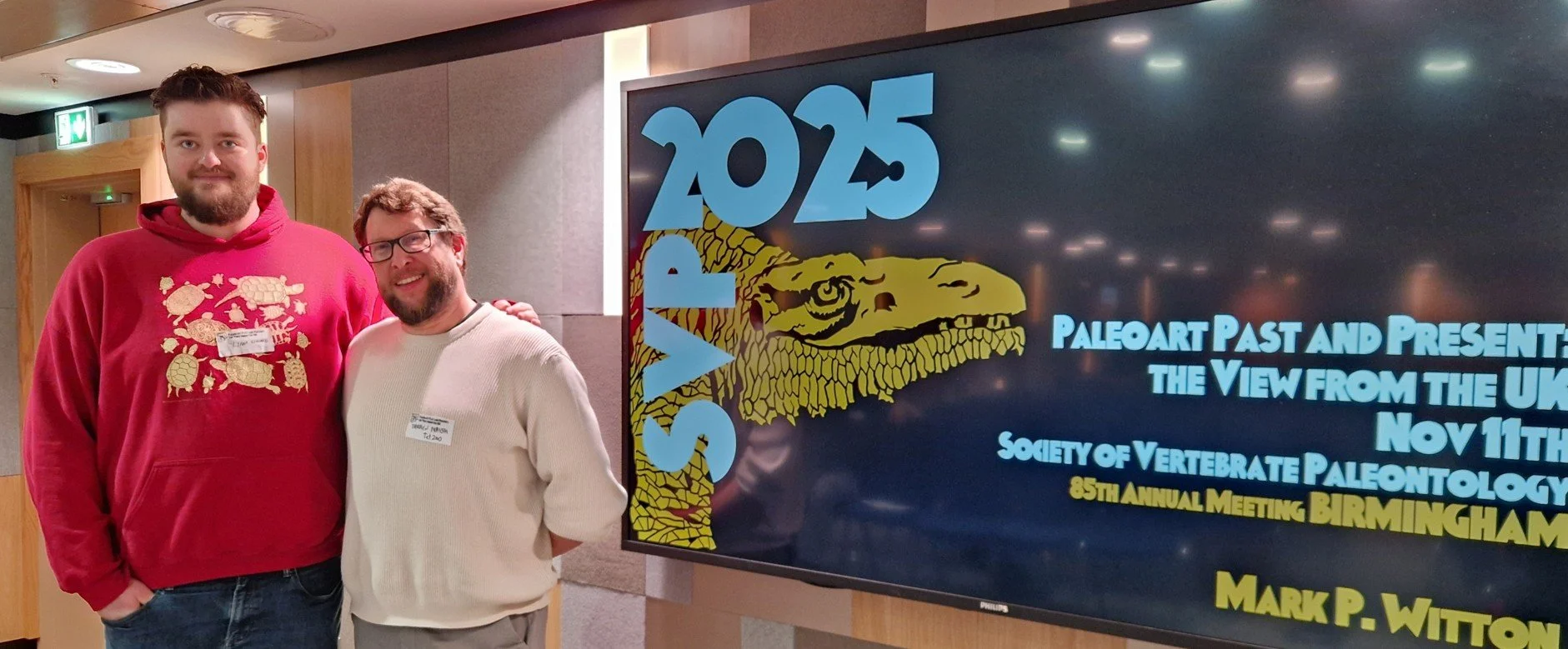
Caption: Liam Elward (the taller individual) and your humble author at Mark Witton’s Paleoart Past and Present: the View from the UK workshop at SVP 2025. I left the event with a small pile of stuff, among which are stickers and prints created by Liam. Image: Julianne Zelda Kiely.
The event involved talks, panel discussions and show-and-tell sessions and was hugely positive. I gave the talk ‘Conway et al.'s All Yesterdays and the Case for Speculative Palaeoart’. It was great to meet a good number of interested people, palaeoartists among them, for the first time as well as others I’ve known for a while. I owe thanks to Mark for organizing it and SVP for assisting my attendance. We talk often about the fact that the UK is a bit of a powerhouse in the production of palaeoart, but an argument can be made that those of us here at ground zero maybe don’t take sufficient advantage of this. Then again, we do have the Popularizing Palaeontology meetings, numerous book launches, the Lyme Regis Fossil Festival and DinoCon, so….
Big Event Number 4: Prehistoric Planet Ice Age! The big event of November, and Big Event Number 4 of 2025, was the release on Apple TV, late in the month, of Prehistoric Planet Ice Age. As per seasons 1 and 2, it was of course years in the making. There was no Los Angeles red carpet event this time, alas, but we did do various press events and big-screen showings in London, including one at Lightroom. Here’s where I got to meet geneticist, author and science communicator Adam Rutherford.
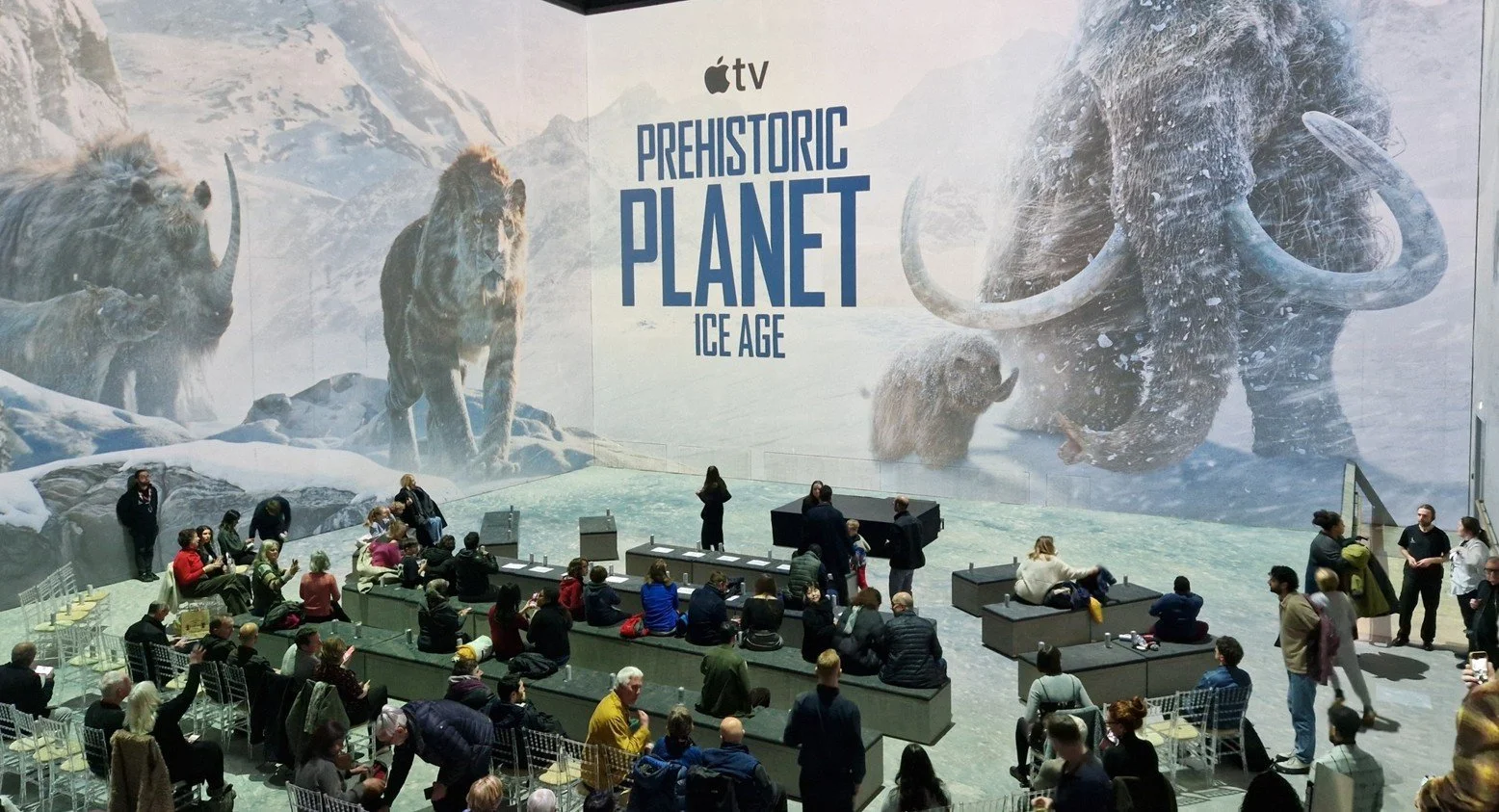
Caption: Lightroom London hosted a special screening of Prehistoric Planet Ice Age during late November 2025. Seeing these shows projected at size is a phenomenal experience that I’ll always make time for if I can. A number of other people in the UK palaeo-scene were able to attend this showing and we hung out afterwards. Image: Darren Naish.
Apple are – with all due respect to my friends and colleagues there – an enigma in terms of when and how they do publicity, and it was quite frustrating for those of us at the BBC end of things to see the months go by with nothing, absolutely nothing, released in terms of promotion. The trailer was finally out on November 6th and the series itself was out in time for Thanksgiving (which was November 27th for 2025). In preparation for the release of the series I published articles at Tet Zoo on sloths, giant fosas, Woolly mammoths, glyptodonts, Thylacoleo and diprotodontians in general, but I didn’t get through as much as I hoped I would. More Pleistocene-themed content is yet to come at Tet Zoo.
Another technical paper – this one being the next instalment in the dinosaur cognition wars – appeared in December (Caspar et al. 2025) and the Tet Zoo article on it is of course still fresh at the time of writing. A spinosaurid paper appeared in the month too (Barker et al. 2025) but I haven’t yet had time to discuss it here. Also fresh and relevant to things covered in this article is the completely unexpected and shocking passing in January of long-time friend and colleague Richard Forrest, covered here. Not a good start to 2026, and something that will make the year’s Lyme Regis Fossil Festival, and other events, very different in tone.
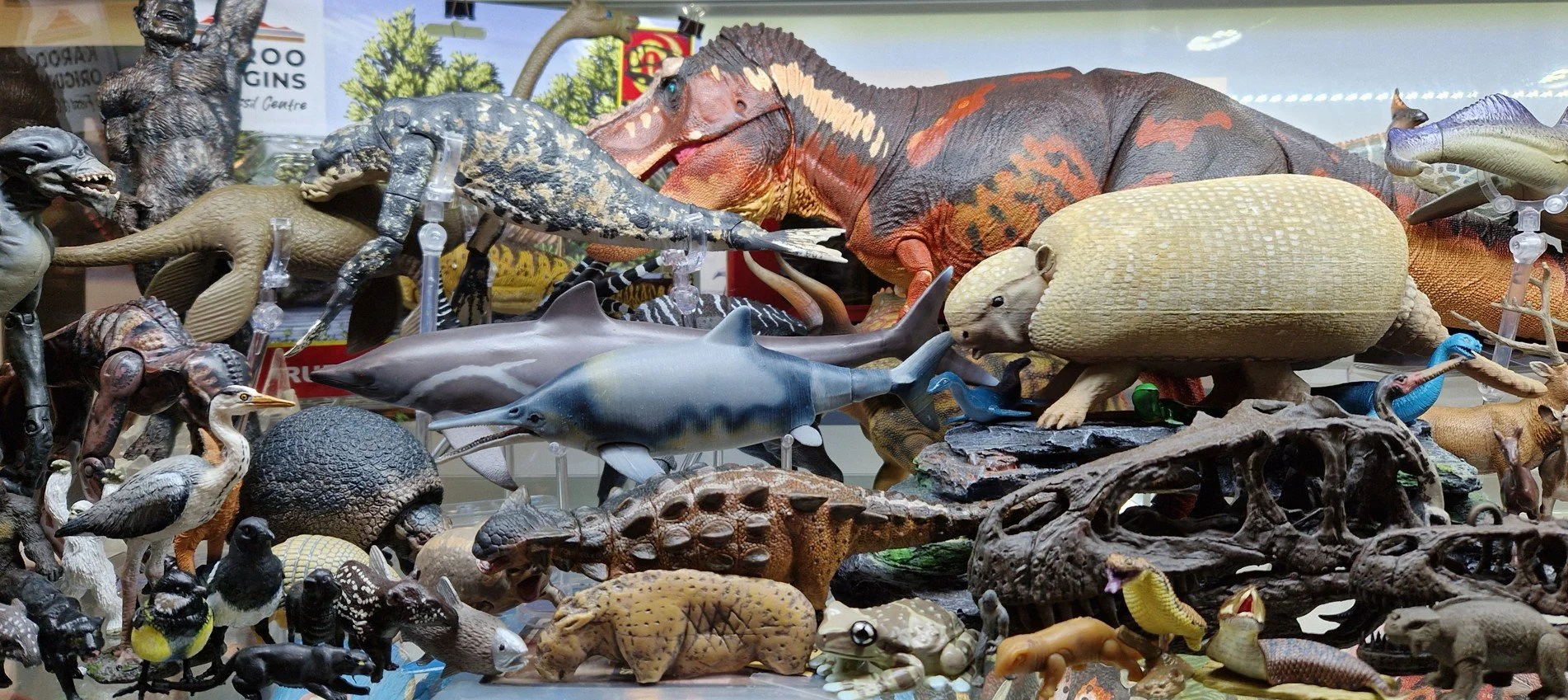
Caption: the top shelf of one of my cabinets, rearranged for 2025. There are some real treasures here if you’re interested in model and toy animals. Image: Darren Naish.
Assessing 2025’s Tet Zoo coverage. This is a good point at which to stop and do what I do in every annual recap: assess Tet Zoo coverage across the year to see which animal groups, which subjects, won coverage and which did not. We start with a list of the year’s articles (remembering that a Tet Zoo Year extends from Jan 21st to Jan 21st), and we then view things on a graph.
SpecBio
Speculative Zoology and the World of After Man; an Interview With Dougal Dixon, April 2025
Speculative Zoology Grand and Photoreal: Boulay and Steyer's Demain, les Animaux du Futur, April 2025
Cryptozoology
Yowies and the Marsupial Hominoid Hypothesis – Neil Frost’s Fatfoot: Encounters With A Dooligahl, February 2025
Adrian Shine's A Natural History of Sea Serpents, March 2025
The Crowing Crested Cobra Once More, September 2025
Non-bird dinosaurs
In Quest of Hybrid (Non-Bird) Dinosaurs, September 2025
The Continuing Debate on Dinosaur Cognition, January 2026
Pterosaurs
Turtles
World Turtle Day 2025!, May 2025
Crocodile-group archosaurs
Crocodiles Attack Elephants Then, Now, and Still, August 2025
Permian and Mesozoic swimming reptiles
Ancient Sea Reptiles Goes to Third Edition!, December 2025
Squamates
Racerunner Lizards of the World Unite, New for 2025!, April 2025
Record-Holding Champion Giant Slow-Worms, July 2025
Mammals
Curtis, Swisher and Lewin’s Java Man of 2000: Hominin-Themed Books, Part 1, March 2025
Otaria, the Southern Sea Lion, March 2025
The Fate of the Woolly Long-Nosed Armadillo of Peru, May 2025
Of Zaedyus, the Pichi, May 2025
Armadillo Empire, Part 1: of Euphractines and Eutatines, June 2025
Armadillo Empire, Part 2: Fairies, Tolypeutines, and Where Glyptodonts Go, June 2025
Whales and Dolphins Around the Coasts of Europe, 2025, July 2025
Sloth World, 2025 (Part 1), October 2025
The Amazing Giant Black Fossa, October 2025
A Woolly Mammoth Primer, November 2025
The Life Appearance of Glyptodonts, November 2025
Thylacoleo, the Incredible Marsupial Lion, November 2025
Diprotodontians Forever: the Vombatiform Radiation, Part I, November 2025
Amphibians
News From the Pond's Edge: Spawnwatch 2025, February 2025
Miscellaneous musings
Tet Zoo Reviews Zoos: Tama Zoological Park, Tokyo, February 2025
Announcing DinoCon … Tickets Now on Sale!, February 2025
Three Months to DinoCon!, May 2025
Suburban Camera Trapping, Week 1, May 2025
Tetrapod Zoology ver 4’s 7th Birthday, July 2025
Mesozoic Art II, Palaeoart Portfolio for the 2020s, September 2025
DinoCon 2025 Has Left the Building, October 2025
British Palaeontologist Richard Forrest, a Brief Obituary, January 2026
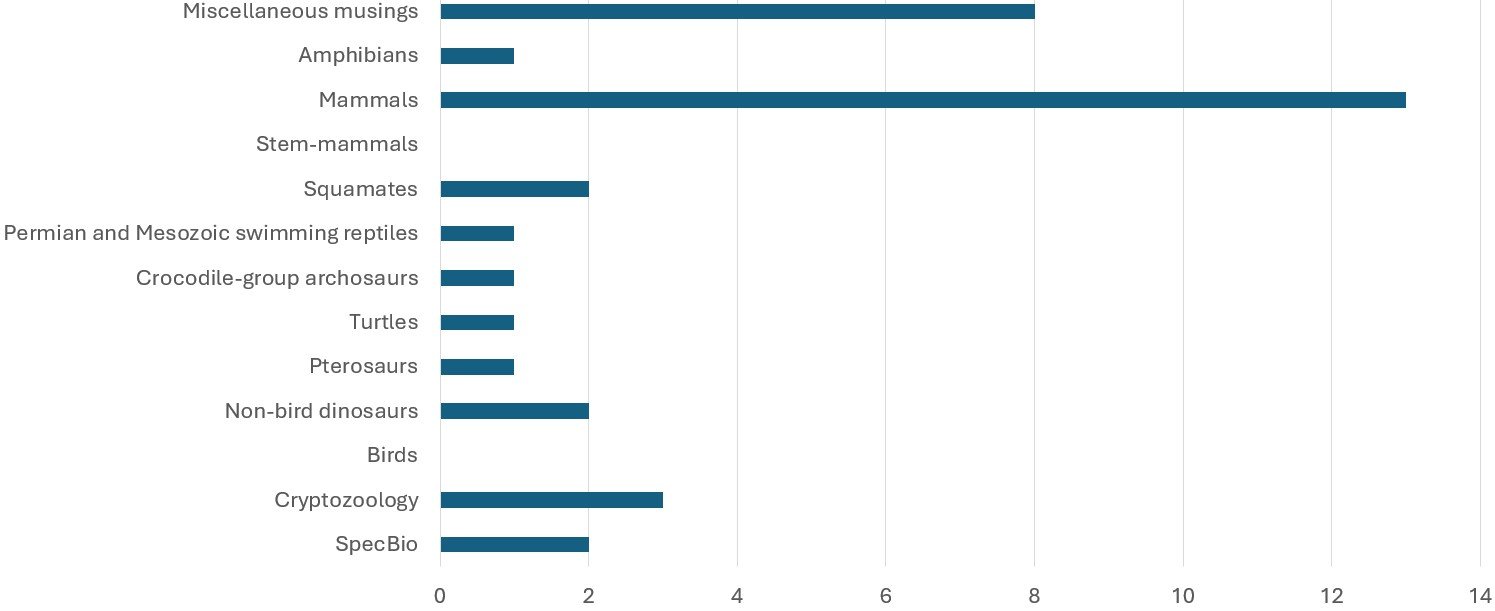
As ever, the results are both frustrating and interesting. The good number of articles relating to miscellaneous notices and announcements (concerning DinoCon and such things as a book announcement and a zoo review) obviously loom large, but if 2025 was anything at Tet Zoo it was mammal heavy. Virtually all of those mammal articles exist as a consequence of Prehistoric Planet Ice Age. Otherwise, coverage looks moderately balanced (that being the thing I ultimately strive for), the low number of articles in the bulk of categories being an inevitable consequence of my inability to do more than I already do. The total lack of birds is a surprise. Remember that I would blog so much more if only I could put more time into it. Hint hint.
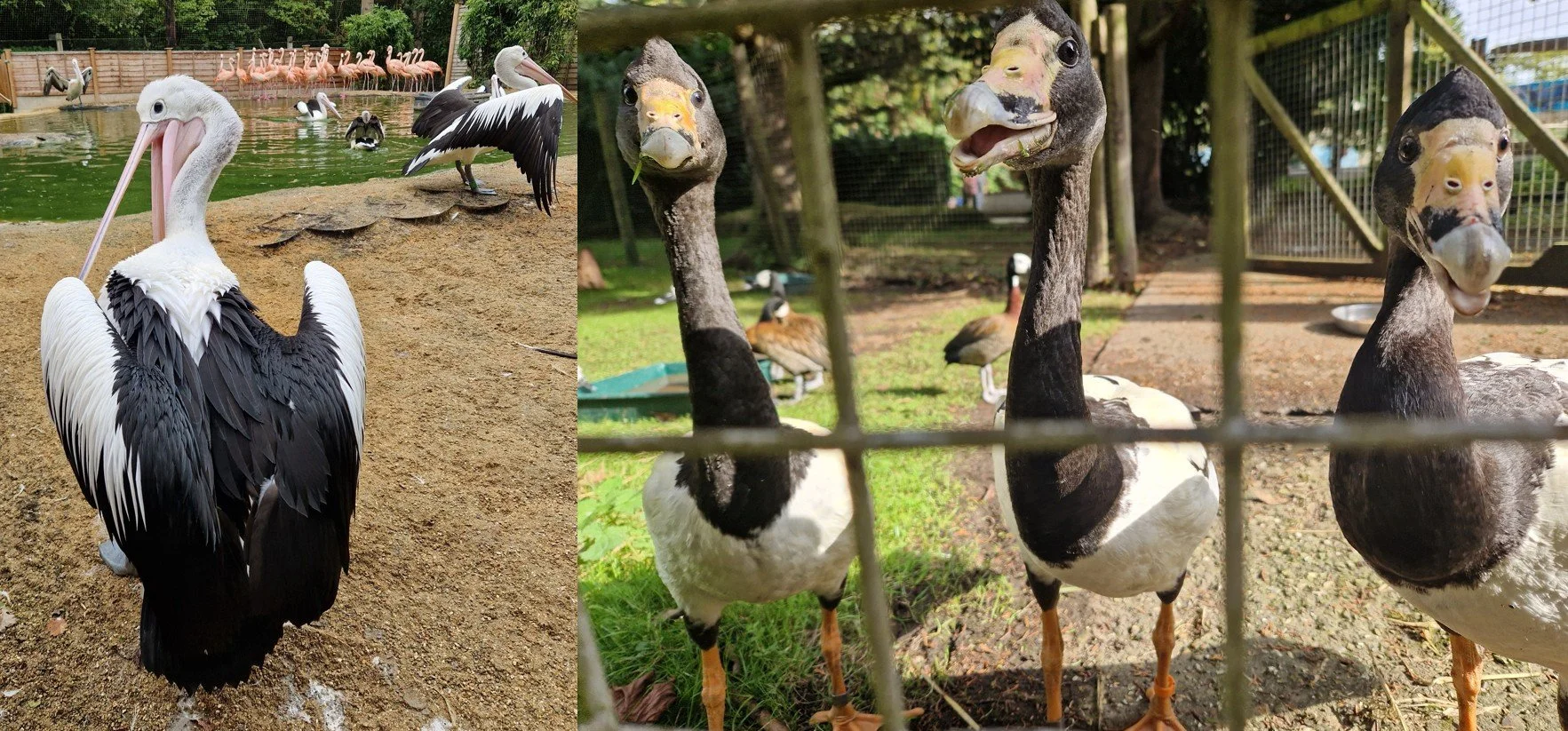
Caption: ok, so I didn’t write about birds at Tet Zoo during 2025 but I did spend a lot of time looking at live ones. These photos are from a Birdworld trip made in September 2025. They show Australian pelican Pelecanus conspicillatus, Greater flamingo Phoenicopterus roseus and Magpie goose Anseranas semipalmata. Images: Darren Naish.
So far I’ve been talking about things as if 21st Jan 2026 is a normal birthday for Tet Zoo. But it isn’t: this particular birthday marks 20 years, if my maths works out. That means, my friends, that even more introspection is required. That’s what’s happening in the next article: a look back at 20 years of Tetrapod Zoology. Thanks, as ever, for visiting Tet Zoo – especially so if you’ve been with me since the beginning in 2006 – and also for leaving comments and for assisting my work and efforts to remain solvent.
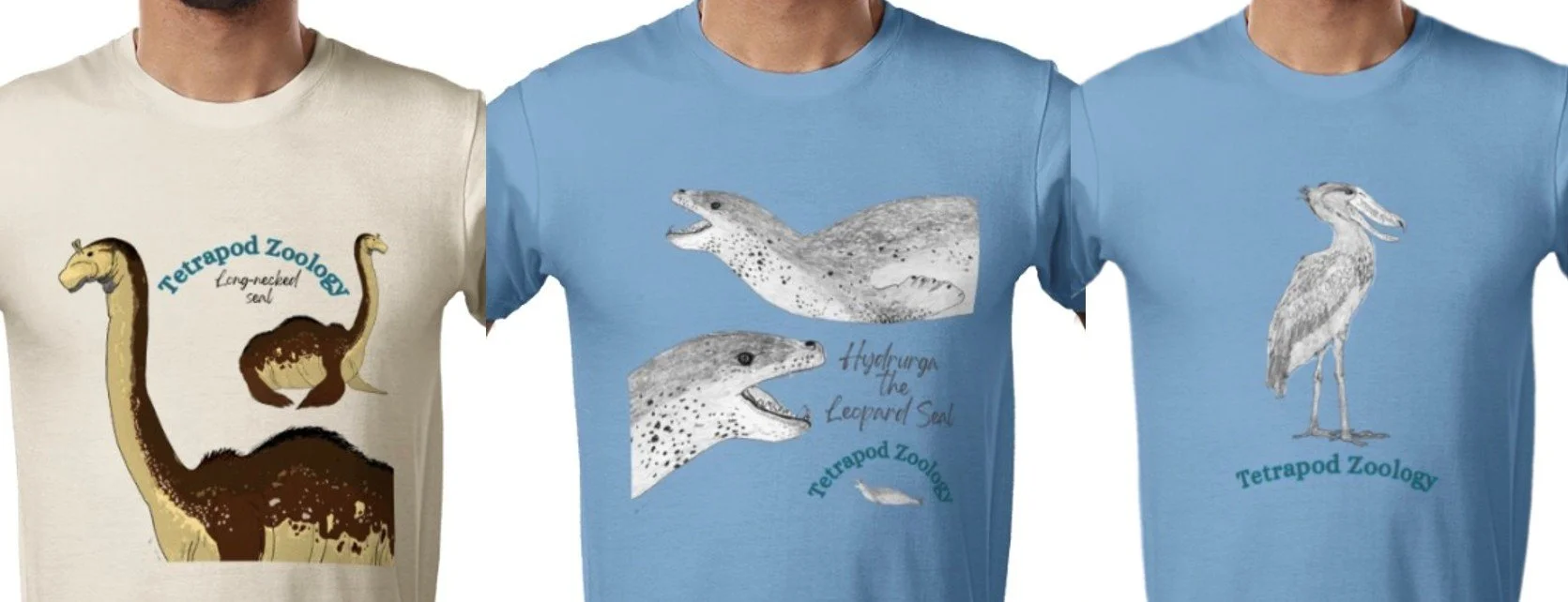
Caption: in celebration of this landmark in Tet Zoo history we’re releasing a new lot of t-shirt designs. They’re available at our SumUp shop from 10.30am (GMT) on Wed 21st January.
For previous TetZoo articles on birthdays and other landmarks, see…
Happy first birthday Tetrapod Zoology (part I), January 2007
Happy first birthday Tetrapod Zoology (part II), January 2007
Happy second birthday Tetrapod Zoology (part I), January 2008
Tetrapods of 2007 (happy birthday Tet Zoo part II), January 2008
Happy THIRD birthday Tet Zoo, January 2009
Tet Zoo = 4 years old today, January 2010
2009, a year of Tet Zooery, January 2010
Four years of Tet Zoo: to infinity... and beyond!, April 2010
It is with some dismay that I announce Tet Zoo's first hemi-decade, January 2011
Tet Zoo 5th birthday extravaganza, part II, January 2011
Happy Birthday Tetrapod Zoology: SIX YEARS of blogging, January 2012
Happy 6th Birthday, Tetrapod Zoology (part II), January 2012
Tetrapod Zoology enters its 8th year of operation, January 2013 (I cannot find any intact versions of this article, thanks SciAm)
Today marks NINE YEARS of Tetrapod Zoology, January 2015
Tetrapod Zoology 10th-Birthday Extravaganza, Part 1: 2015 in Review, January 2016
Tetrapod Zoology 10th Birthday Extravaganza, Part II: the Rest of 2015 Reviewed, January 2016
Tetrapod Zoology 10th-Birthday Extravaganza, Part 3: Tet Zoo's Tetrapod Treatment in 2015, January 2016
Today Is Tet Zoo's 11th Birthday, January 2017
The 12th Year of Tet Zoo, January 2018
The Tet Zoo 12th-Birthday Event, Part 2, January 2018
The Much Belated Final Part of the Tetrapod Zoology 12th Birthday Event, December 2018
Tetrapod Zoology Is A Teenager Now, January 2019
Tetrapod Zoology's 14th Year of Operation, 2019 in Review, January 2020
On Tetrapod Zoology’s 15th Birthday, the Year in Review, January 2021
Happy 16th Birthday, Tetrapod Zoology, February 2022
Four Years of Tetrapod Zoology ver 4, July 2022
The 17th Year of Tetrapod Zoology: 2022 in Review, January 2023
Five Years of Tetrapod Zoology ver 4, July 2023
Tetrapod Zoology Reaches 18 Years of Age, January 2024
It Was the 19th Year in the History of Tetrapod Zoology, January 2025
Refs - -
Jackson, T. 2025. Eyewitness Animal. Dorling Kindersley, London.
Naish, D. 2016. Hunting Monsters. Arcturus Books, London.
Naish, D. 2022. A cultural phenomenon. The Biologist 69 (3), 16-21.
Naish, D. 2025b. Taxonomic trolling. The Biologist 72 (2), 26-29.
Naish, D. 2025c. Dinosaurs are not extinct. In Tucker, L. (ed) Discovering Dinosaurs. Lightroom, London, pp. 16-27.
Naish, D. 2025d. Ichthyosaurs from the Early Jurassic of Britain: by Graham P. Weedon and Sandra D. Chapman, 2022, Siri Scientific Press, 448 pp., £99.99 (Hardcover), ISBN 978-1-8381528-6-4. Historical Biology 10.1080/08912963.2025.2541788
Naish, D. 2025e. Snake summer at the Hunterian. Fortean Times 464, 52-53.
Naish, D. 2025f. Ancient Sea Reptiles (Third Edition). Natural History Museum, London.
Naish, D. 2025g. The response to and rejection of Brian Ford’s Too Big to Walk, a 21st century effort to reinstate the aquatic dinosaur hypothesis. Historical Biology 37, 2147-2156.
White, S. & Naish, D. 2025. Mesozoic Art II: Dinosaurs and Other Ancient Animals in Art. Bloomsbury Wildlife, London.


