Foot deformities are ubiquitous in urban pigeons. Why?
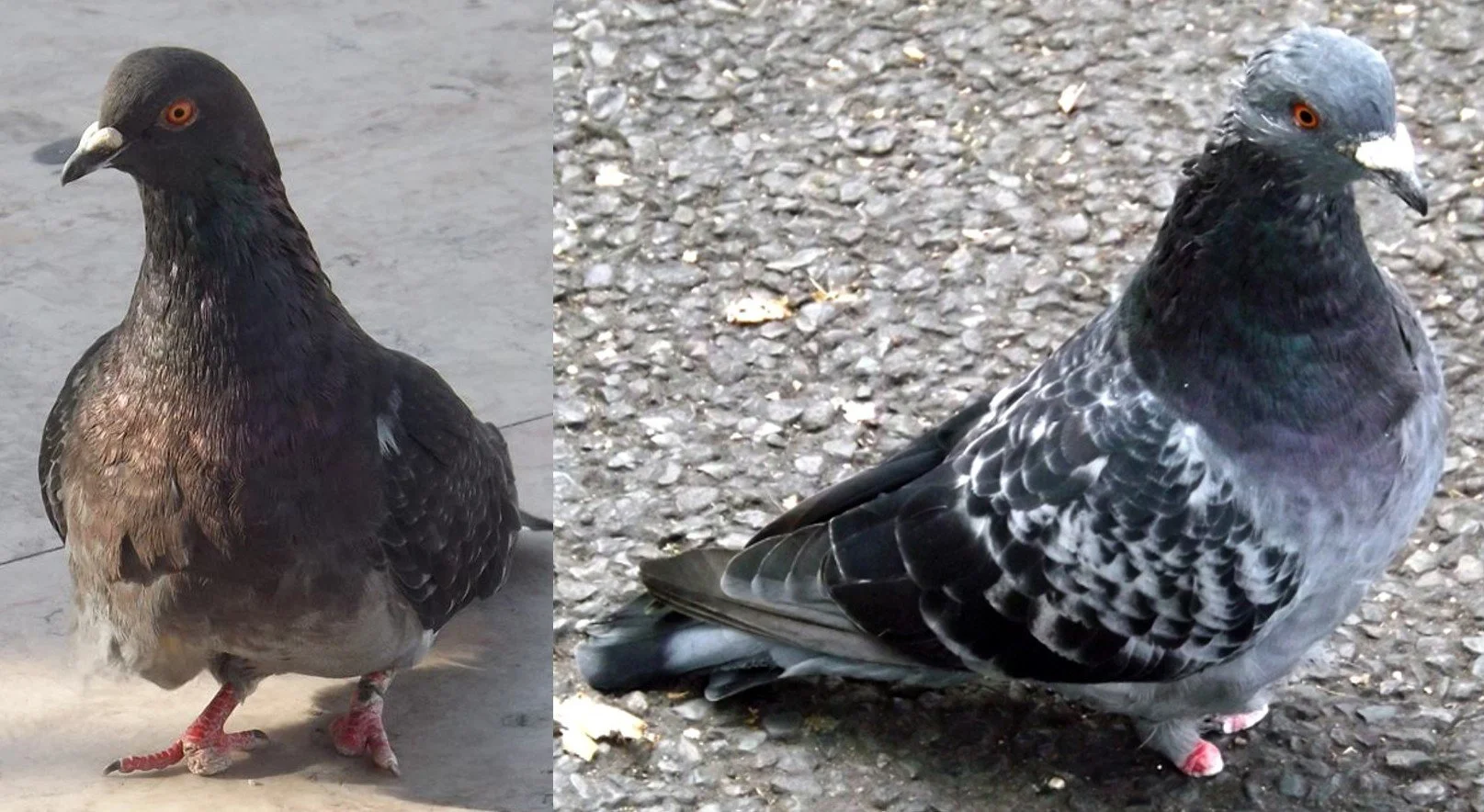
Caption: poor toe-less or even mostly foot-less urban pigeons, one encountered in Lisbon in 2014, the other (on the right) seen close to Kew train station in September 2014. The right foot of the Kew bird is completely absent; the left one had at least one toe, curled round such that the bird was walking on the toe's lateral side. Image: Darren Naish.
Here’s a republished version of an article that originally appeared (here, at ver 3) back in 2022.
As you’ll know if you’ve spent any time watching the pigeons of towns and cities, something like one in every ten has missing or partial toes, or swollen toes, or other pedal deformities of some sort. And then there are really extreme individuals: the ones that are missing the majority of their toes altogether.
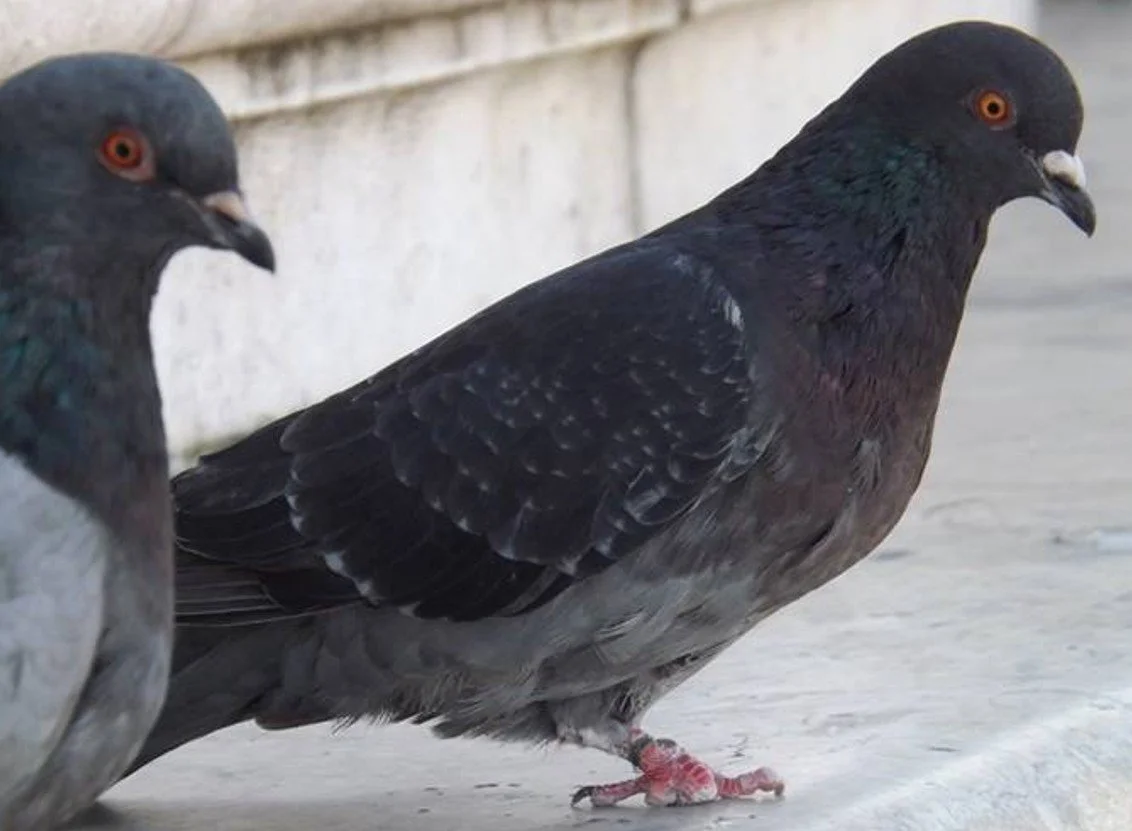
Caption: that bird from Lisbon again, showing how badly mangled its feet are. Image: Darren Naish.
I’m talking here about the domestic form of Columba livia, the so-called Rock pigeon or Rock dove. And, while I’ve mostly paid attention to deformed pigeons here in the UK, it certainly isn’t a UK-only thing, as continental European and North and South American people (and no doubt those of elsewhere in the world too) will confirm.
The Kew bird in the photos here was able to fly around and feed itself, and it might be broadly described as ‘healthy’. However, note that it’s in pretty poor condition. The feathers on its head and neck looked terrible and its rectrices (the big tail feathers) were frayed and shabby. I reckon this is partly due to an inability to groom and scratch itself: obviously, birds use their feet to reach parts that they can’t get to with the bill.
Looking nice, keeping clean. The impact of this is more than cosmetic, since birds with a poorly maintained or unrepaired plumage are disadvantaged in flight relative to tidier individuals, and less able to keep themselves warm and waterproofed. And a bird that isn’t able to groom parts of its plumage is also at risk of being unable to keep on top of parasites like ticks and feather mites. As demonstrated through various experiments, birds with shabby-looking plumage are less attractive as mates (Clayton 1990), so a bad-looking pigeon is likely to be a non-breeding pigeon. It’s also worth noting that (like many animals), pigeons preferentially use one foot more than the other as goes the way they land and perch and sit and so on (Fisher 1957). Individuals that lose or damage their preferred foot might, then, end up being doubly disadvantaged (imagine being right-handed, and then having to rely only on your left hand for evermore). I don’t know how concerned people are about the emotional well-being of animals like urban pigeons (or how far they’re prepared to go in admitting that non-human animals have feelings and states of mind), but I think we can be confident that the most severely deformed of these birds are - at least at times - miserable, unhappy and frustrated.
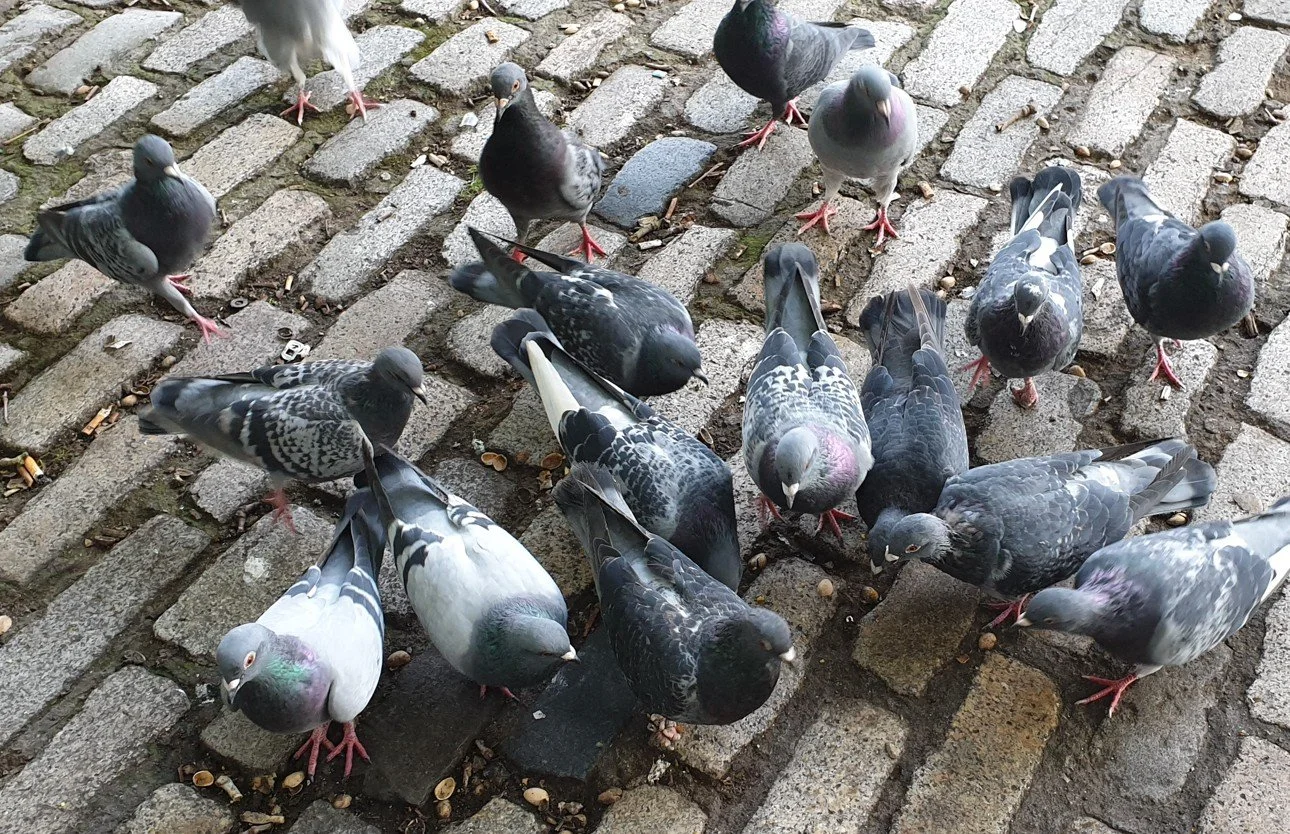
Caption: toe damage is very common in urban pigeons, but we mustn’t think that it’s ubiquitous. In this pigeon group in Bristol, photographed in 2023, I can only see one missing toe (on the right foot of the bird at extreme upper right). UPDATE: ok, I’ve now noticed a second pigeon with a mangled foot. The bird just left of the one at upper right has a club-like left foot. Image: Darren Naish.
The ‘tangled’ or ‘stringfoot’ hypothesis. Several ideas have been put forward to explain the many foot problems seen in urban pigeons. Some probably lose toes after getting them tangled in litter or anti-pigeon netting, or after they've received injuries from anti-pigeon spikes installed on signs and ledges. Fine wire, string, cotton thread and even human hair can all cause problems for birds when caught on or around digits, and some people say that interaction with fine thread and string and so on is the primary cause of pigeon foot damage. My impression is that this ‘tangled’ hypothesis, causing what’s increasingly known as stringfoot in birds, is the most likely explanation for the problem.
The ‘chemical injury’ hypothesis. It’s also sometimes suggested that the deformities result from infections received after standing on excrement, and that the birds become damaged through interaction with chemicals used on roofs and building stone. This ‘chemical injury’ idea is unlikely to be correct, since (a) exactly what sort of chemicals are we talking about here, and why have they been used on buildings in the first place?, and (b) a chemical would basically have to be a powerful acid or alkaline agent (hydrochloric acid, or a very strong bleach) before it could damage a bird’s feet. For completeness, note that hereditary deformities like those reported for some captive populations of other pigeon species (Flach & Cooper 1991) might also explain some abnormalities observed in urban pigeons.
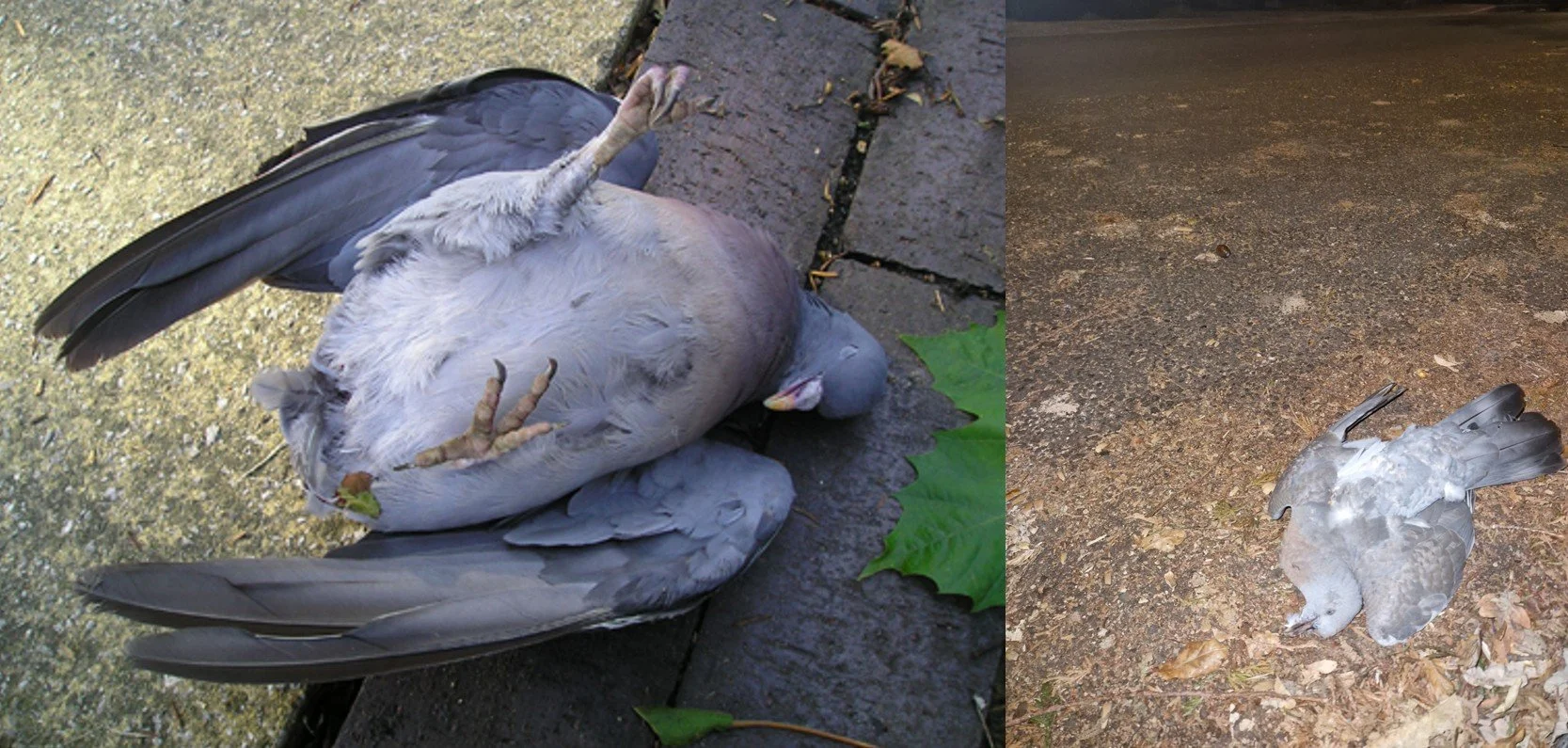
Caption: pigeons are frequently encountered as roadkill here in the UK. The Common wood pigeon Columba palumbus at left was dead at the side of the road and its lack of rectrices show that it had undergone ‘terror moulting’ prior to death, though whether this happened literally moments before it expired or hours or days before is unknown to me. At right, a juvenile wood pigeon on a road. Its position implies that it fell from the tree above before being hit by a car. Images: Darren Naish.
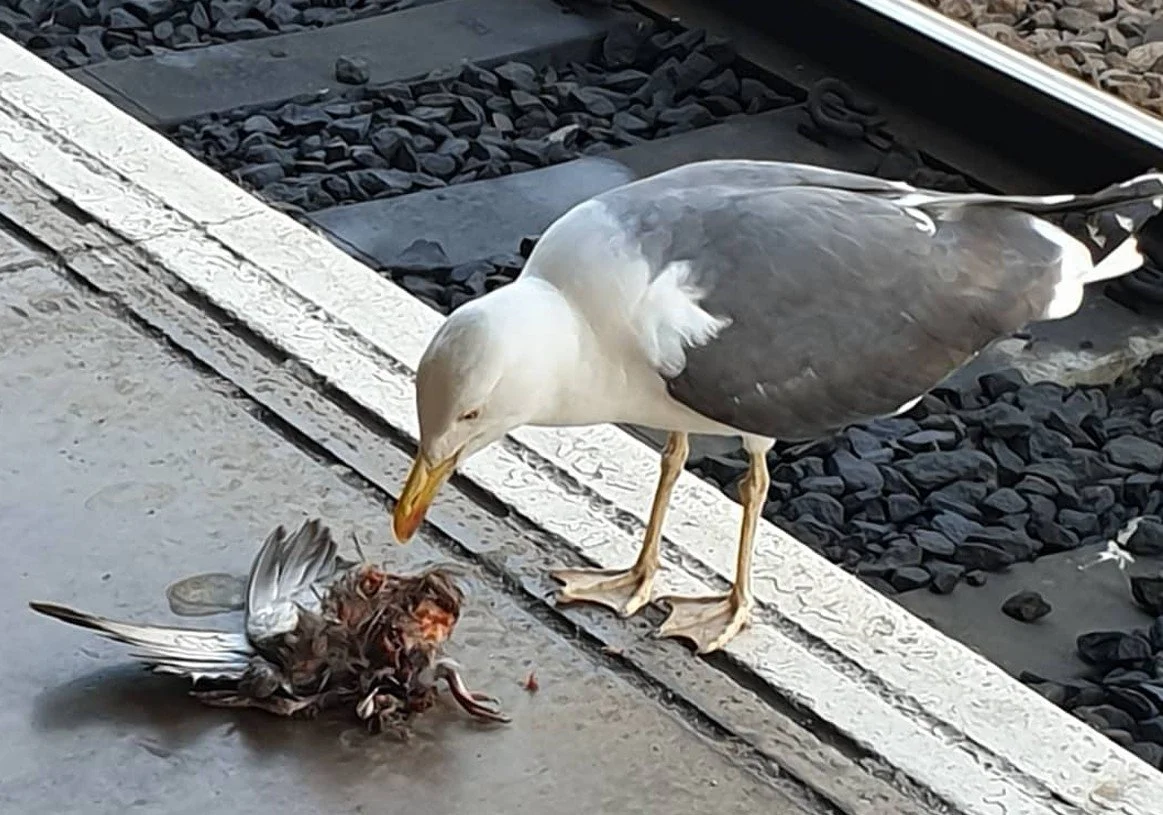
Caption: pigeons do have to deal with a list of predators, even in urban environments. Falcons and domestic cats are pigeon-killers of course, but so are gulls and corvids. This Lesser black-backed gull Larus fuscus at Bristol train station learnt how to kill feral pigeons and I watched it do this once. Image: Darren Naish.
And we’ll end things there. For previous TetZoo articles on pigeons, see…
The detachable tails of pigeons, September 2008
Are parrots actually pigeons?, May 2009
Giant club-winged pigeons and ninja ibises: clubs, spurs, spikes and claws on the hands of birds (part III), February 2011
Footless Urban Pigeons Suffer Untold Trials and Tribulations, September 2014
Voyeurism and Feral Pigeons, June 2015
The Asian Dove That Ate Europe Alive, January 2017
Pigeons and Doves 101, March 2018
The Dodo in Life, July 2020
Otidiphaps the Pheasant-Pigeons, April 2022
Refs - -
Clayton, D. H. 1990. Mate choice in experimentally parasitized rock doves: lousy males lose. American Zoologist 30, 251-262.
Fisher, H. I. 1957. Footedness in domestic pigeons. The Wilson Bulletin 69, 170-177.
Flach, E. J. & Cooper, J. E. 1991. Clinical and pathological findings in two Mauritian pink pigeons (Columba mayeri). Veterinary Record 129, 48-51.


