Alien animals of any sort, by definition, cannot (in the phylogenetic sense) be tetrapods. To be sure, they can’t really be animals either, given that they’re not part of the Terran clade Animalia. But details details. I will discuss books and projects relating to tetrapod-like aliens if I deem them sufficiently worthy, and such it is with the book I’m going to discuss here…
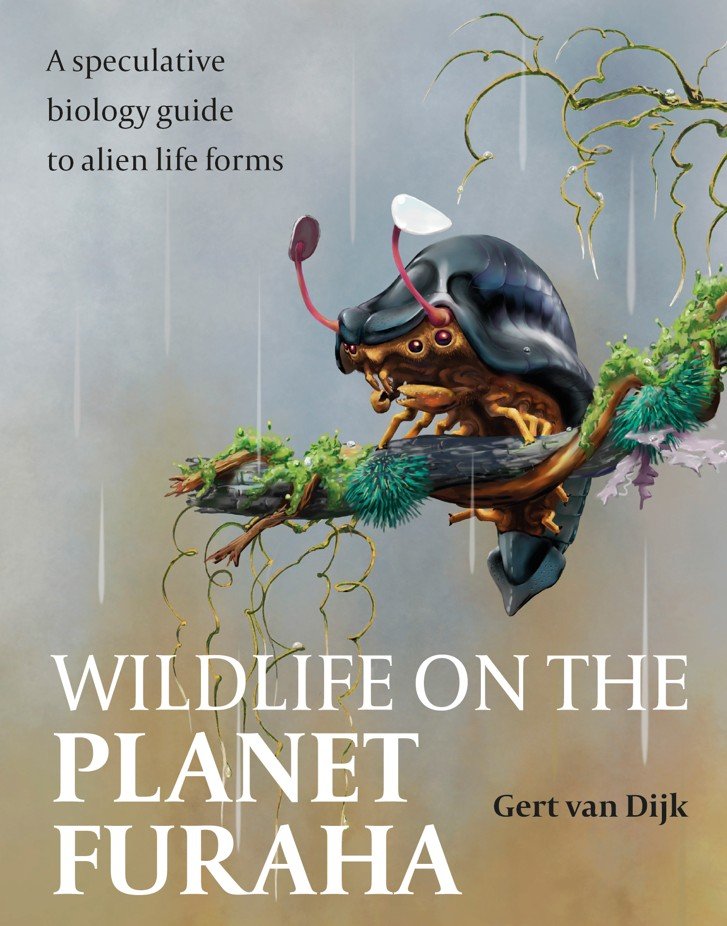
For some years now, author, artist and retired neurology professor Gert van Dijk has been running and compiling the very excellent blog Furahan Biology and Allied Matters. This is required reading for anyone seriously interested in the designing of hypothetical organisms and Spec Bio (speculative biology or Dixoniana) in general. Blogs and other websites are all very well and good, but a project only has ‘weight’ and some greater amount of permanence when it spawns a book, and such it is with Gert’s Furahan thoughts. After teases and promotions extending over more than ten years, I’m pleased to report that Wildlife on the Planet Furaha now exists in hard, physical form, and it was very much worth the wait.
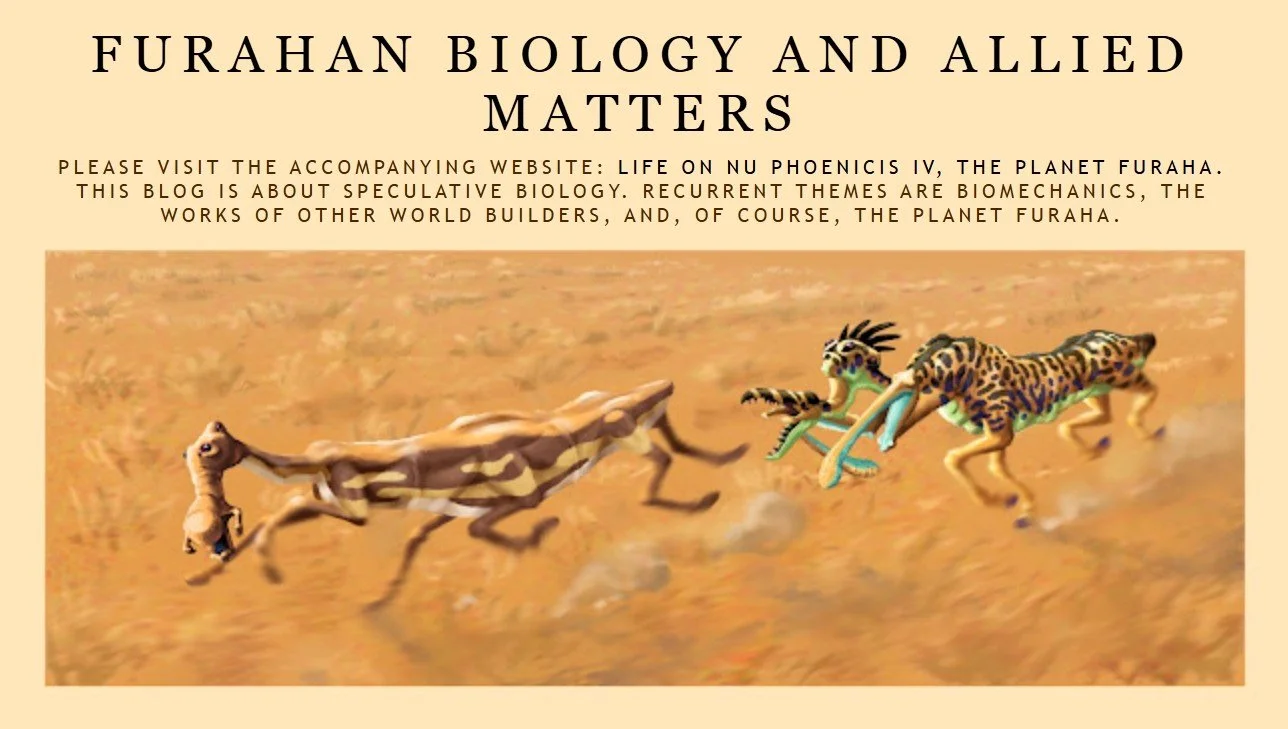
Caption: the current header for the Furahan blog, featuring two cursorial hexapod scalates, a bobbuck at left and prober at right. Both animals are mid-sized at close to 1.5 m in length. Image: Gert van Dijk.
The first thing to say is that this book is gorgeous: fantastically well designed, packed with illustrations of all sorts, and featuring spectacular full-page colour images. It might not be surprising in view of this that the author is a skilled artist who previously created cover illustrations for sci-fi works. Among the most interesting and compelling of books ever published are (in my opinion) those made by authors who have an artistic vision and a creative skill, since authors of this sort understand how to illustrate the concepts, objects and scenes they want to, in addition to knowing why this should be done in the first place.
People on Furaha. Furaha was discovered by Swahili-speaking spacefarers from East Africa and a backstory to its finding and the history of its study is discussed at the start of the book. Various key personnel, some pictured in the field or in their ceremonial academic garb, feature throughout and an entire history and academic genealogy of Furahan exploration and study, associated predominantly with the Institute of Furahan Biology, has been devised.
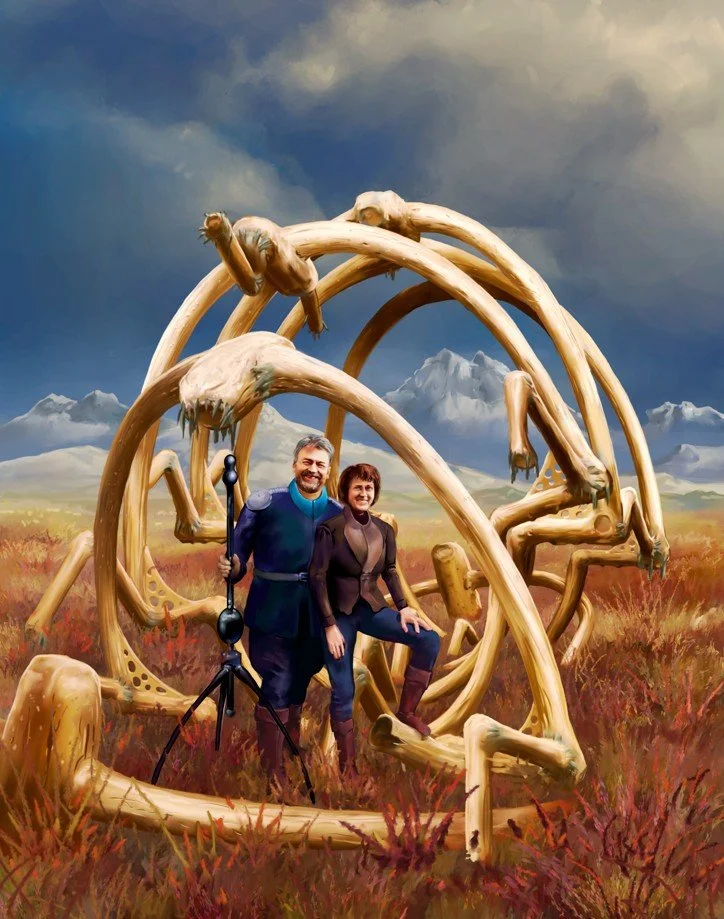
Caption: human explorers, travellers and scientists (including citizen scientists) feature throughout the book, and here are a happy pair adjacent to the bone-like internal elements of a brontorusp. Image: van Dijk (2025), used with permission.
It is a (sadly hypothetical) future to be proud of, where people have collaborated in honourable and scholarly pursuits, and where academic achievement is celebrated. We are reminded throughout the book that people have a tolerant, sensible view of the planet’s organisms, even deliberately avoiding the keeping of Furahan organisms as pets and use of the term ‘monster’ for those where it might be appropriate.
The organisms: plants and mixotrophs. The bulk of the book covers the main groups of organisms, all but two of the seven chapters being devoted to these. A complaint sometimes made about efforts to invent life on alien worlds is that plants, and plant-like organisms in general, are mostly ignored. That’s not entirely fair given that several authors who’ve written seriously about this topic have indeed devised alien plant life; I’m thinking of Lewis Dartnell, among others (e.g., Dartnell 2012). Furahan plants include giant, tree-like forms and many others, and not all are green.
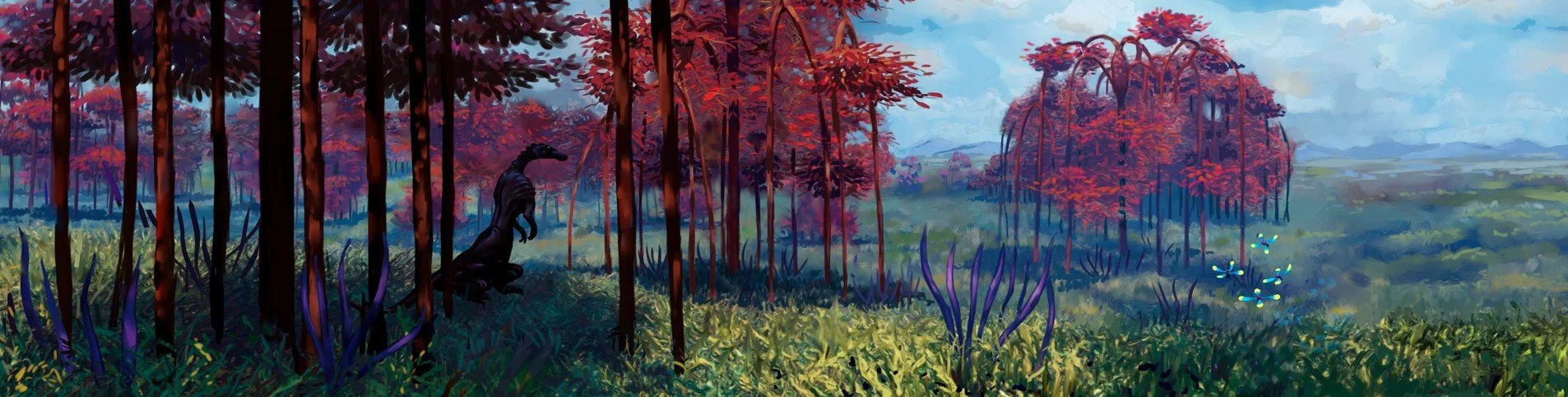
Caption: a beautiful panorama showing red polypremnic trees alongside green and yellow grass-like ground plants. The animal is a Snafe Factotum sequax, a centauric hexapod belonging to a group endemic to the isolated continent of Meralgia. Image: van Dijk (2025), used with permission.
Fungi-like organisms have their own chapter. Like many of us, I have, in recent years, been surprised and impressed by the number and variety of slime-moulds, rusts and other mixotrophs that can be found in the area where I live. Furaha’s mixotrophs are a fascinating and, in part, terrifying bunch. Several are large and absorb nutrients from carcasses; others have evolved trap-like structures (like the dentated spheres of the Phalanx) that enable them (or, at least, enabled their ancestors) to capture and digest animals. Complex lifecycles and innovative means of dispersing larvae are explained.
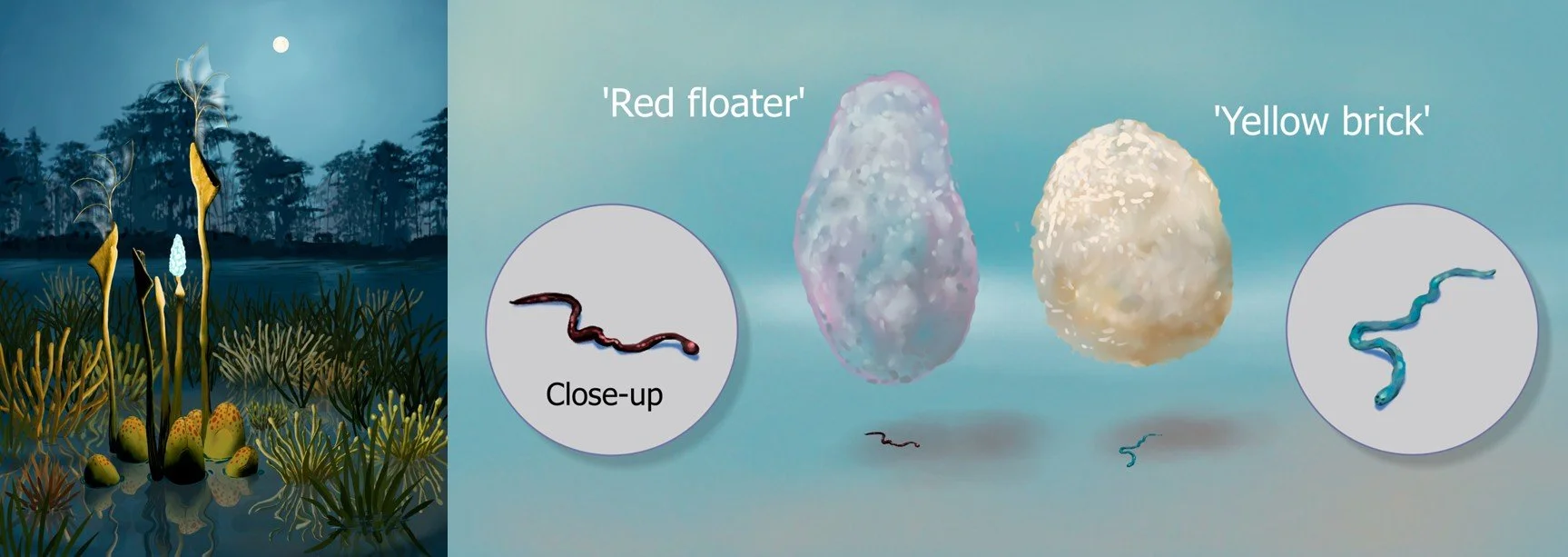
Caption: a mixotroph montage, showing a stand of Nightsnare Laqueus lentus at left, and representatives of the different dispersal methods used by Purple flyfoam Spumascansa damieni at right. The frothy, methanous ‘rafts’ transport the ‘brochos’ larvae. Image: van Dijk (2025), used with permission.
The organisms: kwals and arthropod-like groups. Moving to animals, Furaha is alive with aquatic and terrestrial species. Its skies are inhabited by volant ones too. If it’s not already clear, Furaha is not home to creatures that look like alien copies of Terran vertebrates, though some amount of convergent evolution is inevitable, as we’ll see. Jelly-like marine organisms termed kwals occur in the seas. Though broadly similar to Terran jellies and with similar reproductive and trophic adaptations, they have evolved a suite of innovations and are substantially more complex.
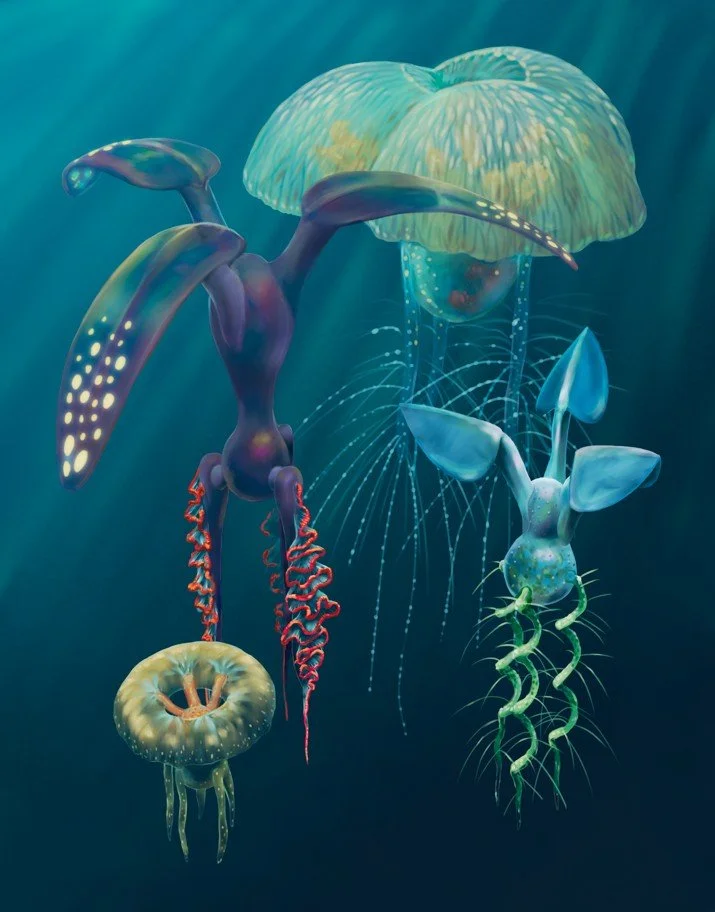
Caption: a selection of kwals, showing (top to bottom) big yellow blob, purple flapper, milky petal pedal and sea wheel. Numerous kwal species exist and the text explains how at least 60 species occur in the small section of coast where these four were encountered. Image: van Dijk (2025), used with permission.
Arthropod-like organisms termed wadudu (singular mdudu) are abundant across the planet and include multi-limbed, terrestrial taxa that resemble spiders, millipedes and insects. Spidrids are superficially spider- or crab-like animals that have adapted to deserts, coasts, woodlands and other habitats, ranging in size from less than 1 mm to 30-40 cm in diameter. Unlike arthropods, they exhibit radial symmetry, with four eyes mounted on the top of the head. They hence don’t have a ‘front’ and can move equally well in any direction.
Explanations and tests. This brings me a key aspect of the book, and indeed the entire Furahan project. Van Dijk’s organisms don’t just do whatever they do based on the designer’s intuition. Rather, he has shown his working, explained his thinking and has even indulged in hypothesis testing when devising body shapes and patterns of locomotion. A detailed and well-illustrated guide to spidrid locomotion is provided (van Dijk 2025, pp. 82-83). If the insect-like organisms of Furaha possess wings and are capable of flight, how would flight occur given body plans built on radial symmetry? Tetrapter flight is explained in a devoted section (van Dijk 2025, pp. 88-89), and likewise for matters concerning locomotion in other organisms.
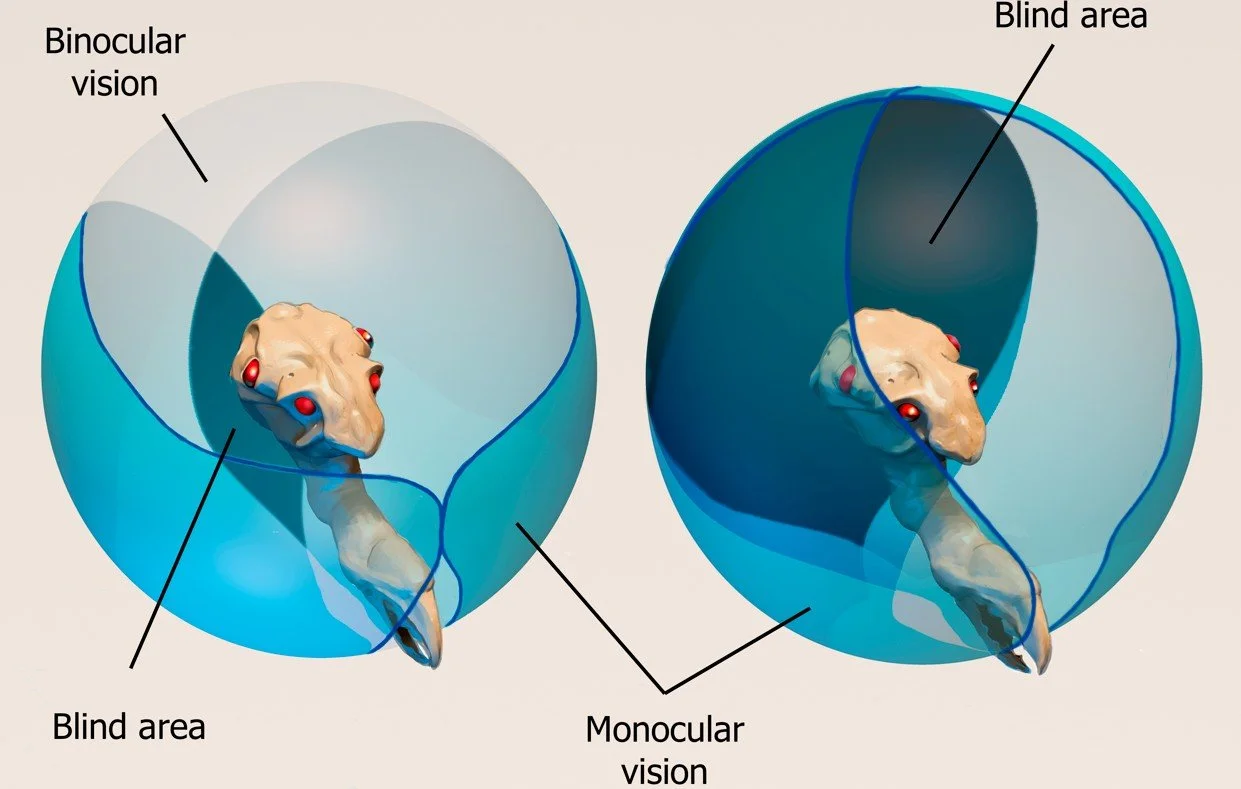
Caption: one of the many ‘technical’ illustrations that appears throughout the book, this one showing the field of vision of the Marblebill Iaculator weismuelleri, an arboreal predatory hexapod. Image: van Dijk (2025), used with permission.
Hypothesis testing does not always yield good news when inventing hypothetical organisms, and thus it is that the skies of Furaha are not filled with floating, balloon-like ‘ballont’ animals (“Unfortunately, physics said no to ballonts on an Earth-like planet, so all ballont paintings ended up in the archives”; van Dijk 2025, p. 152). I find this fascinating since it’s directly connected to a specific point I made in my recently published review of Dougal Dixon’s The New Dinosaurs (Naish 2026): in devising hypothetical or ‘alternative’ organisms, we might be providing an opportunity or opportunities to test certain possibilities that have otherwise gone unexplored. Well, here is an example of exactly that… albeit explored in the broader body of van Dijk’s writing online and not in this book.
This is all phenomenal stuff and those aiming to produce similar works should do likewise. I certainly intend to when I get round to creating a Squamozoic book.
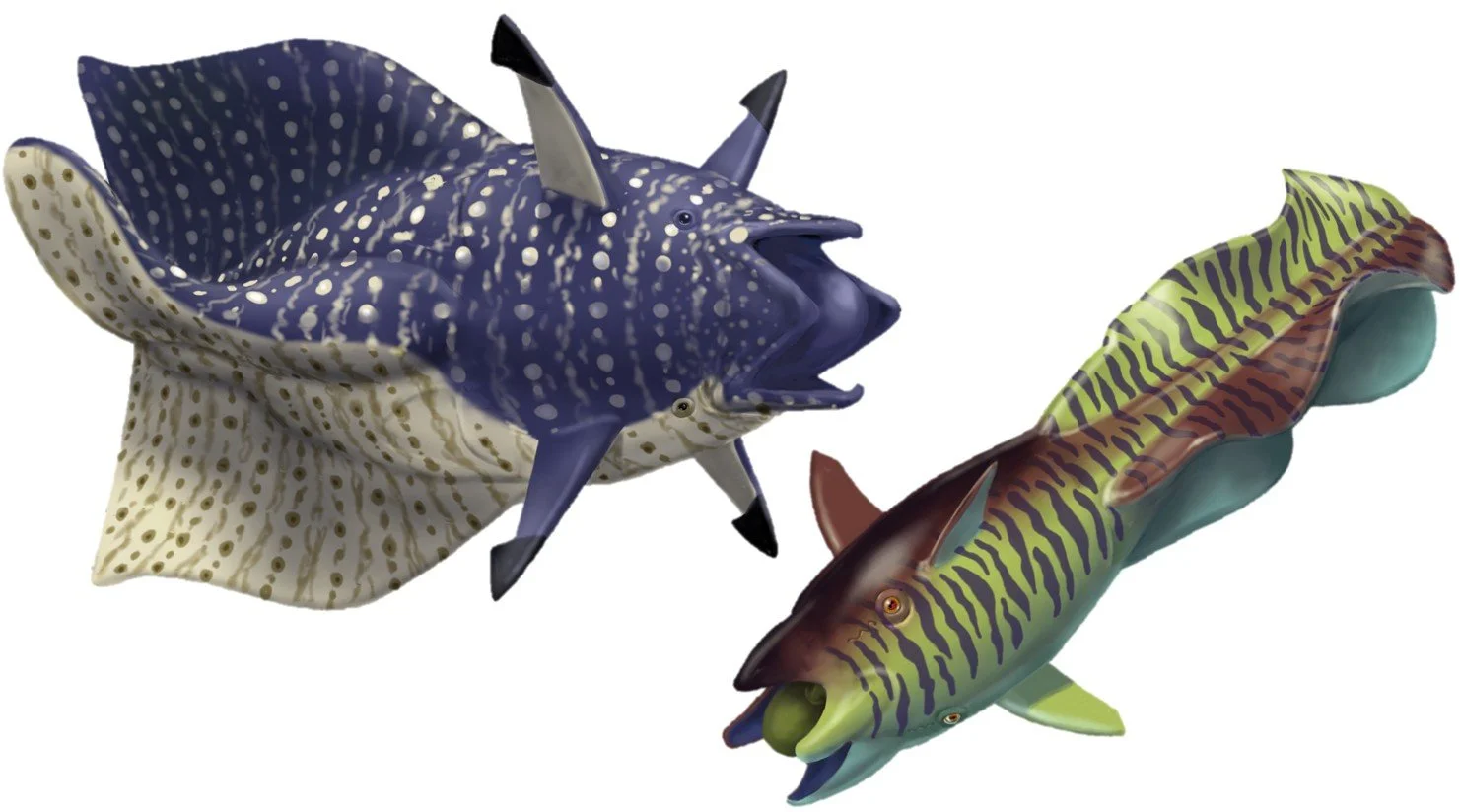
Caption: two of the many cloakfishes illustrated and discussed in the book. At left, a Starfish Tanypteryx archicus; at right, a Common cloak Tetrachlamus pycnus, a species regarded as “the prototypical cloaky” (van Dijk 2025, p. 65). Image: van Dijk (2025), used with permission.
Furahan ‘fishes’: cloakfishes and aquatic scalates. Several aquatic Furahan groups look and act like ‘fishes’. Firstly, there are the cloakfishes, a group whose species differ fundamentally from Terran fishes in having four-sided symmetry and a method of propulsion based on the undulation of four longitudinally aligned membranes, these explaining the common name. There are over 10,000 cloakfish species in the Furahan seas and oceans and they feature a dazzling array of colours, patterns and lifestyles. The very biggest have a full span of 7 m. All cloakfishes are filter-feeders that, despite their alien shape, do have distinct dorsal and ventral surfaces and consequently have dorsoventral counter-shading.
More diverse in shape and ecology are the several ‘fish’ groups united as the scalates, the subgroups of which document an evolutionary transition. Archaic groups possess lateral swimming membranes and multiple jaw pairs, but indentations and a reduction of membrane extent ultimately led to the evolution of three sets of paired fins, the most posterior of which fused in one group. Changes in jaw configuration and respiratory anatomy occurred in step with these events. A cladogram depicts the relationships of these groups and where the relevant anatomical traits occurred.
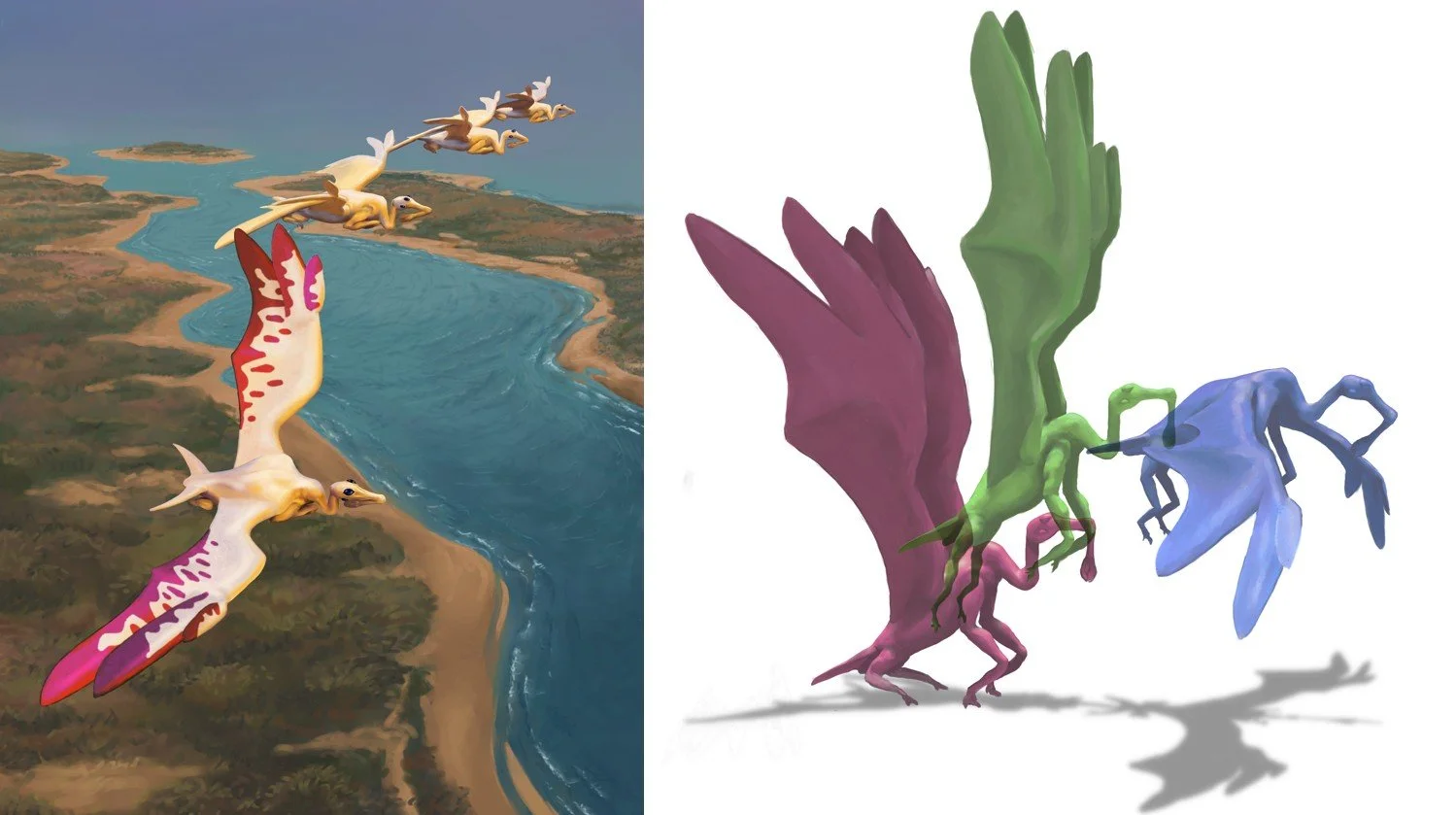
Caption: the major Furahan clade of terrestrial scalates includes terrestrial and aquatic species, and fliers too. Some have four wings (the group Quadrialata) and others two (the group Dialata). The images here show korongoes Dromodraco drungus, in flight and in a diagrammatic takeoff sequence. This is a large dialate species with a wingspan of up to 5 m. Image: van Dijk (2025), used with permission.
Skeletons have evolved in scalates but the arrangement of the internal components is not like that of vertebrates, whereby the evolution of hard structures about a midline notochord was among the first of events. Scalates on Furaha started the evolution of their skeletons with the reinforcement of their lateral membranes, the result being a series of ‘rail bones’ (connected via ‘node bones’) that extend parallel to the long axis on the body’s outer edges. Rung bones then evolved, connecting left-side to right-side rail and node axes. The result is a ladder-like skeleton (hence the group name).
Terrestrial scalates termed hexapods (no connection to the Terran arthropod clade Hexapoda) include a diversity of heavy-bodied herbivores and omnivores, small arboreal forms, cursorial herbivores and predators, and large, long-limbed suspensory species like marblebills and berbies. Some terrestrial hexapods possess an elevated anterior section and their anterior-most limb pair is specialised for a role in disabling or killing prey, this configuration being termed centaurism. Some terrestrial hexapods have returned to life in water, such that there are superficially seal-like forms.
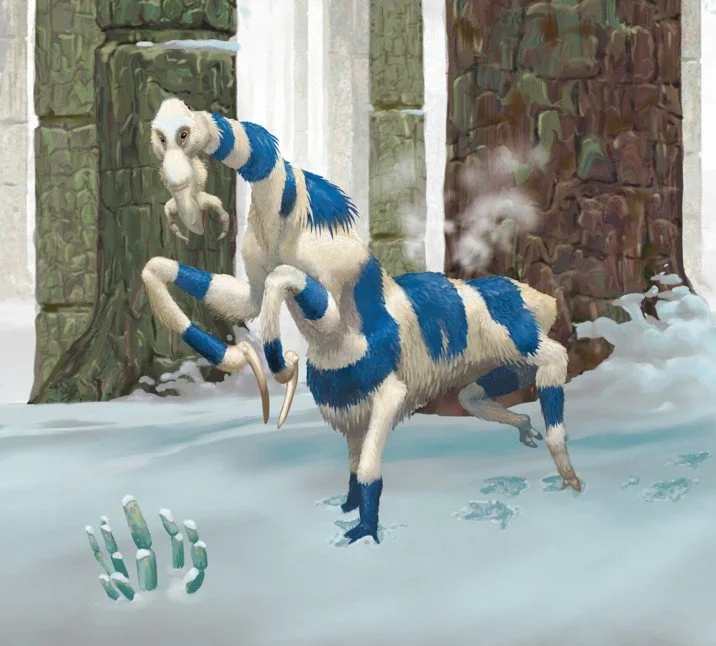
Caption: a Stickler Perfixor artifex, a predatory centauric hexapod of North Auralgia that undergoes colour change across the seasons. It is social and potentially dangerous to humans. The full illustration is taller and occupies an entire page. Image: van Dijk (2025), used with permission.
Rusps, including megarusps. Finally, hexapods are not the only large, terrestrial animals on Furaha. Rusps are long-bodied, multi-limbed animals that look something like armour-plated caterpillars, albeit equipped with an extensible mouth and, in some, a whip-like defensive organ attached to the head. The biggest – certain of the megarusps – are sauropod-sized. The existence of an apparently extinct megapredator that once posed a danger to these animals is hinted at.
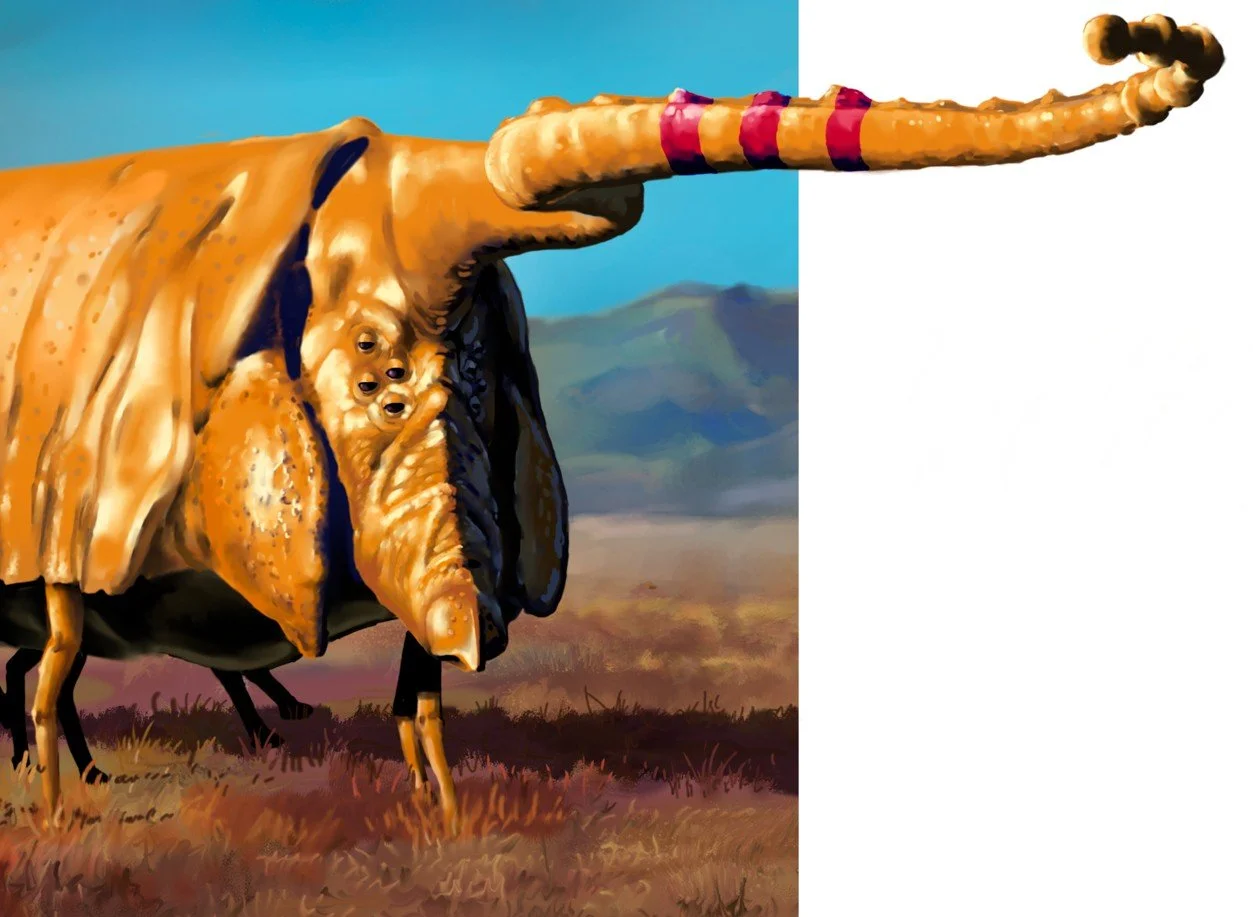
Caption: the anterior end of Brontocrambis brucus, the Brontorusp, as it turns to face the viewer. Without the whip, this animal is 25 m long. The book features a double-page spread showing this species in its environment, plus another showing various megarusps to scale. Image: van Dijk (2025), used with permission.
This is a tremendously fun, charismatic and innovative menagerie. Many of the animals look great and I find their evolutionary backstories plausible. I should emphasise that my discussion here only scratches the surface and that numerous other creatures win coverage in the book. In addition, the book is not a complete list of all Furahan organisms but only a tour of various highlights. My only complaint is the absence of one or more big cladograms that show the relationships between the main groups, since it isn’t immediately clear how the main Furahan clades are related to one other.
As fun as it is to think that Furaha and its wildlife might be real… alas. An Appendix discusses the ‘prehistory’ of this project and discusses how the author got the whole thing off the ground, this section also featuring some of the art he created during its earliest stages. A glossary of Furahan terms follows, and there’s an index too.
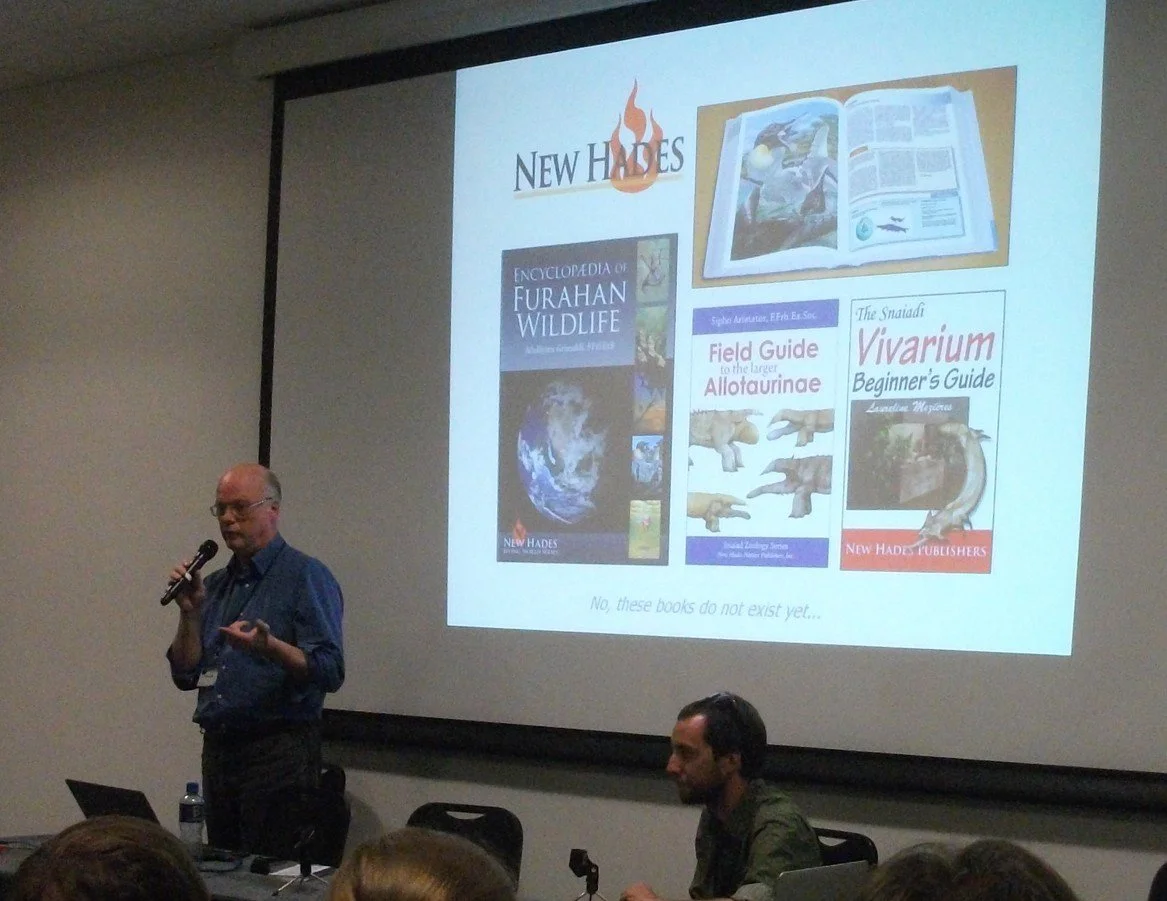
Caption: proof that the idea of this book has been on the cards for a while. This photo was taken at the Spec Bio workshop at LonCon3 of August 2014, and the screen behind Gert (who is standing at left) shows the semi-hypothetical cover of an Encyclopedia of Furahan Wildlife (a double-page spread is visible at top). C. M. Kosemen is sitting at right, and you can see semi-hypothetical books devoted to Snaiad as well. Image: Darren Naish.
As is tradition ever since Dixon, Furahan organisms have binominal names. These feel real and are always worth checking, since they often include fun references to relevant people, among them Dougal Dixon and Johnny Weismueller. I have doubts about the species name in Pigritia sursumvergenspropterpenuriaponderis (the Righteous phelp) making it through peer review though. There are references to other Spec Bio projects here and there. Snaiad exists in the Furahan universe, for example (van Dijk 2025, p. 18). I spotted the Jaws reference but won’t spoil it.
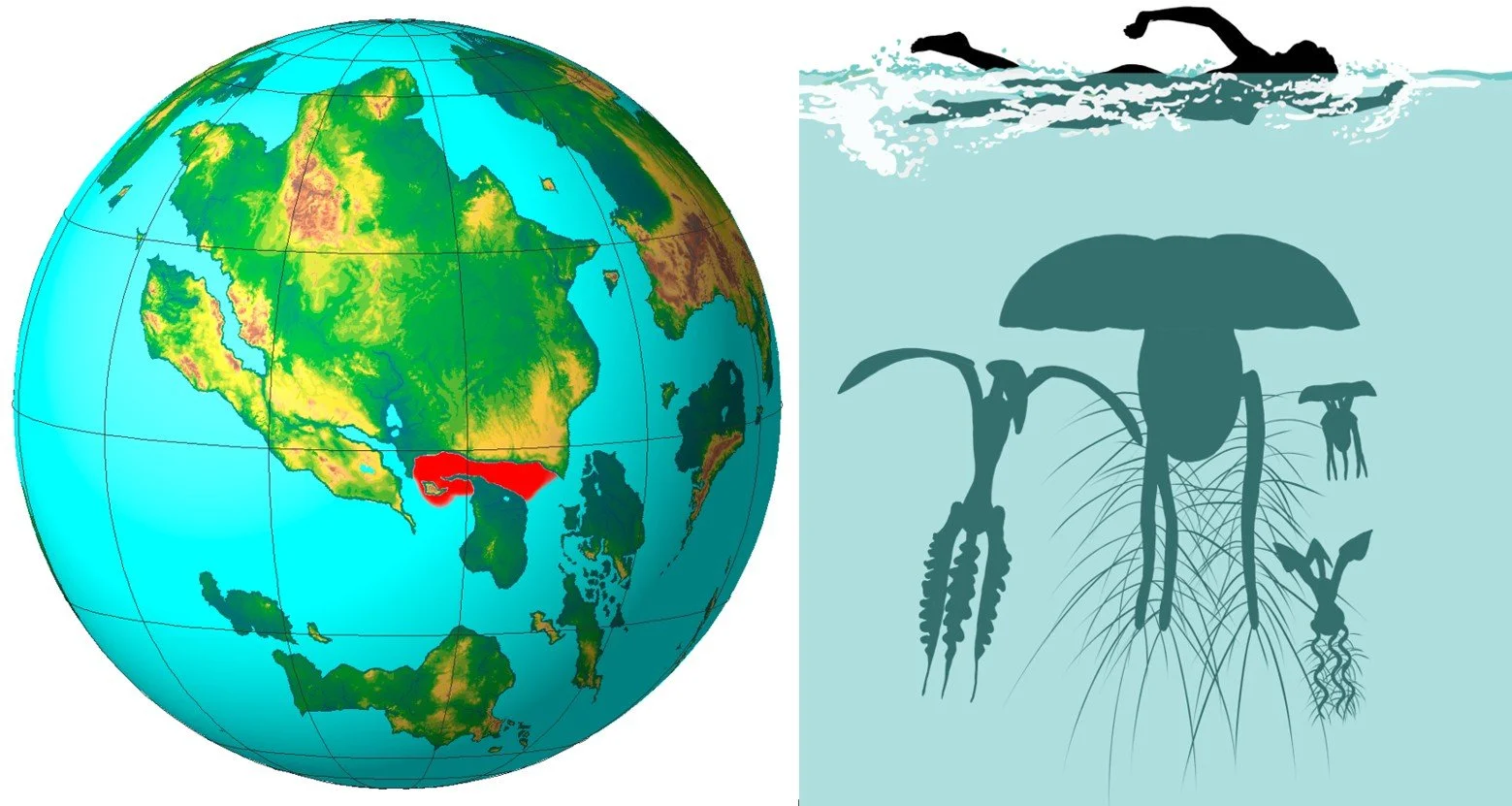
Caption: the book features ‘range map’-type illustrations throughout, showing the known distribution of the species or group in question in red. Also featured throughout are scaled silhouettes showing the organisms with a selection of (often amusingly posed) humans. All of these diagrams are immaculate and wonderfully drafted. Image: van Dijk (2025), used with permission.
Wildlife on the Planet Furaha is a real tour-de-force that does its subject very, very proud. The book is beautifully designed, flawlessly edited, and tremendously fun to read. It is also highly affordable. Books on speculative biology are rare, and those few good ones that exist have – with exceptions – been discussed or even reviewed at Tet Zoo within recent years. It’s therefore very fitting to have the opportunity to discuss Wildlife on the Planet Furaha here.
In short, I adore this book and recommend it extremely highly. You must get hold of it if your interests overlap mine, and my congrats to the author and the publishers on a job very well done.
van Dijk, G. 2025. Wildlife on the Planet Furaha: A Speculative Biology Guide to Alien Life Forms. The Crowood Press Marlborough, UK. ISBN 978-0-7198-4571-0, softback, illustrations, pp. 160. £20.00/$29.99. Here from the publishers (but seemingly sold out). Here from a giant international conglomerate.
For previous Tet Zoo articles on Spec Bio and associated fields, see…
The Dougal Dixon After Man Event of September 2018, September 2018
Dougal Dixon’s After Man, the Initial Pitch Document, June 2020
Humanoid Dinosaurs Revisited Again: Russell and Séguin’s Dinosauroid at (Nearly) 40 Years Old, August 2021
Speculative Zoology and the World of After Man; an Interview With Dougal Dixon, April 2025
Speculative Zoology Grand and Photoreal: Boulay and Steyer's Demain, les Animaux du Futur, April 2025
Refs - -
Dartnell, L. 2012. Life under alien skies. Physics World 25, 26-30.
Naish, D. 2026. The New Dinosaurs: an alternative evolution. Historical Biology doi 10.1080/08912963.2026.2627439
van Dijk, G. 2025. Wildlife on the Planet Furaha: A Speculative Biology Guide to Alien Life Forms. The Crowood Press, Marlborough, UK.


