It’s time for another article in my Tet Zoo Reviews Zoos series, and this time we look at a zoo in that troubled and terrifying nation known as the USA, specifically in the north-western state of Oregon…
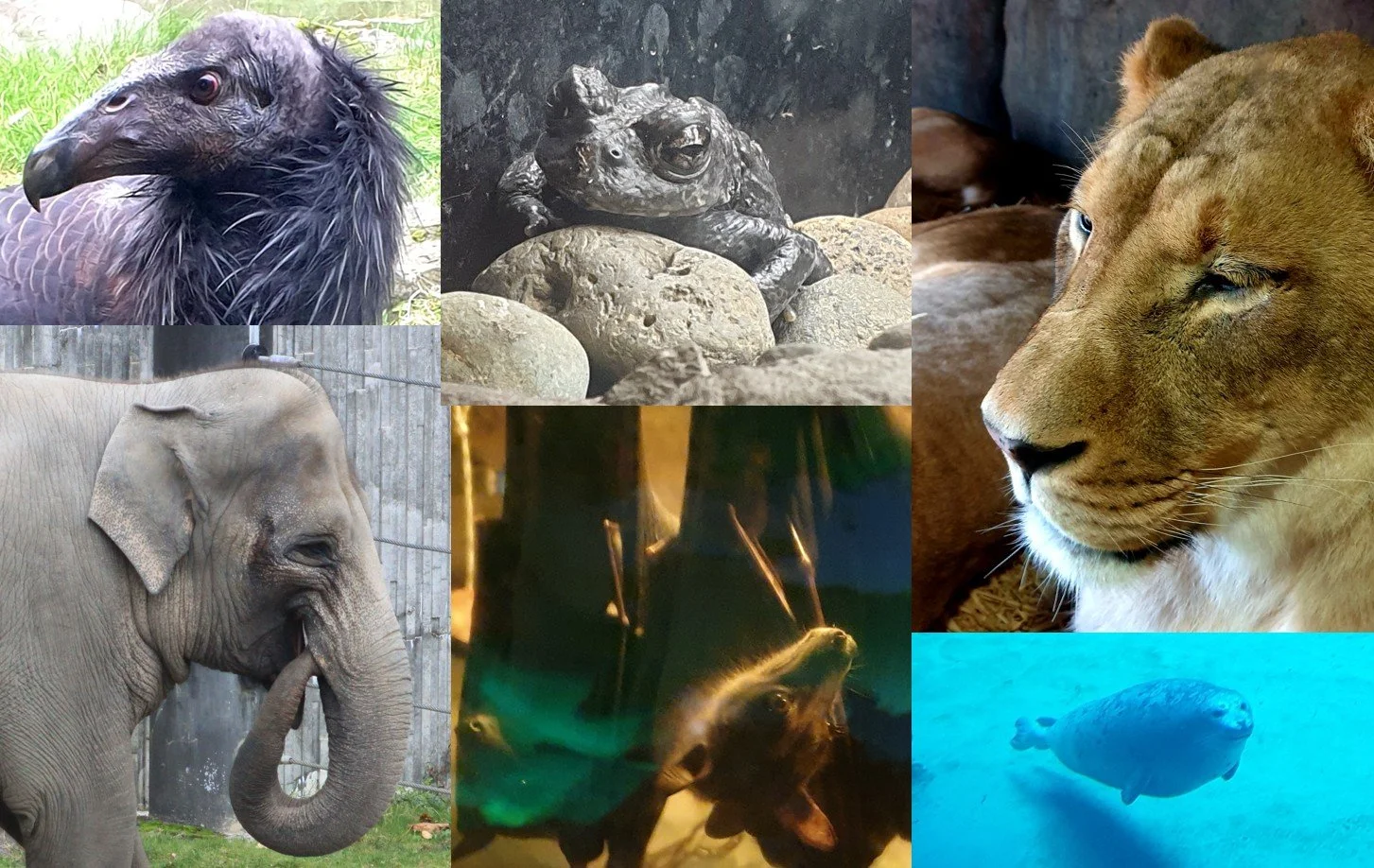
Caption: an Oregon Zoo montage, featuring animals seen on my visit of late 2022. Images: Darren Naish.
My Oregon Zoo trip wasn’t recent but happened way back in November 2022; I just haven’t had time until now to finish the article. I should mention that I was able to visit thanks to the hospitality of my host, the very excellent Nico Spadafore, so big thanks to him. Nico himself worked at the zoo back in the distant past and thus gave me some great insider info that I wouldn’t have had otherwise.
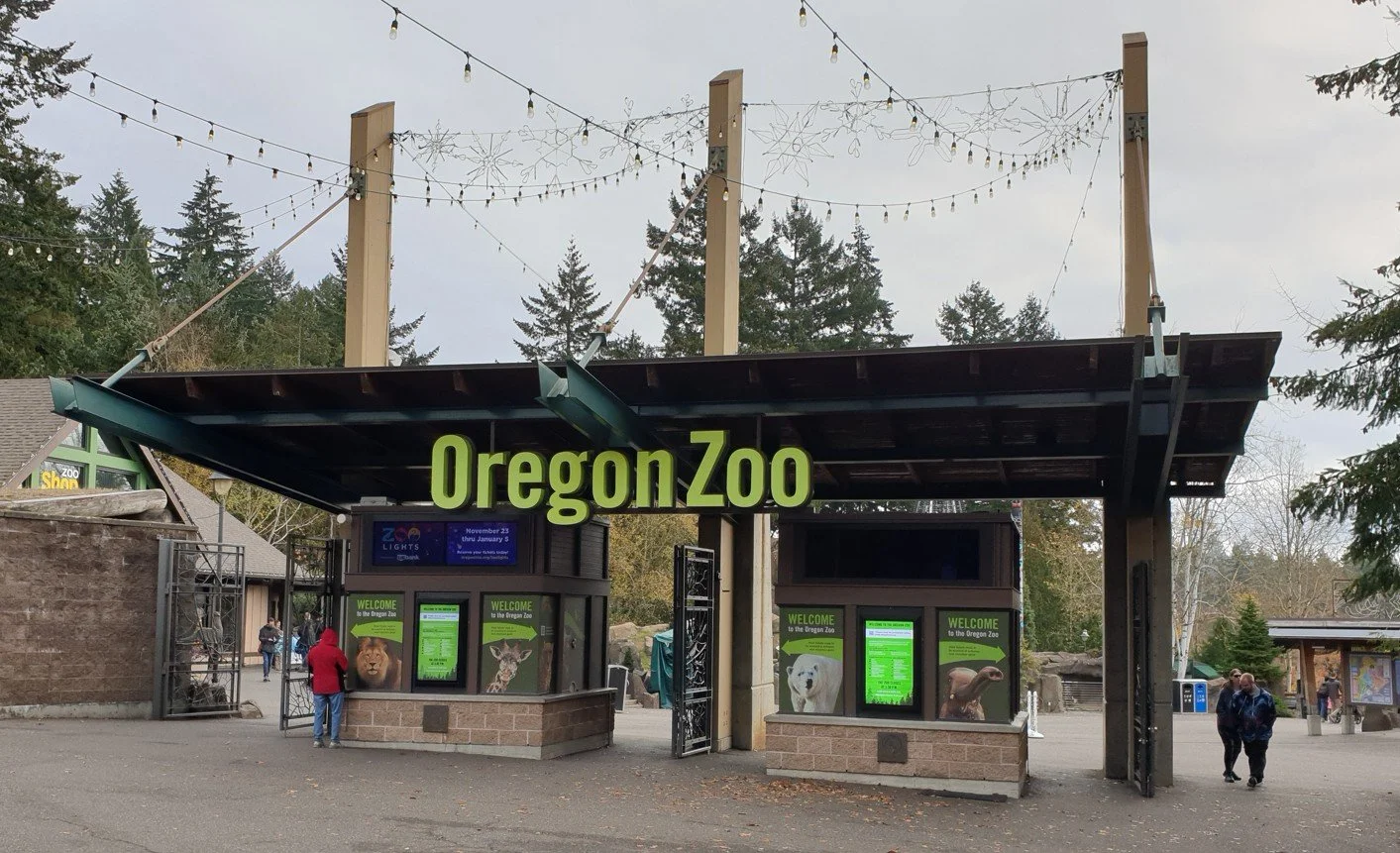
Caption: the zoo’s main entrance is relatively understated. The iron gates (just visible here) feature nice metal sculptures, including of penguins, otters, monkeys, elephants, rhinos, flying frogs(!) and more. Image: Darren Naish.
Oregon Zoo was founded in 1888, making it the oldest zoo in the entire west of the US, but it changed locations and names a few times prior to its 1959 relocation to Washington Park. It’s involved in a good number of conservation efforts, several involving local species like Oregon spotted frog Rana pretiosa, Pygmy rabbit Brachylagus idahoensis (specifically those of the Columbia Basin population) and Oregon silverspot butterfly Speyeria zerene hippolyta. The zoo has a leading role in California condor Gymnogyps californianus conservation, both in terms of breeding and releasing birds into the wild and in leading educational campaigns to reduce the quantity of lead shot that exists in condor habitat. Some of the condors involved in the zoo’s programme are on exhibit but others are kept at the off-site Jonsson Center in Clackamas County. They’ve then been released in northern California and the hope is that they’ll naturally expand their range to recolonise Oregon.
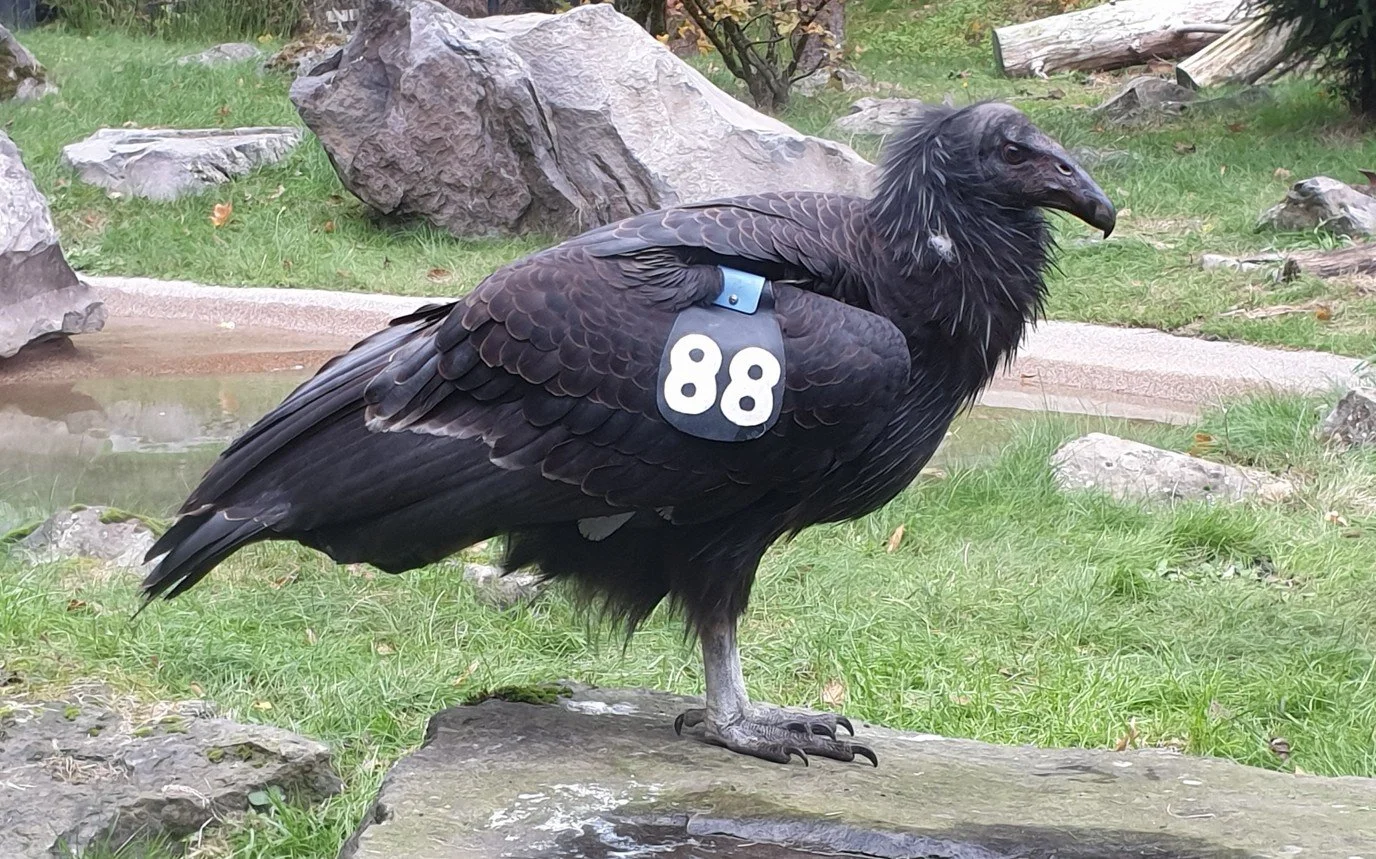
Caption: each California condor is identified by its numbered tag, and here’s one of the several individuals (a young one) that was on show at the zoo during the time of my visit. Fossils show that California condors were far more widespread in the geological past, formerly occurring east to west across North America. The habitat we associate with them today is by no means one the species is specialised for. More on condors below. Image: Darren Naish.
Oregon Zoo houses six zones: Great Northwest (devoted to North American wildlife), Pacific Shores, Primate Forest, Elephant Lands, Africa and Discovery Zone. My coverage here will discuss the animals and enclosures as they were encountered by Nico and I as we walked through the zoo, rather than in phylogenetic order or anything like that. Our visit occurred on an overcast, sometimes rainy, day and this affected both my chances for photography and the tendency of the animals to be out and about.
Great Northwest. Immediately upon entering the zoo, you’re in the North American ‘Great Northwest’ section, the trees and landscaped and planted areas surrounding the walkways being of Oregonian sort. Puma Puma concolor was on show (the zoo uses ‘Cougar’) and nearby were two Bald eagles Haliaeetus leucocephalus. It looked to me as if both birds had damaged eyes and this made me think that they were rescued birds that couldn’t be released into the wild.
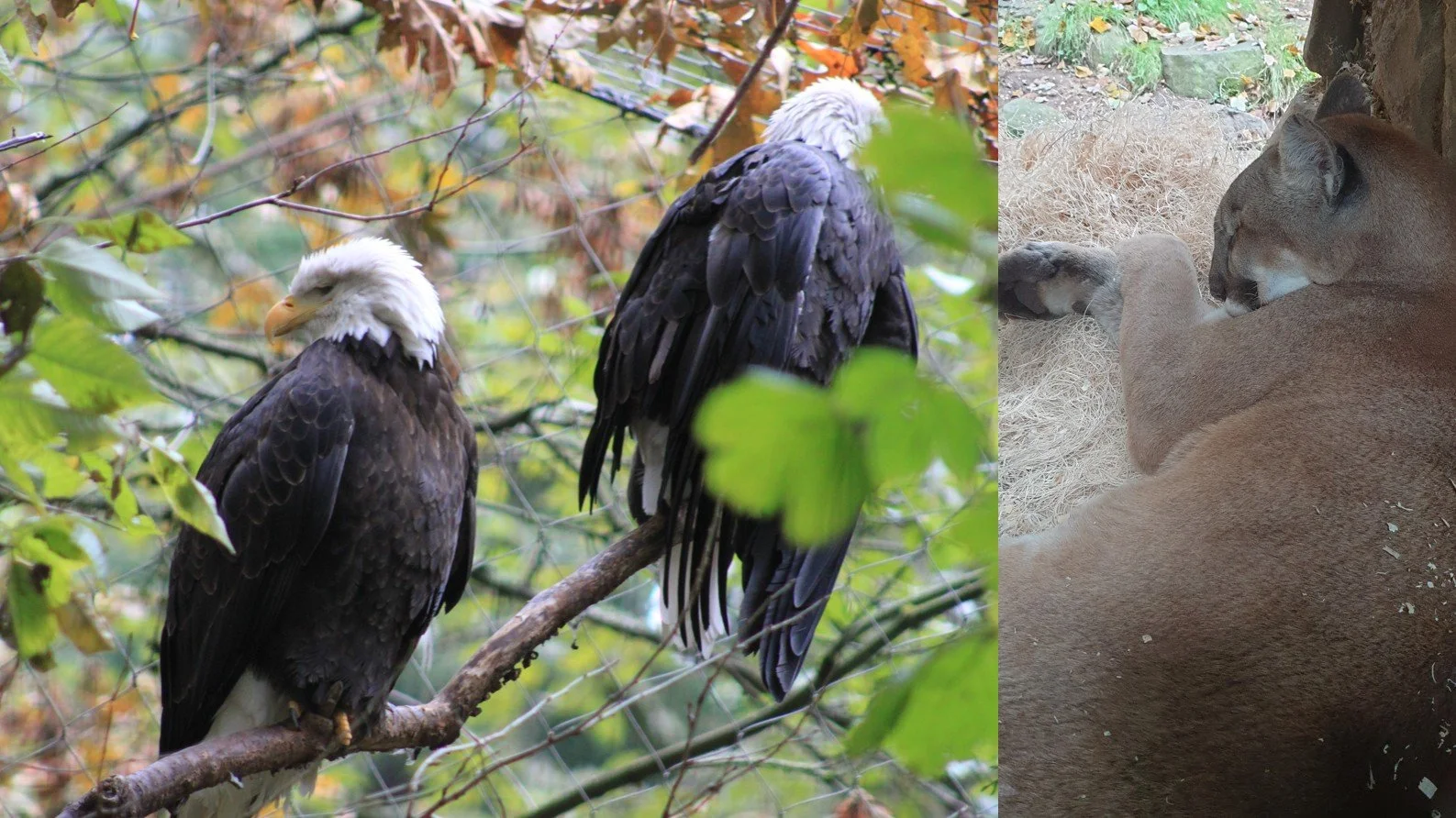
Caption: two Bald eagles on a tree on a damp day. The Bald eagle would be better termed the White-headed eagle (‘balde’ is an old term for ‘white’), and of course versions of this name are used in some languages. At right, one of two reclining Puma seen during our visit. I assume that they’re of local, North American origin, since the species is distributed north to south throughout the mainland of the Americas. Images: Darren Naish.
Close by was a Rocky Mountain goat Oreamnos americanus, a new species for me and one I was very happy to see up close. As you can see, the individual I photographed was both co-operative and charismatic and provided a good view of its tongue (for some reason) as well as its horns and bodily profile. Oreamnos is a strange animal and isn’t really a ‘goat’ at all: it’s not a close relative of the Old World animals most properly associated with that name (Capra hircus and kin), instead perhaps being closer to takins.
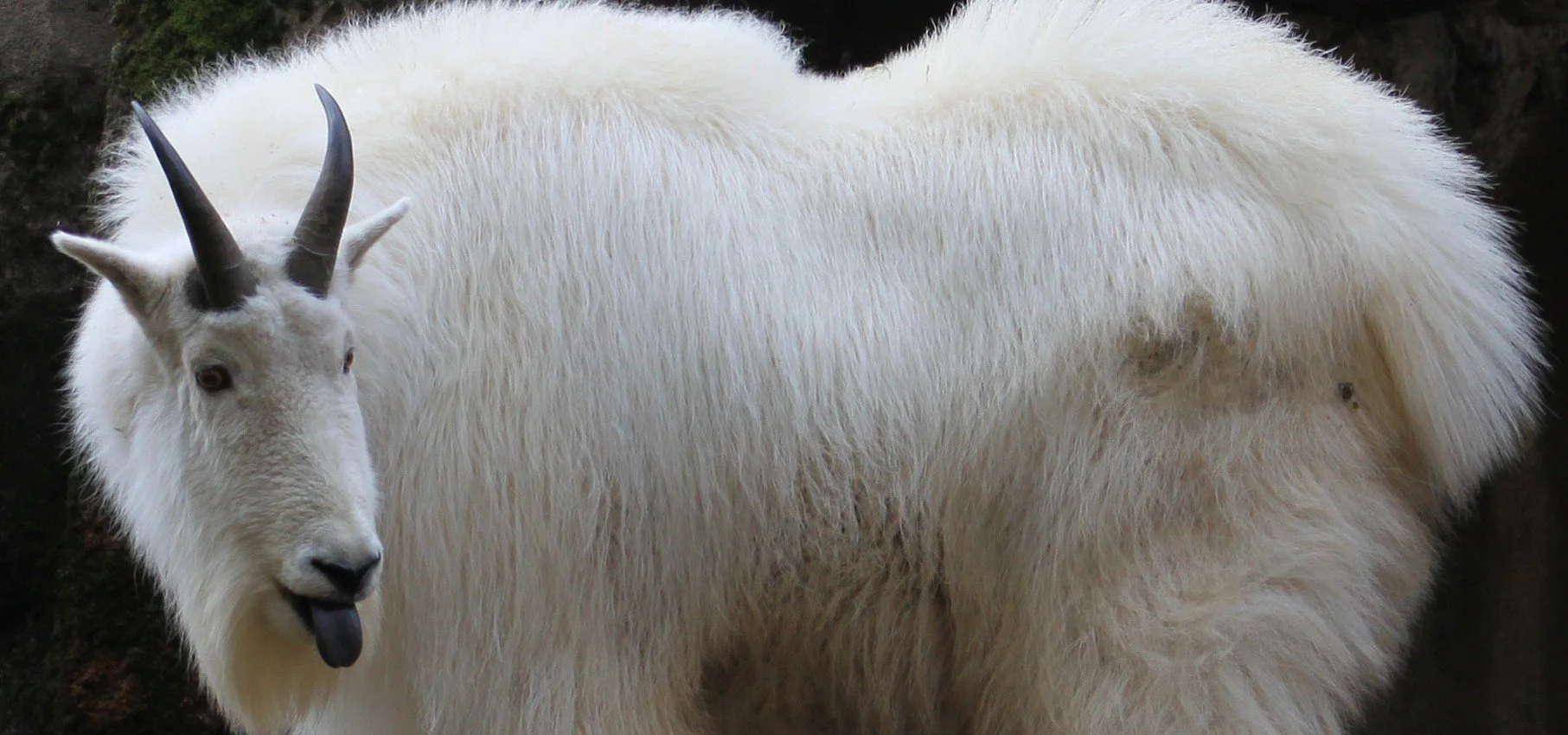
Caption: maybe you’ve seen a Rocky Mountain goat before... but have you seen its tongue? The tongue is smooth and greyish, with a slightly notched tip. Image: Darren Naish.
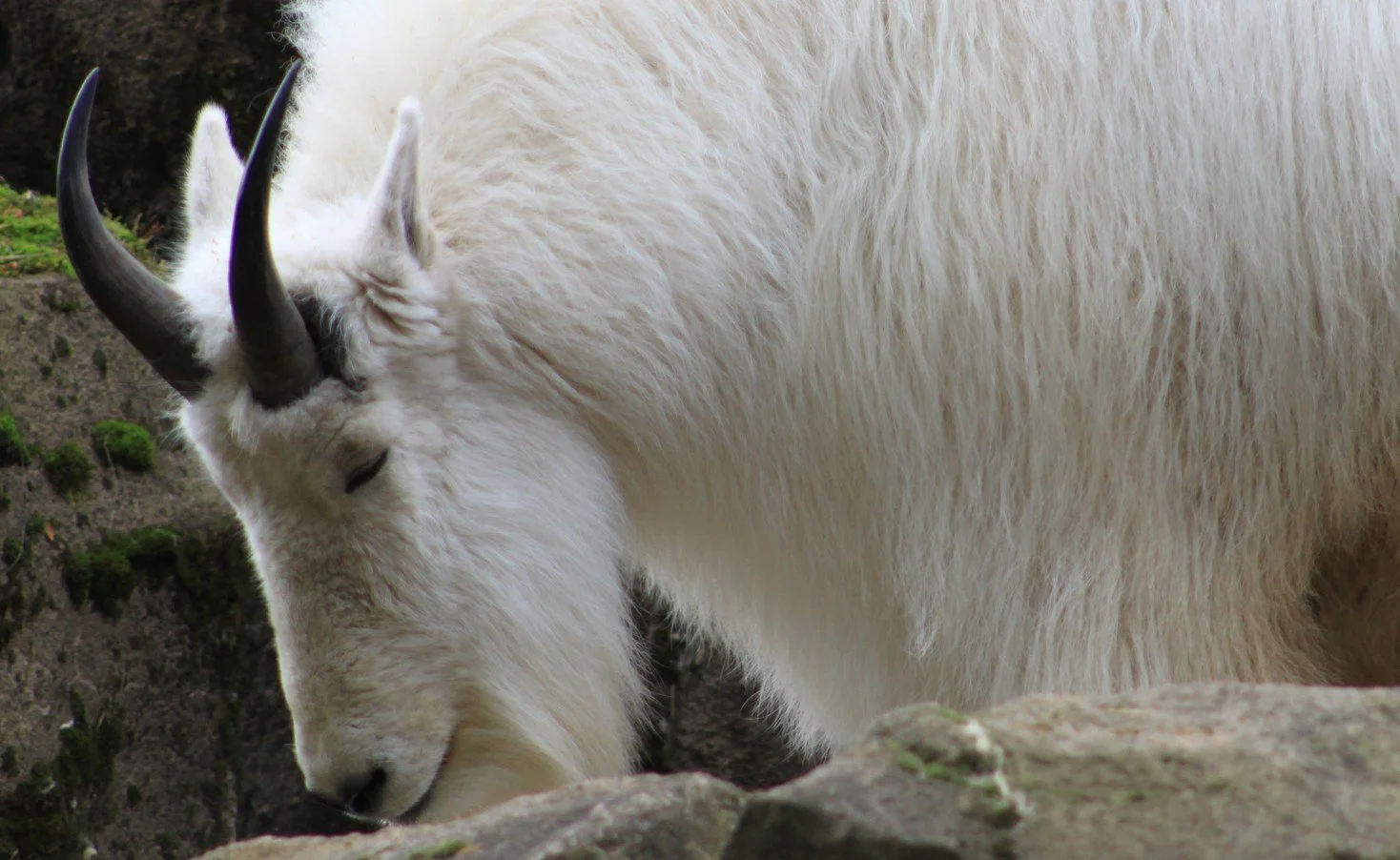
Caption: as a collector of toy and model animals, I’ve always been bothered by the fact that several toys of this species give it light brown horns with transverse rings or ridges. As you can see, they’re dark grey and smooth. Image: Darren Naish.
Nearby was another new species for me but one highly familiar to many North Americans: a Black bear Ursus americanus. I haven’t spent enough time in North America to ever see a Black bear, either wild or in captivity, and this one was not only of the very dark sort typical for the species but also a highly robust – I’m not going to fat shame – individual with substantial adipose deposits about the body. The animal was engaging in an interesting behaviour that I’ve elsewhere seen in pet cats: it was dunking its paws in a trough and then licking off the water. Presumably (and hopefully) this reflects the fact that it wanted to drink, since behaviour of this sort can reflect boredom, a real problem for captive bears as I’ve said before.
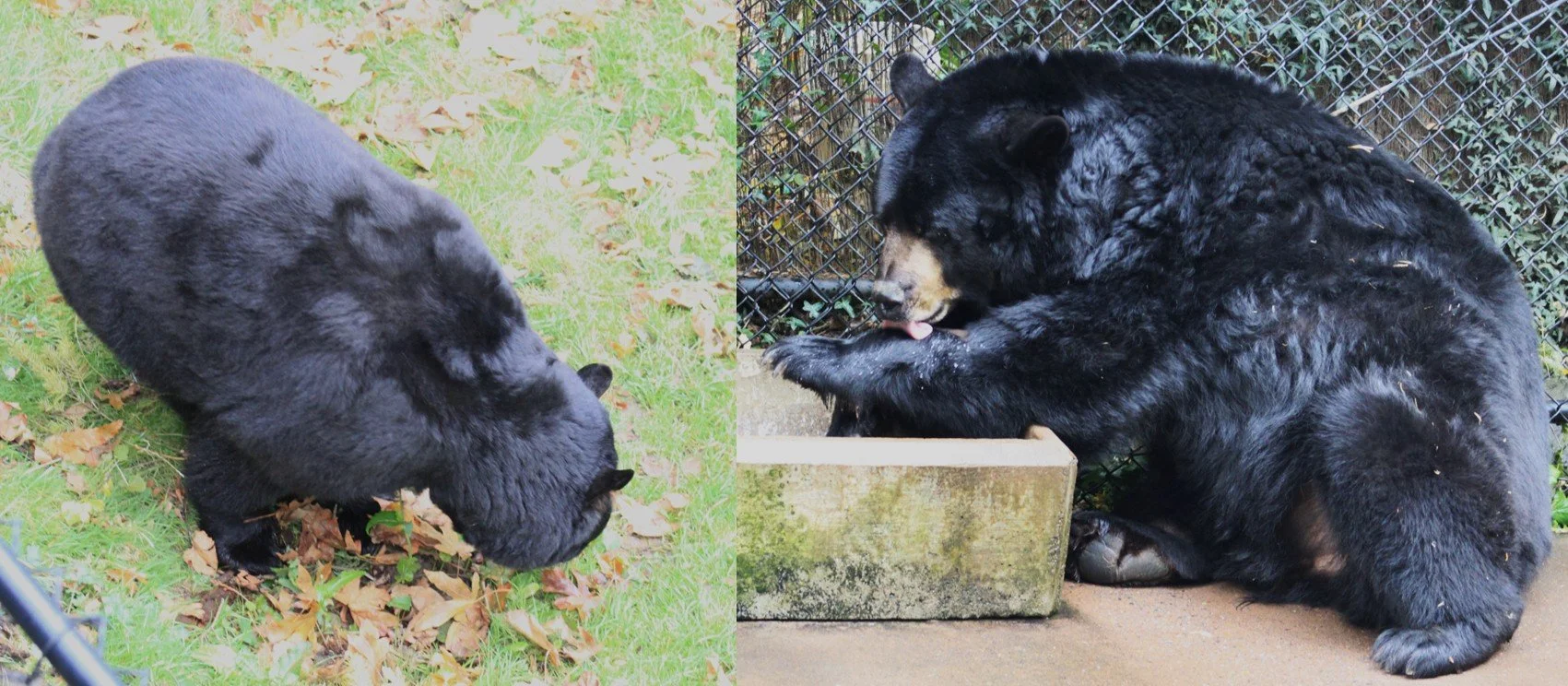
Caption: the bad lighting of the day has resulted in poor photos, many a bit washed out (though the real excuse is that I’m a poor photographer with no good understanding of how cameras work). Here’s one of the zoo’s several American black bears, seen from an overhead walkway and while it was reclining at a drinking trough. Images: Darren Naish.
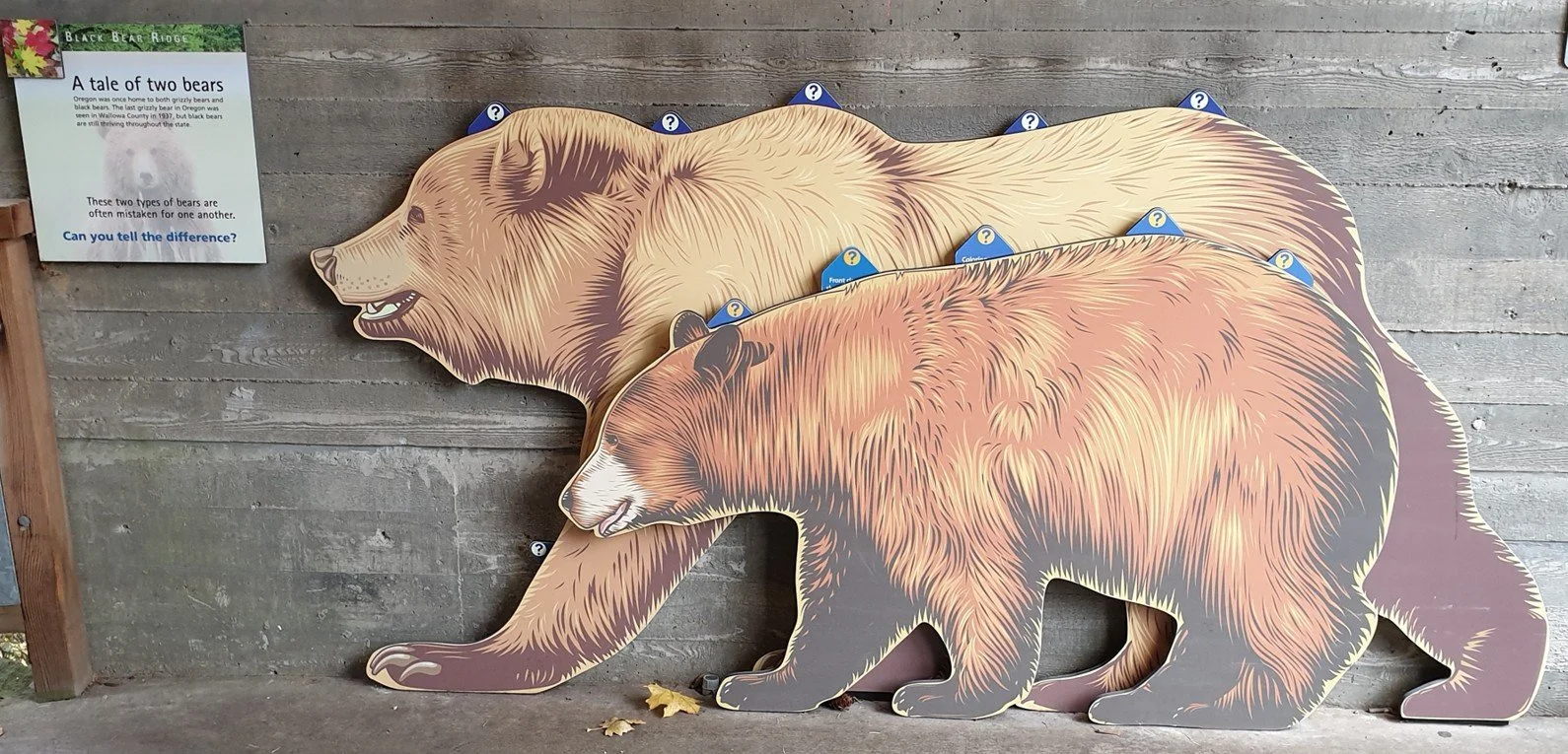
Caption: any and all bears can be dangerous, but this comparison at the zoo emphasizes how a black bear (not all populations of which are black) is a very different beast from a grizzly, which is an American version of the brown bear Ursus arctos… at least, according to the taxonomy we use today. I really must write some time about the bear taxonomies that were used in the past. Image: Darren Naish.
A covered walkway, landscaped to look like a natural tunnel, was home to a Pacific lamprey Entosphenus tridentatus exhibit and a large, glass-fronted display featured trout and sturgeon. Northwestern garter snake Thamnophis ordinoides and Western toad Anaxyrus boreas had small enclosures nearby. The toad sign used the ‘traditional’ name Bufo boreas for that species; I’m an advocate of the Frost et al. (2006) taxonomy for toads.
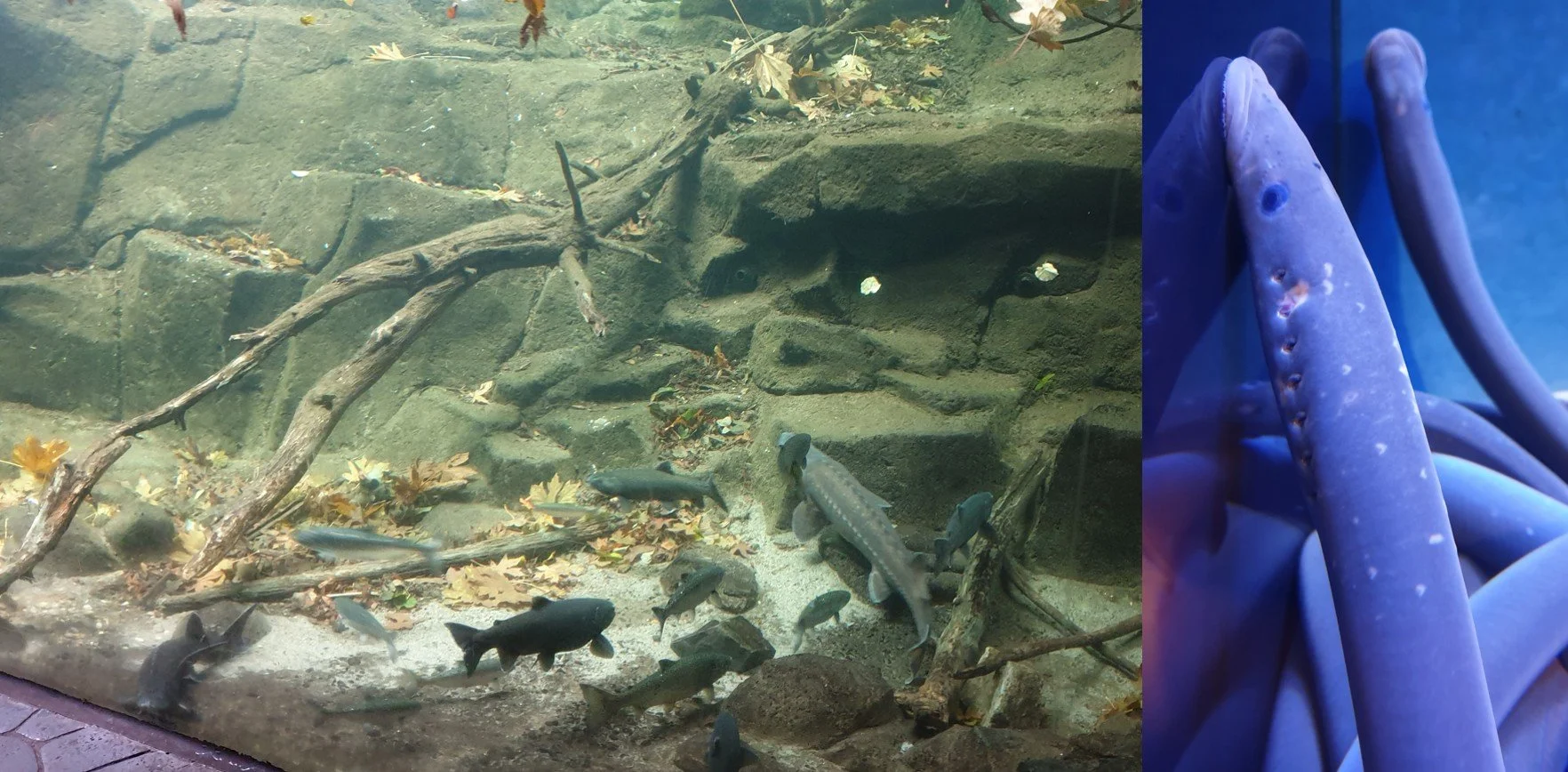
Caption: at left, large, landscaped aquarium, featuring trout of several species as well as White sturgeon Acipenser transmontanus. At right, one of many Pacific lamprey on show. Yes, I have close-up photos of their mouths but opted not to share them here. Images: Darren Naish.
Condors. A highlight was the large California condor exhibit. Several British bird collections house Andean condors Vultur gryphus but I can’t recall seeing the North American species before. Juvenile (albeit adult-sized) and adult condors were both on show, and all were busy feeding on a carcass (I think of a domestic horse foal). A sign warning people to be prepared to witness the consumption of a domestic mammal carcass was located at the entrance to this section, which is fair enough; you have to respect that some people really are bothered by the sight of dead animals. An impressive condor sculpture made of waste plastic was also near the entrance.
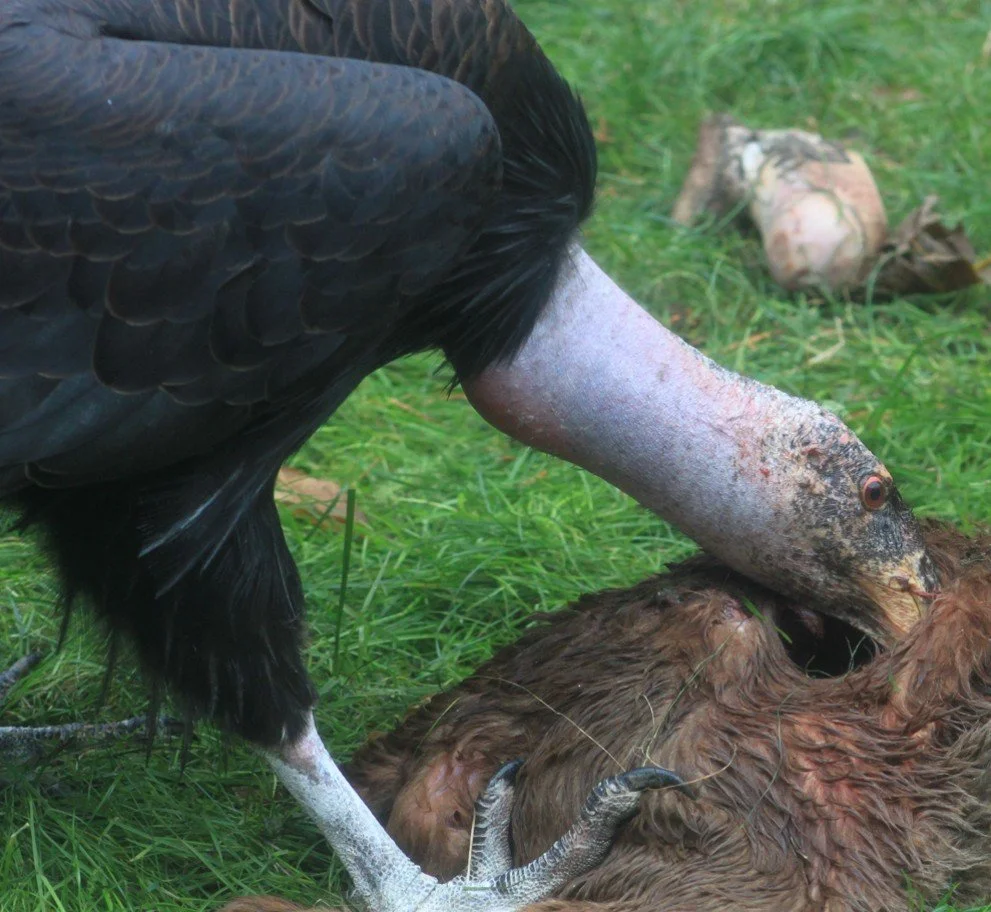
Caption: adult California condor with bill partly inside a large mammal carcass. It’s well known that condors (and cathartids/vulturids in general) can’t grasp or carry items with their feet: note how long the toes are and how the talons are nowhere near as sharply curved as they are in eagles and falcons. Image: Darren Naish.
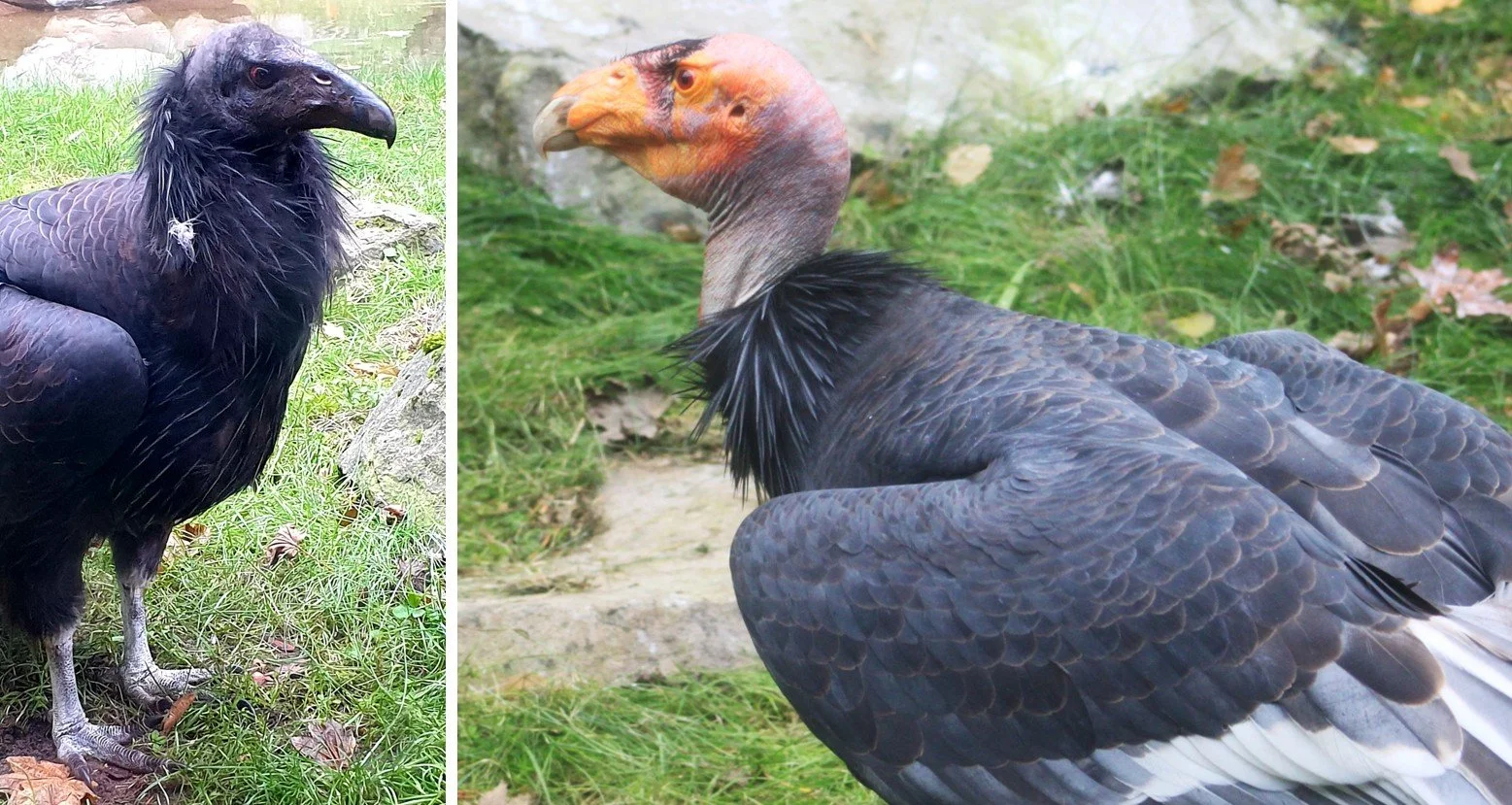
Caption: my first view of California condor. I was impressed with lots of things, but something I hadn’t thought about before was the profound difference of pigmentation between the very black youngsters and the carotenoid-heavy, brightly coloured adults. Their extensive facial soft tissues are of major interest too. Images: Darren Naish.
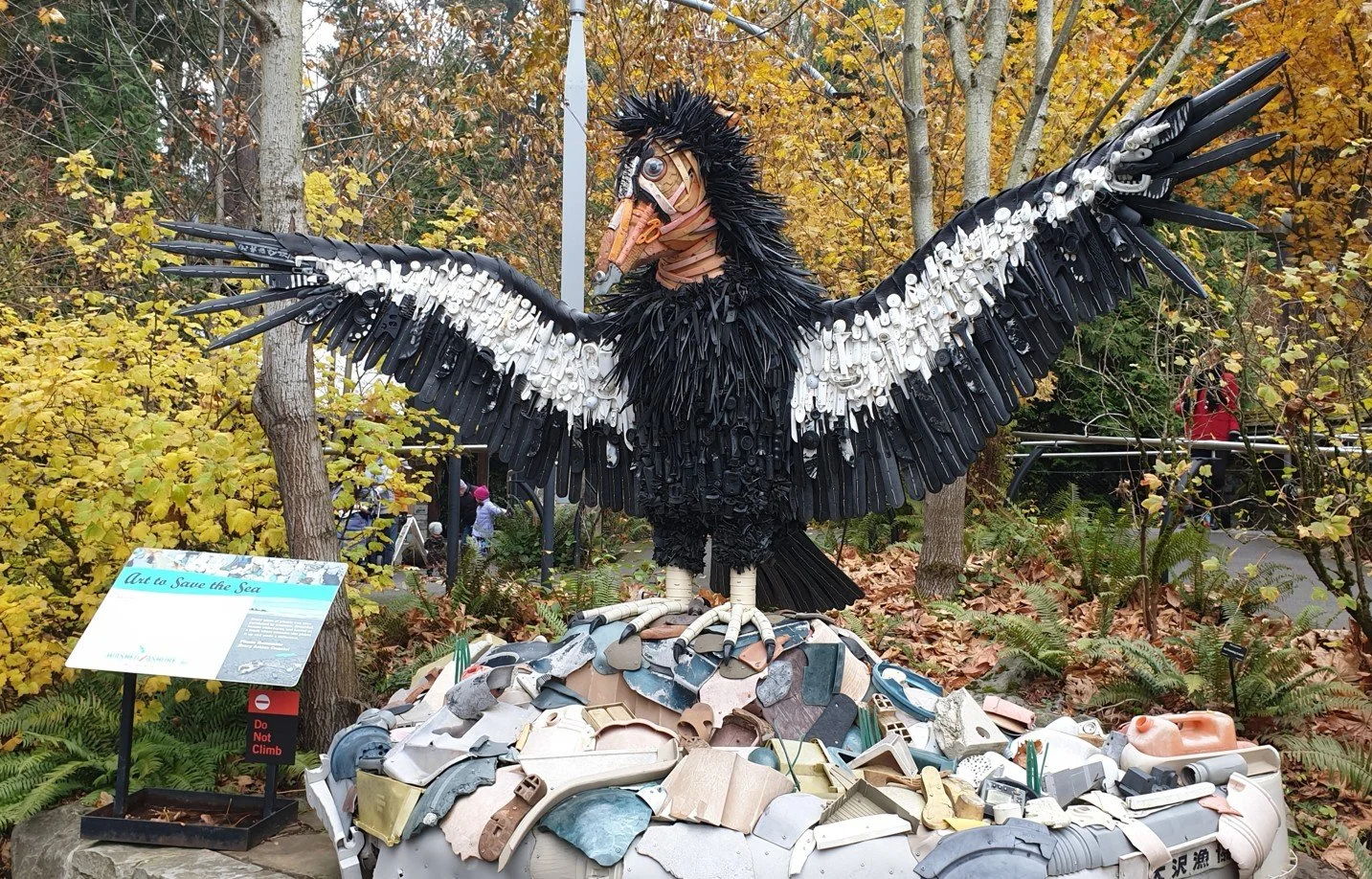
Caption: good zoos include good art, and Oregon had this great display on plastic pollution near its condor exhibit. Image: Darren Naish.
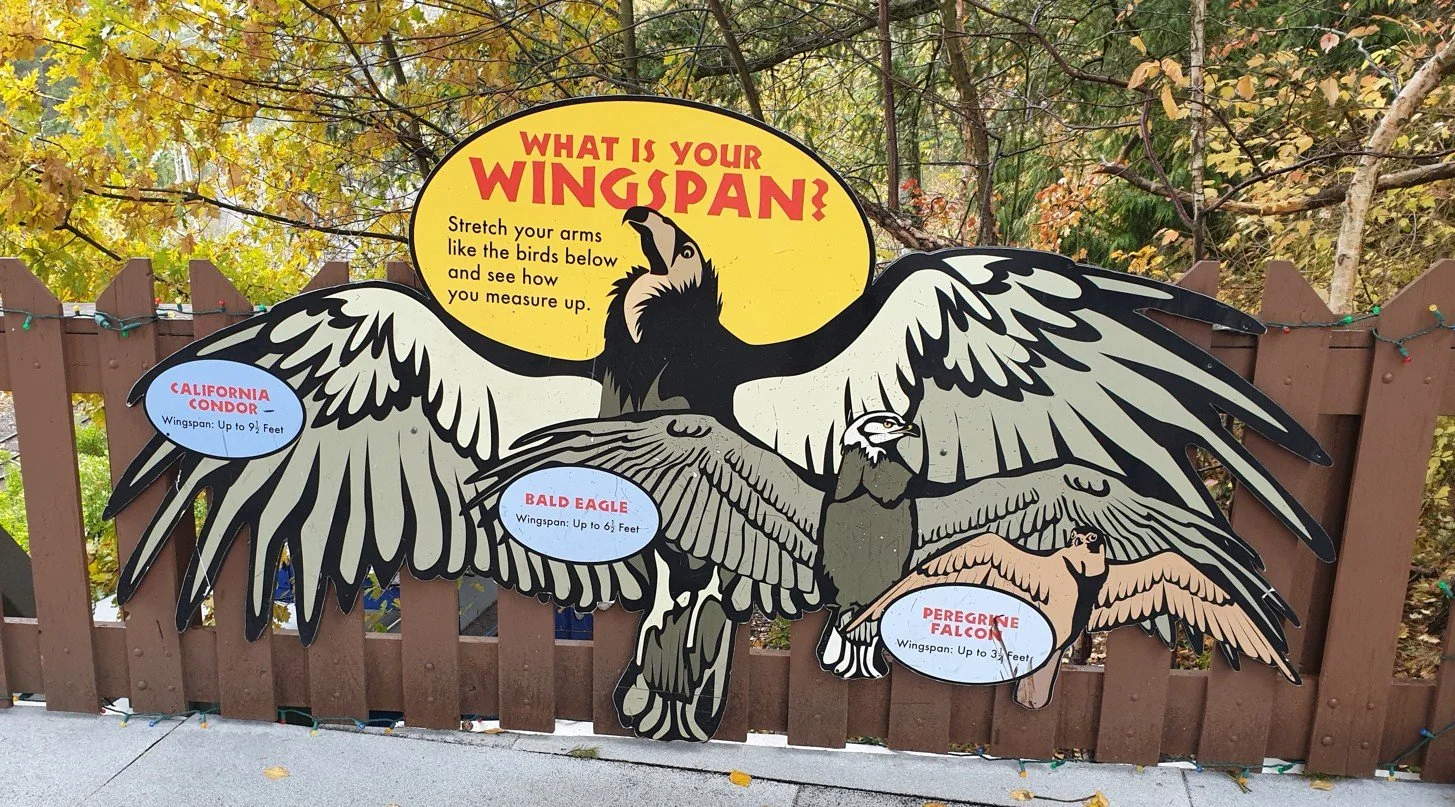
Caption: a good edutainment feature used by several zoos and wildlife parks… compare your arm-spread with the wingspans of several birds, in this case raptors. California condors can have a wingspan of 3 m but there are unverified claims of birds measured at 3.4 m. So far as we can tell, they’re outclassed in wingspan by the Andean condor, record-holders of which have been measured at 3.3 m. Image: Darren Naish.
North American ducks. I’m a fan of wildfowl, so I was pleased that several species were on display and viewable at close range due to windows positioned at water level on the enclosure side and human standing level on the other. None of the birds were substantially exotic to a denizen of northern latitudes, but I know what I like and I like ducks. I’m also relatively inexperienced when it comes to the ducks of North America, at least some of which don’t have ordinary residential status here in Europe.
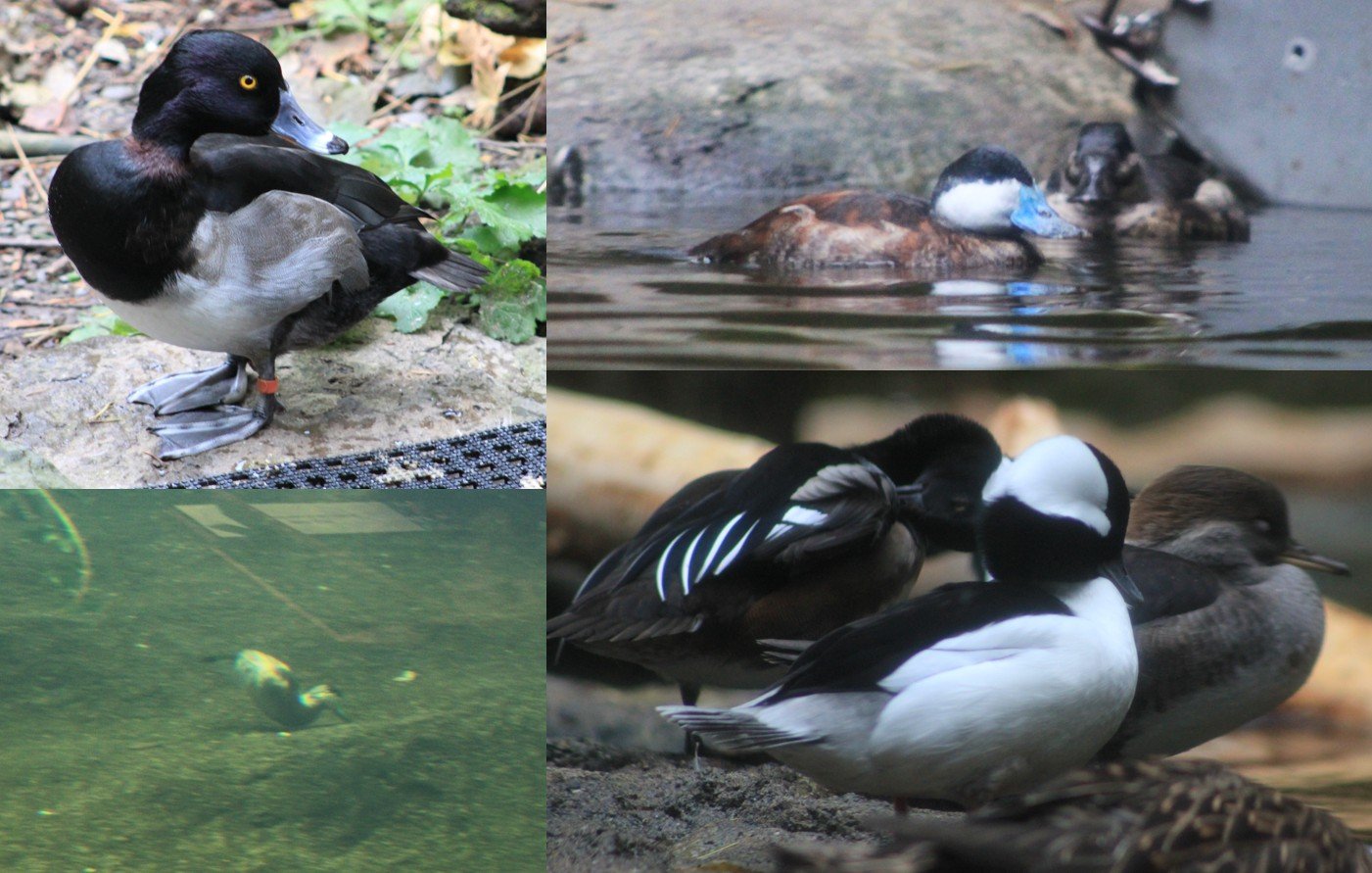
Caption: a North American duck montage part 1, showing (clockwise from top left) Ring-necked duck, Ruddy duck and Bufflehead and Hooded merganser. At lower left is an image showing how part of the exhibit allows you to see the ducks underwater, a really nice feature. I’m not fully sure which species is visible there but I think it’s an aythyin (a diving duck, like the Ringed-necked). Images: Darren Naish.
The species I remember seeing are Ruddy duck Oxyura jamaicensis, Hooded merganser Mergus cucullatus, Wood duck Aix sponsa, Ring-necked duck Aythya collaris, Bufflehead Bucephala albeola, Northern shoveler Spatula clypeata, Green-winged teal Anas crecca and Redhead Aythya americana. A sign said that Cinnamon teal S. cyanoptera was on show too, but I didn’t knowingly see that species. A shame, as it would have been new to me.
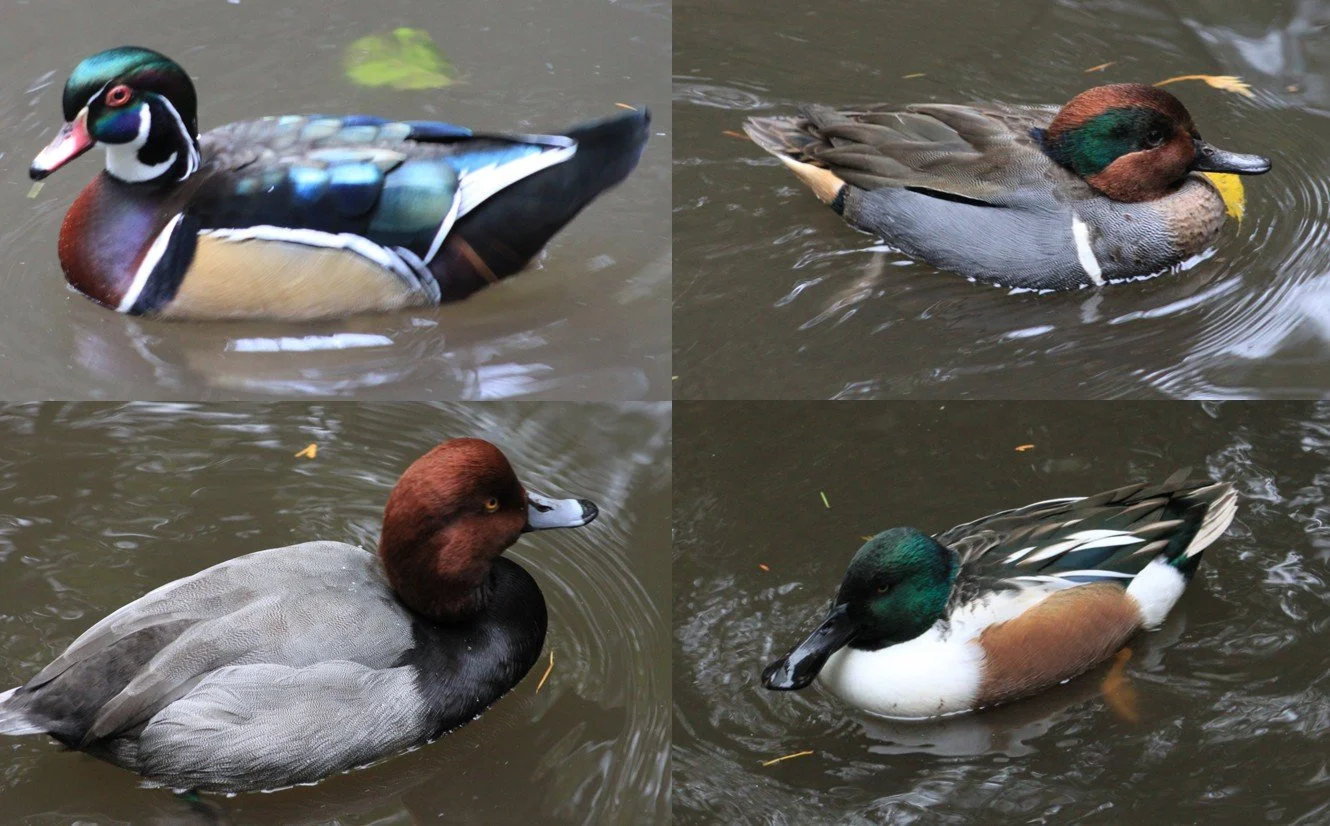
Caption: a North American duck montage part 2, showing (clockwise from top left) Carolina duck, Green-winged teal, Northern shoveler, Redhead. My apologies for focusing on the more gaudy, boldly marked males. Images: Darren Naish.
North American beaver Castor canadensis, Snowy owl Bubo scandiacus, River otter Lontra canadensis and Northwestern pond turtle Actinemys marmorata were in this part of the zoo too.
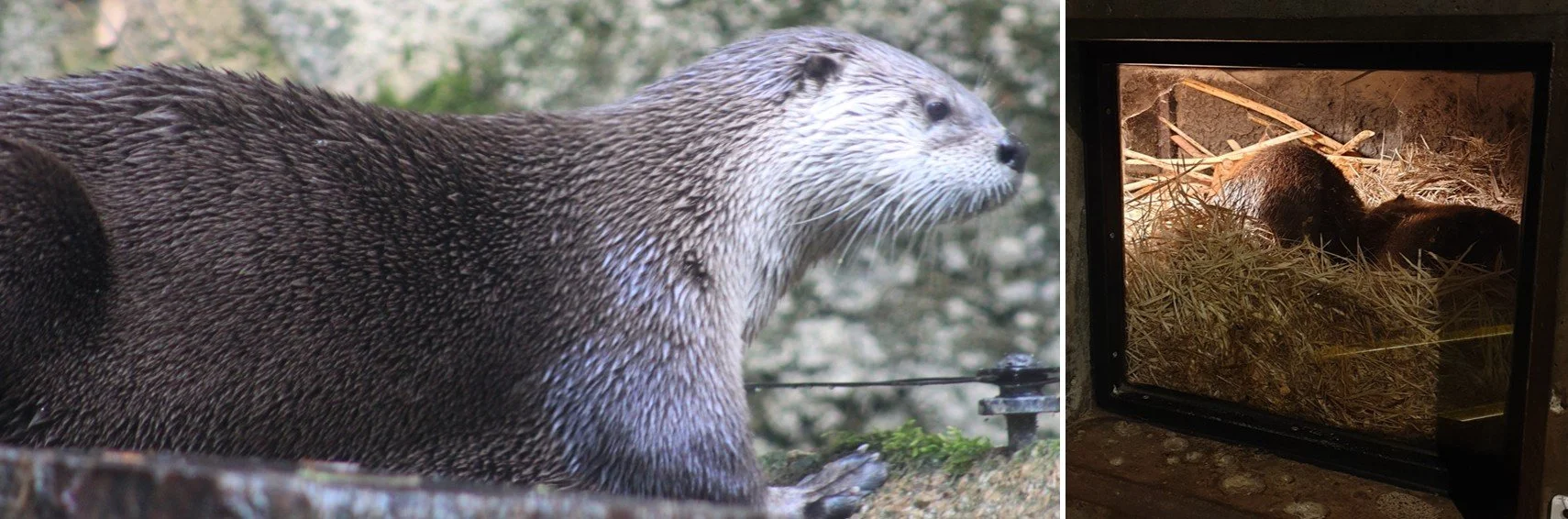
Caption: I’ve seen American River otter in captivity in the UK, so seeing one in the US wasn’t a first for me. At right, two beavers in the indoor den part of their enclosure, which they share with the selection of American wildfowl discussed above. The zoo has had involvement with various local beaver rescue and release projects. Images: Darren Naish.
Pacific Shores. We followed the walkway south and moved to the Pacific Shores section, a crown jewel of the zoo. A second bear species – Polar bear U. maritimus – was on show here. As typical for Polar bear exhibitions, the enclosure had a blue-walled pool and was fronted by glass. One of the bears spent time right at the front, allowing close-up views. Again, I saw a damaged eye; I don’t know if this is a coincidence or reflects the zoo taking on animals that can’t be elsewhere.
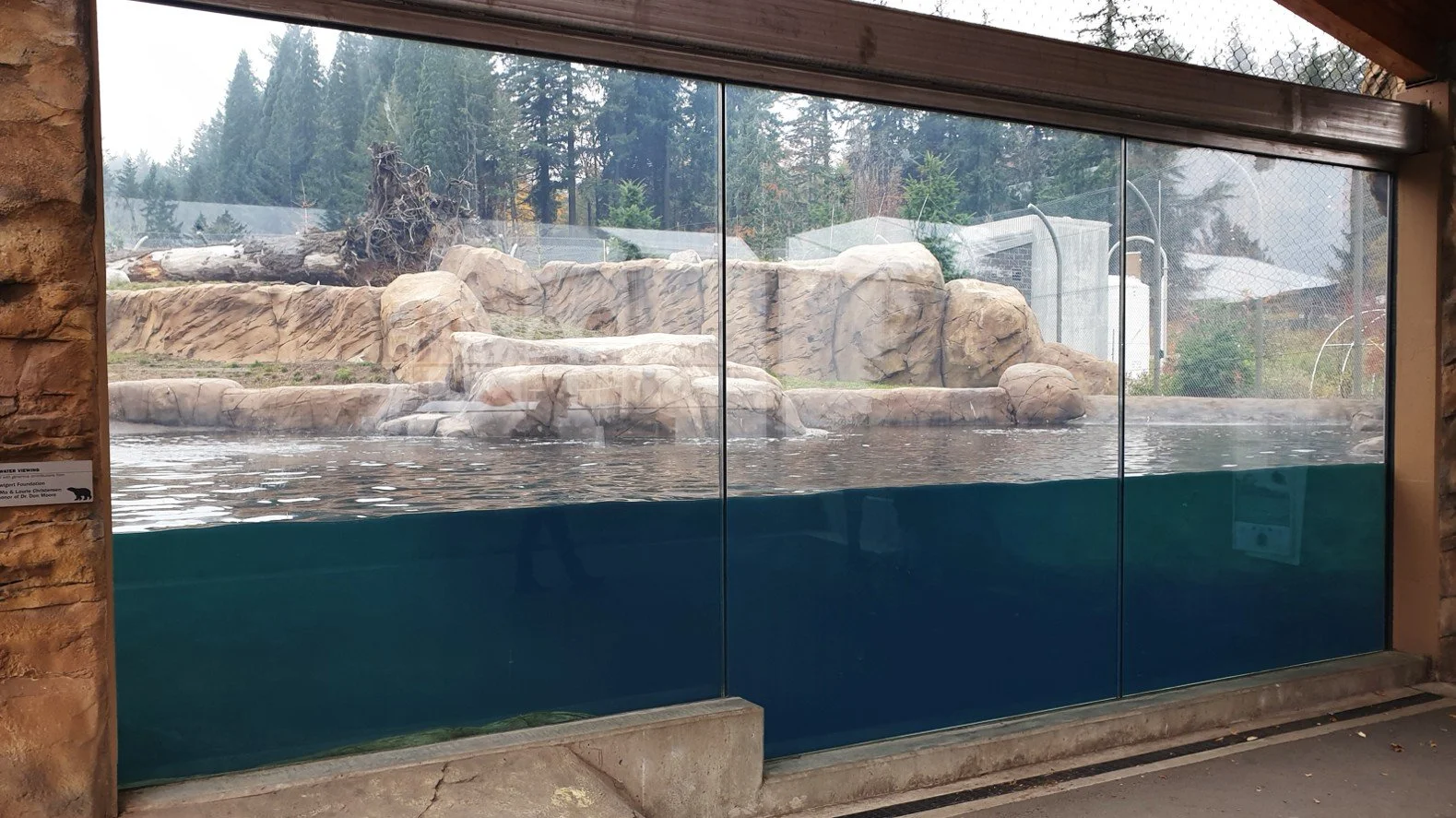
Caption: part of the polar bear enclosure, showing a low cliff and other (fake) rocky structures and a deep blue pool. I didn’t get to see the bears swimming while I was there, unfortunately. I’ve seen polar bears in captivity several times but can’t recall ever seeing them in the water. Image: Darren Naish.
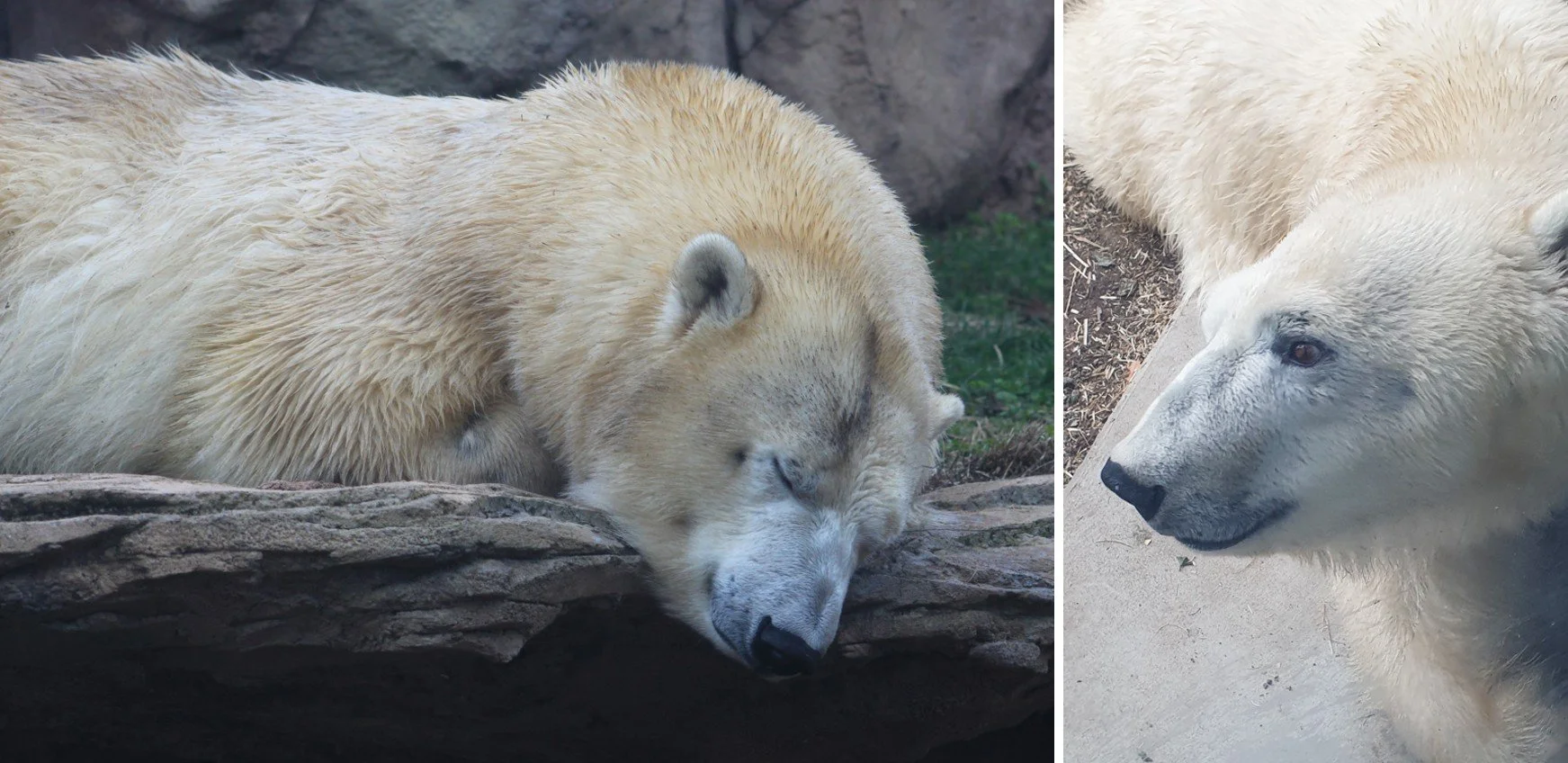
Caption: two bears were on show at the time of my visit, one dozing on the rocks and one right up close to the glass. The polar bear is a member of the brown bear clade but exactly where it fits within that group varies among studies. I understand that technical work does mostly still find it nested within a specific clade of grizzly bears. Images: Darren Naish.
More unusual and more noteworthy (no offence, polar bears) was the sea otter Enhydra lutris display. However… the only sea otter I recall seeing (2022 is a long time ago) was a statue. I do remember seeing sea otters on the same trip, but they were at the Oregon Coast Aquarium, a venue I’ll discuss in a different article, if time allows. Anyway, an adjacent Harbour seal Phoca vitulina section featured a nice landscaped ‘cove’ above water, and an impressive underwater section with rocky tunnels, overhangs, submerged logs and caverns. From underground floor-to-ceiling windows, you could watch the seals close up as they swam back and forth, sometimes upside down as is so common for pinnipeds. Also in this section was a coastal ‘general marine life’ exhibit, with crabs, urchins, sea stars, chitons and anemones, rockfishes and surfperches.
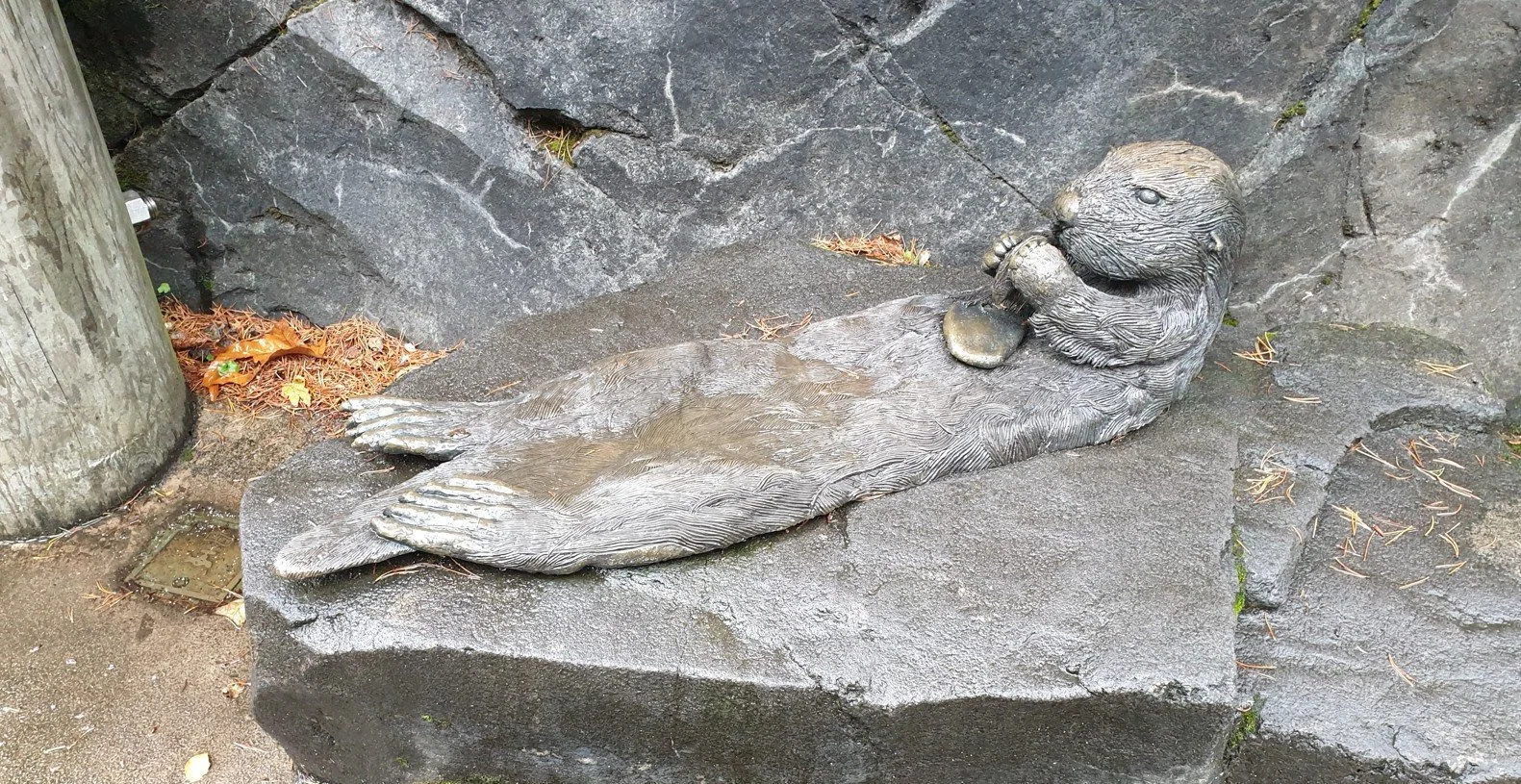
Caption: a strength of the zoo is the presence of life-sized statues, and here’s one showing a sea otter doing the standard ‘using the chest as a table’ thing. Sea otters are diverse in terms of what they eat but studies show that they mostly stick to the kind of prey they were introduced to by their mothers. Image: Darren Naish.
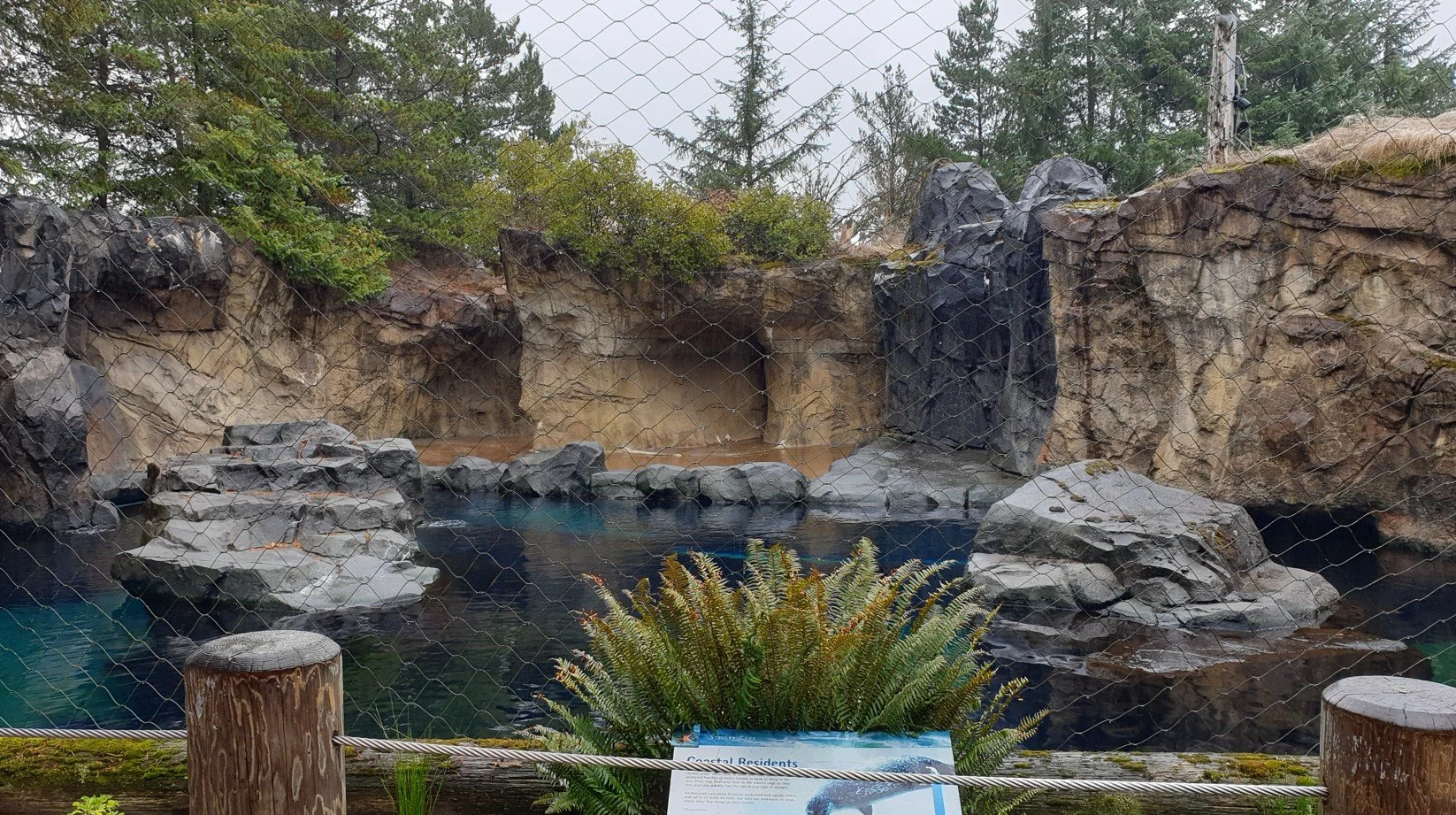
Caption: the above-water ‘Steller Cove’ area of the harbour seal exhibit, showing rock walls and haul-out sites well suited for pinnipeds. It looks appropriately NW Pacific I think. Image: Darren Naish.
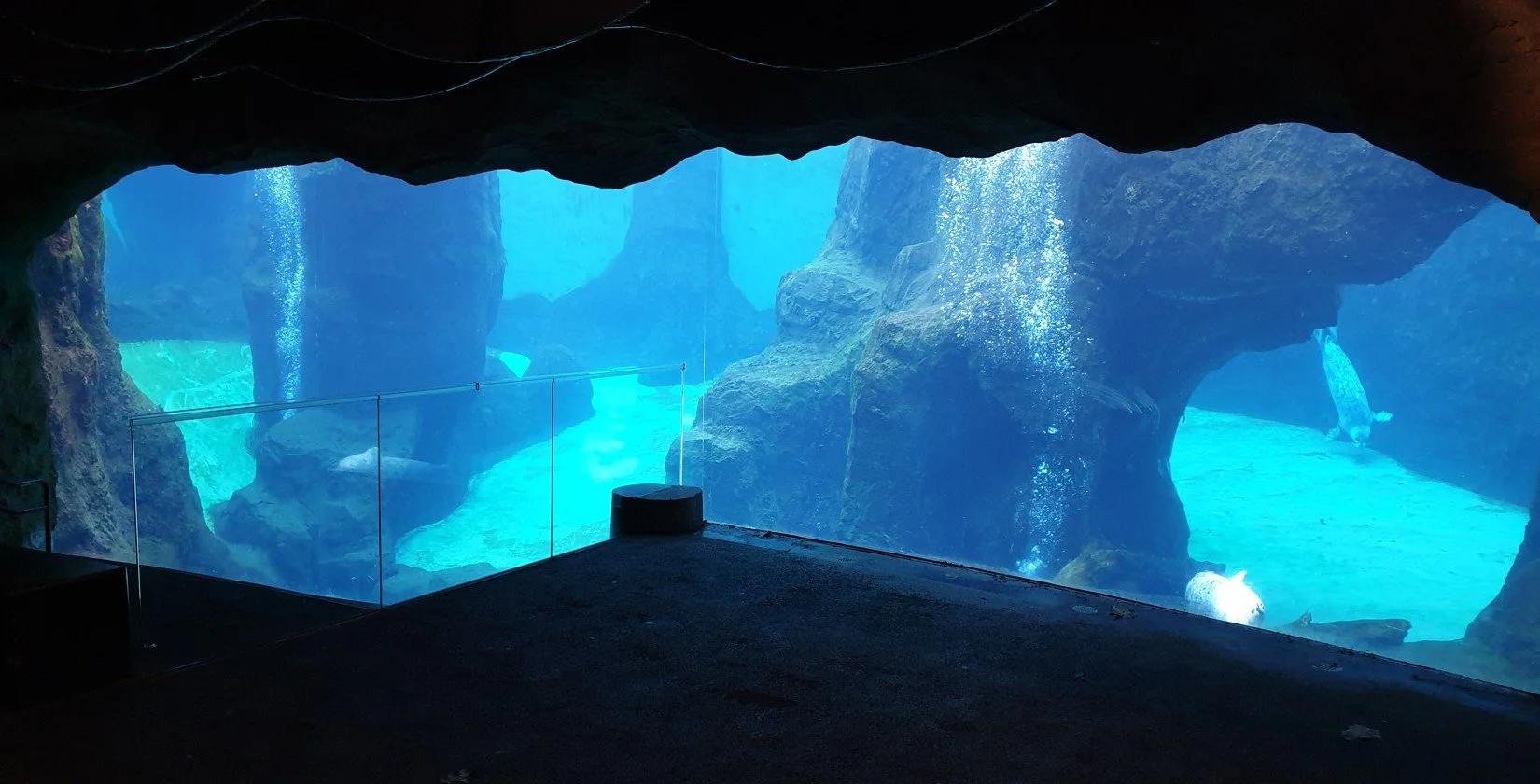
Caption: underwater viewing area of the seal display, two seals visible swimming at right. I really like the landscaping here; it’s a great exhibit. The Harbour (or Common) seal is a widespread species that occurs throughout the coastal North Atlantic and North Pacific and the two have traditionally been recognised as distinct subspecies (P. v. vitulina in the Atlantic and the larger P. v. richardii in the Pacific). Image: Darren Naish.
A central rotunda – very close to the literal centre of the zoo – was devoted to penguins, though only Humboldt penguins Spheniscus humboldti were there. Inca tern Larosterna inca and Grey gull Larus modestus were present too. I’ve commented before on the relative rarity of gulls in zoo displays, so Oregon Zoo is on the short list concerned. The building – with blue interior walls and a mostly concrete rocky ‘island’ for the penguins in the middle – wasn’t great and didn’t show the birds in an interesting or pleasing setting. I really hope it gets a revamp.
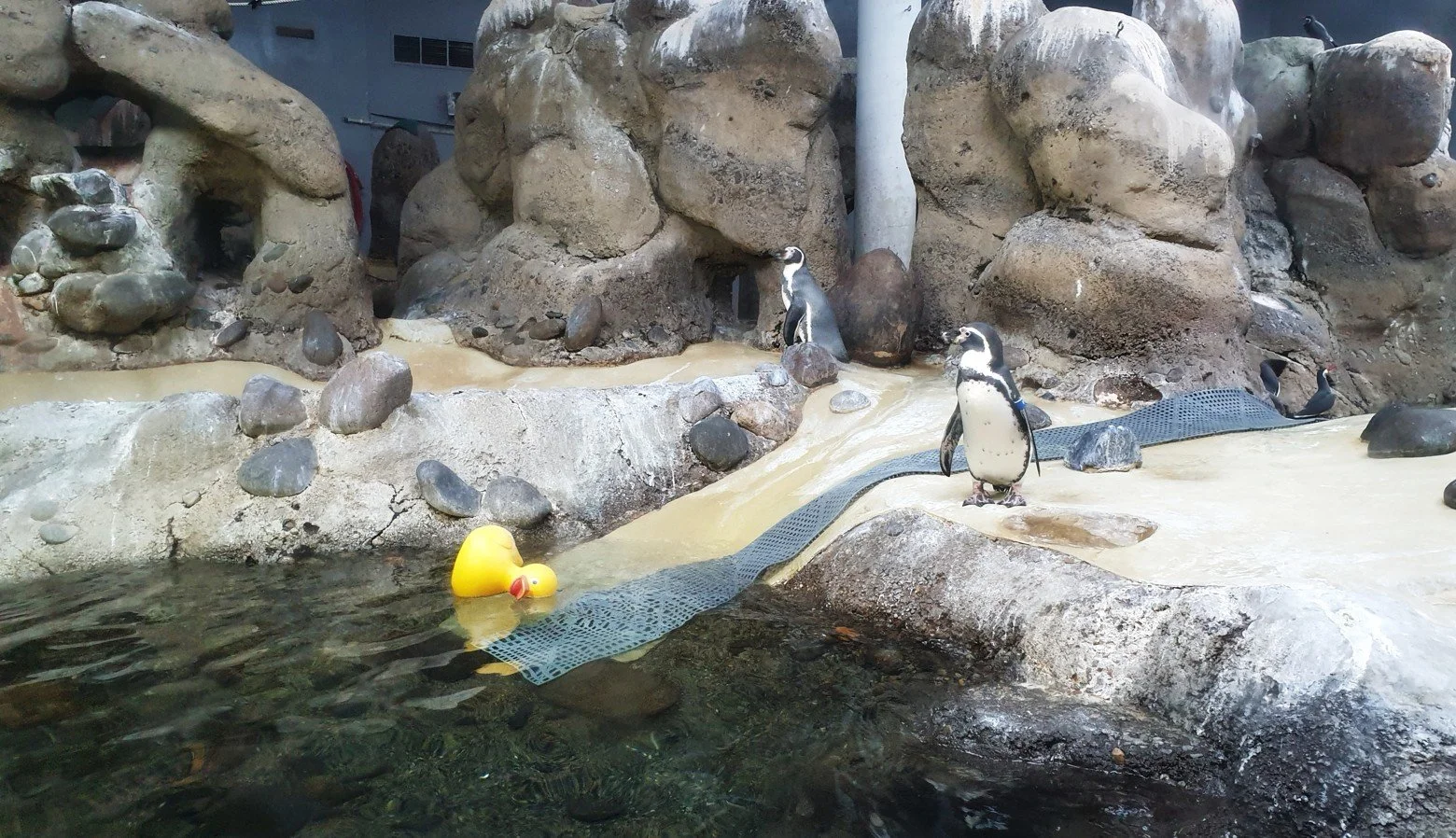
Caption: interior view of the rather sorry penguin exhibit. You might just be able to see a few Inca terns at far right. The yellow toy ducky is a nice touch. Image: Darren Naish.
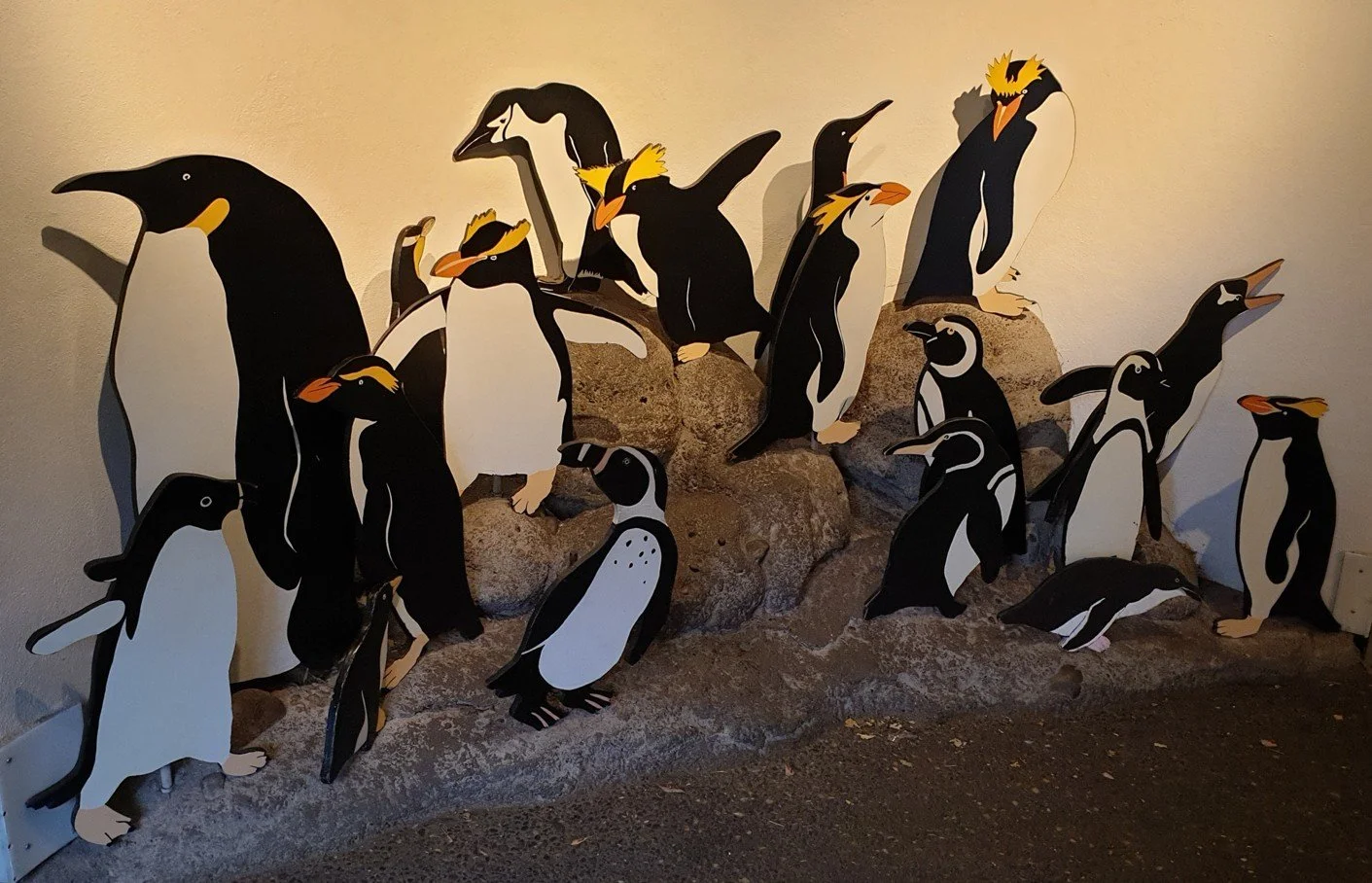
Caption: Oregon Zoo is very strong on signage and art that informs visitors about the animals they’re looking at, and various items in the penguin rotunda are devoted to the penguins of the world. Several zoos showcase penguin diversity in this way. It’s also not infrequent to see some representation of extinct species, focusing of course on the giant species of the Paleogene. Image: Darren Naish.
We moved next to the Primate Forest, where there are chimpanzees Pan troglodytes, Bornean orangutan Pongo pygmaeus (and, formerly, Sumatran P. abelii too) and White-cheeked gibbon Nomascus leucogenys. Tall indoor and outdoor enclosures provided a lot of climbing space and meant that the apes could stay out of view if they wanted to, and I didn’t see any of the chimps. A male orang was suitably active near the indoor windows when I was there.
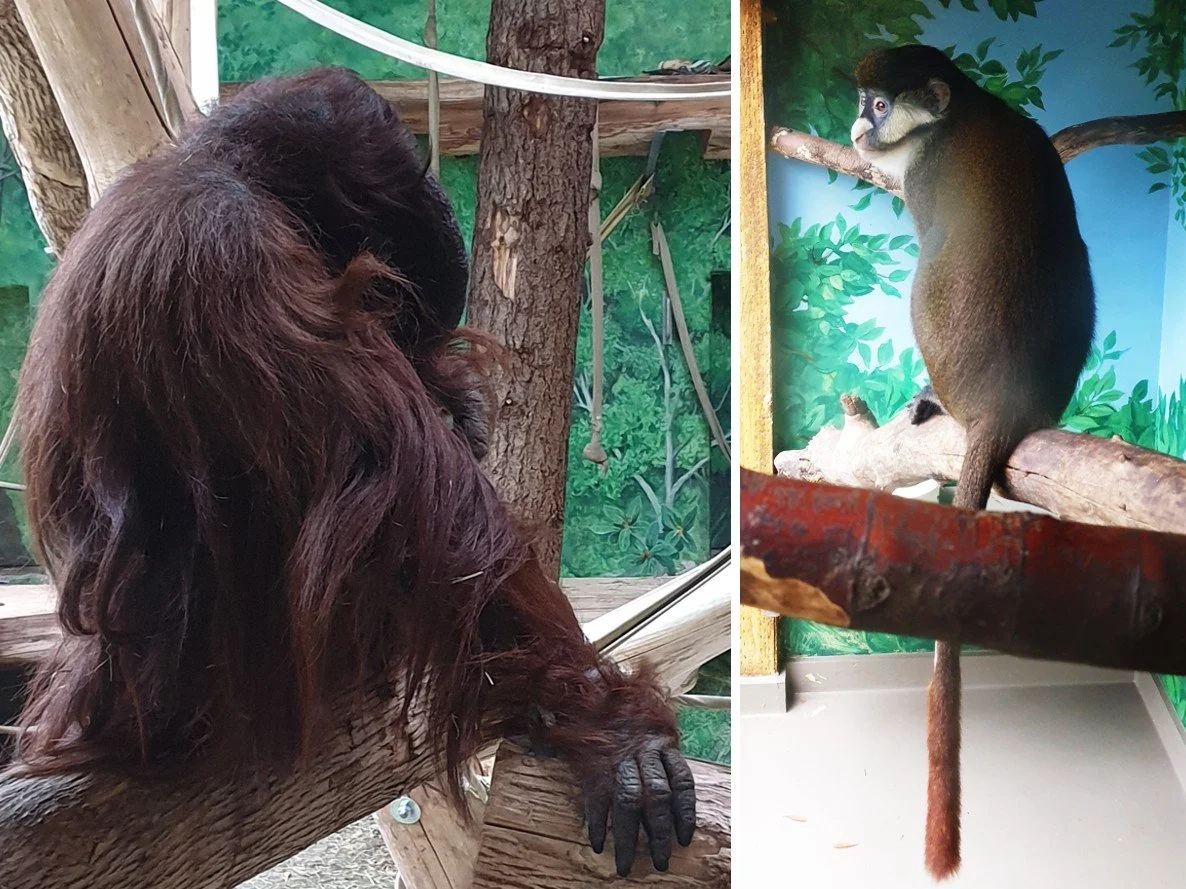
Caption: the zoo’s adult male Bornean orangutan Bob at left, who came to the zoo from Greenville Zoo in South Carolina in 2014. A Sumatran orangutan female kept at Oregon Zoo – Inji – was 61 when she died in 2021, and the oldest orangutan in captivity. At right, a Schmidt’s red-tailed monkey Cercopithecus ascanius schmidti, a Central African guenon. Images: Darren Naish.
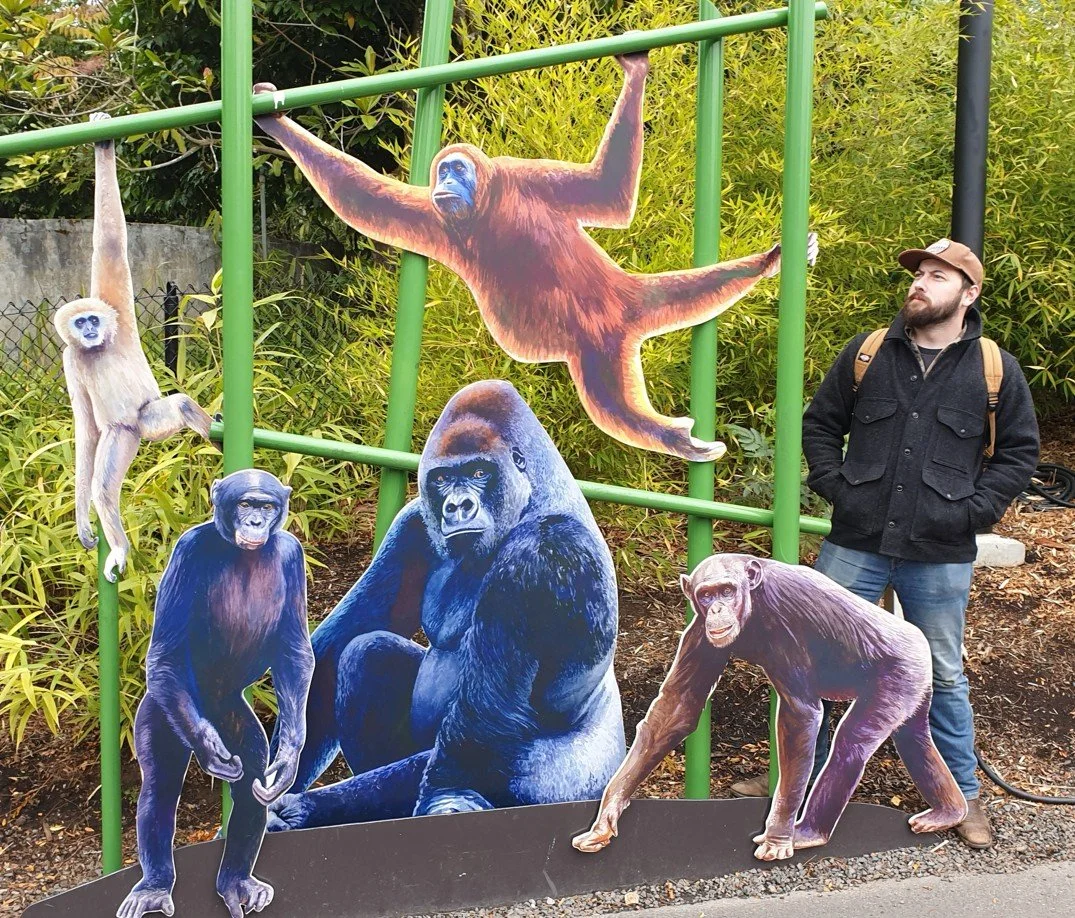
Caption: many zoos today have a feature where you can ‘insert’ yourself (or a companion) into a montage depicting our closest relatives, and here’s one at Oregon. Bonobos and gorillas aren’t kept at the zoo but gibbons, orangs and chimpanzees are. As for Nico… he’s only there occasionally. Image: Darren Naish.
Elephants. Virtually the whole of the zoo’s east and south-east is occupied by the massive Elephant Lands section, this housing Asian elephants Elephas maximus and including two indoor display areas and a large outdoor arena with a deep pool. The zoo is strongly associated with Asian elephants and has housed individuals since 1953; a remarkable 29 calves have been born at the zoo. One individual – a male called Samudra – is a third-generation captive-born animal, the only such elephant in the US.
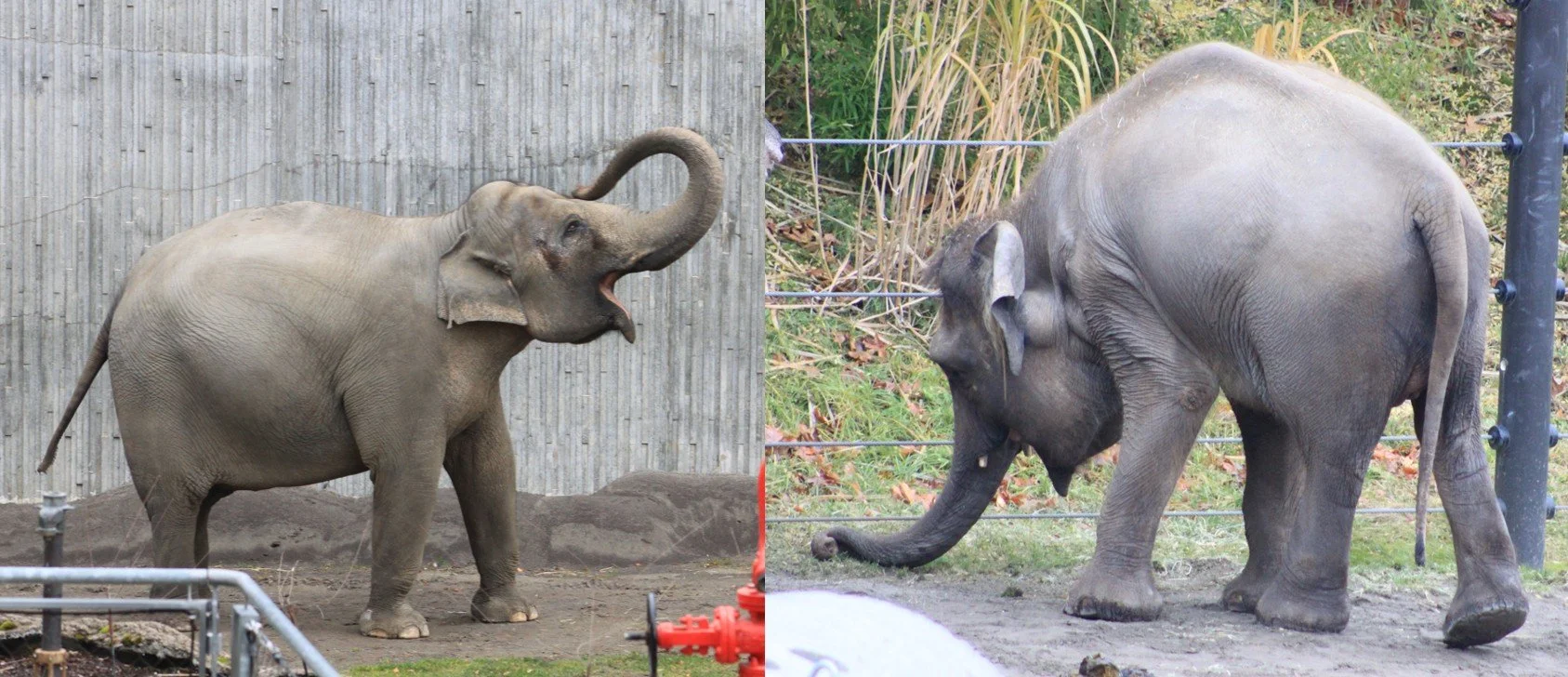
Caption: elephants outdoors, doing interesting things. I can’t remember what the adult female at left was doing, but the young animal at right is reaching under the fence to pluck grass from the verge. Note how this behaviour involves lying part of the trunk on the ground, rather than plucking the grass with the trunk tip alone. Images: Darren Naish.
The zoo has had its fair share of elephant-related controversy, most notably in 2000 when a keeper was found guilty of seriously abusing the female elephant Rose-Tu. The fallout resulted in the Rose-Tu law of 2001, which basically strengthened the power of the law to prosecute animal abusers in the state. On keeping elephants in general… naturally, no zoo can really give elephants sufficient space relative to what they have when living wild and the zoo has been in the news on several occasions due to protests about its keeping of elephants. There is, of course, a lot that could be said on the ethics of zoos and this isn’t the place. As someone invested in conservation and efforts to help animals persist into the future, I will say, however, that zoos are necessary, in cases essential, whatever our personal feelings on life-time captivity for their occupants.
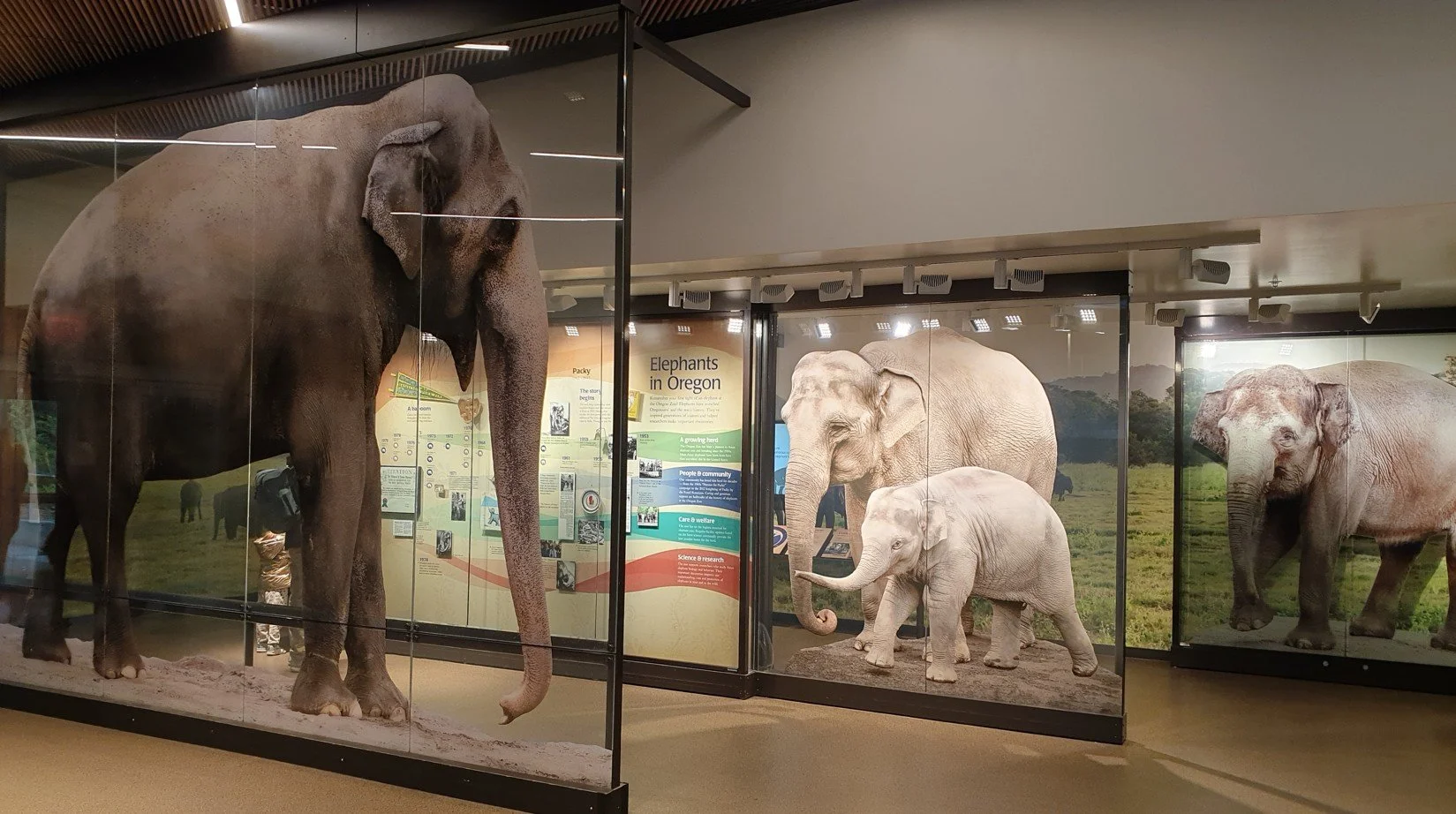
Caption: the zoo’s Elephant Lands is really big on information panels and displays that provide information on elephant anatomy, biology and lifestyle, and there are impressive features on feet, tusks, and on the history of Oregon Zoo’s elephants specifically. Image: Darren Naish.

Caption: view showing part of the outdoor arena of Elephant Lands. Oregon is cool or cold for part of the year and at or close to freezing in the winter. Elephants are very resistant to low temperatures but modern zoos of course provide them with heated buildings. Image: Darren Naish.
Africa Zone. We next moved on to the south-west quadrant, the Africa zone. Outdoor enclosures feature Giraffe Giraffa camelopardalis (both Masai G. c. tippelskirchi and Reticulated G. c. reticulata*), Black rhino Diceros bicornis, Cape hunting dog Lycaon pictus (the zoo uses ‘Painted dog’), African lion Panthera leo, Mountain or Eastern bongo Tragelaphus euryceros isaaci and Bontebok Damaliscus pygargus. Bontebok are a big deal in view of the conservation history of this taxon**, (in)famously reduced to a relict population of less than 20 South African individuals.
* You will of course be aware of the argument that these should be recognised as species, not subspecies.
** The conventional view that the Bontebok is conspecific with the Blesbok D. phillipsi would mean that it was an endangered subspecies, not a species, but views differ on what to do with the taxonomy of these antelope (Castelló 2016).
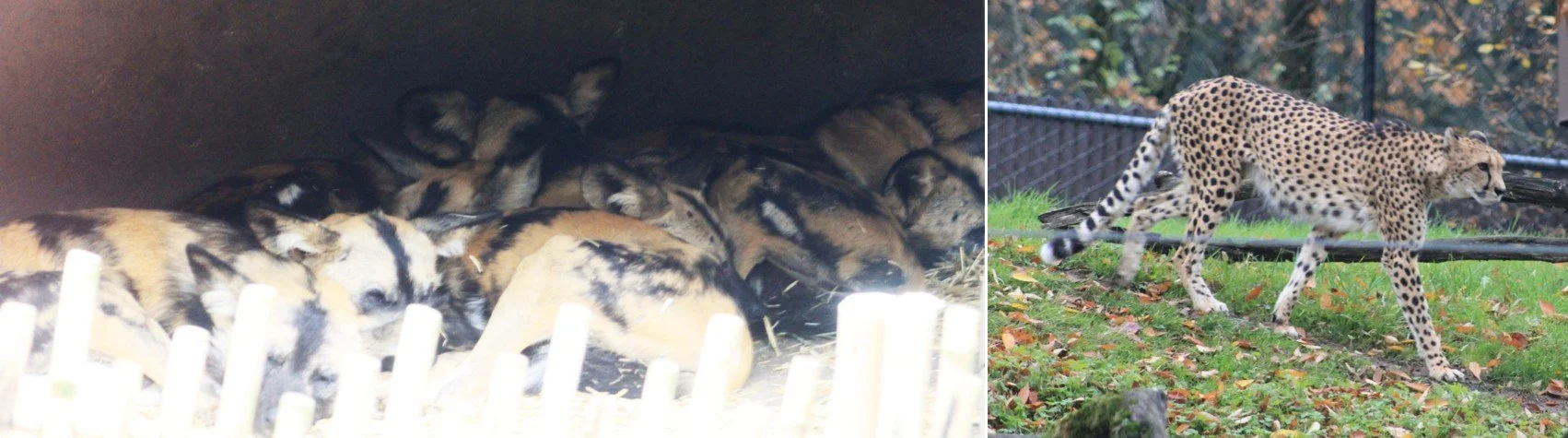
Caption: perhaps because of the weather, the Cape hunting dog group were all huddled together in their rock shelter during my visit. At right, cheetah on the move. As usual for zoos, this is a cheetah of east African origin. The far rarer Asiatic cheetah is scarcely not kept in captivity at all; sources disagree, but there are something like five or six in captivity, I think all of them in Iran. Images: Darren Naish.
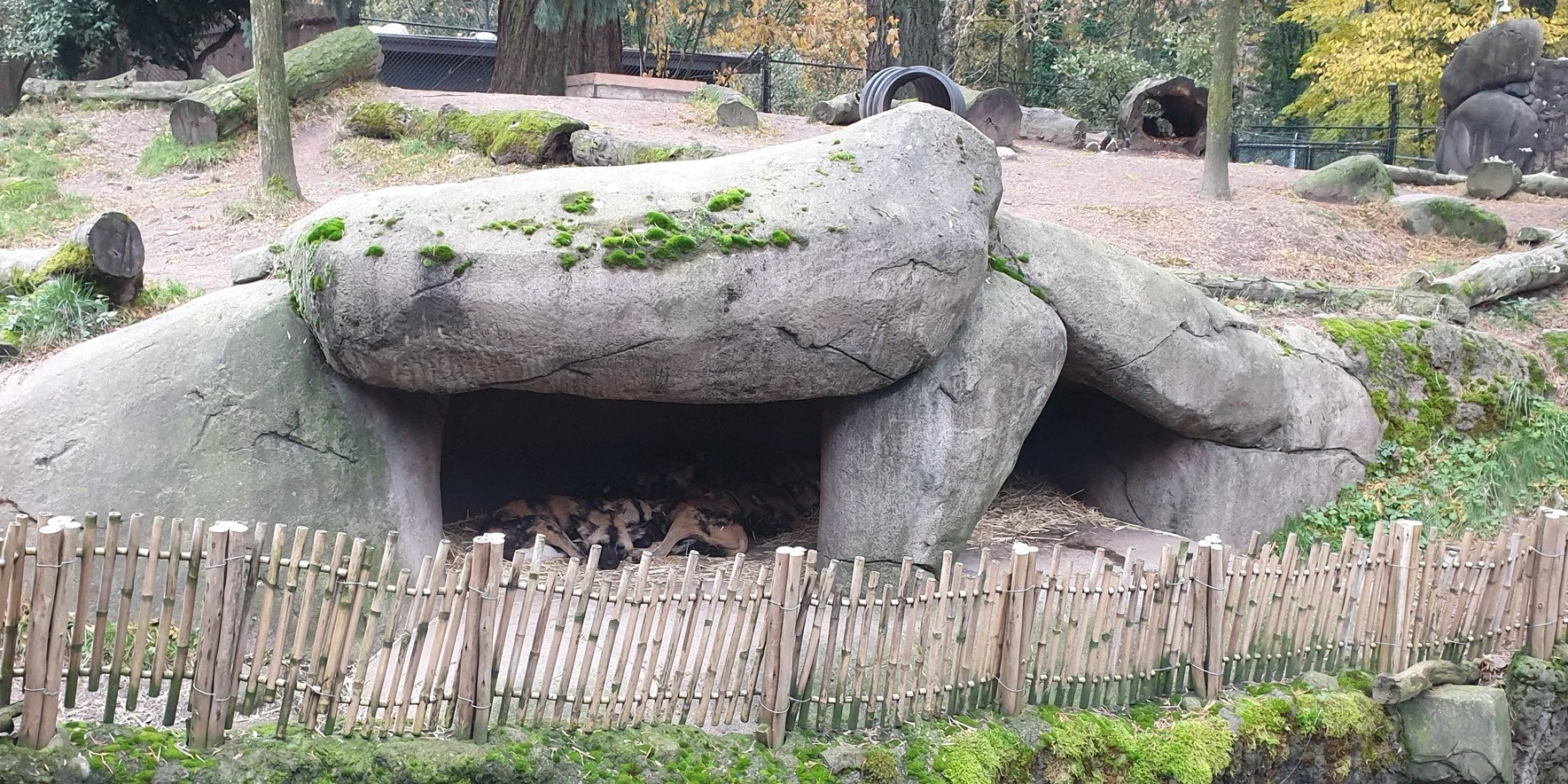
Caption: the Cape hunting dog enclosure with rock shelter (and resting dog pile) very obvious. Over-use of the same areas of ground is evidenced by the heavily worn, de-grassed areas. Image: Darren Naish.
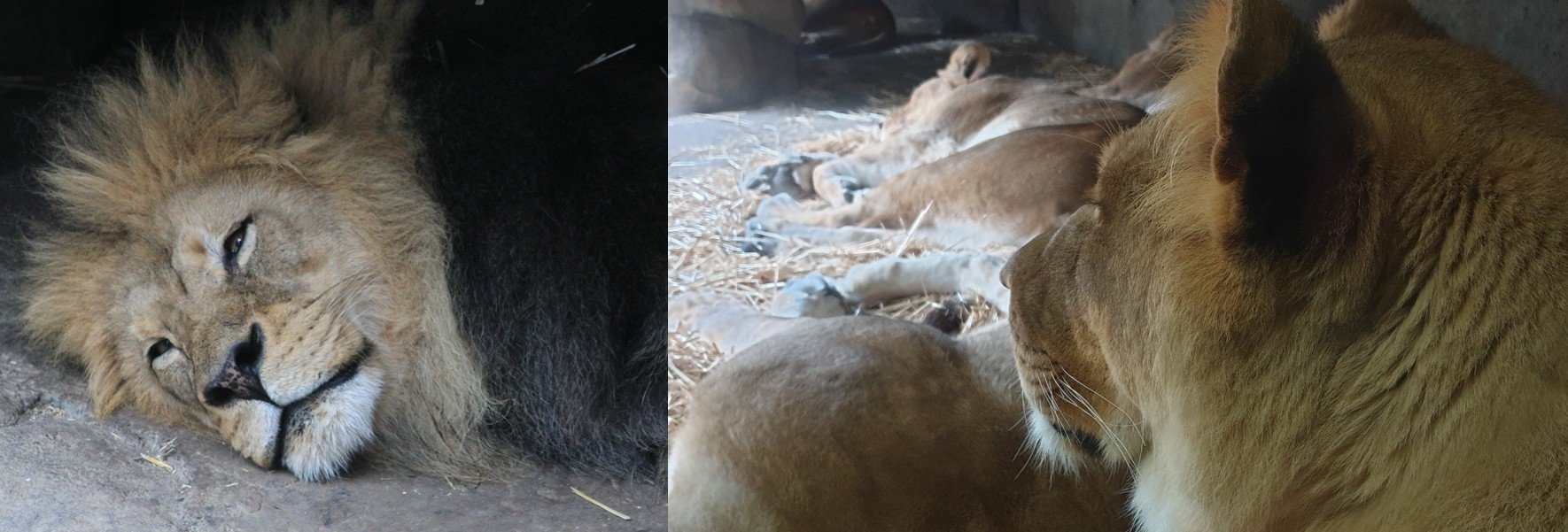
Caption: these images give some idea of how close you can get to the lions thanks to the glass partition that allows viewing inside their rest area. I think that the male here is Zawadi, who has only just (April 2026) died. He was 18, making him another unusually old animal kept at the zoo. Many zoos here in the UK now have Asiatic, rather than African, lions, so seeing African animals these days often feels special. Images: Darren Naish.
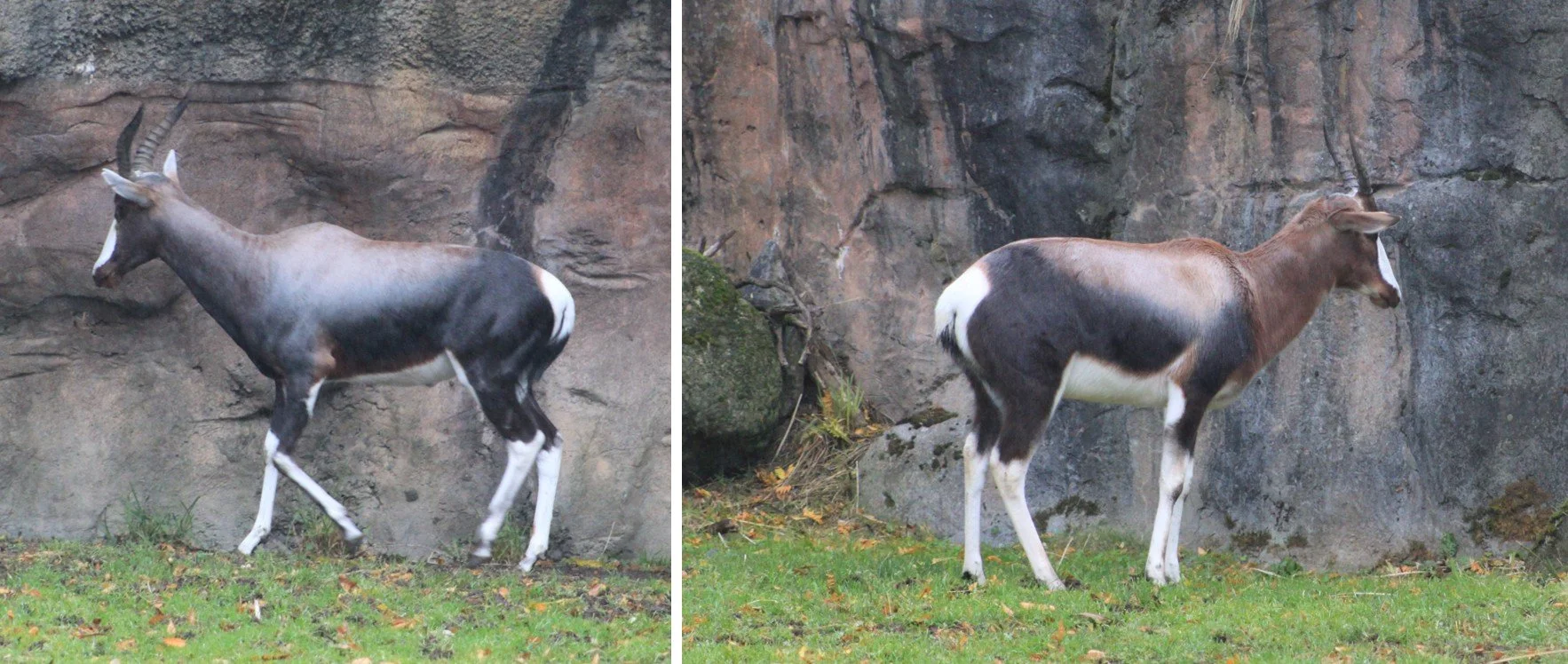
Caption: I think the photos here show two different Bontebok individuals. The animal on the right has its ears in an odd position because this photo was taken just before it shook its head (due to light rain). Images: Darren Naish.
Both Greater flamingo Phoenicopterus roseus and Lesser flamingo Phoeniconaias minor shared an enclosure with Fulvous whistling duck Dendrocynga bicolor, White-faced whistling duck D. viduata, African spoonbill Platalea alba and Gadwall Mareca strepera. Other animals I recall seeing here include Common dwarf mongoose Helogale parvula and Red-tailed monkey Cercopithecus ascanius schmidti. A number of heated buildings featured Red-billed hornbill Tockus erythrorhynchus and Blue-bellied roller Coracias cyanogaster as well as Baja blue rock lizard Petrosaurus thalassinus and Philippine sailfin lizard Hydrosaurus pustulatus (both very much not at home in an African section), African plated lizard Gerrhosaurus validus, Malagasy Henkel’s leaf-tailed gecko Uroplatus henkeli and more.
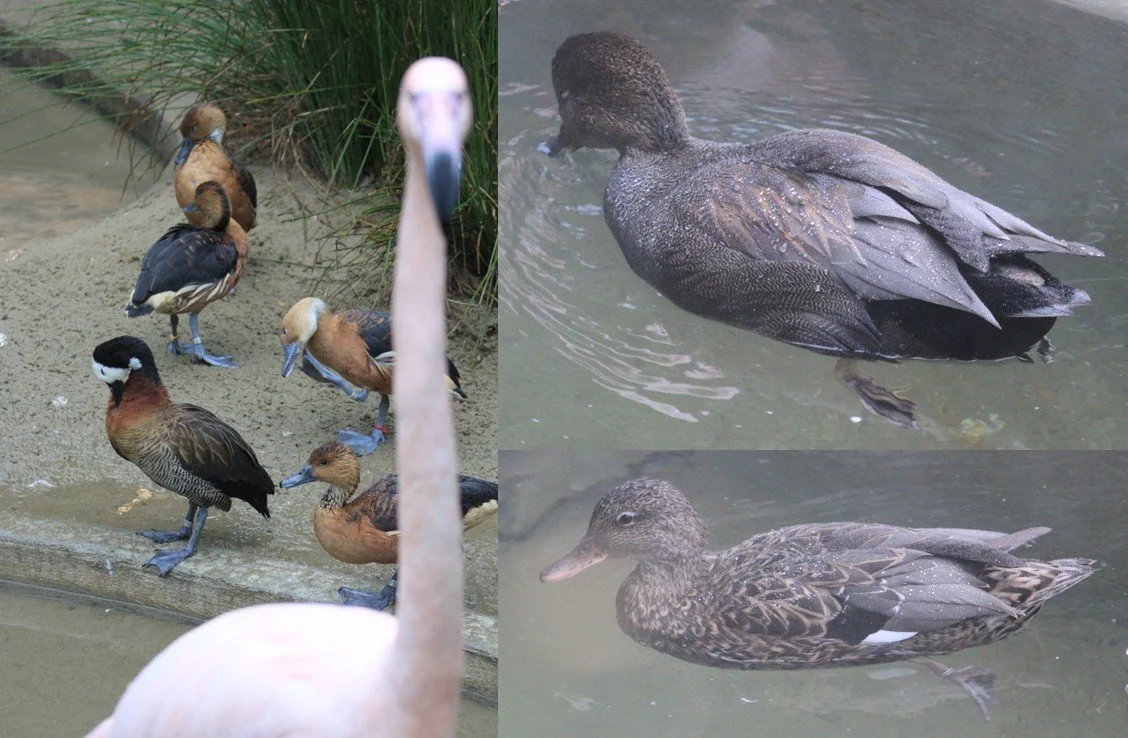
Caption: at left, a Greater flamingo photobombs my whistling duck photo, both White-faced and Fulvous species visible here. At right, two different Gadwall, I think a male (top) and female. These photos are quite washed out and the browns on these birds should be brighter and richer. Images: Darren Naish.
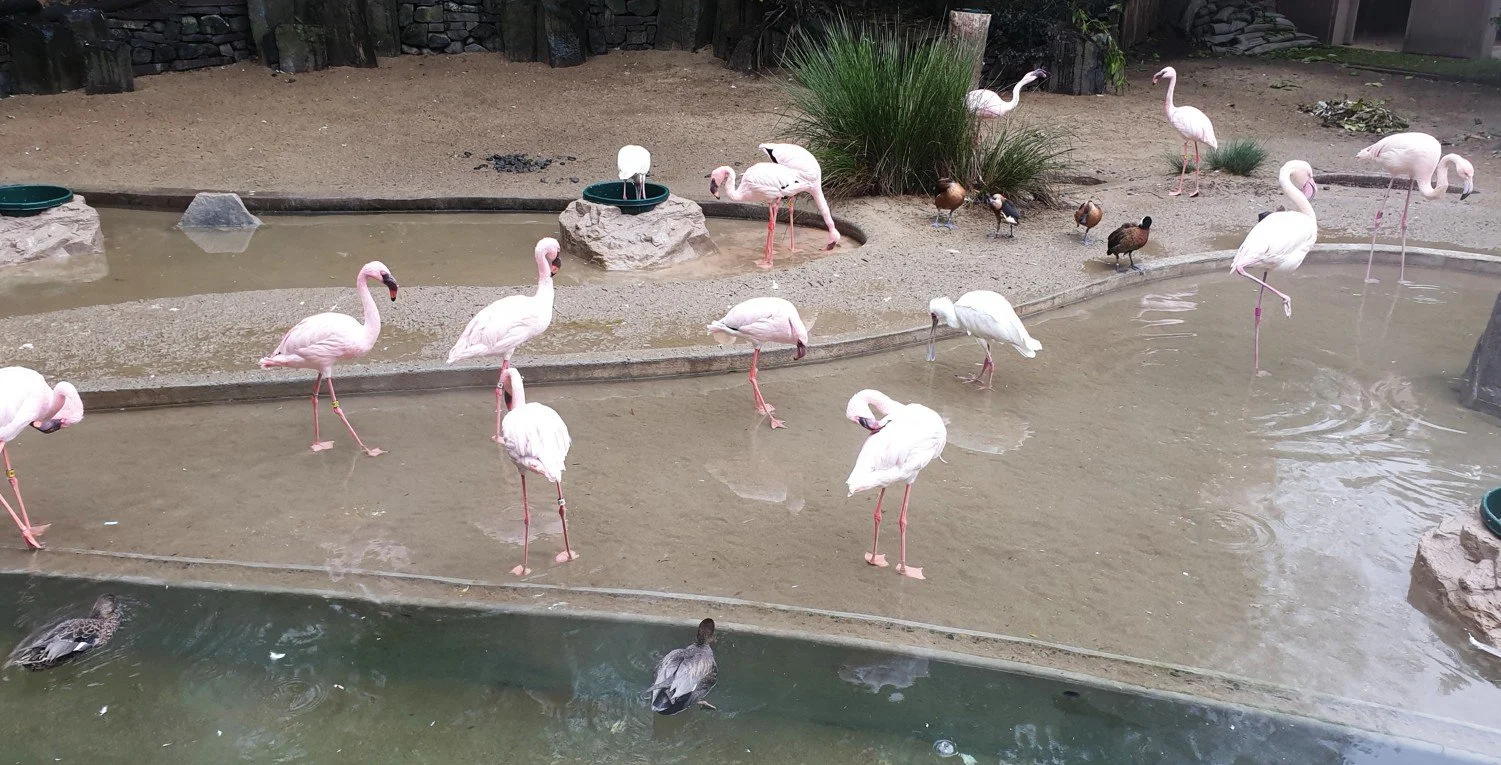
Caption: flamingo and duck exhibit, with Lesser flamingo at left and two Greaters at right. Whistling ducks, a spoonbill and gadwalls are visible too. Image: Darren Naish.
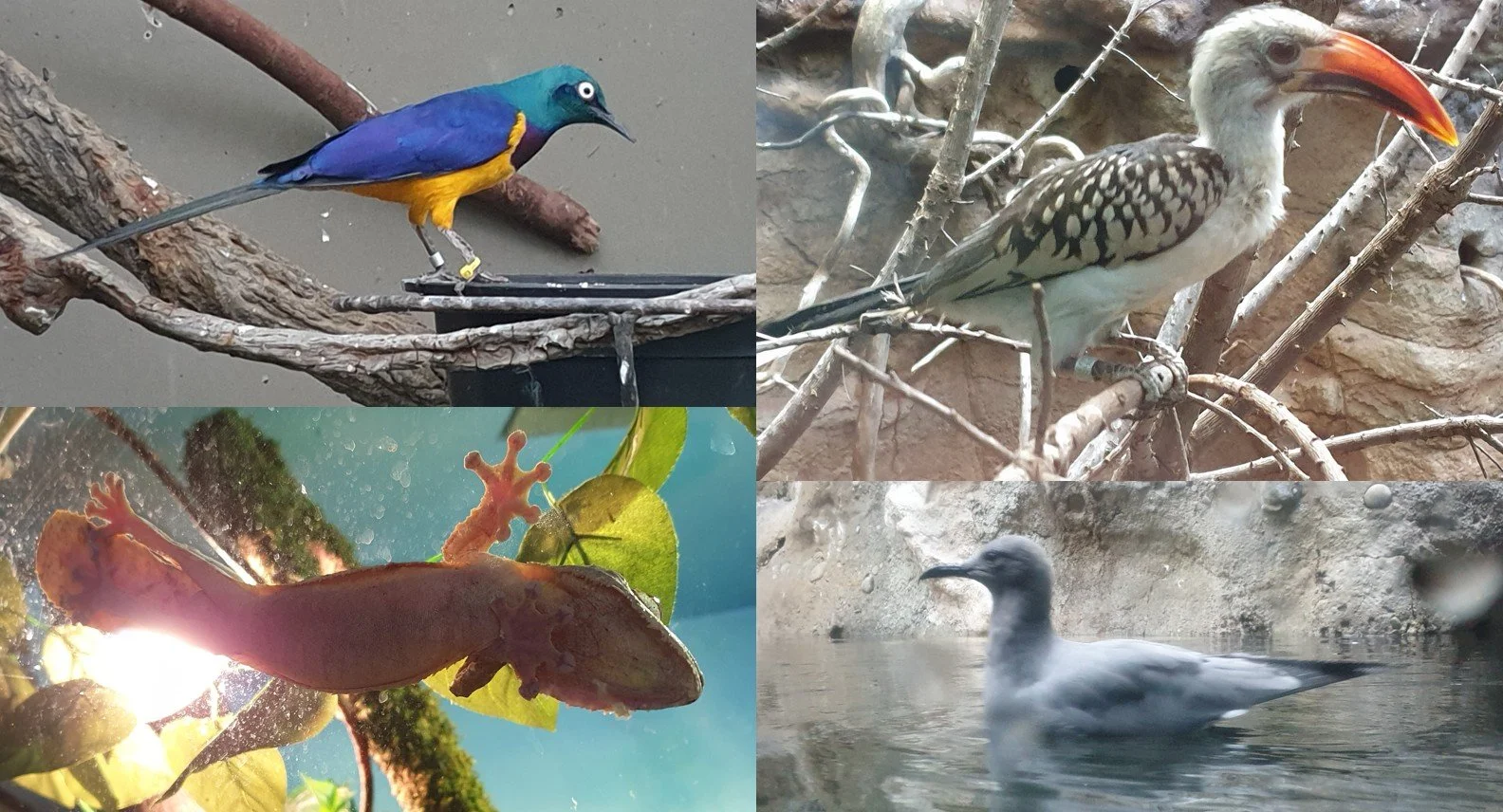
Caption: a bird montage with bonus Henkel’s leaf-tailed gecko. Clockwise from upper left: Golden-breasted starling Cosmopsarus regius, Northern red-billed hornbill Tockus erythrorhynchus, Grey gull (from the penguin rotunda discussed above), and gecko seen from underneath while it was clinging to the side wall of its terrarium. Images: Darren Naish.
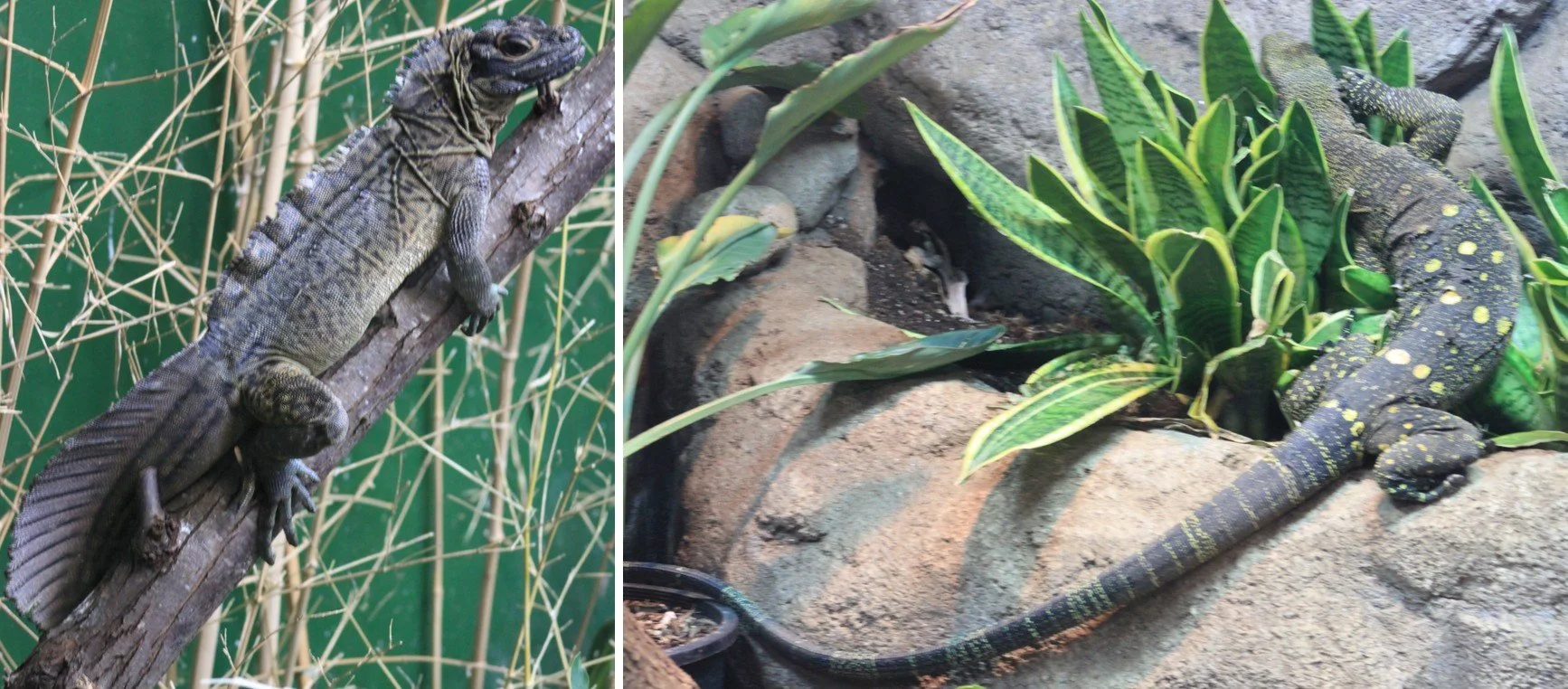
Caption: two big, impressive squamates housed in the Africa section, even though they’re very much not from that part of the world. Sailfin lizards like that at left are from Indonesia and the Philippines; Crocodile monitors Varanus salvadorii are from New Guinea. The Crocodile monitor is one of the world’s rarest monitors, but these days it’s one of the species most often encountered in captivity, due predominantly to a successful captive breeding programme. Images: Darren Naish.
The large Aviary Understory (it should be ‘Understorey’), another rotunda, featured a large area of tropical plants and free-flying Crested coua Coua cristata, Golden-breasted starling, Purple glossy starling Lamprotornis purpureus, Emerald starling L. iris and much else. The birds I most wanted to see – Maccoa duck Oxyura maccoa, Allen’s gallinule Porphyrio alleni and Magpie shrike Corvinella melanoleuca – were a no-show for me, alas.
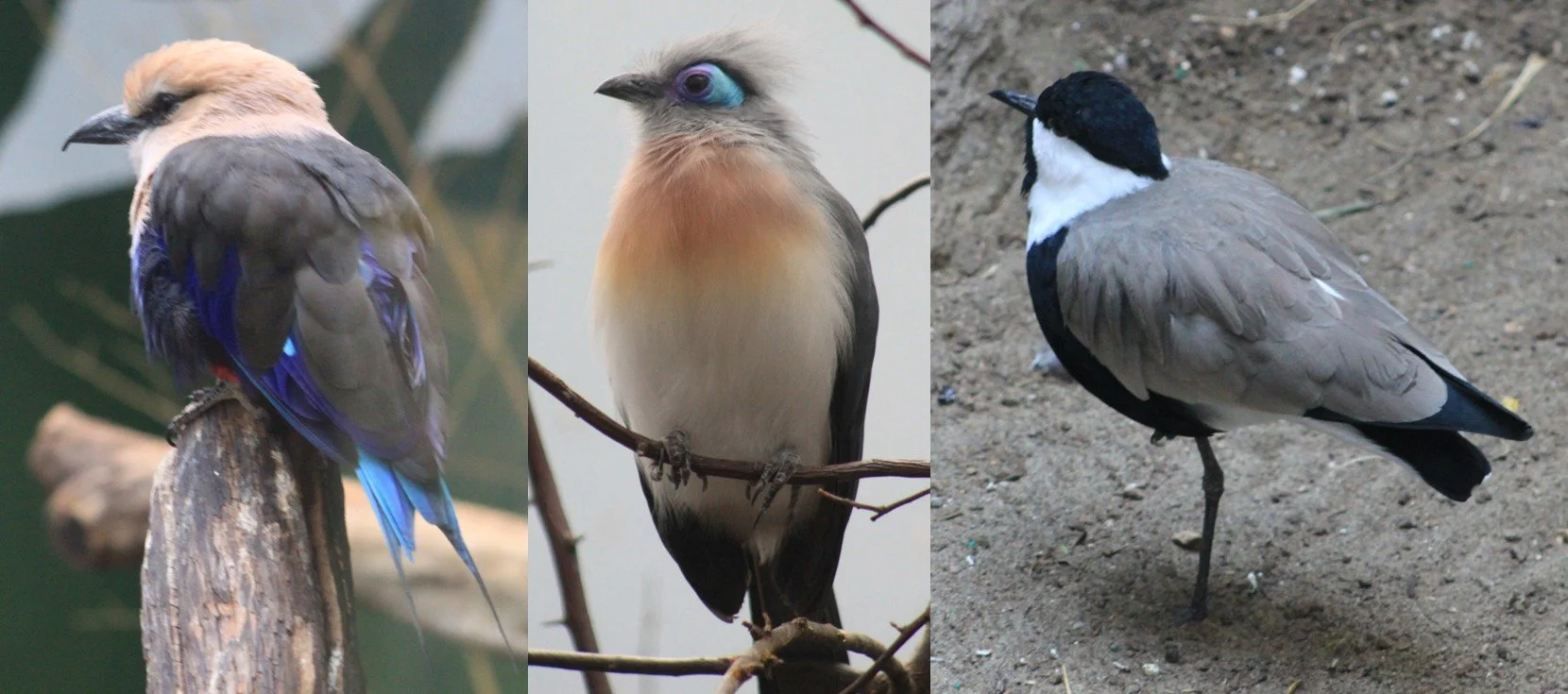
Caption: from left to right, Blue-bellied roller, Crested coua and the Afro-Arabian Spur-winged lapwing or Spur-winged plover Vanellus spinosus. The Spur-winged plover is the species apocryphally claimed to clean the teeth of crocodiles, though this role is also associated today with the Egyptian plover Pluvianus aegyptius (a bird that isn’t a plover, despite its name). Images: Darren Naish.
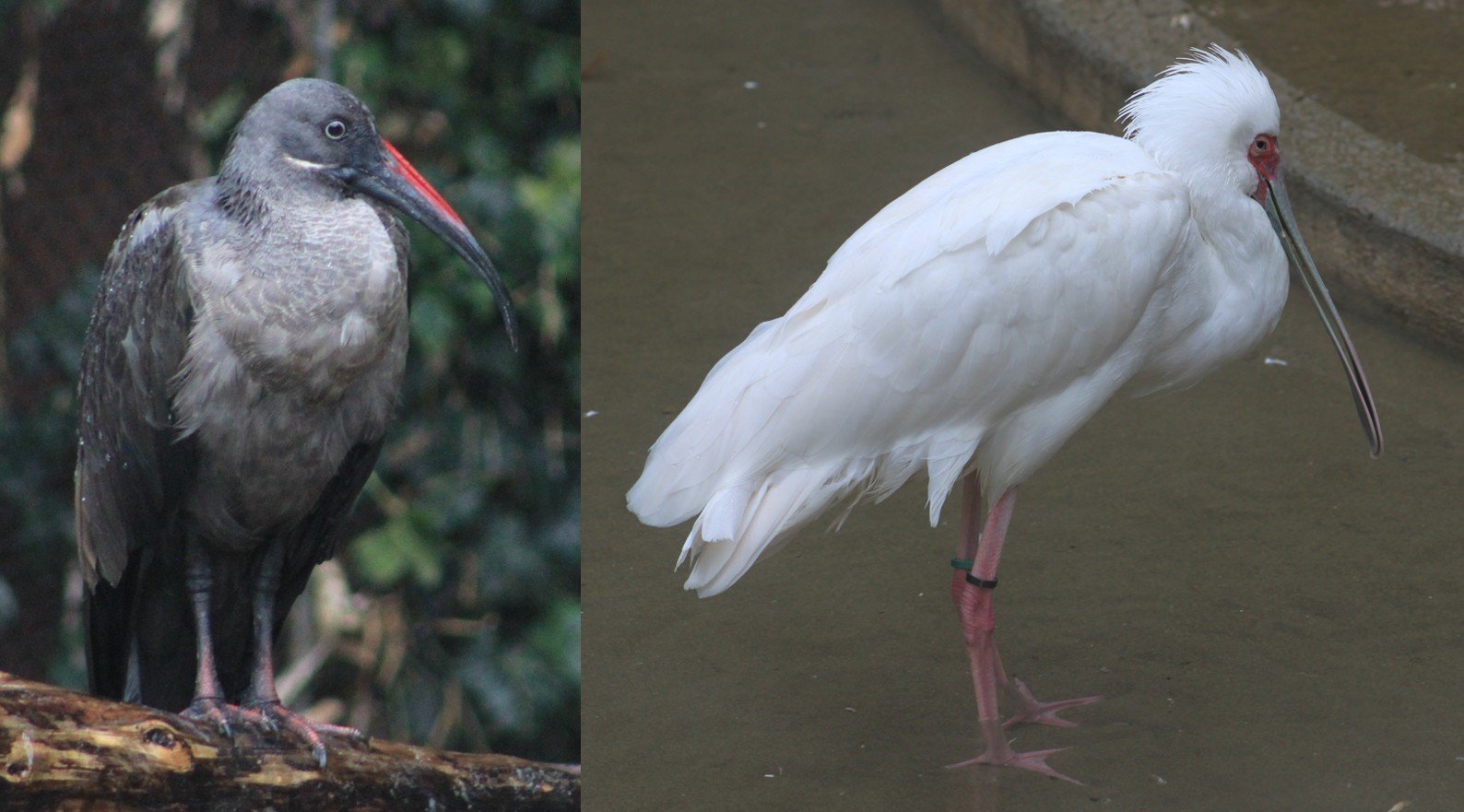
Caption: Hadada ibis at left, a large ibis widely distributed across Africa and named for its distinctive call. It’s been introduced to peninsula Malaysia, which is weird. All Bostrychia ibises are odd, often being comparatively short-billed and with unusual ornamentation. At right, African spoonbill. Images: Darren Naish.
I really enjoyed seeing Hadada ibis Bostrychia hagedash, a splendid bird with a deep base to its bill and striking eyes where the pupil has a slightly oval form (the horizontal axis being the longest one). If you think of ibises as a fairly samey group of birds, it’s well worth checking out the diversity they include, since there’s a lot going on there. I don’t think I’ve ever written about them at length.
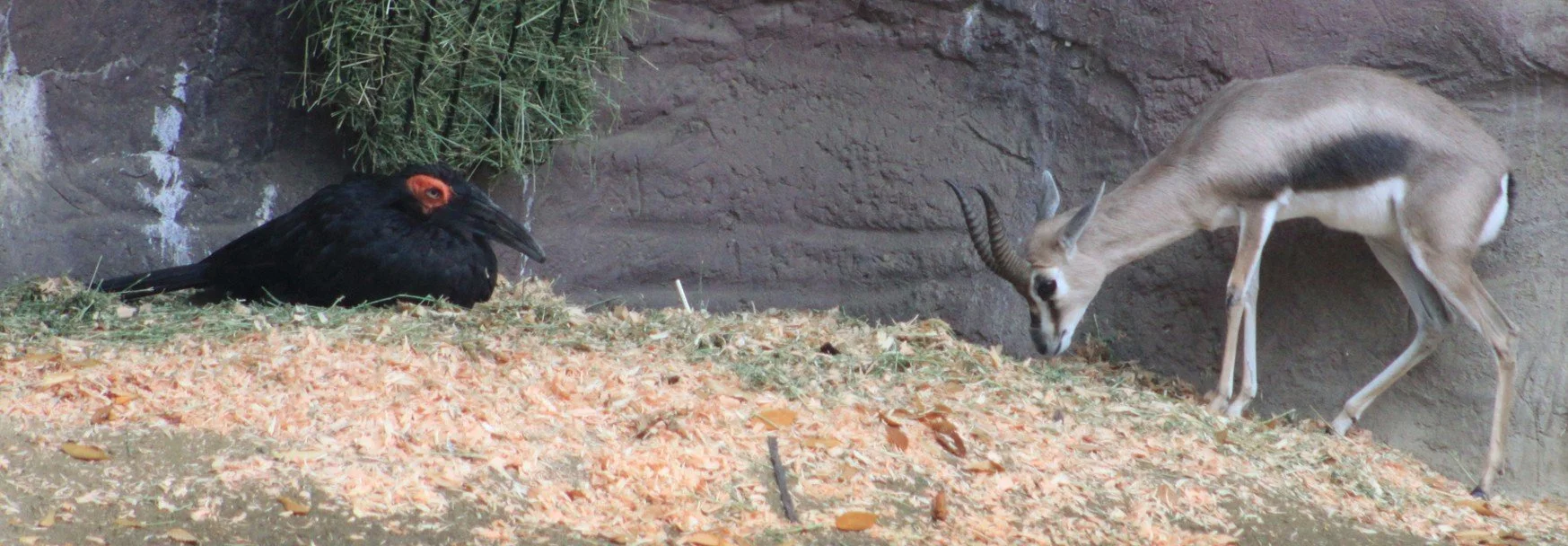
Caption: Southern ground hornbill Buceros leadbeateri at left, Speke’s gazelle Gazella spekei of Somalia at right. The hornbill isn’t nesting (like all hornbills, it’s a cavity-nester). Speke’s is one of the most unusual of gazelle, what with its inflatable nose, but is today among those species most often seen in captivity. Image: Darren Naish.
Another indoor display area was devoted to Naked mole-rat Heterocephalus glaber (though read on). As is standard in displays of this species, they were housed in a human-made system of tunnels and galleries and could be viewed through small windows. I like Naked mole-rats and enjoy looking at them, but it’s somehow ironic that the most specialized and unusual member of this group – there are around 30 mole-rat species – is essentially the only one you ever seen in captivity. I guess that both weirdness and fame account for this. You might argue that their sociality and use of complex burrow systems recalling those of social insects are also plus points for display in captivity, though this would work for at least some other, non-naked mole-rat species. Incidentally, some workers argue that H. glaber of traditional is a species complex and consists of taxa that started diverging during the Late Miocene (Uhrová et al. 2026). It might be a while before we start seeing this proposed taxonomy – if it proves valid – reflected in zoos, I think.
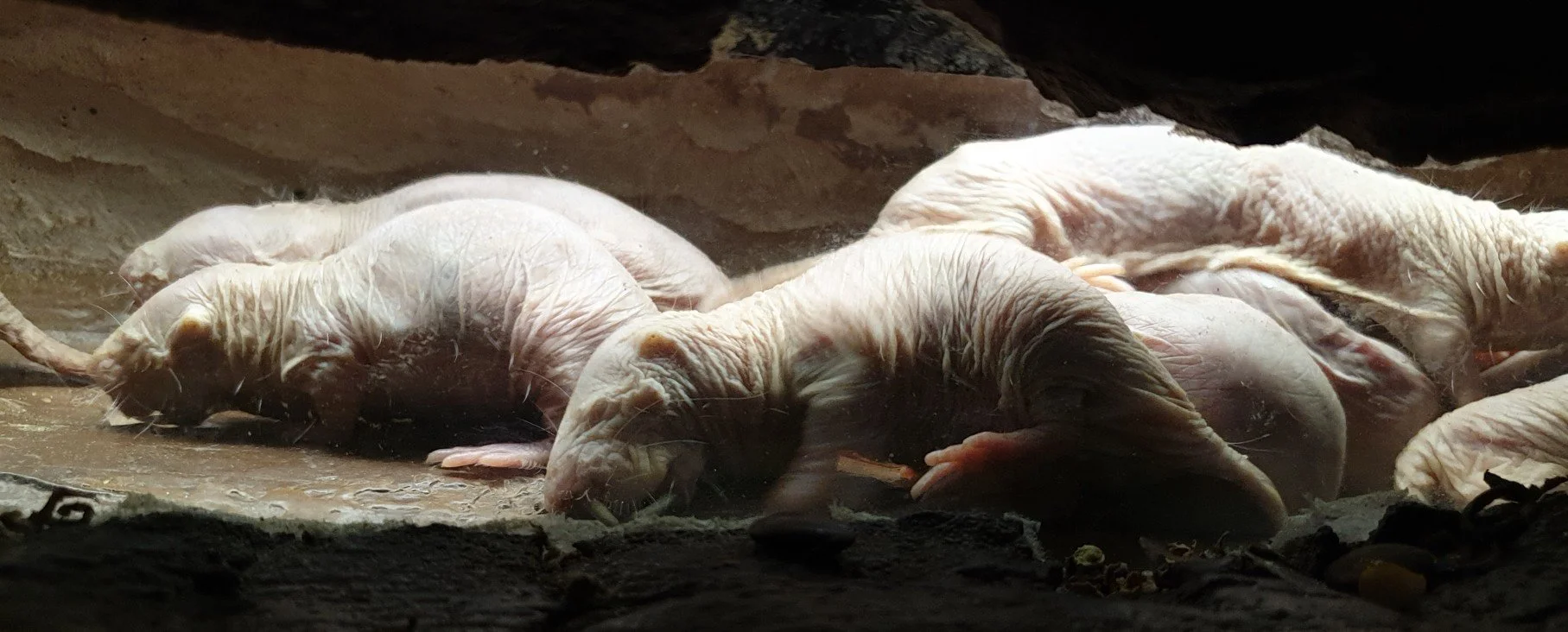
Caption: naked mole-rats are fun to watch in their tunnels, but they never actually do that much. Fossils show that these animals have been around since the Miocene, with molecular data indicating divergence from other mole-rats even earlier than this. I wrote about mole-rat evolution back here in 2016 and I’m pleased to see that the article is intact, its images still in place! Image: Darren Naish.
Tortoises, Spotted-necked otter Hydrictis maculicollis, fruit bats (Rodrigues fruit bat Pteropus rodricensis, Egyptian fruit bat Rousettus aegyptiacus and Straw-coloured fruit bat Eidolon helvum) and lemurs were in this part of the zoo too, and also indoors was a Slender-snouted crocodile Mecistops cataphractops. If you’re a crocodylian fan, this is a major tick. Several collections in the UK house Mecistops, so I have seen them before. Then again, there’s more than one species, so not all Mecistops are alike. Spotted-necked otter is rarity but wasn’t showing, perhaps because of the rain. A big African lungfish Protopterus annectans lived in a landscaped enclosure near the crocodile.
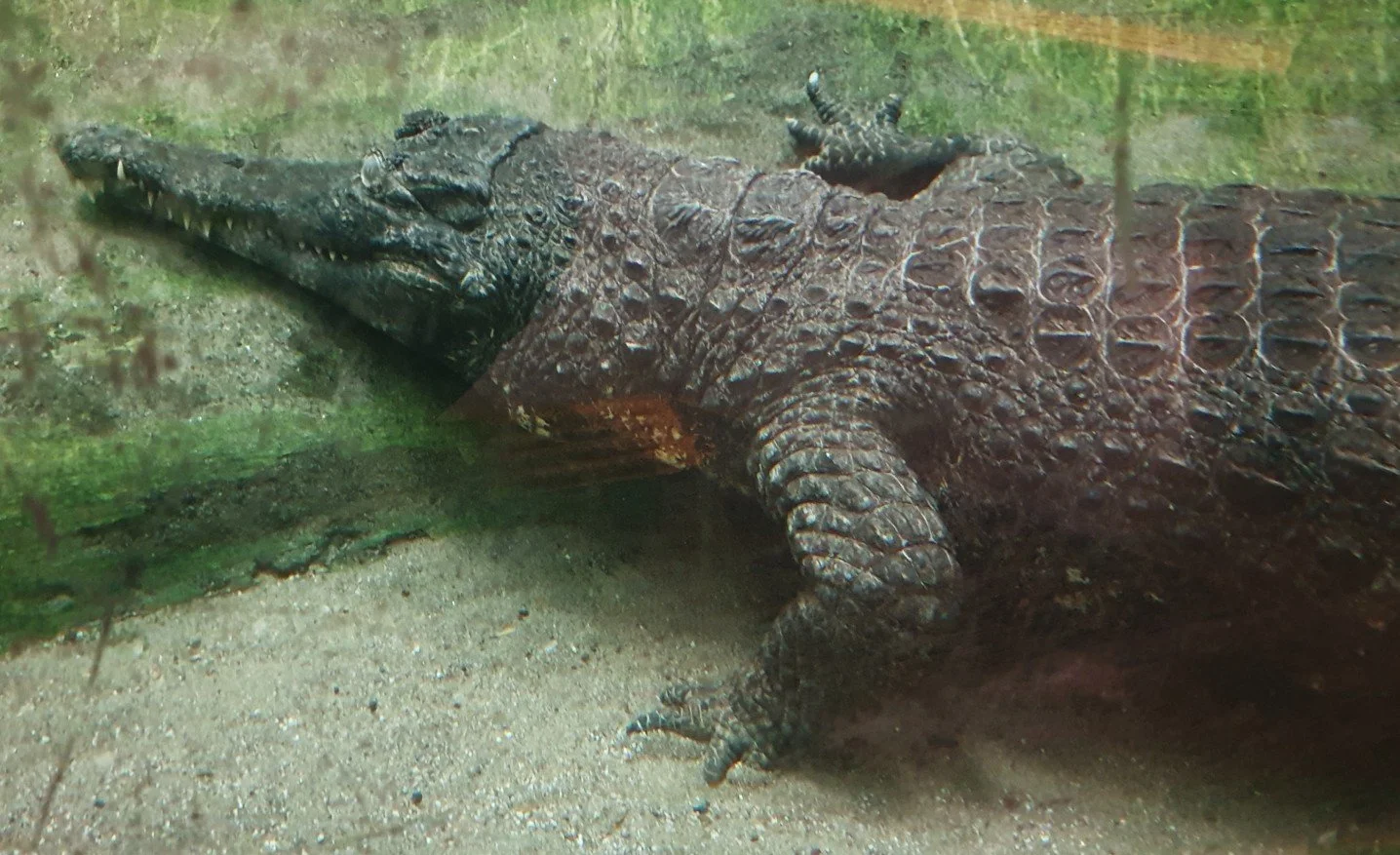
Caption: the glass-fronted crocodile enclosure allows you to look at the Mecistops while it’s submerged, which is great. It seems odd today to think that Mecistops was included within Crocodylus just a few decades ago. Molecular data published since around 2006 has shown that the old genus name published for it by J. E. Gray back in 1844 should be reinstated, and that it might be an osteolaemine. Some anatomical data even supports a close relationship with the extinct Euthecodon. Image: Darren Naish.
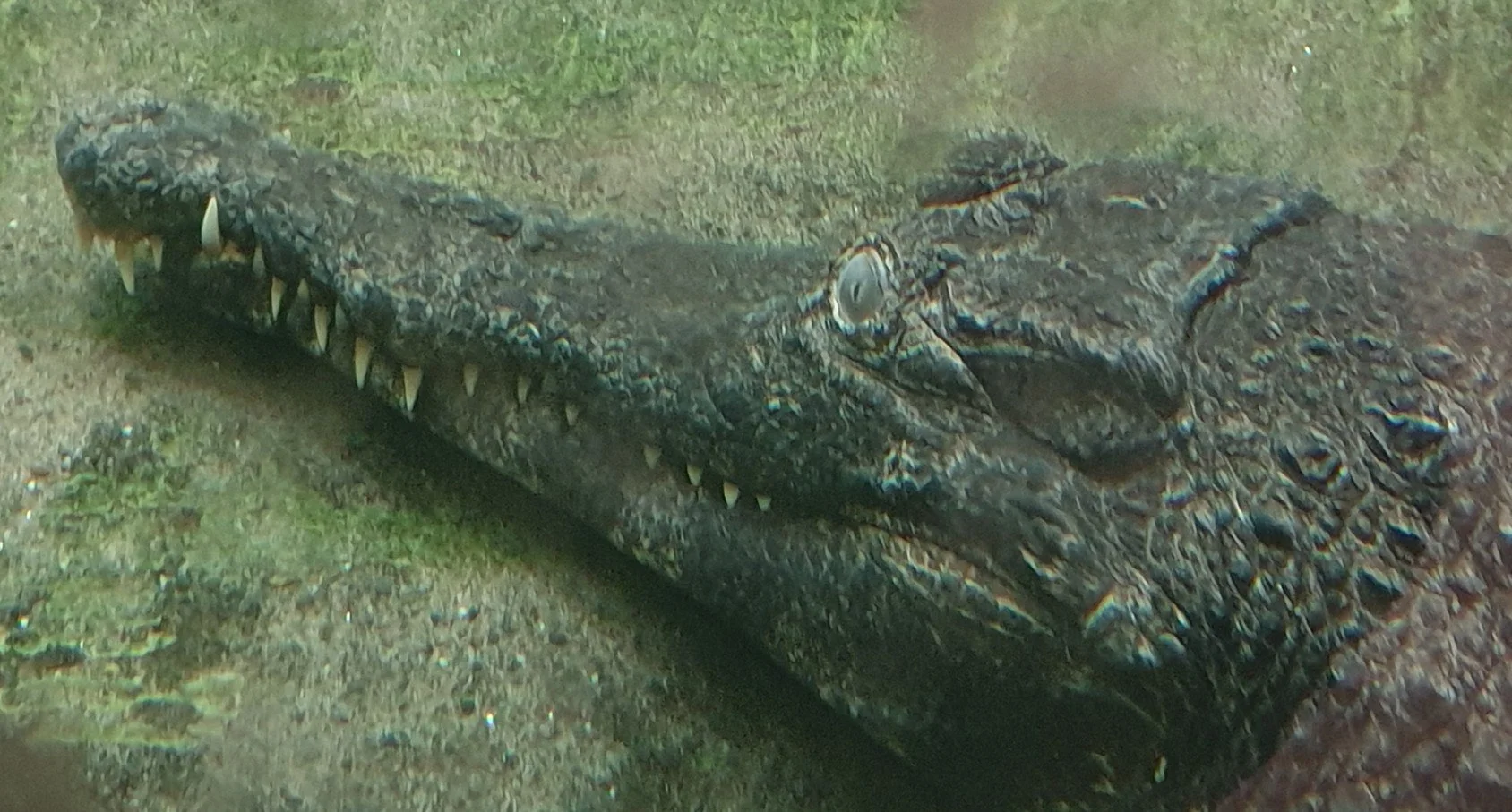
Caption: Mecistops in profile. The steepness of the forehead is interesting, as is the relative shortness of the skull deck. The nictitating membrane is sufficiently transparent (albeit not fully) that it clearly allows good underwater vision, though I wonder if submerged crocodylians see the world through a slightly milky lens. Image: Darren Naish.
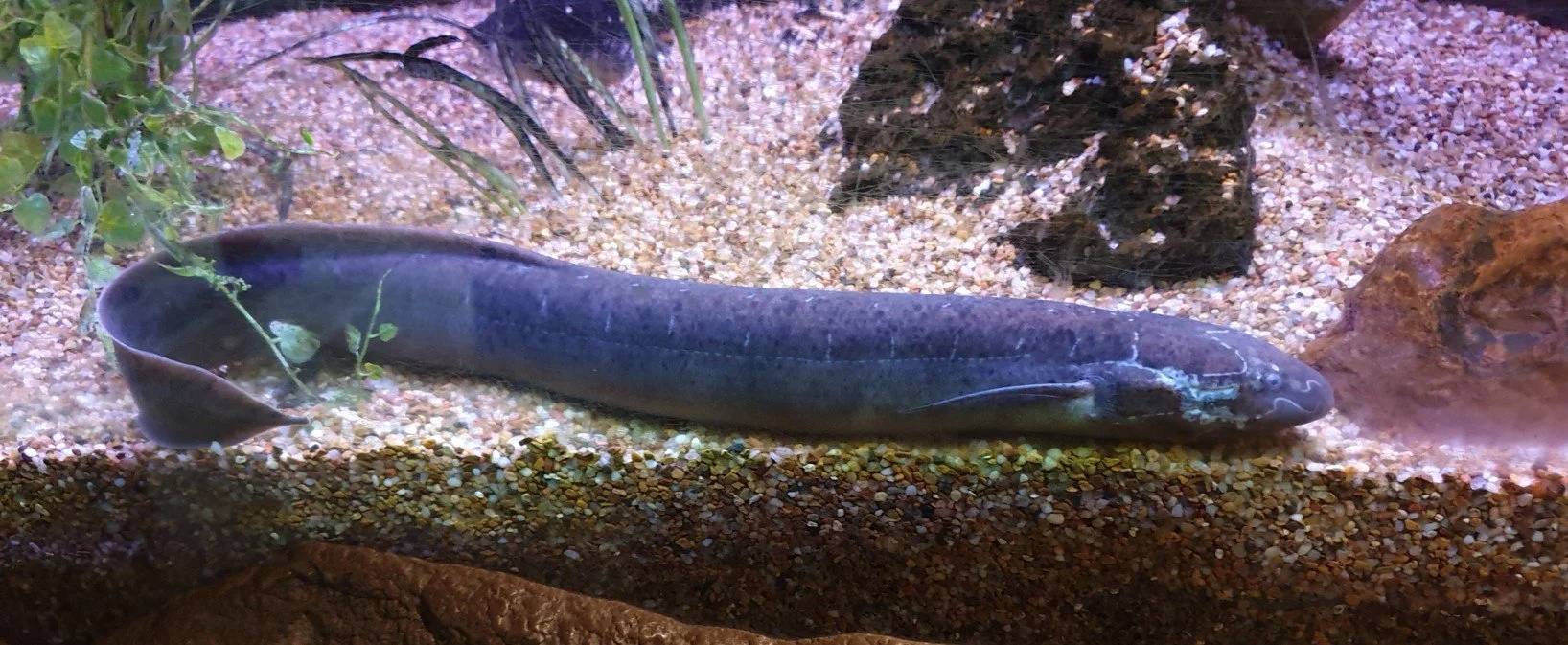
Caption: African lungfish co-operatively showing at the front of its enclosure. There are four extant species of Protopterus and this is specifically P. annectans, the so-called West African lungfish. It does live in the west, but in the east as well. It’s large, reaching 1 m in length. Image: Darren Naish.
The lions were busy reclining, albeit awake, but the Black rhinos Diceros bicornis were extremely active. The two individuals we watched had been housed together in the hope that they might mate. Courtship in black rhinos seems to involve the male pursuing, harassing and mounting the female until she eventually gives in. Nature is the way it is and many ‘natural’ behaviours are unfair and involve pain and distress; also, the world needs more baby rhinos. But you have to feel sorry for a female when, as here, there isn’t the opportunity to ever get away.
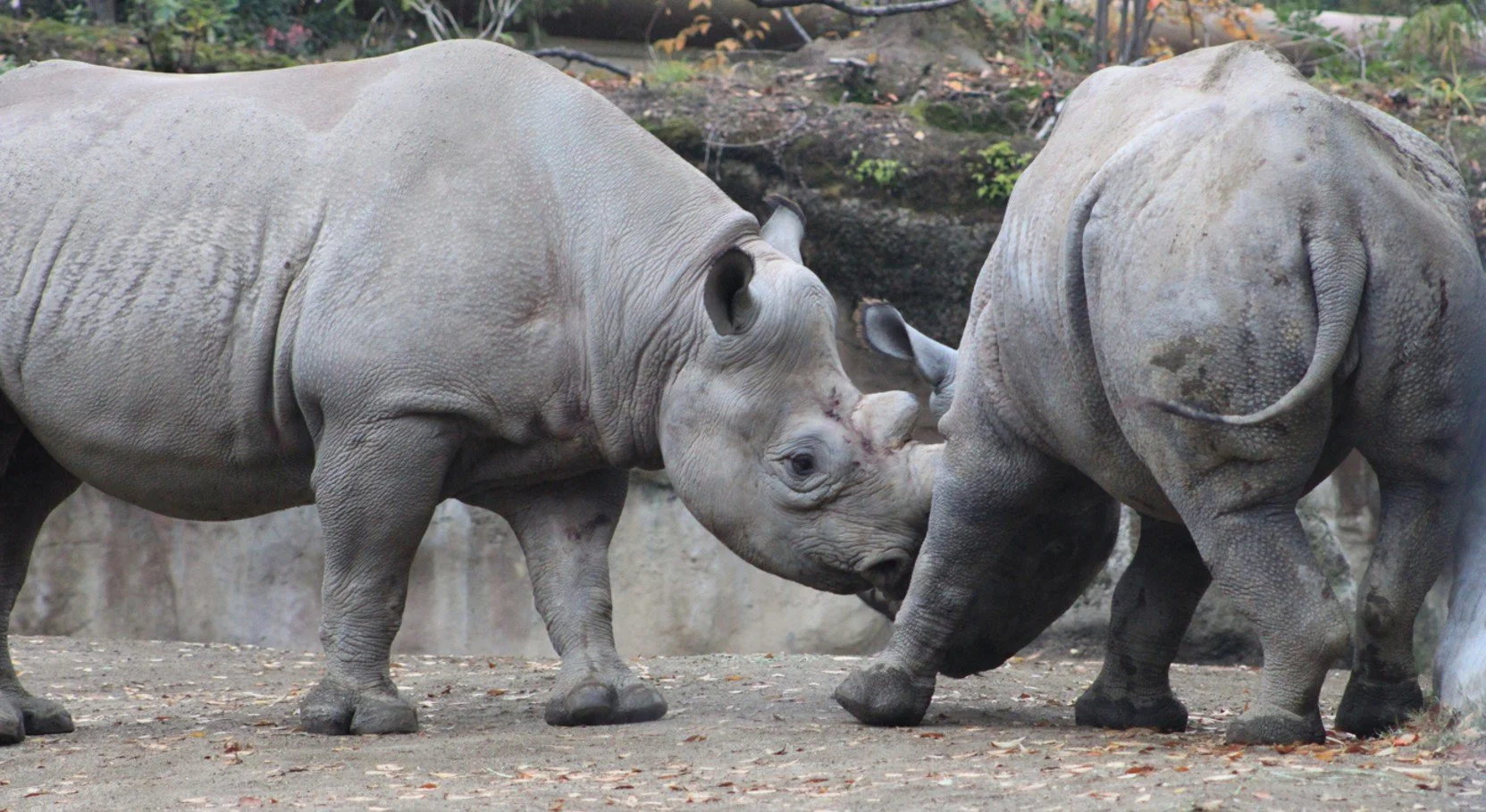
Caption: black rhino pair interacting. There are supposed to be at least five black rhino subspecies, two of which are recently extinct. For some animals, we always get to learn which subspecies we’re looking at; for others – and the black rhino is an example – we very often don’t. I had assumed that most black rhinos in zoos are of the south-central subspecies D. b. minor but these individuals are the critically endangered Eastern black rhino D. b. michaeli (which was only awarded taxonomic distinction in 1965). Image: Darren Naish.
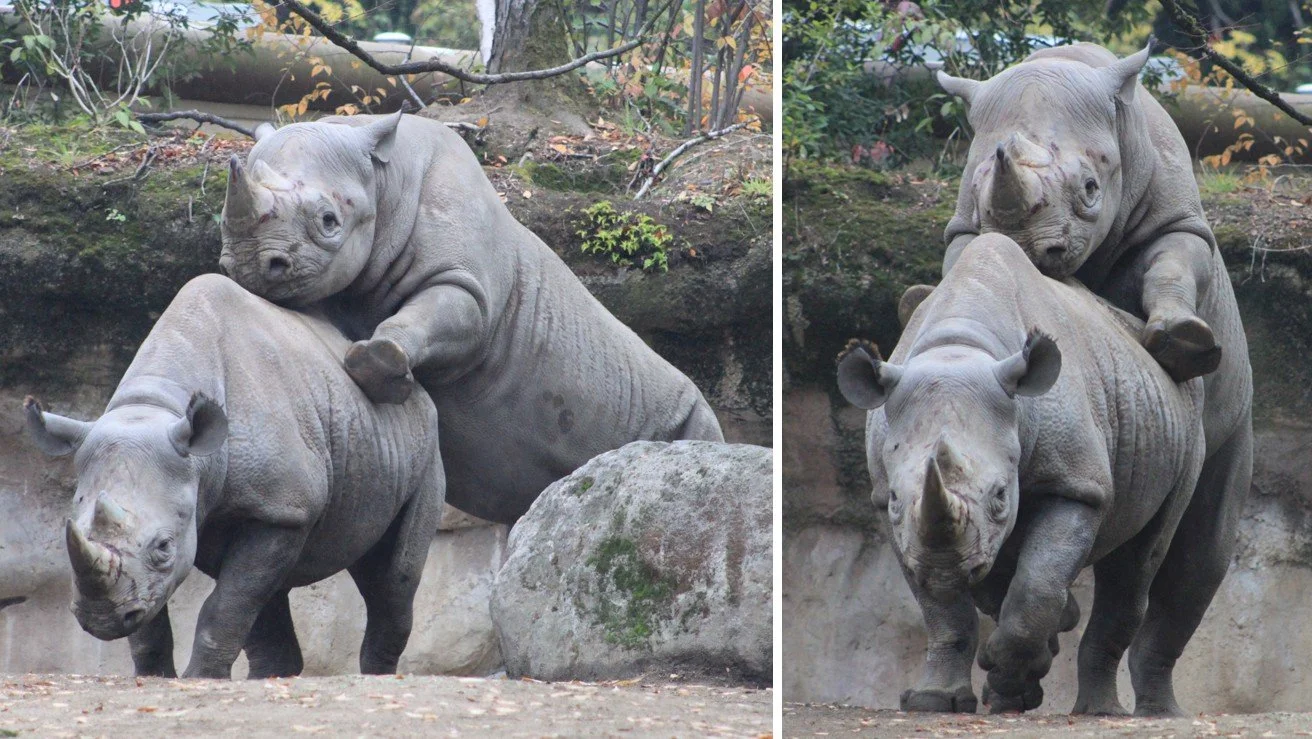
Caption: this sort of behaviour is all part of courtship, though the male here has a sheepish and embarrassed look and seems to know that he’s doing wrong. The male rhino is called King (he was born at Lincoln Park Zoo, Chicago, in 2013); the female is Jozi (she was born at Pittsburgh Zoo in 2012). Images: Darren Naish.
Overall, that’s a pretty impressive selection of African (and Malagasy) species, involving zoo classics as well as species only rarely seen.
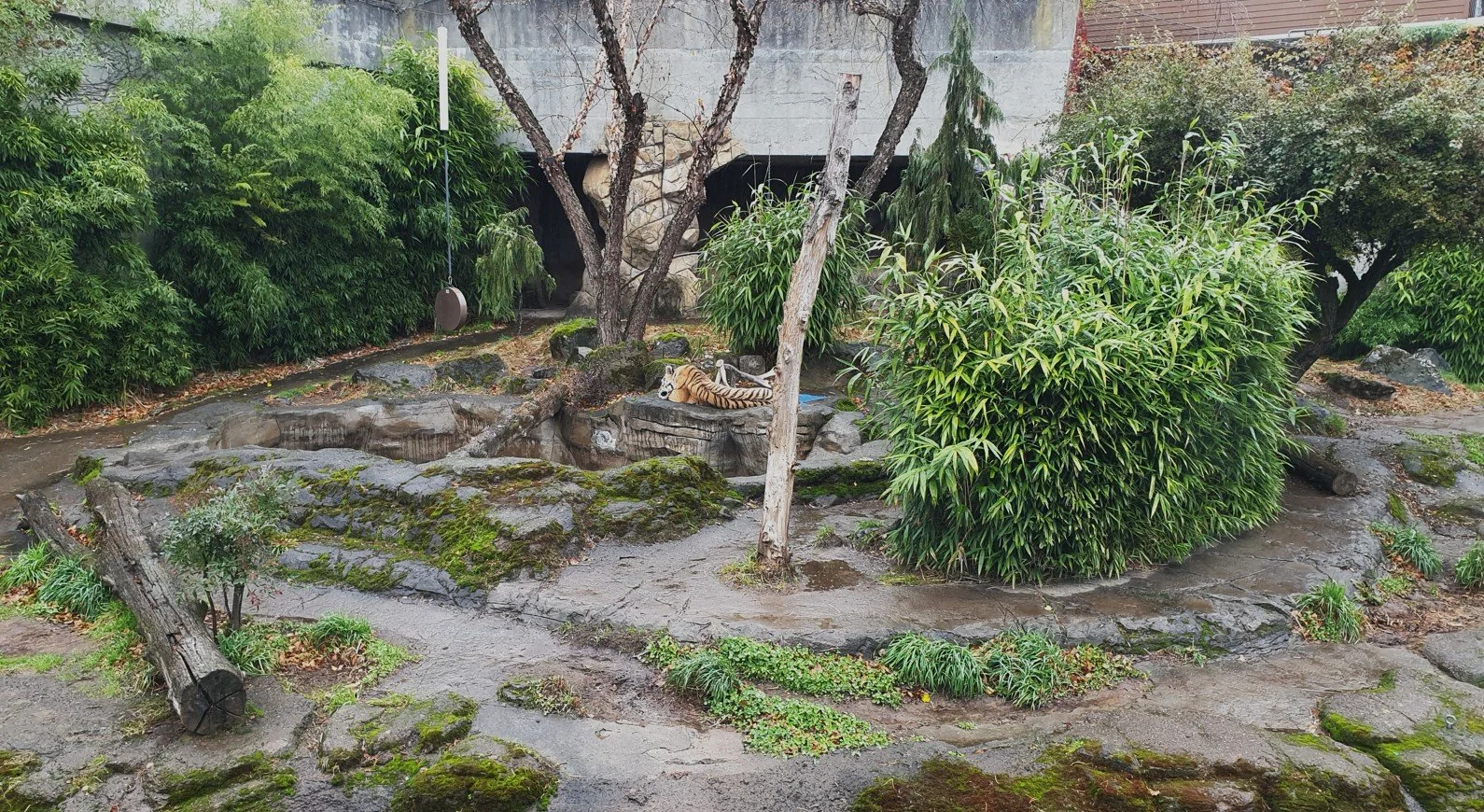
Caption: Siberian/Amur tiger enclosure, located in the Discovery Zone and hence in the far west of the zoo. You should be able to see the lone tiger close to the centre of the image. Two were present at the time of my 2022 visit: Eloise and Bernadette, both originally from Milwaukee County Zoo in Wisconsin. The zoo has kept several Siberian tigers in recent years and one of them, Mikhail, was the oldest captive member of his species. On his death in 2018 he was one day short of his 20th birthday. Image: Darren Naish.
Finally… the Discovery Zone includes an Insect Zoo as well as Siberian/Amur tiger Panthera tigris altaica (the zoo goes with ‘Amur’). And that about sums things up. I was really impressed both with the landscaping and general look of the zoo and also at its selection of animals, and also with its really well-designed and informative signage and art. I’ve said before that you can judge a zoo from the amount and quality of information it provides its visitors, and Oregon Zoo is very, very strong on this front. A number of animal statues throughout the zoo improved the surrounds and were appreciated as well.
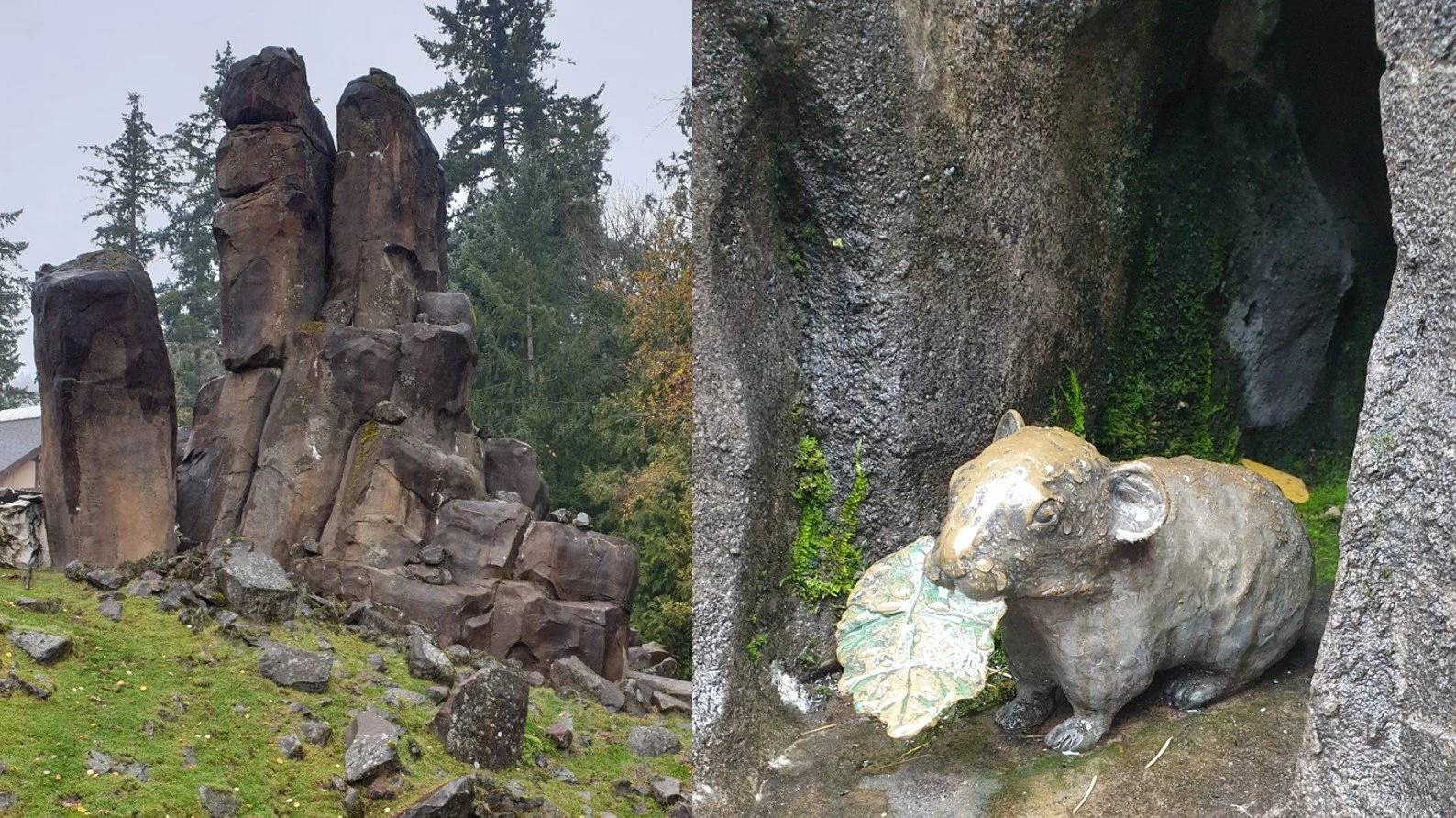
Caption: I really enjoyed the landscaping and sculpted features of the zoo, the rocks here (from the Great Northwest section) being a good example. At right, one of at least two pika statues findable within the same section. Images: Darren Naish.
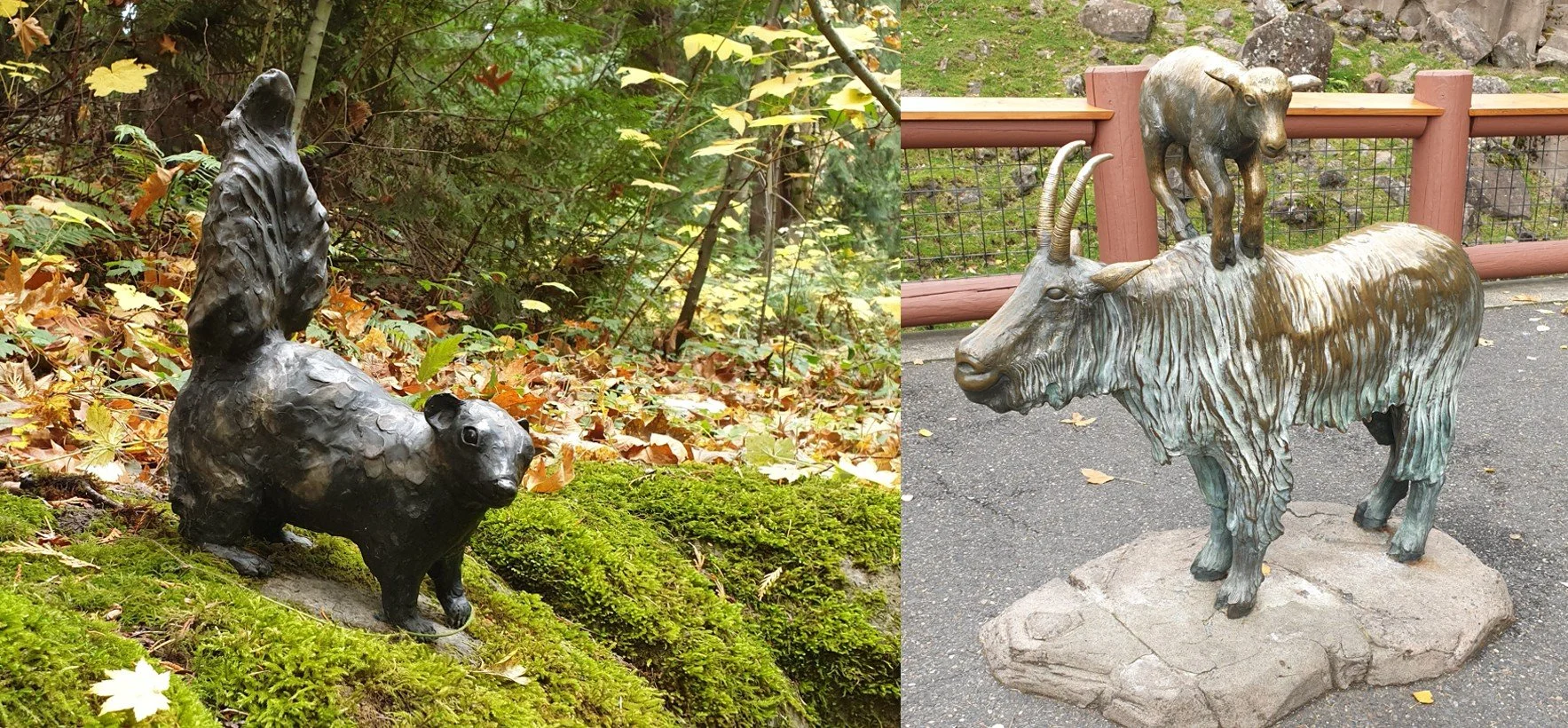
Caption: more very nice metal statues from the Great Northwest section. A skunk at left, Rocky Mountain goat at right. Images: Darren Naish.
As ever, I’ll end with my wholly idiosyncratic scoring system…
Selection of species: 9 out of 10
Zoo nerd highlights: Rocky mountain goat, California condor, Slender-snouted crocodile, Sea otter, Spotted-necked otter
Quality of signage: 10 out of 10
Value for money: 9 out of 10
Overall worthiness: 9 out of 10
For previous articles in my zoo reviews series, see…
Tet Zoo Reviews Zoos: Edinburgh Zoo, August 2016
Tet Zoo Reviews Zoos: Colchester Zoo, October 2017
Tet Zoo Reviews Zoos: the Isle of Wight Zoo, February 2020
Tet Zoo Reviews Zoos: ZSL Whipsnade Zoo, June 2021
Tet Zoo Reviews Zoos: Bristol Zoo, July 2021
Tet Zoo Reviews Zoos: Tripoli Zoo in Libya, January 2023
Tet Zoo Reviews Zoos: New Forest Wildlife Park, April 2024
Tet Zoo Reviews Zoos: Tokyo’s Ueno Zoo, September 2024
Tet Zoo Reviews Zoos: Tama Zoological Park, Tokyo, February 2025
Refs - -
Castelló, J. R. 2016. Bovids of the World: Antelopes, Gazelles, Cattle, Goats, Sheep, and Relatives. Princeton University Press, Princeton and Oxford.


