It’s time again to rescue another squamate-themed article from the Tet Zoo articles. This one – devoted to the treerunners, obviously – was first published at Tet Zoo ver 3 in December 2017 (the original Sci Am version is hosted here) and here it is again, with substantial updates…
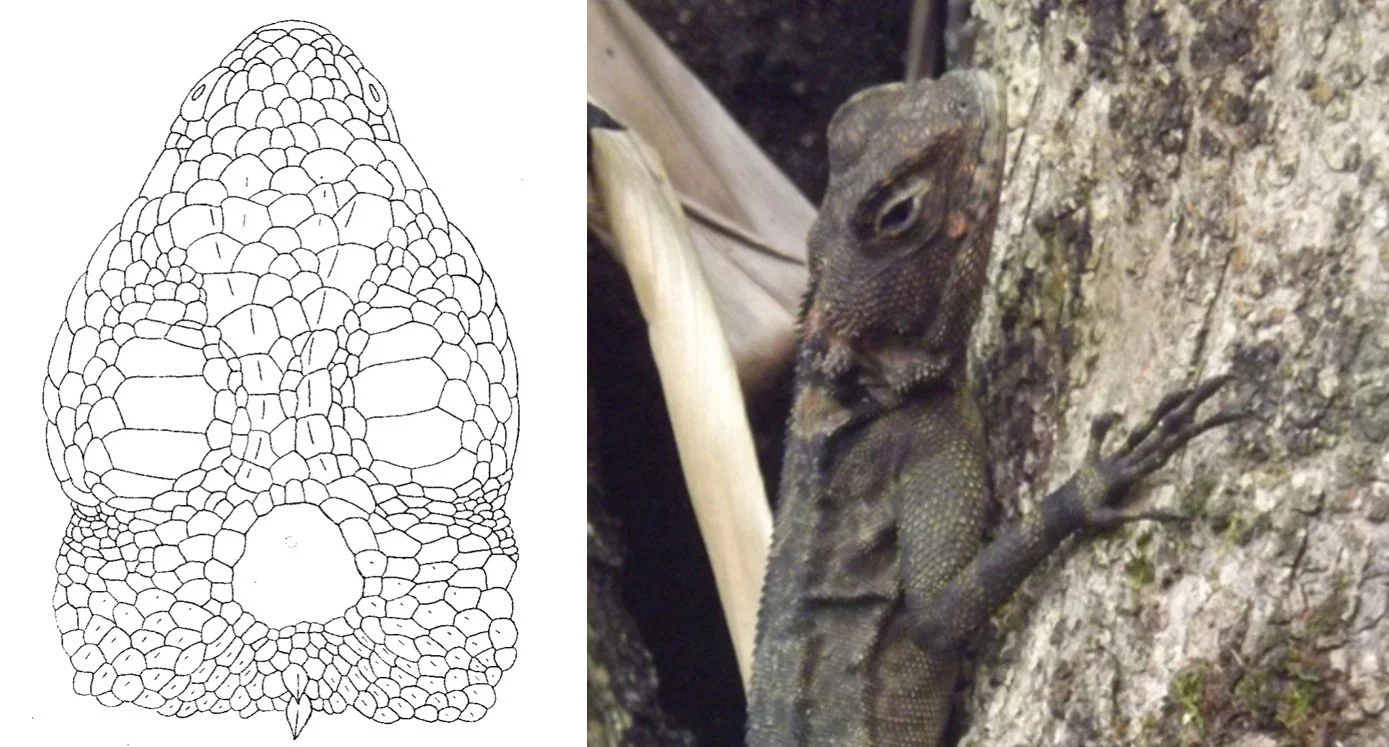
Caption: at left, the head of a Plica plica specimen in dorsal view, showing scalation. Squamates vary in how symmetrical their head scales are, and minor asymmetry (as seen here) is common in many species. At right, a captive individual of what’s probably Plica plica. This individual lacks bright colours or a prominent nuchal crest, indicating that it’s a female or a juvenile male. Credits: Etheridge (1970); Darren Naish
What is Plica plica? It’s a strikingly proportioned, diurnal, arboreal iguanian lizard that can exceed 17 cm in total length and has a range that encompasses a huge part of northern South America (though, keep that in mind and read on). Etheridge (1970) described Plica plica and its close relative P. umbra as “among the most abundant, widespread, and earliest known lizards of South America” (p. 237). That “earliest known” always looked odd: what he meant is that P. plica is among the earliest of South American lizards to be scientifically recognised, since Linnaeus listed it (as ‘Lacerta plica’) in 1758.
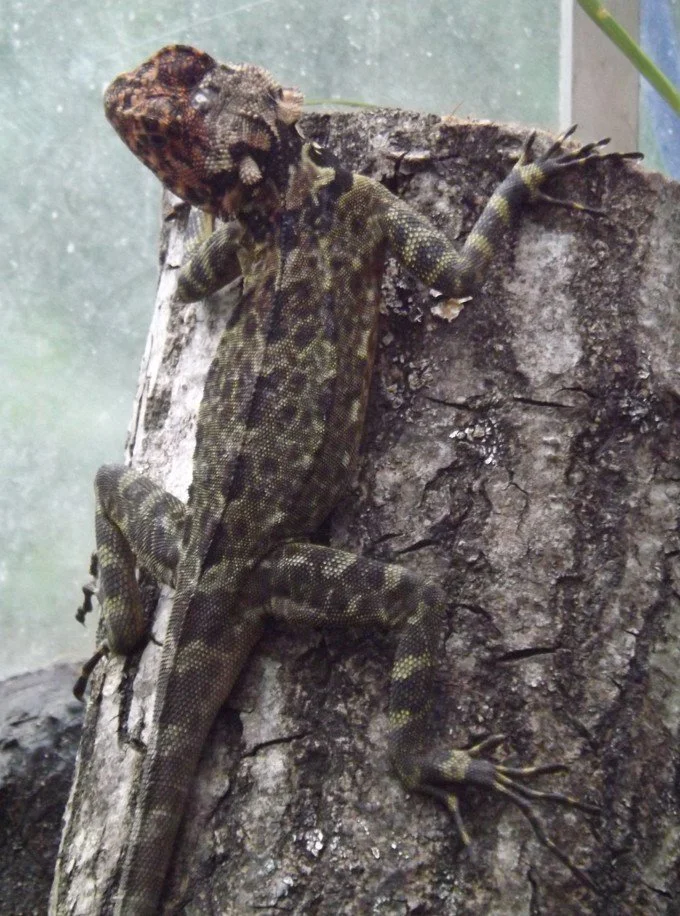
Caption: captive Plica photographed in captivity in 2012, labelled as P. plica (but is it? Read on). Note the reddish head, light green or yellowish rings on the distal parts of the limbs, and the especially dark collar-like markings. Credit: Darren Naish.
I say that this lizard is “strikingly proportioned” because it’s shockingly suited for arboreal, trunk-clinging life, being highly gracile – almost spidery – and with a very slim tail, slender digits and hooked claws.
Plica is a tropidurine, a group of iguanian lizards that I thought I’d written about before. On checking, it turns out that I’ve written (more than once) about the liolaemines, another iguanian group sometimes confused or combined with tropidurines but nowadays thought to be quite distinct from them (Pyron et al. 2013). Indeed, a taxonomic system that recognises these major lizard groups as ‘families’ and separate from the super-inclusive Iguanidae of tradition probably best reflects their distinct nature and phylogenetic history. Tropidurines (Tropiduridae, if we go with that family-level thing) appear to be the sister-group to all other pleurodont iguanians, meaning that they’ve almost definitely been distinct since early in the Cenozoic if not before (Townsend et al. 2011). In addition to Plica, Tropiduridae includes Eurolophosaurus, Microlophus, Stenocercus, Strobilurus, Tropidurus, Uracentron and Uranoscodon. Some of those lizards are incredible and I really must cover them here some time.
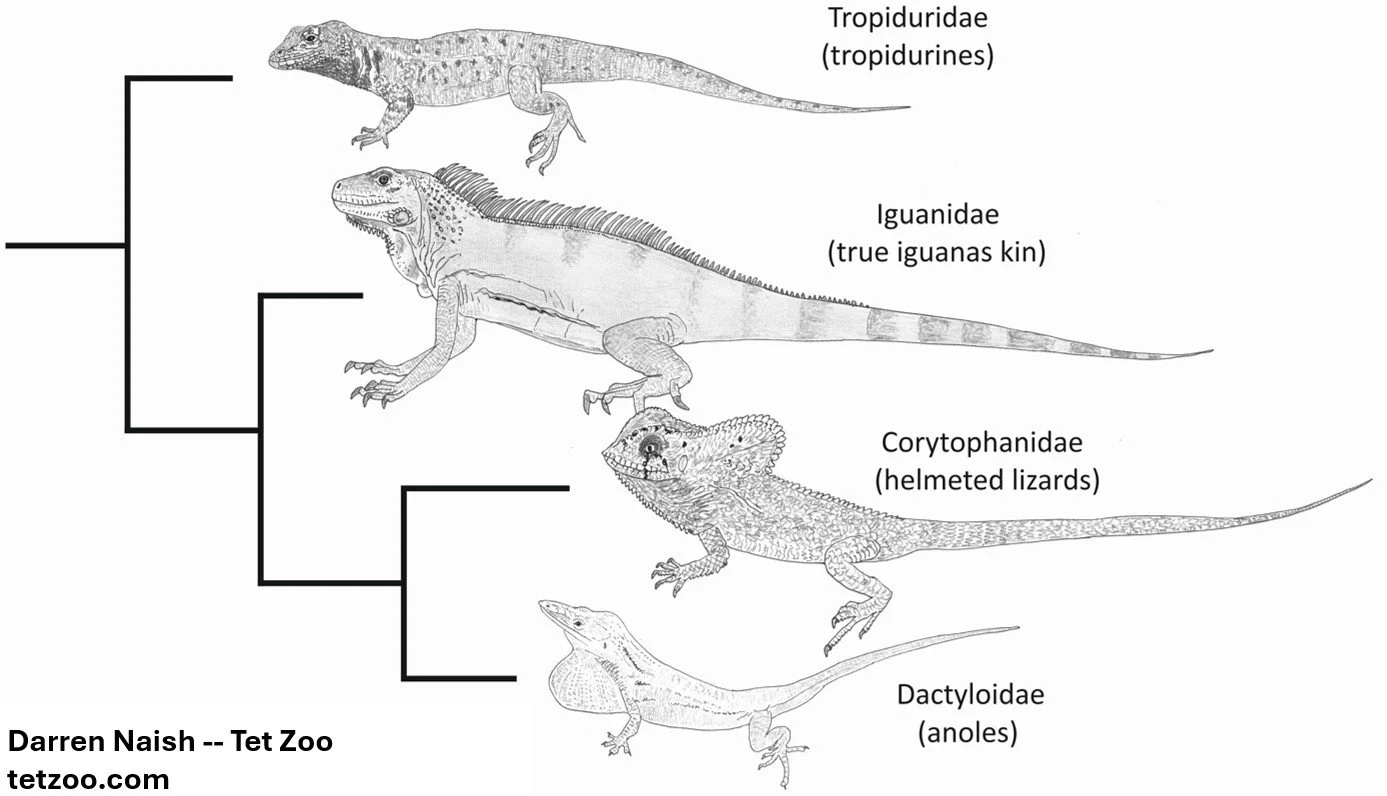
Caption: much simplified, stripped-down cladogram for pleurodont iguanians. More complete, more complex versions of this tree will appear here in later articles (something I’ve been saying since 2017). It’s one of the hundreds of illustrations produced for my in-prep textbook on the vertebrate fossil record on which go here. Credit: Darren Naish
Anyway, those arboreal habits explain why the Plica species are sometimes called ‘tree runners’ or ‘treerunners’, though – frankly – this is a terribly vague name since I don’t think it’s clear that it refers to a group of lizards. The names Collared tree lizard, Collared tree runner and Harlequin racerunner are apparently also in use for P. plica. Calling it a ‘racerunner’ also seems less than brilliant given that the term ‘racerunner’ is more normally applied to a group of lacertids (see the article here); it’s also sometimes used for certain teiids. Thanks to Wikipedia, I know that a local name used for P. plica in Guyana is wakanama and I wish that this was in general use as its vernacular name.
Taxonomic revision and the post-2013 recognition of new species. An interesting thing long known about P. plica (in the traditional, inclusive sense of the name) is that it’s highly variable across its range: in size, the shape of the snout, the size and nature of the scales and neck spines, and in how much spotting there is on the throat. They’re sexually dimorphic, males having brighter, bolder colours and more prominent nuchal crest scales than females... and I’m going to assume here that discussions of variation within the species do take account of this dimorphism. Etheridge (1970) drew attention to geographical diversity in P. plica but noted that the poor preservation of many of the specimens used in his study didn’t allow this variation to be studied more carefully. It has long seemed plausible that various subspecies or even species might be involved.
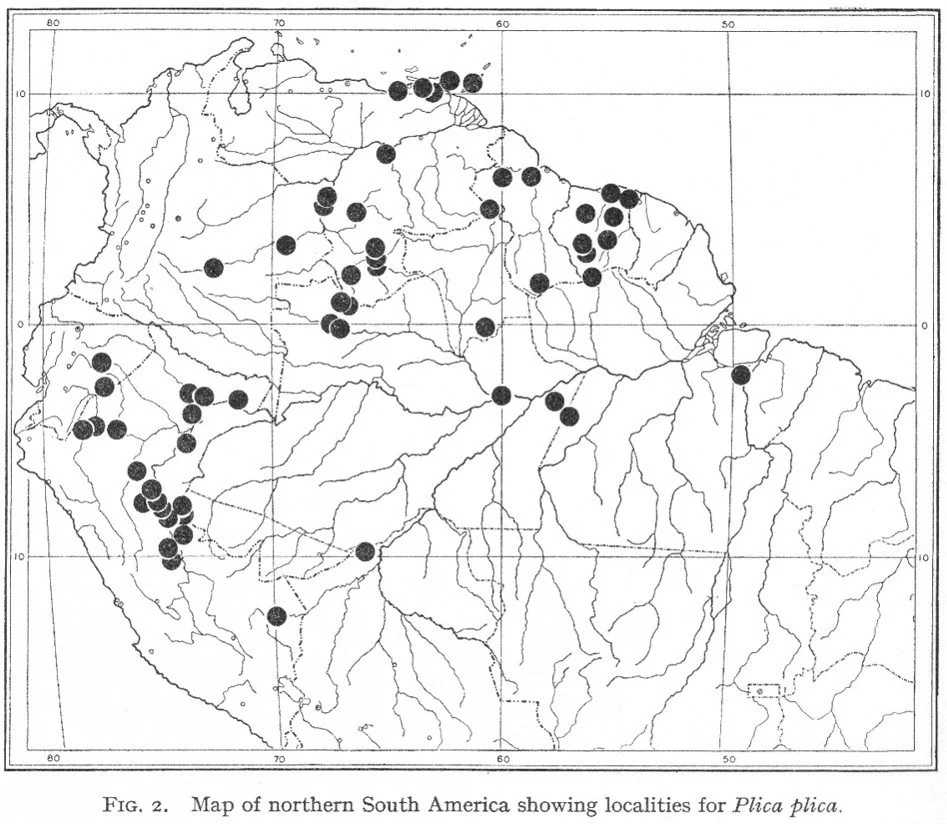
Caption: a map from Etheridge’s 1970 study of P. plica, showing the reported localities he was aware of. As you can see, this species – as perceived by Etheridge – was meant to have an enormous range, and to occur across a fairly wide range of topographies and habitats. Credit: Etheridge (1970).
Murphy & Jowers (2013) used both morphological and molecular data to show that P. plica of tradition is indeed a complex of cryptic species. They named the Caribbean treerunner P. caribeana of the Eastern Coastal Range of Venezuela, Trinidad and Tobago, Kathleen’s treerunner P. kathleenae of Guyana, Medem’s treerunner P. medemi of Colombia, and Ray’s treerunner P. rayi of Venezuela and Colombia as new. P. plica proper is restricted to Surinam according to this view. Furthermore, this isn’t the end of it, since they noted that their study was not a revision of the entire species complex but merely an initial demonstration of ‘P. plica’s’ polytypic status. In another Plica-based study, Paula de Oliveira et al. (2016) found another species – P. umbra – to also be a species complex. A key point they made in that study is that: “If the observed diversity of lineages within the genus Plica is characteristic of squamate reptiles of the Amazon region, the diversity of squamates is grossly underestimated”. That’s very much a non-trivial observation.
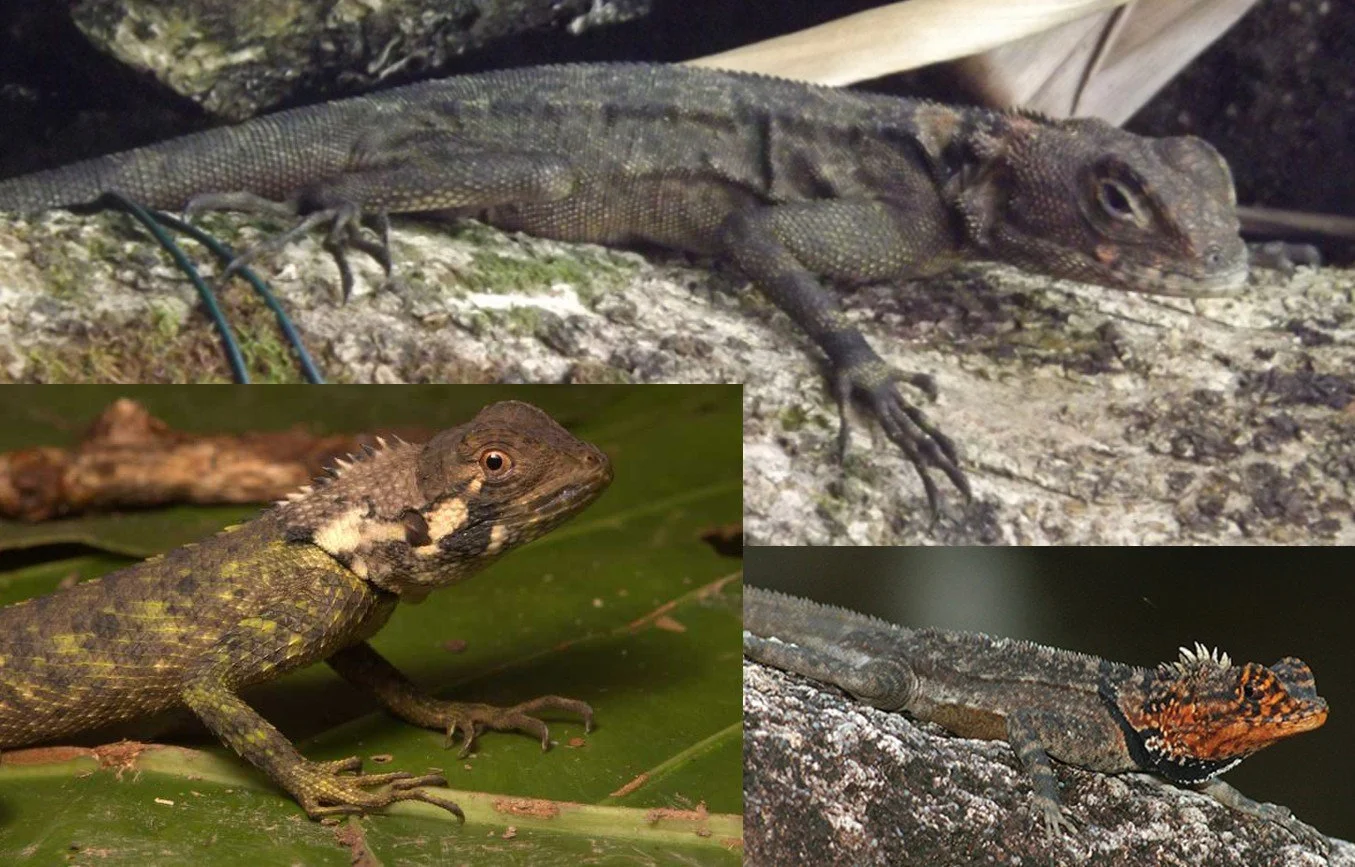
Caption: a Plica montage. At top, a captive animal labelled as P. plica (the image has been rotated by 90°; it was actually clinging vertically from a trunk). At lower left, P. umbra photographed in the wild. At lower right, P. rayi in Puerto Ayacucho, Venezuela. Images: Darren Naish (top); Alessandro Catenazzi, CC BY-SA 2.5 (lower left; original here); Zelimir Cernelic, CC BY 3.0 (lower right; original here).
All of this leaves me wondering about the precise status of the captive animal or animals – labelled P. plica – shown in my photos here. The reddish head in the animal at the top of the article makes it look like one photographed in the Sierra de Lema of Venezuela, and figured by Murphy & Jowers (2013), though I can’t work out from their paper which species that specific specimen belongs to. Ho hum.
Behaviour and biology. Having mentioned sexual dimorphism, I should note the claim that dimorphism in these lizards is actually less pronounced than it is in other tropidurines (Vitt et al. 1997). That same study reported many interesting things about the ecology and biology of treerunners. They’re partly social, often occurring in pairs or groups. They’re ant specialists, a sample of 36 individuals revealing no other prey items whatsoever, even though other arthropod prey were apparently highly available. Vitt et al. (1997) wondered if the success of treerunners throughout South American lowland forests might be related to their exploitation of this resource, one otherwise not utilized by many other tree-climbing lizards across the region. You might be wondering what this means for maintaining them in captivity (where they do comparatively well). It turns out that they’ll accept crickets, weevils, cockroaches and fruit flies (Harding et al. 2016).
Egg-laying in Plica seems to occur throughout the wet season and during some of the dry months as well, and clutch size is small, averaging 2.9 in P. plica. This is presumably related to their compressed, gracile body shape (Vitt et al. 1997). They don’t nest in the arboreal environment but come down to the ground and bury the eggs among leaf litter (Harding et al. 2016). One final thing: despite living in environments where shade is common, treerunners do well at maintaining high temperatures and have generally been found to be a few degrees warmer than air and surface temperatures (Vitt et al. 1997).
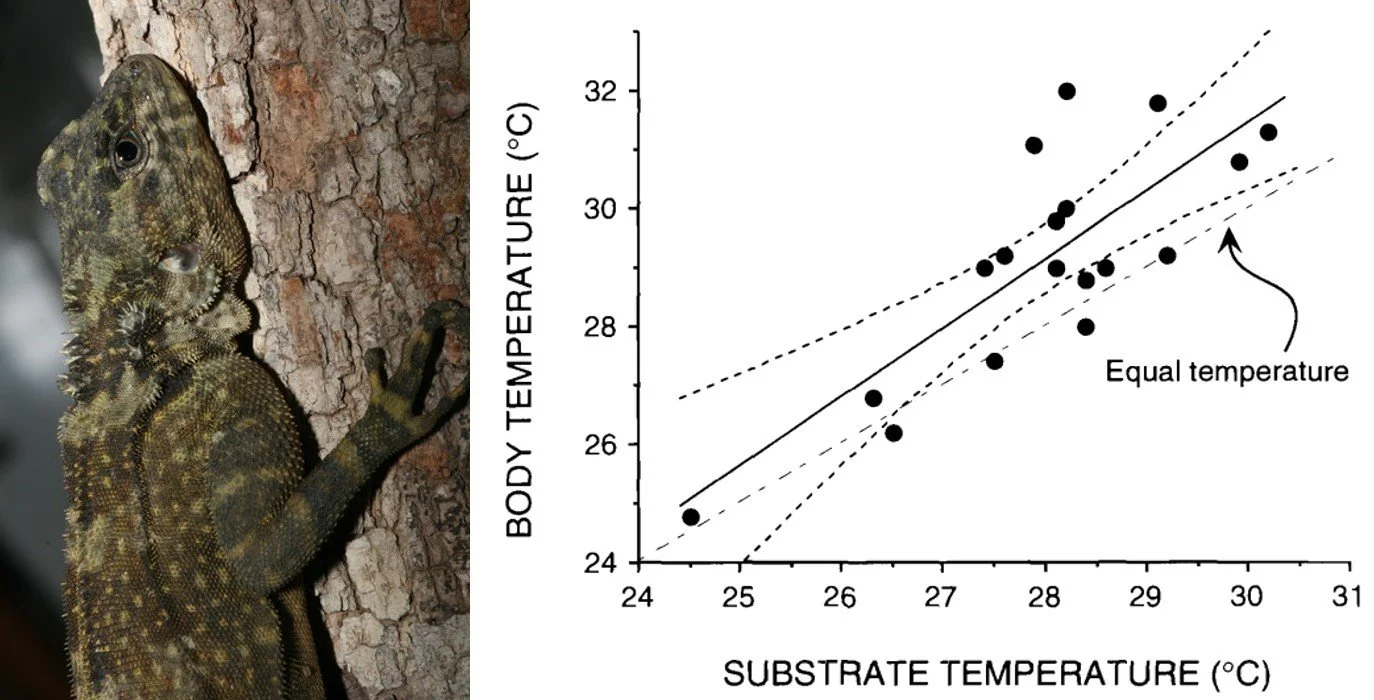
Caption: Plica plica at left. At right, graph from Vitt et al. (1997) showing relationship between body temperature and substrate temperature in wild P. umbra. Images: DuSantos, CC BY 2.0 (original here); Vitt et al. (1997).
Iguanians might be over-represented (as lizards go) at Tet Zoo, in part because they’re kept more frequently in captivity than other lizard groups and hence are more likely to be photographed. One thing I aim to deal with when time allows: that whole Toxicofera thing!
For previous Tet Zoo articles on iguanians, see…
The Tet Zoo Guide to Mastigures, August 2018
The Remarkable Basilisks, May 2023
Leiosaurid Lizards: South America, Land of Iguanians, November 2024
What's With All These New Chameleon Names? Chameleons, Part 1, November 2024
Refs - -
Etheridge, R. 1970. A review of the South American iguanid lizard genus Plica. Bulletin of the British Museum (Natural History) 19, 237-256.
Harding, L., Tapley, B., Gill, I., Kane, D., Servini, F., Januszczak, I. S., Capon-Doyle, J.-S. & Michaels, C. J. 2016. Captive husbandry and breeding of the tree-runner lizard (Plica plica) at ZSL London Zoo. The Herpetological Bulletin 138, 1-5.
Paula de Oliveira, D., Tadeu de Carvalho, V. & Hrbek, T. 2016. Cryptic diversity in the lizard genus Plica (Squamata): phylogenetic diversity and Amazonian biogeography. Zoologica Scripta 45, 630-641.
Townsend, T. M., Mulcahy, D. G., Noonan, B. P., Sites, J. W., Kuczynski, C. A., Wiens, J. J. & Reeder, T. W. 2011. Phylogeny of iguanian lizards inferred from 29 nuclear loci, and a comparison of concatenated and species-tree approaches for an ancient, rapid radiation. Molecular Phylogenetics and Evolution 61, 363-380.
Vitt, L. J., Zani, P. A. & Avila-Pires, T. C. S. 1997. Ecology of the arboreal tropidurid lizard Tropidurus (=Plica) umbra in the Amazon region. Canadian Journal of Zoology 75, 1876-1882.


