Long-time readers of Tet Zoo will perhaps be aware of my efforts, beginning in 2012 or something like that, to depict in a montage the diversity of crocodylomorphs extinct and extant. This whole thing actually started way back in 2001 when I published a terse but adequate review article of crocodylomorph diversity in Geology Today (Naish 2001).
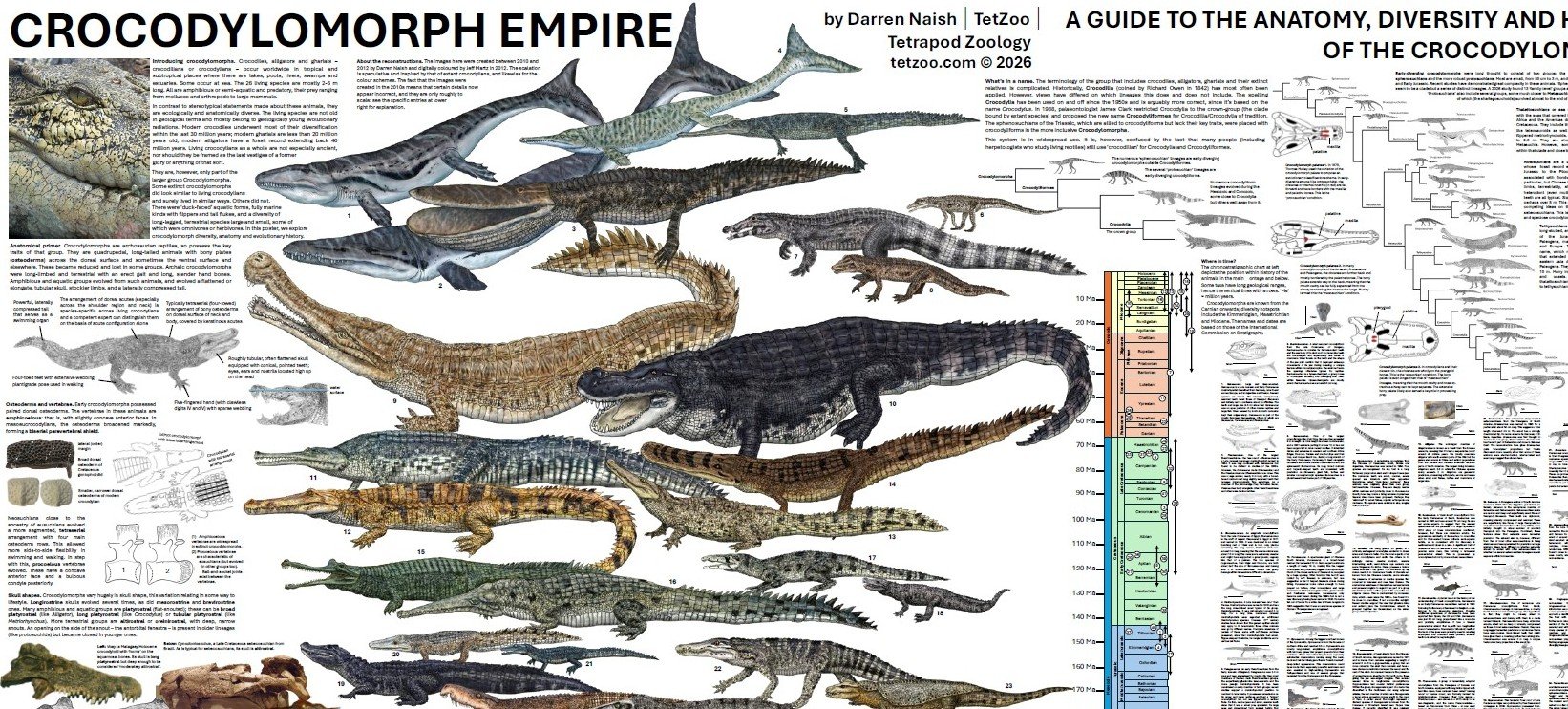
Caption: low-res section of the Crocodylomorph Empire poster. Now on sale, right now only for collection at DinoCon 2026.
My aim since then has been to publish a big review of crocodylomorph diversity and fossil history. Maybe that’ll happen one day but you can understand that the topic is considered sufficiently niche that publishers generally don’t want to commit to an entire book on the group. Anyway, various versions of the montage have appeared since I compiled it, including in museum displays, on a T-shirt and in online articles.
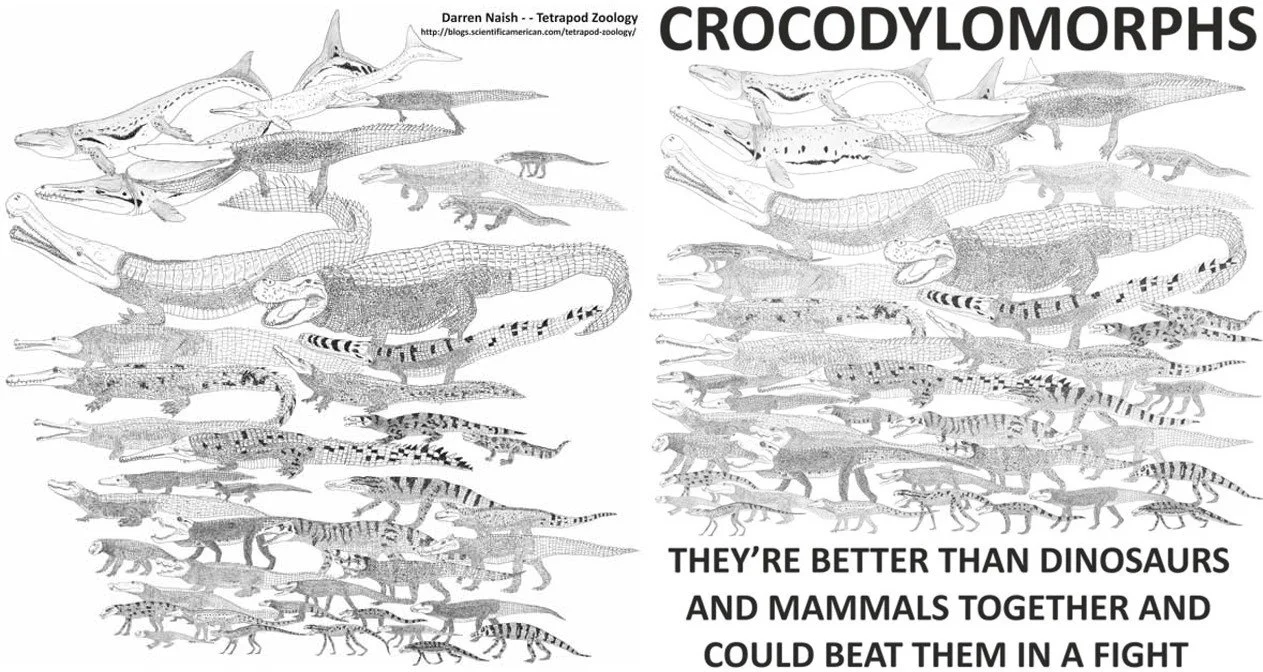
Caption: old versions of my big croc montage, this being the ‘vertical’ version designed for t-shirts… hence the hilarious text at right. Yes, there actually are people who own t-shirts with this very design. I do.
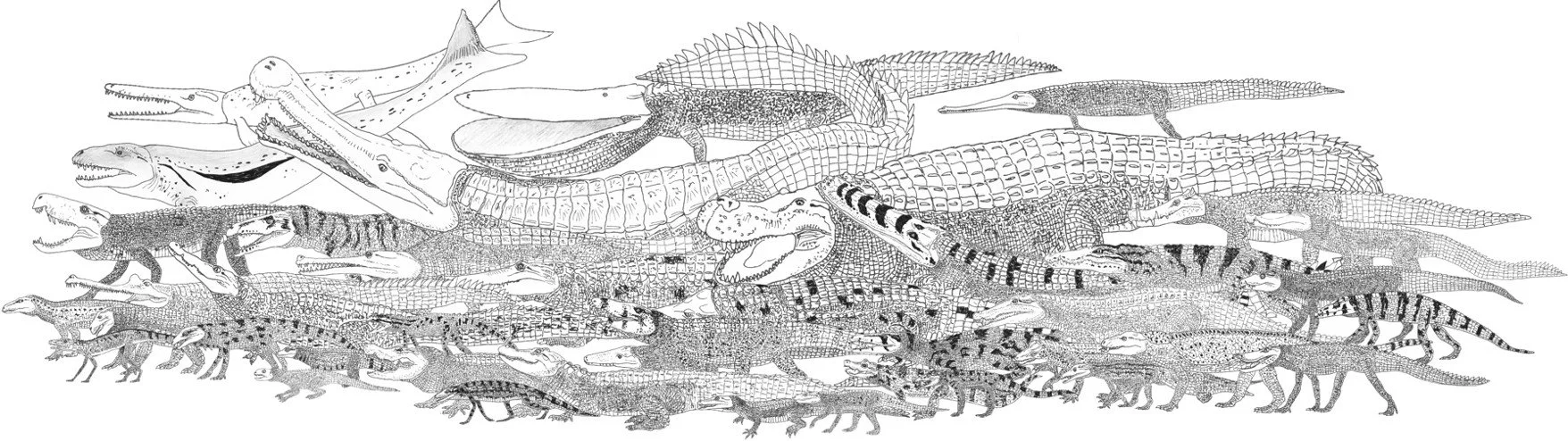
Caption: the more horizontal version of the montage, this one showing several variants of the animals that I later became unhappy with and replaced, the metriorhynchids in particular.
In 2014, Jeff Martz – best known for his work on aetosaurs, an armour-plated group of Triassic croc-line archosaurs – liked the montage sufficiently that he opted to colour it, meaning that we have a new and improved version, much more attractive than my black-and-white original. It looked so good that Jeff and I discussed plans to make it the main focal point of a big, croc-themed poster. And, thus, more than ten years later… here we are. Yes, it’s taken me years to put this together, but I’ve finally done it. The montage is at the core and the main feature, but there are discussions of anatomy, skull diversity, croc nomenclature and phylogeny overall, and individual pieces of text on the featured taxa too. It should be obvious that this is a visual treat to those interested in these animals, or in archosaurs or reptiles more broadly.
A downside of the fact that Jeff worked with my 2014 version is that a few of the animals look technically incorrect for 2026, mostly because my drawings were based on information that’s now been superseded by new finds and publications. This is all explained within the text of the poster: it’s a necessary consequence of effort to depict fossil animals in life that views become out of date.
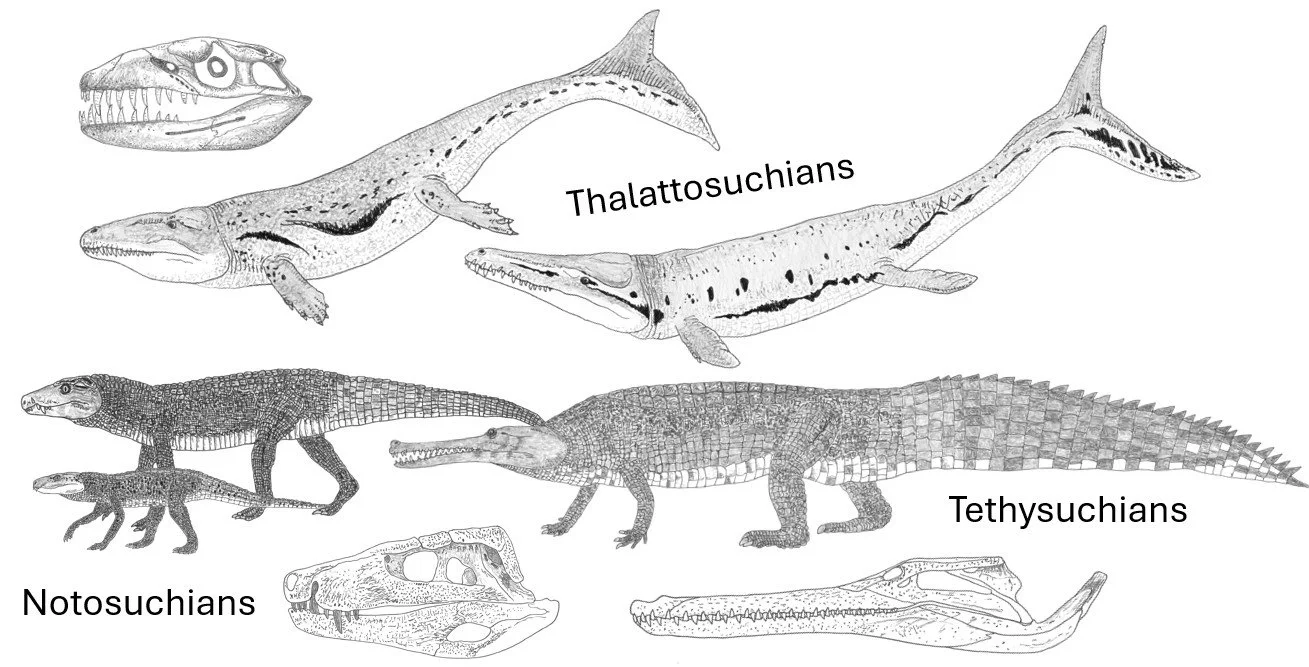
Caption: three enormous, diverse crocodylomorph groups are wholly extinct, though notosuchians persisted to relatively recently (the Late Miocene or maybe even the Pliocene). The life reconstructions and skull drawings here all feature on the poster.
Crocodylomorph, crocodyliform, crocodylian; and what is a ‘crocodile’? A topic I’ve aimed to emphasize here at Tet Zoo – thus far with limited success due, in part, to the loss of so much material published at ver 2 and 3 – is the massive diversity of fossil crocodylomorphs. The archaic ‘sphenosuchians’ of the Triassic and Jurassic and the ‘protosuchians’ of the Triassic, Jurassic and Cretaceous (neither group appears to be a clade) are extremely different from living members of this group, and the thalattosuchian, notosuchian and tethysuchian radiations – all wholly extinct – have proved enormous and complex and all contain species, again, very different from their extant cousins.
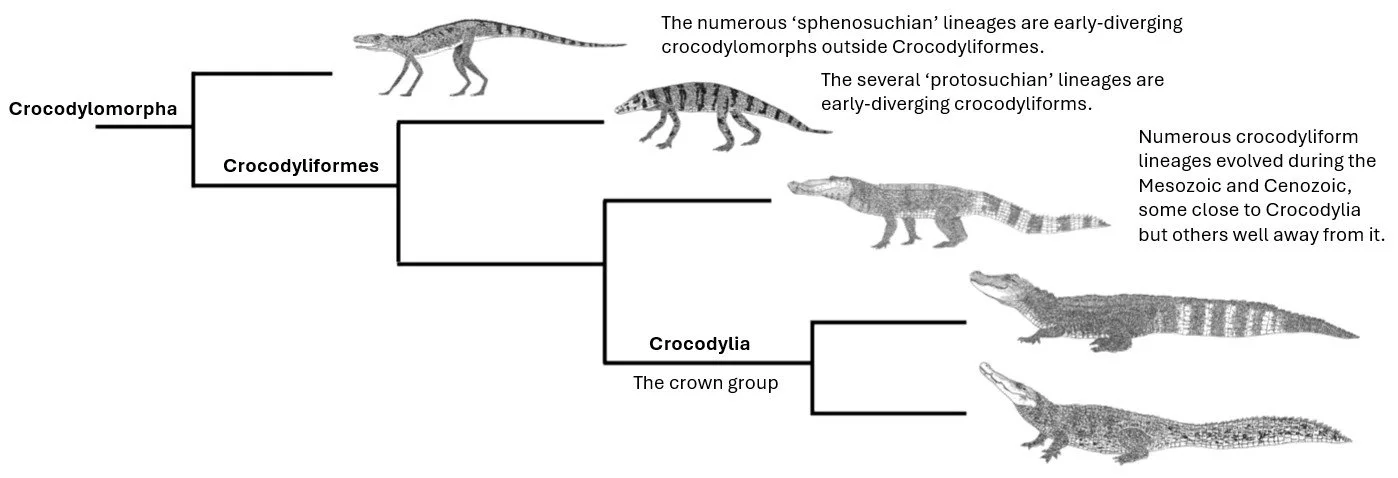
Caption: a simplified cladogram from the poster, used to show the difference between the terms Crocodylomorpha, Crocodyliformes, and Crocodylia.
The terminology of these animals – I’ve addressed this several times at Tet Zoo but still need to keep doing it – is confusing but the majority of workers follow the Benton & Clark (1988) system. ‘Crocodilia’ has been sufficiently vague across its history that Clark (in Benton & Clark 1988) opted to restrict Crocodylia (which is the more correct spelling in view of the generic name it’s based on) to the crown-group, Crocodyliformes being used for all ‘crocodylian-like’ lineages and Crocodylomorpha for the whole lot. This is why I refer to all of these animals as ‘crocodylomorphs’: I opt not to use ‘crocodilian’ at all anymore, and ‘crocodylian’ should only be applied to the crown.
Adding further complexity is that some palaeontologists – including the Benton of Benton & Clark (1988)! – have pushed back on this system and have argued that we should use Crocodylia in place of Crocodylomorpha. I agree with Brochu et al. (2009) that this is a stupendously bad idea at this point in the game. And I wish that palaeontologists would wean themselves off the frustrating habit of just calling everything a ‘crocodile’. An alligator is unambiguously not a crocodile, ergo extinct crocodylomorphs sure aren’t either. Crocodiles are a specific group within Crocodylia, and not an especially old one in geological terms.
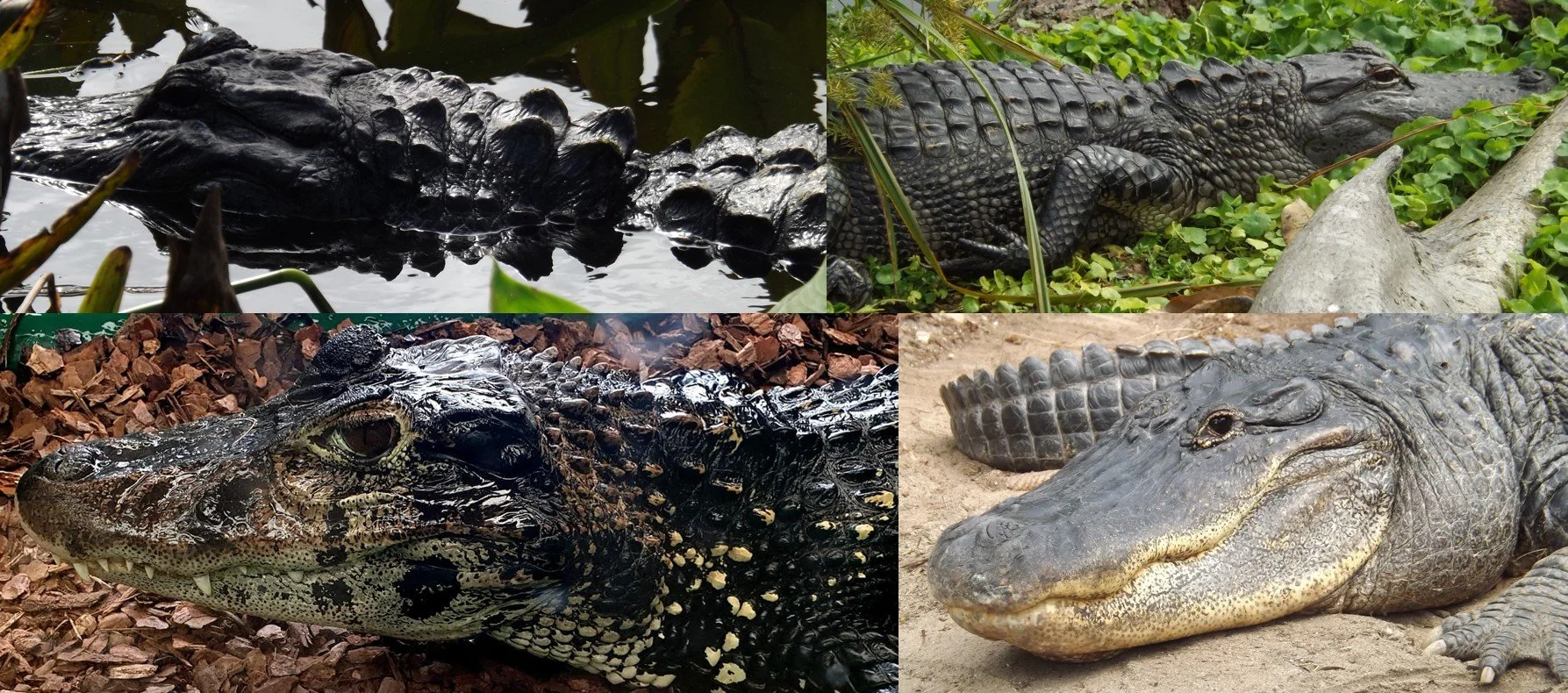
Caption: how many crocodiles are in this montage? Answer: ZERO. It is categorically wrong to call alligatoroids of any sort ‘crocodiles’. Ergo, the term ‘crocodile’ has a strict and specific meaning and we should push back against the tendency in palaeontology to just slap it on all members of Crocodylia, Crocodyliformes or Crocodylomorpha. Images: Darren Naish.
The poster is now on sale. Anyway… if you want to learn more about crocodylomorph diversity, anatomy and evolutionary history, I hope you’re interested in getting the poster yourself. Yes, years in the making, representing a huge amount of work! It’s big, at 1.4 m long and 76 cm deep.
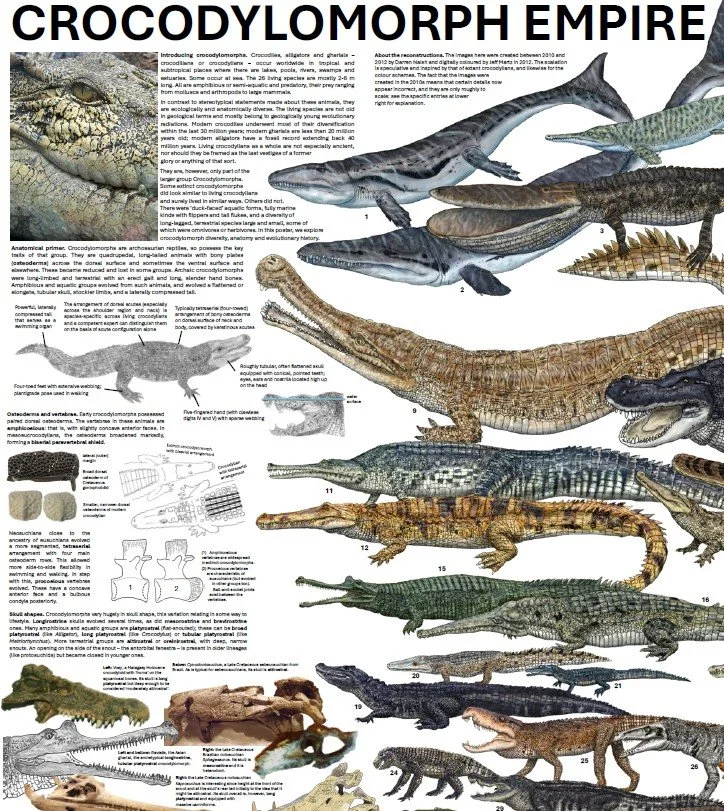
The good news is that it’s available for sale right now, initially only for collection in person at DinoCon 2026. Yes, DinoCon, happening this year on July 25th-26th at the Hilton Birmingham Metropole (tickets and accommodation available here). Once DinoCon is out of the way we’ll be selling the poster more widely, but please be patient.
Thanks for your interest, and more on crocodylomorphs here in due time.
Your usual lament. Crocodylomorphs of several sorts have been covered here on a reasonable number of occasions but most of this material is now lost due to the death of ScienceBlogs and Scientific American blogs. Consequently, only a small number of articles are easily findable today. I aim to recover and republish my older articles here, in time. Sigh. Anyway…
Crocodiles Attack Elephants Then, Now, and Still, August 2025
Koumpi the Wealden Croc: Tons of New Data and Phylogeny Resolved, April 2026
‘Shanklin Croc’ and the Dawn of the Tethysuchian Radiation, April 2026
Refs - -
Benton, M. J. & Clark, J. M. 1988. Archosaur phylogeny and the relationships of the Crocodylia. In Benton, M. J. (eds) The Phylogeny and Classification of the Tetrapods, Volume 1: Amphibians, Reptiles, Birds. Clarendon Press (Oxford), pp. 295-338.
Brochu, A. C., Wagner, J. R., Jouve, S., Sumrall, C. D. & Densmore, L. D. 2009. A correction corrected: consensus over the meaning of Crocodylia and why it matters. Systematic Biology 58, 537-543.
Naish, D. 2001. Fossils explained 34: Crocodilians. Geology Today 17 (2), 71-77.


