Regular readers of Tet Zoo will – I hope – be familiar with taxonomic vandalism…
Put simply, this is the phenomenon whereby rebellious individuals, typically working outside of institutional academia, seek to formally name or rename the organisms they’re interested in, most usually by way of self-published works that have a decidedly ‘non-standard’ feel and approach. I’ve published on this subject, not just at Tet Zoo (here) but also in both the semi-technical literature (Naish 2025) and as a contributor to technical cases that seek to minimise or negate the acts of specific vandals (Rhodin et al. 2015).
Among those organisms most frequently affected by taxonomic vandalism are reptiles, in particular those of Australasia. And you may know already that one of the most active of the various battlefields is that involving one Mr Raymond Hoser, his work building on that of his predecessors, among them Richard Wells and Ross Wellington.
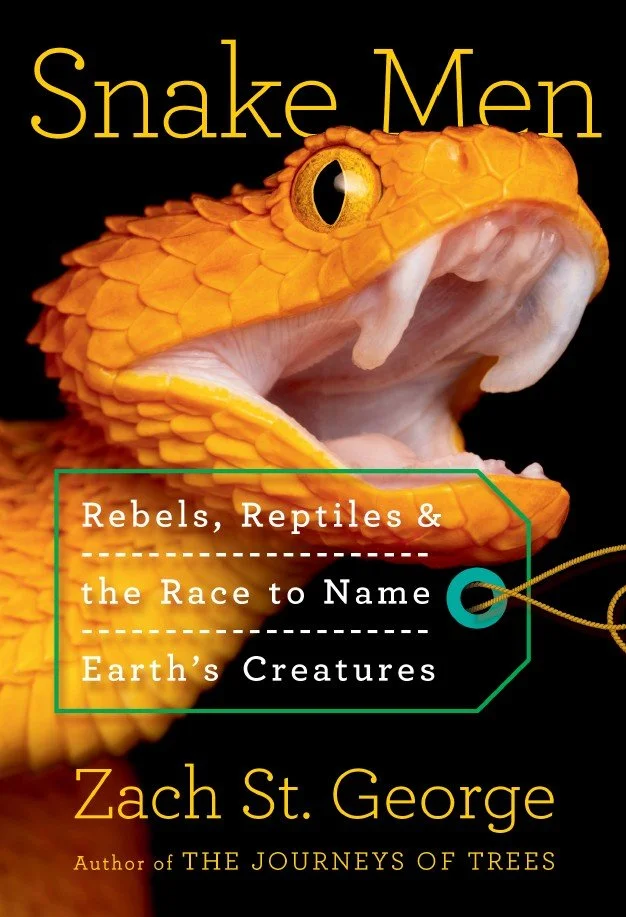
So interesting and frighteningly esoteric are these various characters and their exploits, adventures and battles that this entire subject looks over-ripe as the perfect fodder for a book, and that’s why we’re here: Snake Men by Zach St. George, published by W. W. Norton & Co, is out now and on the shelves, and I’m in the fortunate position of owning an advance copy.
Snake Men is fun and fast-paced, focusing mostly on Hoser and what it’s like to spend one-to-one time with him as he speeds about the Melbourne suburbs in his Nissan Micra, at times applauding pedestrians “for their fitness” and leaning “out the window to woof at dogs” (St. George 2026, p. 141). St. George notes that he wasn’t able to spend as much time with Hoser as he might have liked due to Hoser being busy with, err, “legal efforts” (St. George 2026, p. 130).
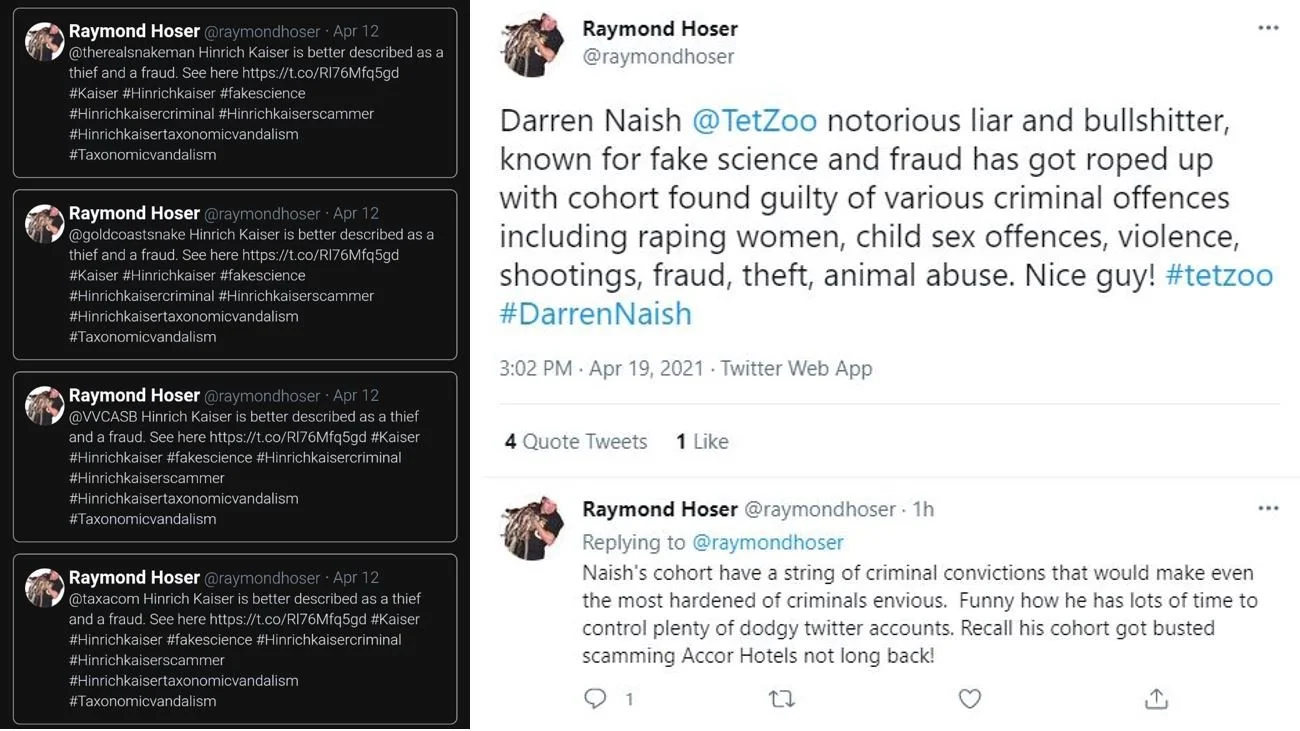
Caption: Raymond Hoser, a scrupulously ethical individual who definitely doesn’t run numerous different sock puppet accounts on social media nor engage in a worrying amount of projection. Here he is on Twitter/X in 2021, falsely accusing me of stuff.
Use of the term Snake Men as the title is not, as St. George notes deep within the book, without a little irony given that Hoser claims legal ownership of this widely used term, something he has no right to do.
Before getting to Hoser, we learn about the history of formal zoological taxonomy and the herpetologists, amateur and professional, who shaped the road before Hoser came along. I was fascinated to learn that Richard Wells – a polymath and inveterate collector of books as well as a dedicated herpetologist – claims to have gained his special ability to process and understand complex things following a night-time encounter with a mysterious mobile light (St. George 2026, pp. 91-93).

Caption: Richard Wells (in green shirt) with just part of his vast collection of books. This screengrab is from a documentary devoted to Wells, viewable here on YouTube.
Working together with Ross Wellington, Wells published articles that have to be regarded as among the most controversial within the history of Australasian herpetology (Wells & Wellington 1983, 1985). How Wells and Wellington came to be outcast from formal zoology is pegged, in their version of events, on Ross Sadlier at the Australian Museum but let’s just say that what Wells describes isn’t exactly consistent with the recollections of others, most notably Hal Cogger, author of the standard tome on Australia’s reptile and amphibian diversity (St. George 2026, pp. 100-101). Anyway, there’s a lot to say about the long-running furore that Wells and Wellington initiated and I thoroughly enjoyed St. George’s coverage of it.
It was Wells and Wellington’s work, predictably enough, that inspired Hoser to do what he does, though Wells, at least, doesn’t speak highly of Hoser within the book. But then, not many do. Hoser’s assorted legal dealings, chaotic entertainment business and debates and disputes with academic herpetologists – in particular the group that Hoser terms the ‘Wüster gang’ (after Bangor University snake expert Wulfgang Wüster) – are the focus of several chapters. The ICZN case is covered, St. George at one point taking 14 pages to list the taxonomic names that Hoser published between 2013 and 2021 alone (St. George 2026, pp. 181-194).
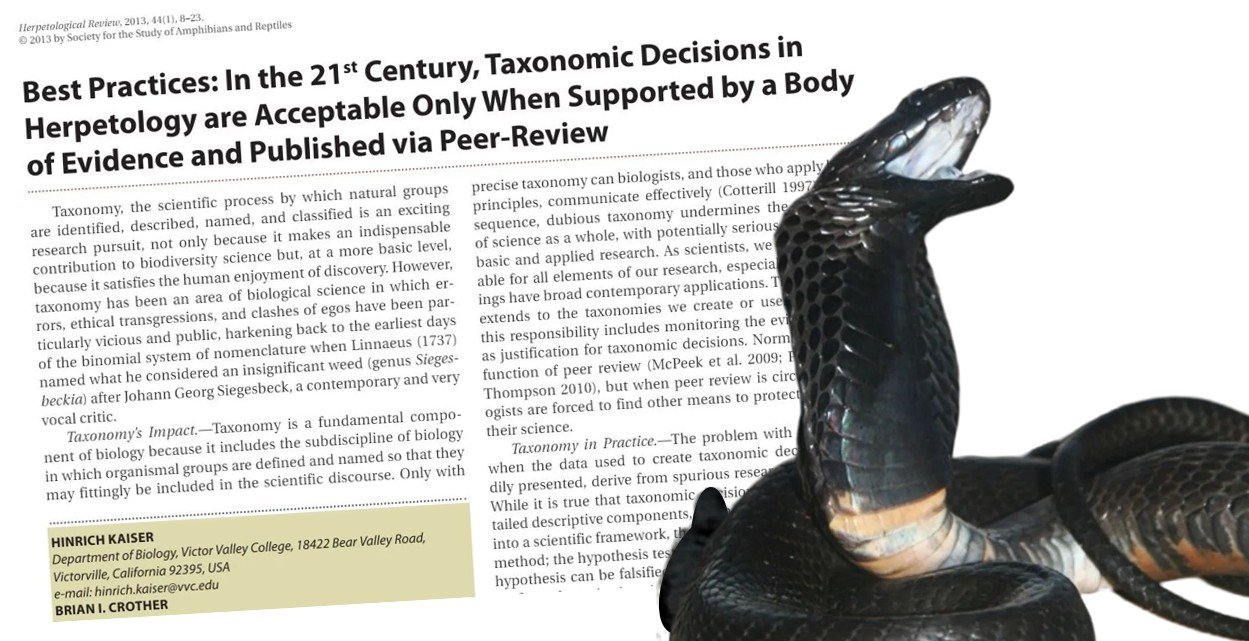
Caption: at left, opening text of Kaiser et al. (2013), a key paper in the fight against taxonomic vandalism in herpetology. At right, Black-necked spitting cobra Naja nigricollis, type species for Afronaja, the taxon also named ‘Spracklandus’ by Hoser and pivotal in a case submitted to the ICZN on Hoser names. Image: Warren Klein, CC BY-SA 3.0 (original here).
All in all, Snake Men is a highly entertaining, well-written overview of one furiously over-active taxonomic vandal in particular and I really enjoyed it. It’s required reading for those interested in the bizarre life and times of Raymond Hoser, and St. George never has to work hard to show Hoser’s true colours. The book says enough about taxonomic vandalism in general to be of broader interest too, and I strongly recommend it to anyone interested in the more arcane side of taxonomy or in reptiles or biology in general.
My thanks to W. W. Norton & Company for provision of an advance review copy.
St. George, Z. 2026. Snake Men: Rebels, Reptiles & the Race to Name Earth’s Creatures. W. W. Norton & Company, New York. ISBN 9781324134084, hardcover, pp. 272. $29.99. Here from the publishers.
Hoser names and taxonomic vandalism have been mentioned or discussed on a few previous occasions at Tet Zoo. See…
The Freshie: Australian crocodile, seemingly from the north (crocodiles part V), July 2012
Ray Hoser, Number 1 Taxonomic Vandal, May 2024
Refs - -
Kaiser, H., Crother, B. I., Kelly, C. M. R., Luiselli, L., O’Shea, M., Ota, H., Passos, P. Schleip, W. & Wüster, W. 2013. Best practices: in the 21st Century, taxonomic decisions in herpetology are acceptable only when supported by a body of evidence and published via peer-review. Herpetological Review 44, 8-23.
Naish, D. 2025. Taxonomic trolling. The Biologist 72 (2), 26-29.
Rhodin, A. G. J., Kaiser, H., van Dijk, P. P., Wüster, W., O’Shea, M., Archer, M., Auliya, M., Boitani, L., Bour, R., Clausnitzer, V., Contreras-MacBeath, T., Crother, B. I., Daza, J. M., Driscoll, C. A., Flores-Villela, O., Frazier, J., Fritz, U., Gardner, A., Gascon, C., Georges, A., Glaw, F., Grazziotin, F. G., Groves, C. P., Haszprunar, G., Havaš, P., Hero, J. M., Hoffmann, M., Hoogmoed, M. S., Horne, B. D., Iverson, J. B., Jäch, M., Jenkins, C. L., Jenkins, R. K. B., Kiester, A. R., Keogh, J. S., Lacher Jr., T. E., Lovich, J. E., Luiselli, L., Mahler, D. L., Mallon, D., Mast, R., Mcdiarmid, R. W., Measey, J., Mittermeier, R. A., Molur, S., Mossbrugger, V., Murphy, R., Naish, D., Niekisch, M., Ota, J., Parham, J. F., Parr, M. J., Pilcher, N. J., Pine, R. H., Rylands, A. B., Sanderson, J. G., Savage, J., Schleip, W., Scrocchi, G. J., Shaffer, H. B., Smith, E. N., Sprackland, R., Stuart, S. N., Vetter, H., Vitt, L. J., Waller, T., Webb, G., Wilson, E. O., Zaher, H. & Thomson, S. 2015. Comment on Spracklandus Hoser, 2009 (Reptilia, Serpentes, ELAPIDAE): request for confirmation of the availability of the generic name and for the nomenclatural validation of the journal in which it was published. (Case 3601; see BZN 70: 234–237; 71: 30–38, 133–135, 181–182, 252–253). Bulletin of Zoological Nomenclature 72 (1): 65-78.
St. George, Z. 2026. Snake Men: Rebels, Reptiles & the Race to Name Earth’s Creatures. W. W. Norton & Company, New York.
Wells, R. W. & Wellington, C. R. 1983. A synopsis of the Class Reptilia in Australia. Australian Journal of Herpetology 1, 73-129.
Wells, R. W. & Wellington, C. R. 1985. A classification of the Amphibia and Reptilia of Australia. Australian Journal of Herpetology, Suppl. Ser. 1, 1-61.


