Among the most handsome and striking of seabirds is the Razorbill.
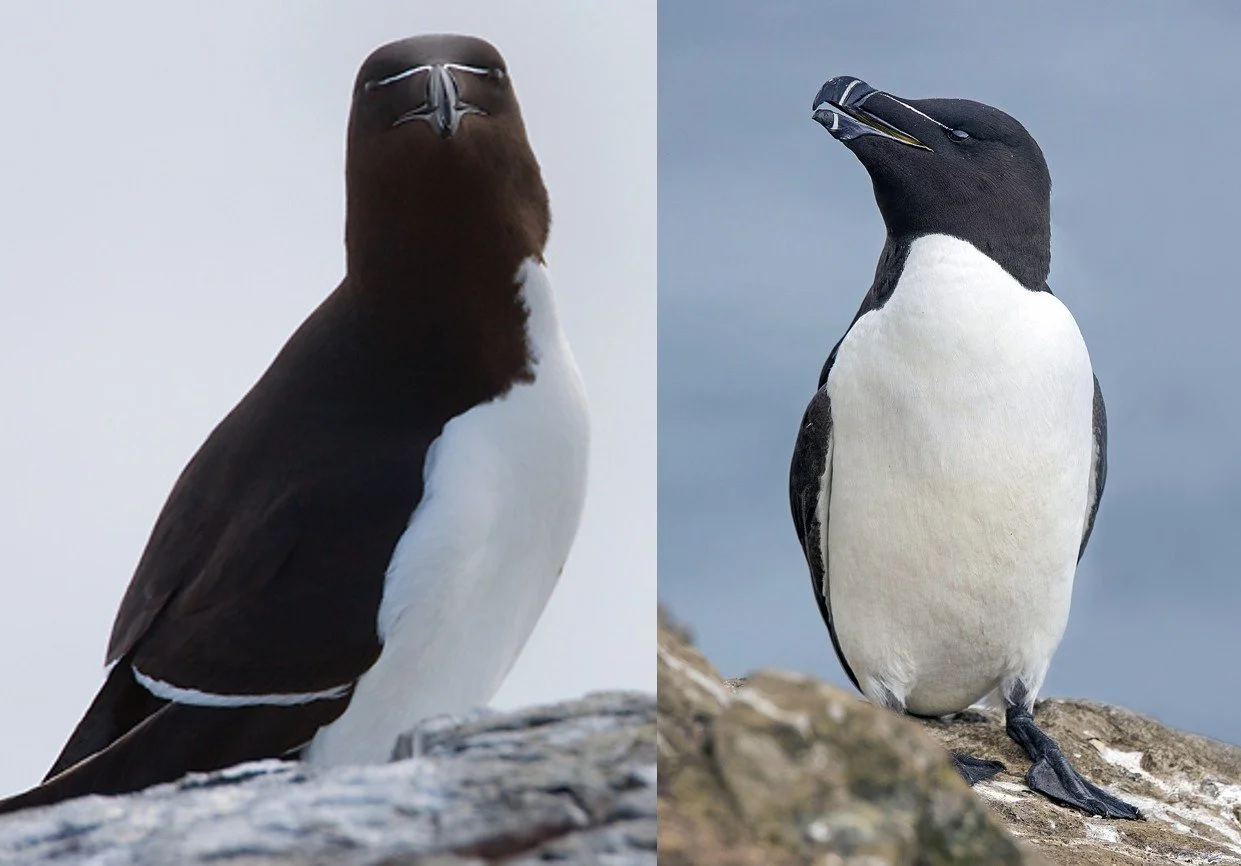
Caption: Razorbill profiles. Note that the eyes are reflective enough to be picked out from the plumage, that the white stripe on the head leads toward the middle part of the eye and is not above it, and that the upper part of the bill is deep. Images: Marek Szczepanek, CC BY-SA 4.0 (original here); Charles J. Sharp, CC BY-SA 4.0 (original here).
If you don’t know this bird already, its incredibly sharp, perfect black and white lines can look almost unreal, and it’s for this reason that a number of AI images have recently been widely shared online, sigh. Anyway…
The Razorbill Alca torda is a North Atlantic auk, its largest breeding colonies being those around the shores of Britain, Scandinavia, western Greenland, Iceland and north-east Canada. It dislikes ice, avoids brackish water, and prefers rocky islands with broad ledges as nesting areas. It’s a large, stout-bodied auk, and is longer-tailed than other large auks, like guillemots. Long tails in seabirds typically relate to improved aerial manoeuvrability: I can’t find any comments in the literature on the aerial manoeuvrability of the Razorbill relative to other auks (all of which have much shorter tails), but – as we’ll see – an adaptive reason for the long tail might have been identified.
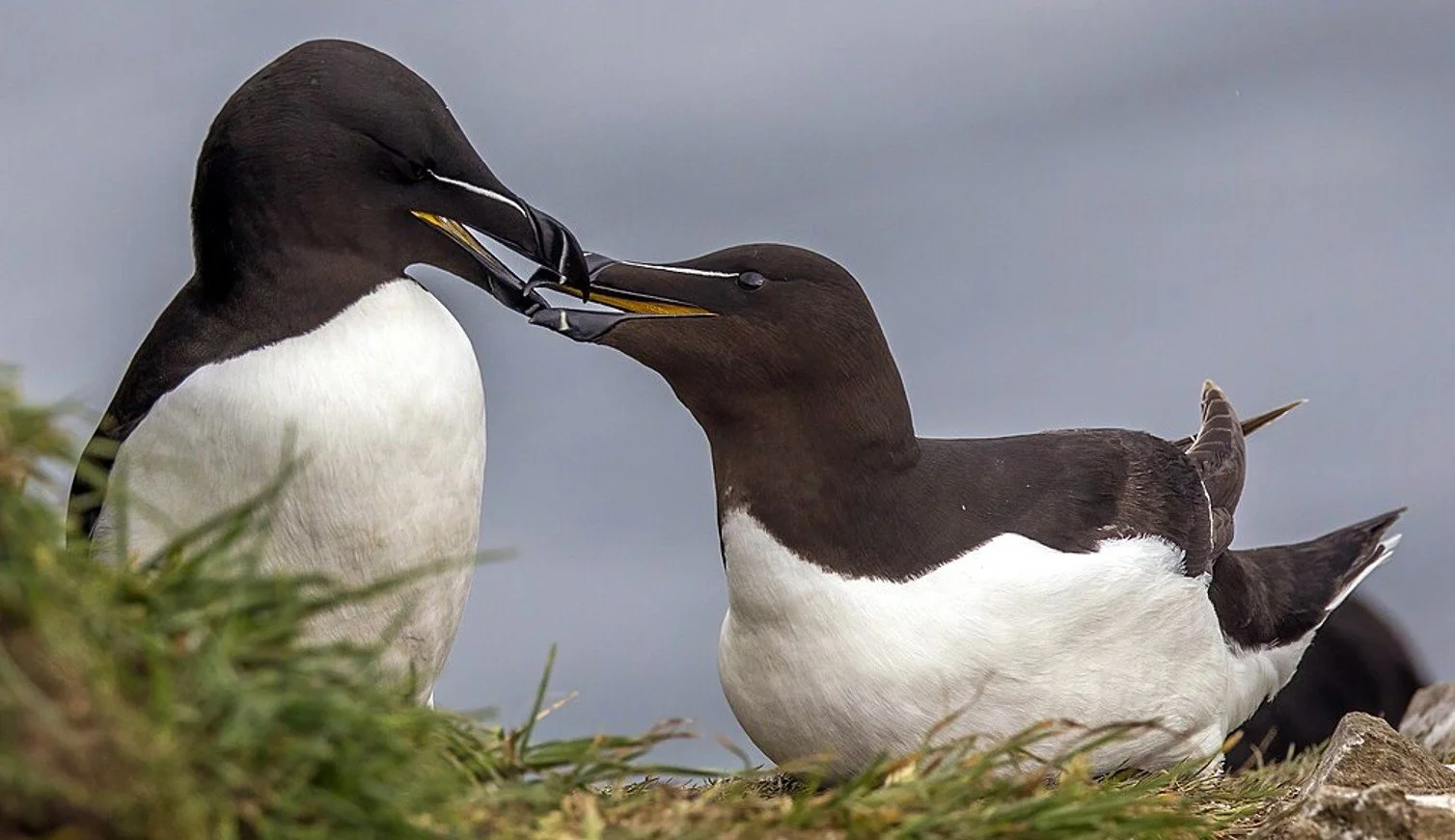
Caption: Razorbill pair photographed in Skomer Island, Wales. Image: Charles J. Sharp, CC BY-SA 4.0 (original here).
The English common name of this species comes from the superficial resemblance its deep, laterally compressed bill has with an old-fashioned razor (its old name was ‘Razorbilled auk’), and it uses this to grab and hold sand-eels, capelin and other mid-water schooling fishes. As many as 20 fish can be held in the bill at any one time. People often wonder how puffins – which manage the same trick – can hold fish while continuing to catch others. I presume Great auks did the same thing, but unfortunately virtually nothing is known of their diet or feeding habits (for data on possible prey species see Olson et al. 1979). Anyway, the birds apparently use their tongue, the horny papillae on the palate, and the mobile prokinetic hinge zone to retain fish at the back of the bill while continuing to grab new ones at the front. It’s still hard to appreciate how this might work, but it obviously does.
The inside of the mouth is yellow. The Great auk also had a yellow mouth interior according to some reports, though others said that the inside of its mouth was red or orange, so we’re not fully sure. I tell you, it’s shocking how little we know of the Great auk: a species that only went extinct in 1844 (or thereabouts).
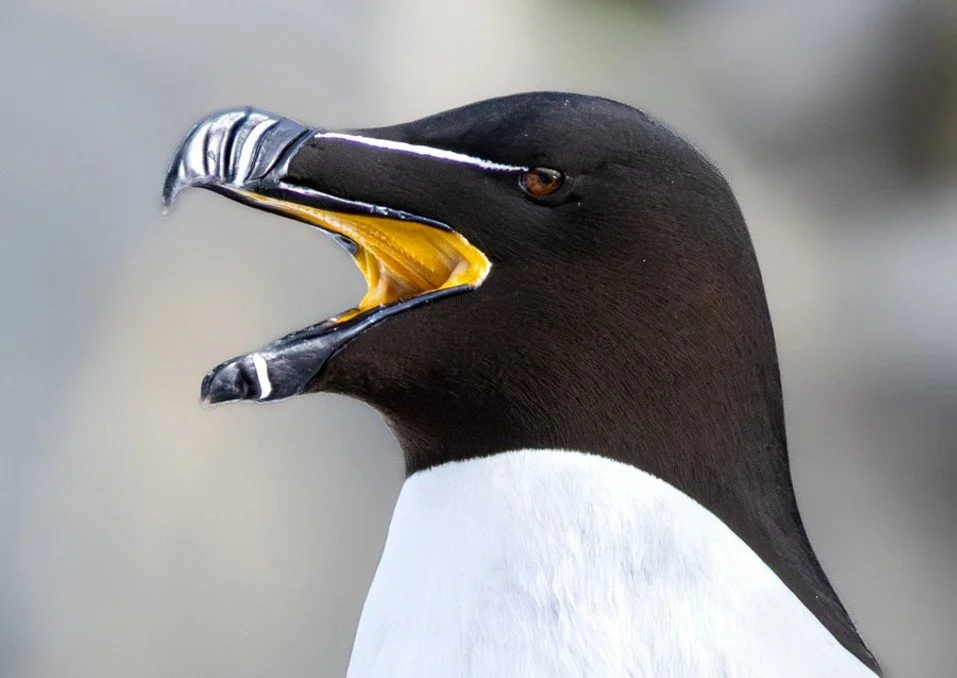
Caption: a Razorbill in Norway demonstrating the presence of a yellow mouth interior. The rhamphothecal grooves are obvious here too and you can also seen the rows of papillae on the soft choanal folds of the palate. A subtle feature is that the white stripe leading from the bill to the eye is approximately continued posterior to the eye by a shallow groove in the feathers. Image: (c) Diego González Dopico, CC BY 4.0 (original here).
What’s with the lateral grooves on the Razorbill’s bill? We don’t know, but a few suggestions have been made. One idea is that they play a role in sexual display, and this seems likely given that the bill is used extensively for signalling during courtship. Rather more interesting, however, is the hypothesis that the grooves “function rather like the sights on a rifle as the bird dives in pursuit of its prey” (Freethy 1987, p. 58). This seems unlikely to me given data showing that few birds can see the sides of their own bills (e.g., Martin et al. 2004). Again, highly similar structures were present in the Great auk (and presumably in the fossil species intermediate between these two). Debate exists as to whether the grooves of the Great auk were white or not.
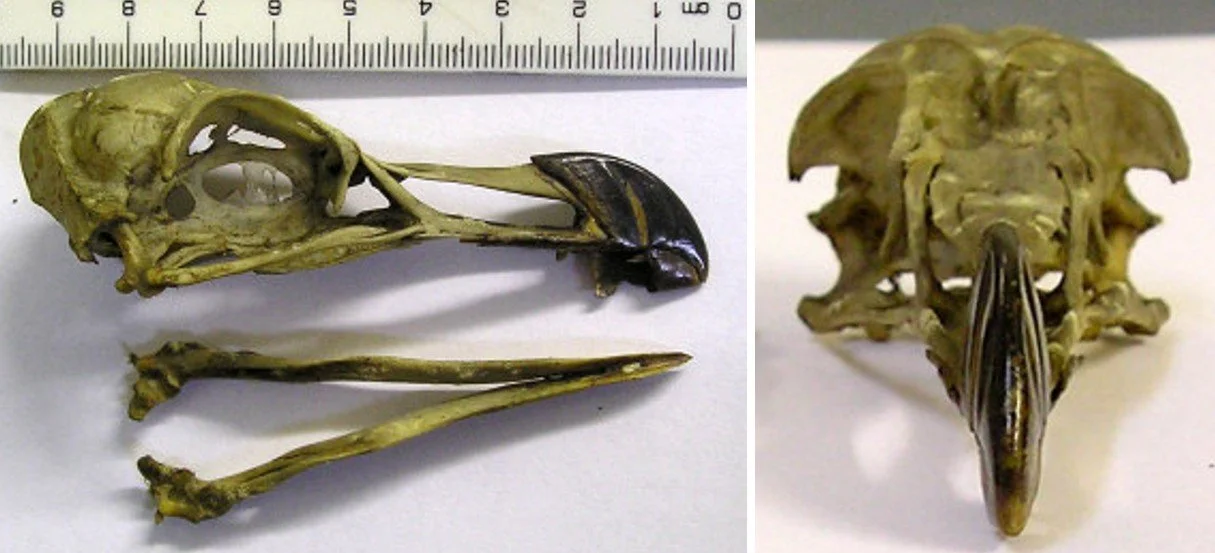
Caption: a museum Razorbill skull that I photographed in 2009, still with the rhamphotheca present on the upper jaw (it has broken away from the lower jaw and is now attached to the upper part). Prominent rhamphothecal grooves are present and the deep, curved form of the beak tissue overall is obvious. Note also the shallow and large concavities over the eyes (only visible here in the anterior view). These are the fossae for the supraorbital salt glands. Images: Darren Naish.
Another interesting feature is the narrow channel that extends backwards from the eye. This is better known in guillemots, where – in so-called bridled individuals of Uria aalge – it’s picked out by white feathers. Gaston & Jones (1998) hypothesised that this channel might help “aid the flow of water over the eye while the birds are swimming rapidly” (p. 71), though this intriguing function remains untested so far as I know. Furthermore, if this were true I would expect the Great auk to have such a channel: there’s no mention of it in the Great auk literature (Fuller 1999). Then again – as just mentioned – our knowledge of the Great auk as a live animal is pitiful and it’s not possible to be confident about such a subtle, easily overlooked feature. The ‘lazy’ hypothesis – that the channel might function in communication – was deemed unlikely as the channel is usually all but invisible (Gaston & Jones 1998). It’s been claimed that prominent supra-orbital ridges in the Razorbill might help resist deformation of the eyeball caused by deep-diving: well, maybe. However, some deep-diving seabirds lack prominent supra-orbital ridges, and I’m not sure that Razorbills have prominent supra-orbital ridges anyway.
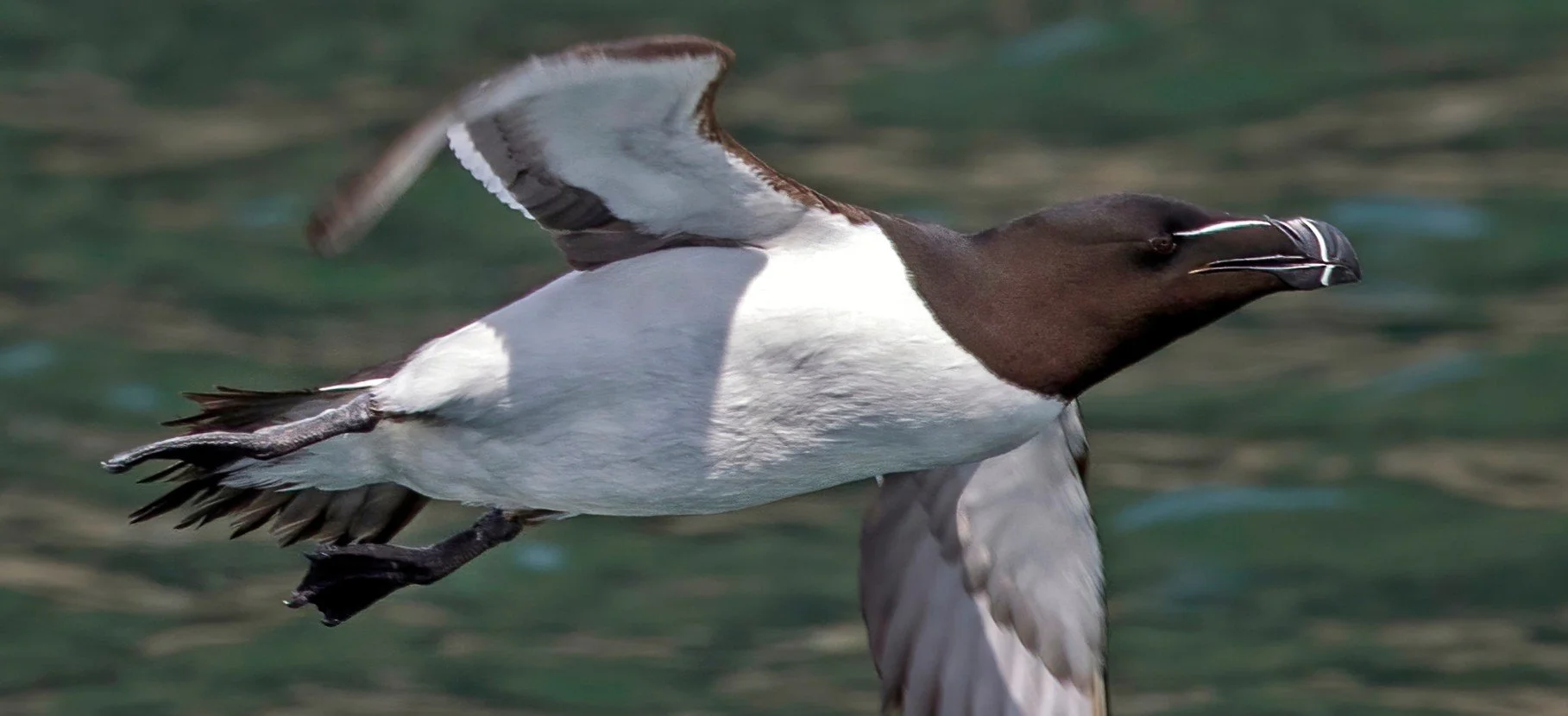
Caption: Razorbill in flight off Skomer Island. Note how shallow the wing is relative to the body (or how long the body is relative to the wings). Image: Charles J. Sharp, CC BY-SA 4.0 (original here).
I was surprised to learn that as much as 42% of the Razorbill diet might be made up of crustaceans and annelids, and 10% by molluscs (W. E. Collinge, cited in Freethy 1987). This is surprising because the Razorbill is almost exclusively a pursuit-diver, swimming underwater with feet and half-open wings, and its generally short dive time (mostly less than one minute) and maximum dive depth indicate that it doesn’t spend time foraging at or near the sea-floor. Maybe these benthic prey come from the stomachs of the fish it eats. These data might not be accurate, however, as some sources only discuss fishes (and predominantly mid-water fishes) as forming Razorbill diet (Gaston & Jones 1998).
As with so many other seabirds, it turns out that Razorbills dive much more deeply than used to be thought. Older references say that dives are typically of 2-3 m, and that 10 m might be exceptional. More recent work indicates that average dive depth is 25 m, with the range being 11-38 m (Wanless et al. 1988, Barrett & Furness 1990). However, Piatt & Nettleship (1985) reported a maximum dive depth of 120 m for the species and Jury (1986) then reported 140 m, thereby making a mockery of all previous estimates. These deep dives can’t, I assume, have been done in “less than one minute” as noted above, so the bird can clearly stay down for longer than we’ve generally thought.
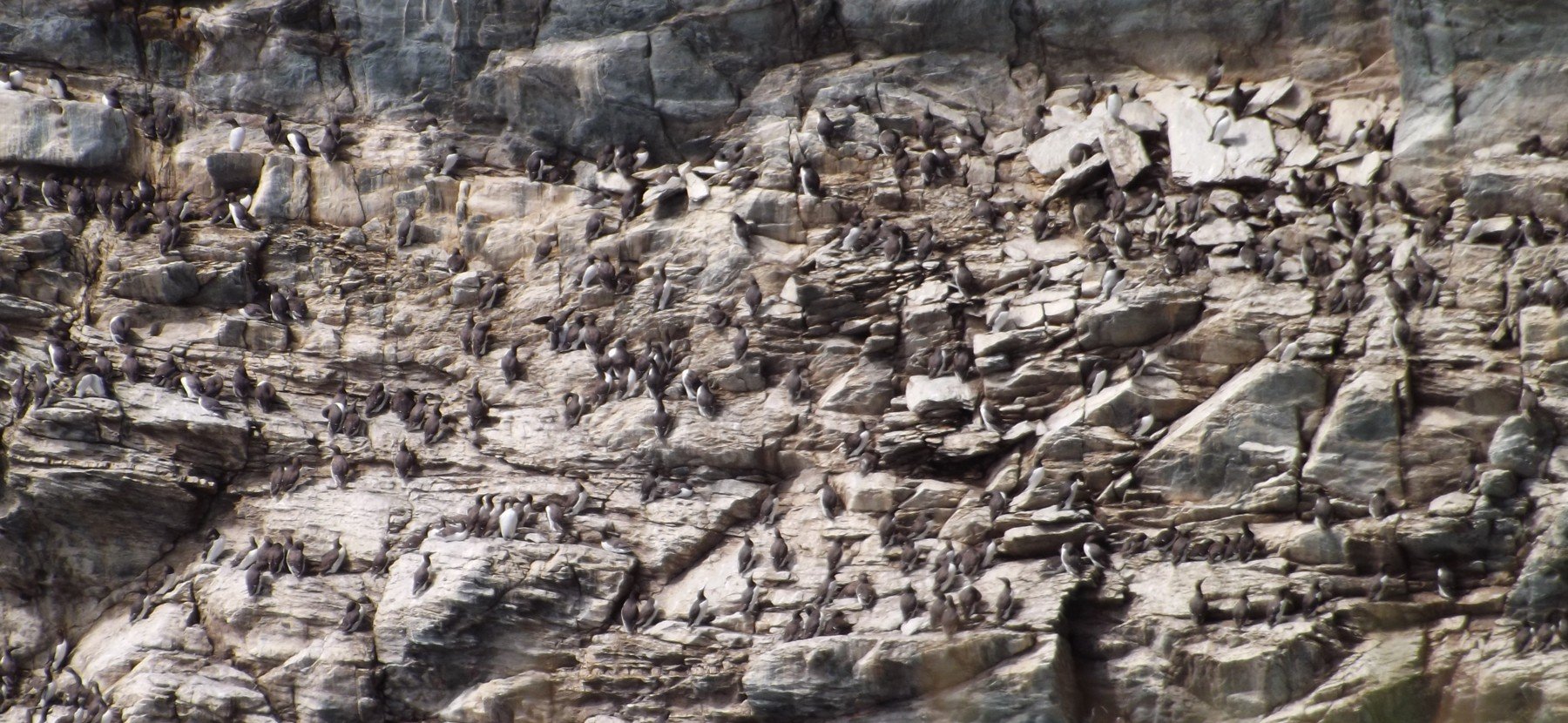
Caption: there are no Razorbills in this photo (so far as I can tell) but the species was present at the location (South Stack, Anglesey) when this photo was taken (August 2016). If you’re interested in seabirds, seeing these giant cliffside breeding ‘cities’ are an incredible experience that you have to seek out. The birds on the ledges here are all Common guillemot Uria aalge but Atlantic puffins Fratercula arctica and Razorbill were seen on the cliffs and water surface nearby. Image: Darren Naish.
Equally surprising is the fact that the Razorbill is adept at kleptoparatisism, and it frequently steals from Atlantic puffins. Razorbills attack puffins in flight, but more frequently “swim beneath the puffin and torpedo it from below or actually pursue the puffin under the water” (Freethy 1987, p. 71). One might predict that species which indulge in aerial piracy need to be particularly manoeuvrable: is this why the Razorbill has such a long tail?
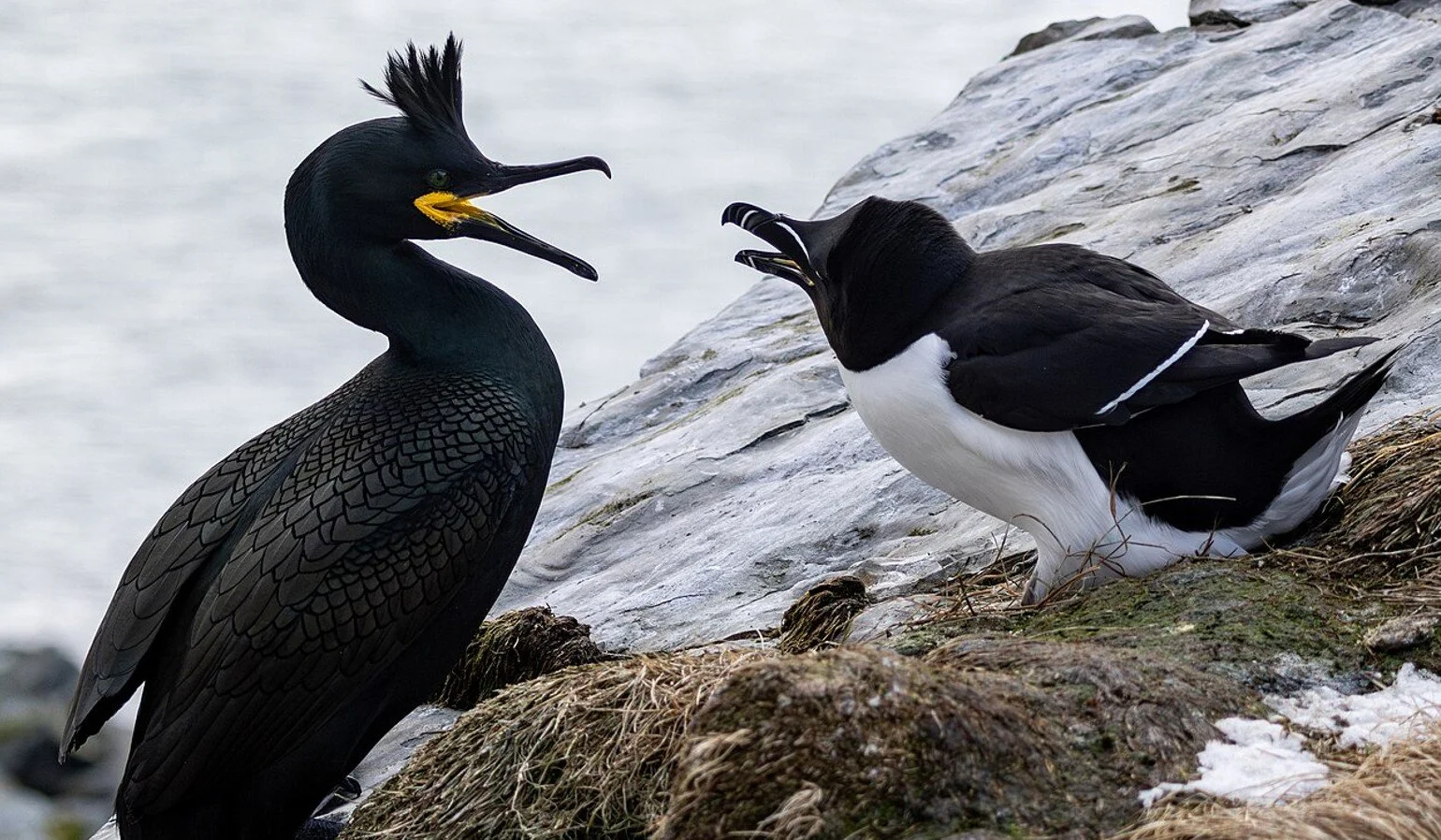
Caption: a really great photo of a Razorbill vs a European shag Phalacrocorax aristotelis, taken in Norway. The shag is a fantastic and striking seabird as well, looking something like a slender-jawed miniature dragon. Image: (c) Diego González Dopico, CC BY 4.0 (original here).
This brief text is borrowed from an article originally published at Tet Zoo ver 2 back in January 2009 (original here), written following my observation of a razorbill skull in a museum collection.
For previous Tet Zoo articles on seabirds, see…
Hacks Vs Wildlife: the Eternal Vilification of Gulls, July 2019
Pete Dunne and Kevin T. Karlson’s Gulls Simplified: A Comparative Approach to Identification, October 2021
Refs – -
Barrett, R. T. & Furness, R. W. 1990. The prey and diving depths of seabirds on Hornoy, North Norway after a decrease in the Barents Sea capelin stocks. Ornis Scandinavica 21, 179-186.
Freethy, R. 1987. Auks: An Ornithologist’s Guide. Facts on File, New York.
Fuller, E. 1999. The Great Auk. Harry Abrams, New York.
Gaston, A. J. & Jones, I. L. 1998. The Auks. Oxford University Press, Oxford.
Jury, J. A. 1986. Razorbill swimming at depth of 140 m. British Birds 79, 339.
Martin, G. R. & Coetzee, H. C. 2004. Visual fields in hornbills: precision-grasping and sunshades. Ibis 146, 18-26.
Olson, S. L., Swift, C. C. & Mokhiber, C. 1979. An attempt to determine the prey of the Great auk (Pinguinus impennis). The Auk 96, 790-792.
Piatt, J. F. & Nettleship, D. N. 1985. Diving depths of four alcids. Auk 102, 293-297.
Wanless, S., Morris, J. A. & Harris, M. P. 1988. Diving behaviour of guillemot Uria aalge, puffin Fratercula arctica and razorbill Alca torda as shown by radio-telemetry. Journal of Zoology 216, 73-81.


