Salamanders have been covered at Tet Zoo on numerous occasions, there being articles on newts and other salamandrids, plethodontids (lungless salamanders) of numerous sorts, and also ambystomatids (the group that includes the Axolotl and other mole salamanders). It’s the very weird salamanders that bring in the most interest, however, and today we’re going to look briefly at them again….
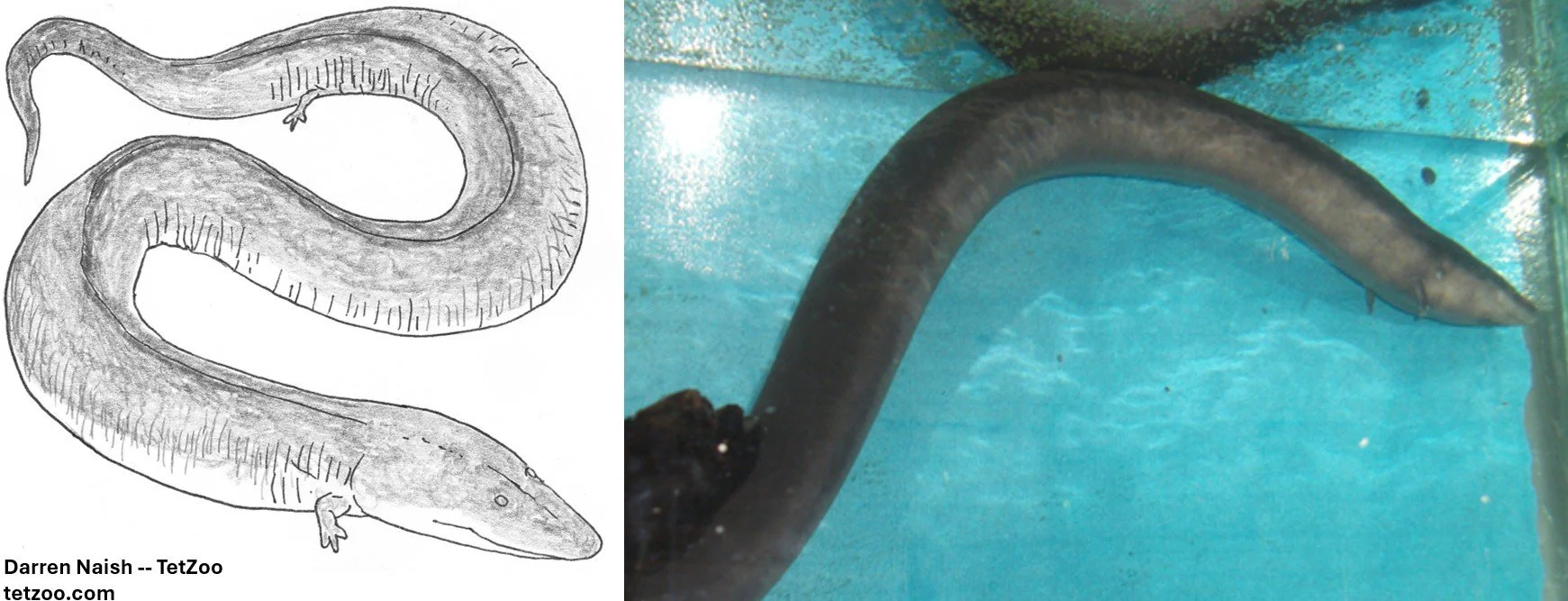
Caption: amphiumas in life. At right is Cuddles, the Two-toed amphiuma Amphiuma means formerly kept at the Centre for Fortean Zoology in Exeter, UK. A very big amphiuma can exceed 1.1 m in length. Images: Darren Naish.
Amphiumas are a remarkable group of eel-shaped, long-bodied, aquatic salamanders with internal gills and reduced limbs. They’re represented by just three extant species in one genus (Amphiuma), all restricted to the south-eastern USA. Fossils show that the group has been present in North America since the Late Cretaceous at least. I have written about them in the past. Today, we’re looking briefly just at their cranial anatomy, because boy is it interesting.
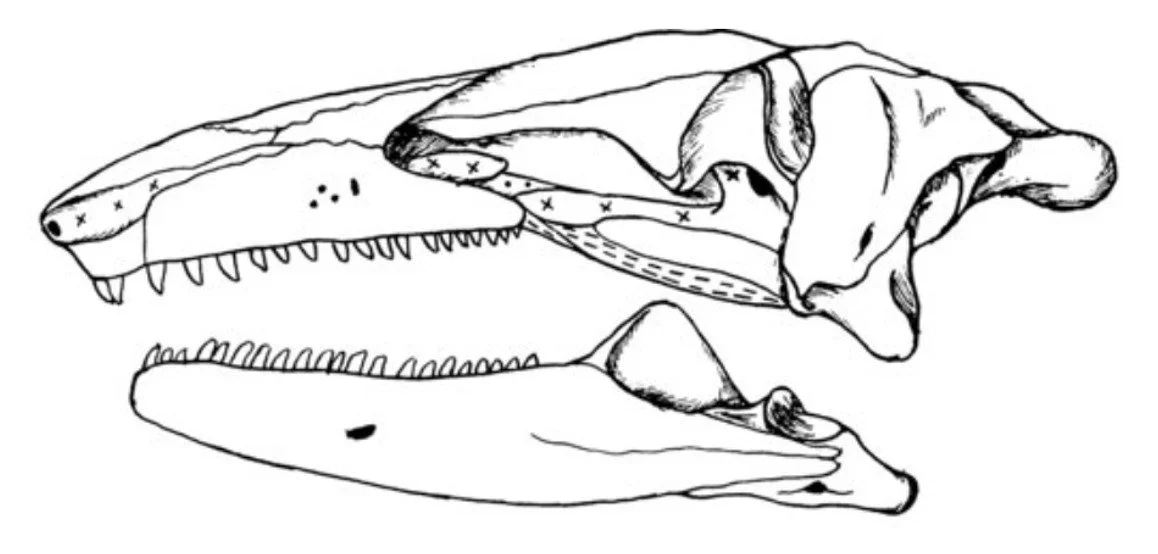
Caption: diagram of a Two-toed amphiuma Amphiuma means skull that accompanies Iordansky (2001) online… yet doesn’t appear in this unlabelled form in the paper. Things to note: this is a robust, well-ossified, relatively long-snouted skull with prominent teeth, a tall coronoid process on the mandible and a prominent, elongate occipital condyle. Image: Iordansky (2001).
In general, the amphiuma skull is “firmly constructed” (Iordansky 2001, p. 180) with an unusually long, narrow and most un-salamander-like snout. Amphiumas lack eyelids, as is typical of aquatic amphibians, and also lack a tongue. The mouth is made shorter than might be expected from skull anatomy thanks to extensive lateral skin folds that cover the jaw margins: here’s a reminder that the structures termed ‘lips’ in the vernacular have other terms in the anatomy literature, with ‘inferior labial fold’ and ‘superior labial fold’ used for the structures extending from the lower and upper jaws, respectively.
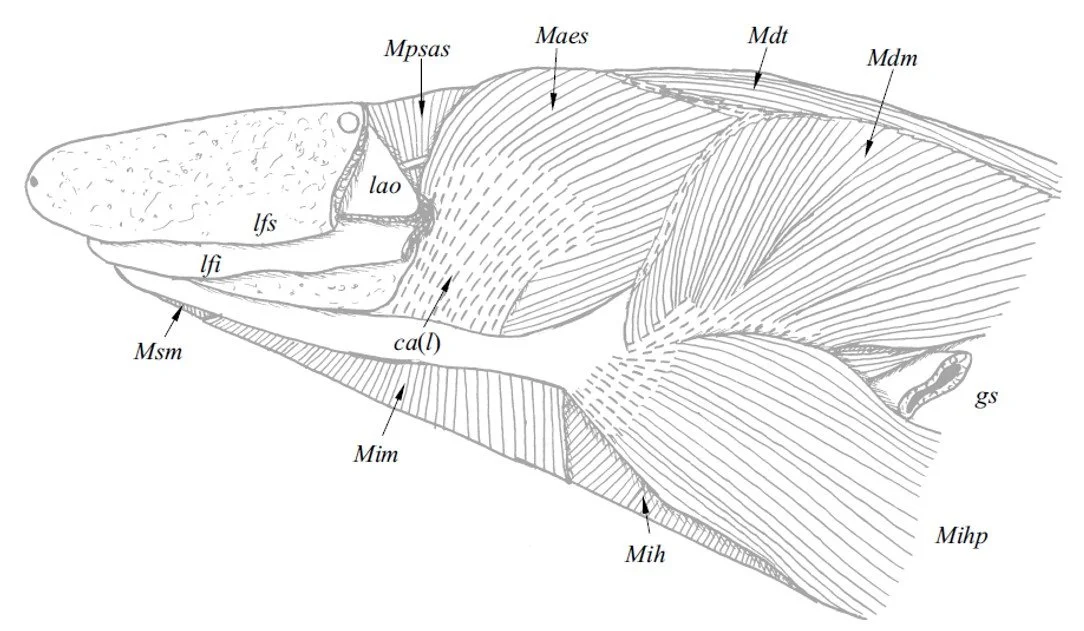
Caption: facial soft tissues and musculature in an amphiuma, depicted by Iordansky (2001). The small eye is obvious, as is the superior labial fold (lfs) and inferior labial fold (lfi). Moving to muscles, the Maes (adductor mandibulae externus superficialis) and Mdm (depressor mandibulae) and their aponeuroses (like the ca, the coronar aponeurosis) are prominent. Image: Iordansky (2001).
Despite those soft tissue folds, amphiumas can open the jaws extremely wide, in part because the occipital condyles (which are normally paired convexities on either side of the foramen magnum) extend posteriorly as short stalks. This allows the cranium to be rotated much further dorsally (and ventrally) than is normally the case. When writing about all of this in the past, I had to make do with ineffective photos of skull found online. I’ve since discovered that Nikolai Iordansky published a very useful paper in 2001 that includes good images of amphiuma skull anatomy (Iordansky 2001), and hence…
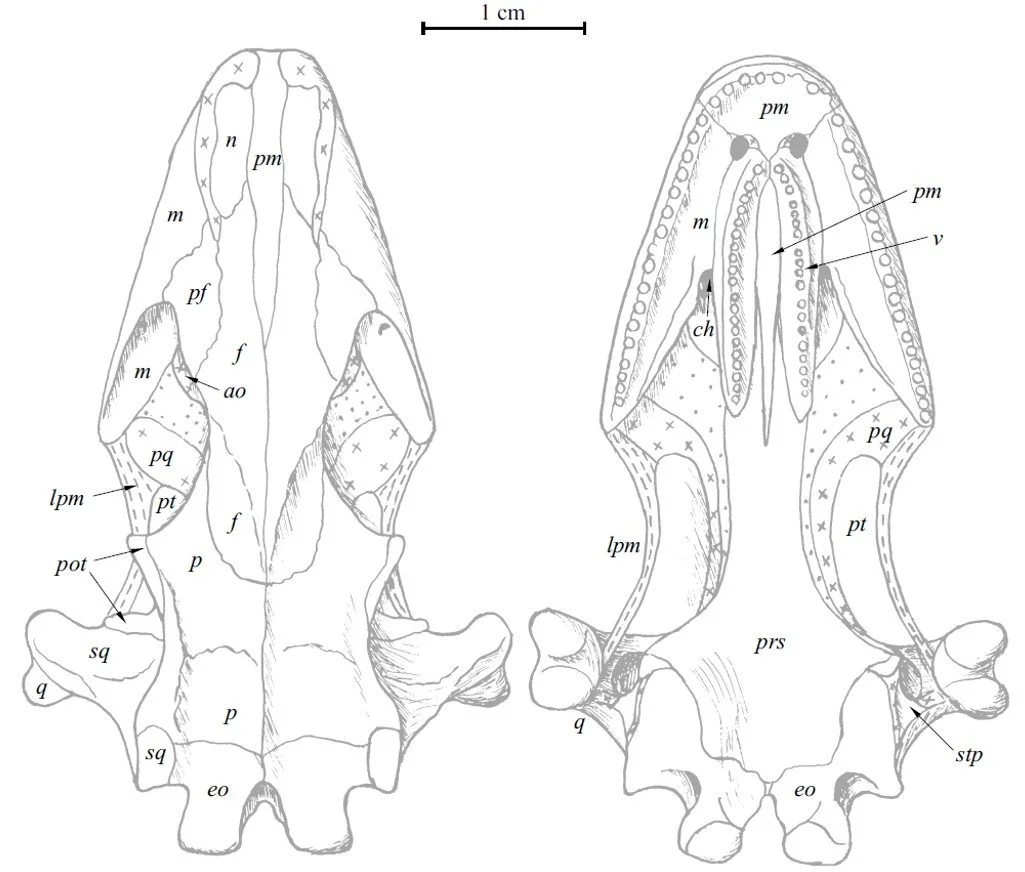
Caption: amphiuma skull in dorsal (left) and ventral views, from Iordansky (2001). Some areas (marked with crosses) are cartilaginous, others tendinous (marked with dotted lines). The stalked occipital condyles are obvious; note also the vomerine tooth rows, large shallow areas on the skull roof for jaw muscles, and the big, flattened palatal area, mostly formed by the parasphenoid (prs). Images: Iordansky (2001).
The skull is also kinetic, specifically pleurokinetic thanks to mobile zones between the maxillae and the nasals and premaxilla, and the prefrontal and frontals. These allow the maxillae (which form much of the sides of the snout) to rotate outwards and inwards by around 15° (Iordansky 2001). The premaxillae are fused into a single element, perhaps to reinforce the snout and allow for more powerful bites, though a role in burrow-digging has also been suggested. The sides of the snout bones have a distinctive sculptured texture.
Amphiumas will simply grab prey with a rapid bite, but high-speed photography has shown that they can also use extremely rapid jaw-opening and throat expansion to generate suction (Erdman & Cundall 1984). The adductor and depressor muscles are substantial; the adductors are attached to multi-part, tendinous sheets (aponeuroses) that cover much of the sides of the rear part of the skull and even well posterior to it.
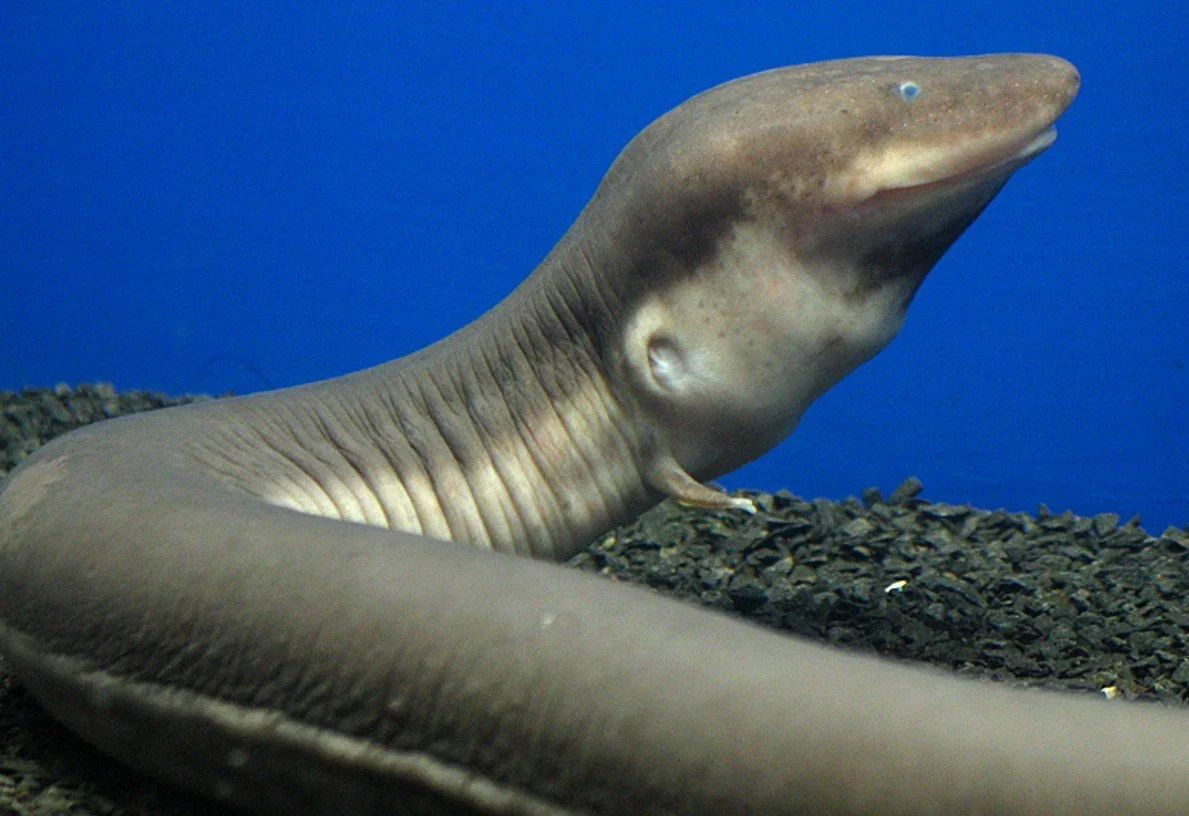
Caption: I like this photo of a captive amphiuma as it emphasizes the fact that salamanders can ‘elevate’ (or extend) the head and neck relative to the long axis of the vertebral column. Image: (c) Andri Pogo, archived version here.
The teeth have distinct pedicels (flexible zones separating the crowns from the roots) and there are rows of teeth on the vomerine bones on the palate. Amphiumas are reported to bite readily and nastily and are sometimes referred to as to the only amphibians within their range that can pose any sort of physical (as opposed to chemical) danger to humans.
For previous Tet Zoo articles on salamanders (there’s a lot, but much of it is now only findable on the internet archive and a whole list of articles I just checked are all ruined and lacking images) see…
Nobody Expects the Korean Crevice Salamander UPDATE.. now titled The Korean Crevice Salamander, August 2015
A Need for News on Nototriton, August 2015
The Pacific Giant Salamanders, October 2016
Erdman, S. & Cundall, D. 1984. The feeding apparatus of the salamander Amphiuma tridactylum: morphology and behaviour. Journal of Morphology 181, 175-204.
Iordansky, N. N. 2001. Jaw apparatus of the permanent-aquatic Urodela: paedomorphosis, neoteny, and feeding adaptations. Russian Journal of Herpetology 8, 179-194.


