Frogs and toads – collectively, the anurans – have been covered on numerous occasion across the history of Tetrapod Zoology though….
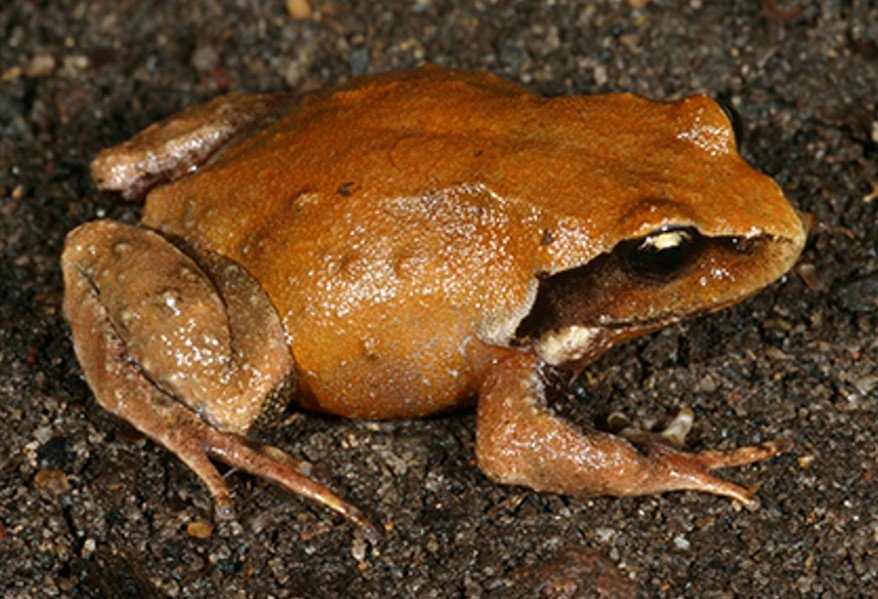
Caption: Mount Ballow mountain frog Philoria knowlesi, an east Australian species named in 2022 from the McPherson Ranges on the Queensland-New South Wales border. Named in honour of conservationist Ross Knowles, it’s endangered by habitat loss and deterioration, and potentially by frog-killing fungus. Image: Mahony et al. (2022), original here.
…. as usual, the bulk of content isn’t here at version 4 but in the archives. Ever aiming to rescue such material and republish it, I here present an article on a select group of Australian limnodynastid frogs, the highland-dwelling sphagnum or Baw Baw frogs. It was originally published at ver 2 in August 2008, a time when I was collaborating with the EDGE (Evolutionary Distinct and Globally Endangered) group at ZSL in order to raise awareness of amphibian conservation. EDGE is still active and regularly posting great reports from the field.
Introducing the Australian ground frogs (again). The frogs you’re about to read more about were, until recently, among the many species grouped together within Myobatrachidae, a group vernacularly termed the southern frogs or Australo-Papuan frogs. Some of the animals included here are very special, and among the most incredible and bizarre of anurans. The Turtle frog Myobatrachus gouldii looks like a toy, is apparently sometimes mistaken for a baby turtle, and is one of just a few anuran species that burrows head-first. In the (now extinct) gastric-brooding frogs Rheobatrachus, females swallowed their eggs and then turned the stomach into a brooding chamber. The Pouched frog Assa darlingtoni of Queensland and New South Wales, first described in 1933, possesses paired hip pouches in which the males carry the metamorphosing tadpoles.
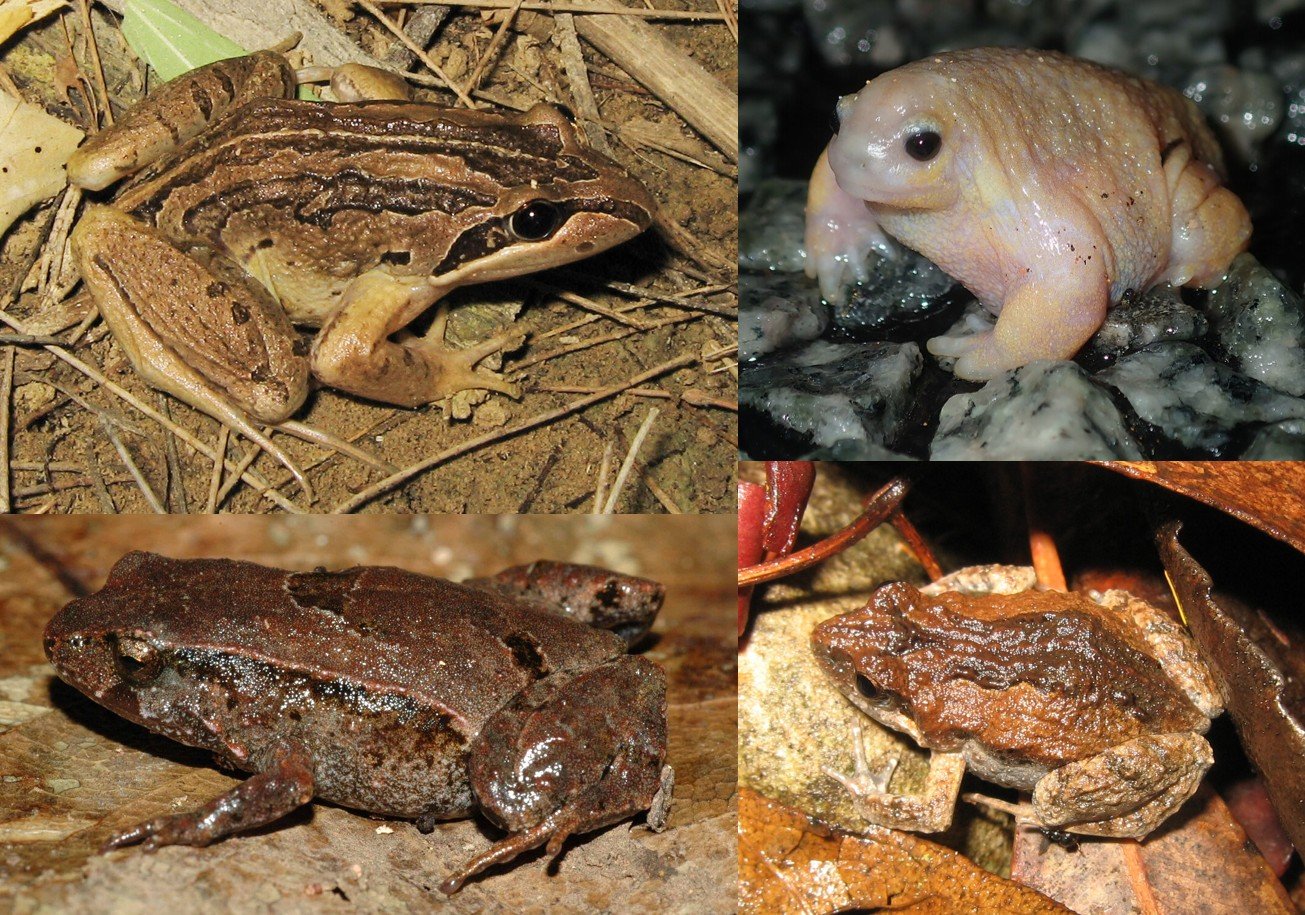
Caption: montage depicting some of the characters mentioned in the story here, featured to showcase myobatrachoid diversity and not shown to scale. Clockwise from upper left: Brown-striped frog Limnodynastes peronii, Turtle frog, Common eastern froglet Crinia signifera, Pouched frog. Images: LiquidGhoul, CC BY-SA 3.0 (original here); Thomas Mesaglio, CC BY 4.0 (original here); Retama, CC BY-SA 3.0 (original here); Hexasoft, CC BY-SA 3.0 (original here).
Anatomical synapomorphies that unite the supposed members of Myobatrachidae have never been identified and it’s occasionally been suggested that they’re not a natural group, some perhaps being allied to sooglossids (Seychelles frogs) and others to heleophrynids (ghost frogs). Frost et al. (2006) didn’t support this idea of polyphyly but did find the Australo-Papuan frogs to group into two clades: one containing Australian swamp frogs (Limnodynastes) and relatives (which they called Limnodynastidae) and one containing Australian froglets (Crinia), the Pouched frog, Turtle frog and their relatives (which they called Myobatrachidae). While there seem to be two distinct large groups here, they’re still close, limnodynastids + myobatrachids being united as Myobatrachoidea. Their closest relatives are a number of poorly known South American taxa that I’ll avoid discussing for now.
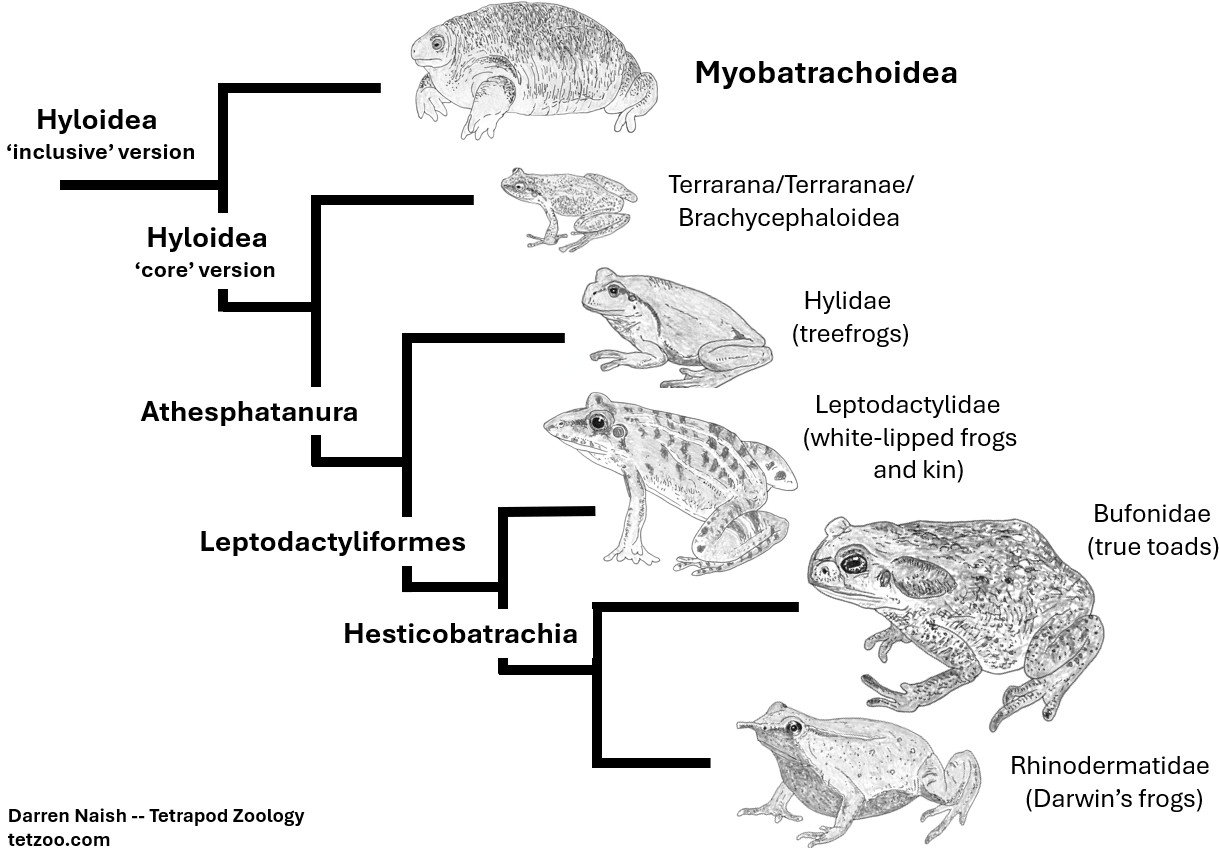
Caption: a much simplified hyloid cladogram, based largely on the topology recovered by Frost et al. (2006) and with elements of their taxonomy superimposed on the branches. As discussed most recently in my 2024 strabomantid article (here), several different versions of the hyloid tree published since the early 2000s change things around. Anyway, myobatrachoids are outside ‘core Hyloidea': some authors have them within Hyloidea, others use a version of Hyloidea that excludes them. Image: Darren Naish.
Phylogenetic studies mostly find myobatrachoids to be an early-diverging lineage within Hyloidea, the neobatrachian clade that includes treefrogs, true toads and others. Some authors have expressed preference for a node-based concept of Hyloidea that includes only ‘core hyloids’ (Darst & Cannatella 2004). If adopted, this would exclude myobatrachoids from this group. This was followed in the cladograms shown by Pyron & Wiens (2011) where myobatrachoids are outside of Hyloidea proper.
Decline of the Baw Baw frog. Among those limnodynastids (sometimes called Australian ground frogs) on the EDGE list we find the Baw Baw frog Philoria frosti, a species restricted to Victoria’s Baw Baw Plateau, located about 120 km east of Melbourne. Thought to number between 10,000-15,000 during the early 1980s, it was relatively common and easy to find, and Malone (1985) reported the discovery of over 4200 calling males during the first systematic survey. Things were to go horribly wrong.
Soon afterwards, the species went into chronic decline, and no individuals were reported between 1985 and 1988, only a few scant records were made between 1989 and 1992, and by 1996 it seemed that calling males were down to just 1-2% of the number reported a decade earlier. Some reports indicate that the species, now critically endangered, has declined to as few as 250 individuals.
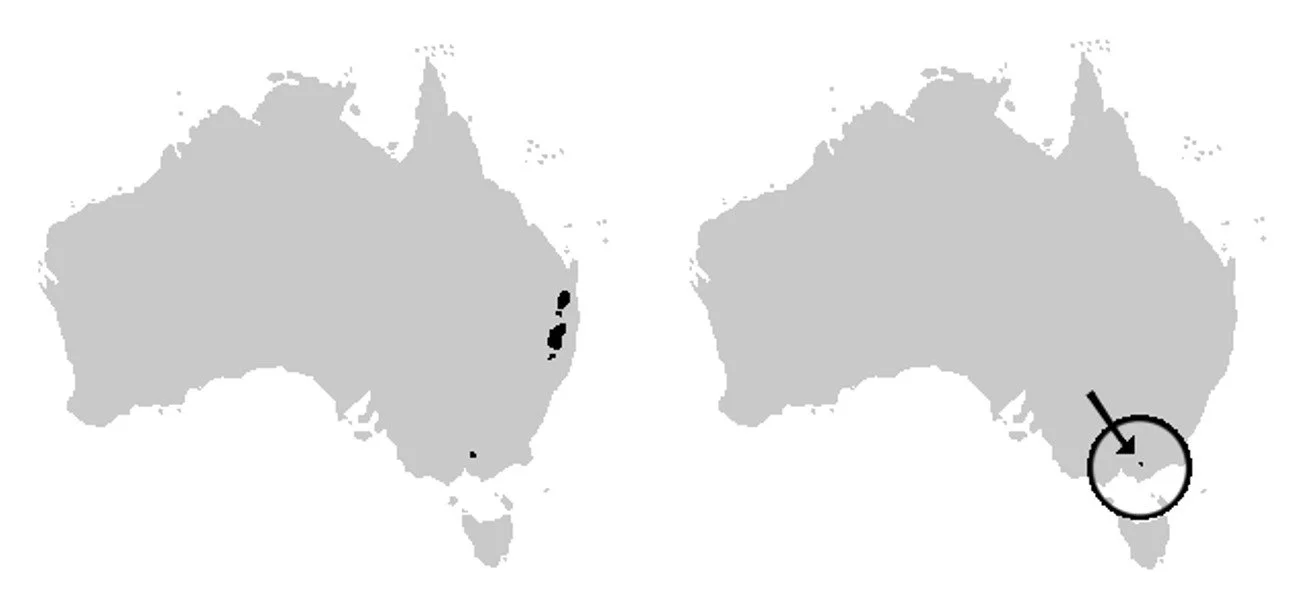
Caption: range maps showing, at left, the entire global range of all Philoria species and, at right, the Victorian distribution of the type species for the group, the Baw Baw frog P. frosti Spencer, 1901. Images: Tnarg 12345, CC BY-SA 3.0 (original here); Froggdarb, CC BY-SA 3.0 (original here).
Sphagnum frogs: the other Philoria species. P. frosti is one of seven species of Philoria, all of which are sometimes called Baw Baw frogs, despite the fact that P. frosti is the only species restricted to the Baw Baw Plateau. The others are from Queensland and New South Wales. Sometimes called sphagnum frogs, six have been named since 1940 and three (P. pughi Knowles et al., 2004, P. richmondensis Knowles et al., 2004 and P. knowlesi Mahony et al., 2022) this century. It’s probably more sensible to refer to all Philoria species as sphagnum frogs in order that we avoid confusing the entire group with the one species P. frosti.
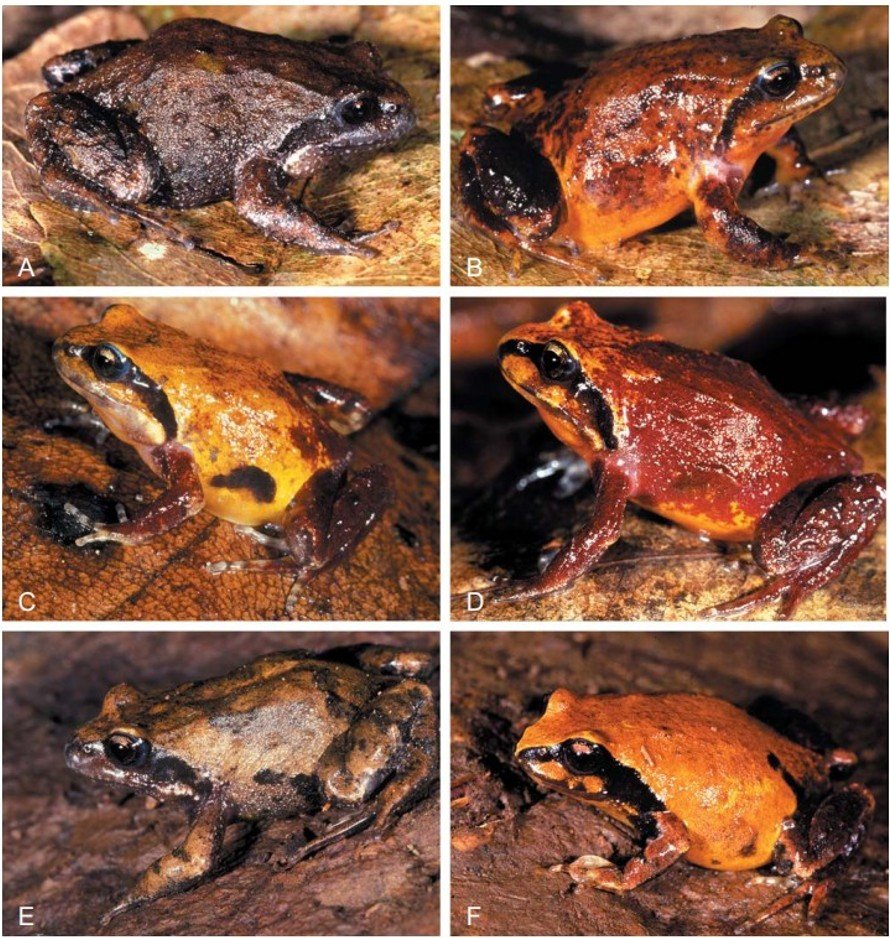
Caption: a Philoria montage from Knowles et al. (2004), a paper that named the two new species P. pughi and P. richmondensis. A and B are individuals of P. kundagungan (no connection to Star Wars); C and D belong to P. pughi; E and F represent P. richmondensis. Images: Knowles et al. (2004).
Sphagnum frogs are robust little frogs, all less than 55 mm long, with horizontal pupils. The parotoid glands are small in some species but very large in others. In P. frosti, they’re dark and extend backwards over the shoulder region. The species also differ in skin texture, with most being smooth-skinned but P. frosti being covered with multiple tiny tubercles that give it a spiky appearance. In being ‘spiky’ and in sporting massive and dark parotoid glands, P. frosti is probably the most distinctive member of the group.
Moore (1958) proposed that Philoria should be split into two genera, with Kyarranus being suggested for the northern species. Kyarranus is still used by some authors for some species but, as noted by Cogger (2000), there doesn’t seem to be any good reason for this separation as the characters thought to be diagnostic for Kyarranus also occur in Philoria. A third generic name, Coplandia, was erected for the Mountain or Red-and-yellow mountain frog P. kundagungun by those authors who shall remain nameless but hasn’t been used much since. Fossils belonging to Philoria date back to the Late Oligocene or Early Miocene (Sanchiz 1998) and phylogenetic studies have found Philoria to be the sister-taxon to all other limnodynastids (Frost et al. 2006).
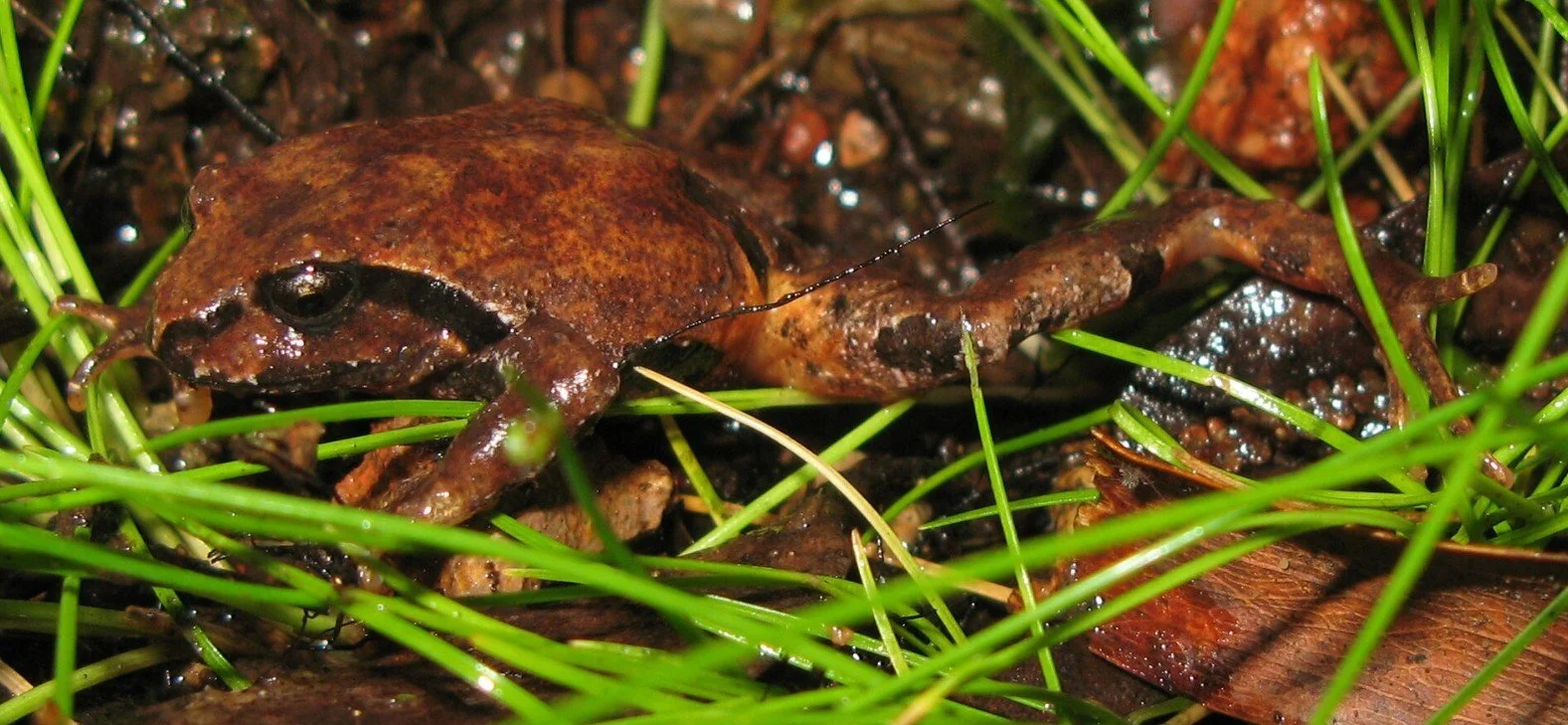
Caption: Sphagnum or Bog frog P. sphagnicola in life, a species named in 1958 (originally as part of Kyrarranus) and currently listed as Vulnerable. Image: LiquidGhoul, CC BY-SA 3.0 (original here).
Sphagnum frogs prey on arthropod larvae and other animals but may specialize on annelids. Their best known peculiarity, however, concerns their highly specialized mode of reproduction. They manufacture a transparent foam nest by beating air bubbles into the egg mass: special flanges on the female’s digits are thought to assist in the creation of the bubbles. This nest can be created in a variety of sites, ranging from a cavity within moist sphagnum moss to about a metre up within vegetation. The relatively immobile aquatic larvae don’t feed (and have reduced mouthparts) but retain a yolk store all the way through to metamorphosis, eventually completing development within the nest (Debavay 1993).
Why P. frosti has gone into chronic decline is of course the big question and the real answer is that we don’t know. However, it’s hardly the only anuran where this has happened, both in Australia and worldwide. In Australia, species of both torrent frog (Taudactylus) and barred frog (Mixophyes) have been severely affected or even made extinct. In the case of the Baw Baw Plateau, development and the forestry industry have reduced available habitat. As a highland species it’s also likely that the Baw Baw frog has been affected by environmental changes and perhaps by the spread of the Bd chytrid fungus (Pounds et al. 2006). As of 2003, the Bd chytrid known to kill frogs elsewhere had not been reported on P. frosti and there were plans to look for it on museum and living specimens.
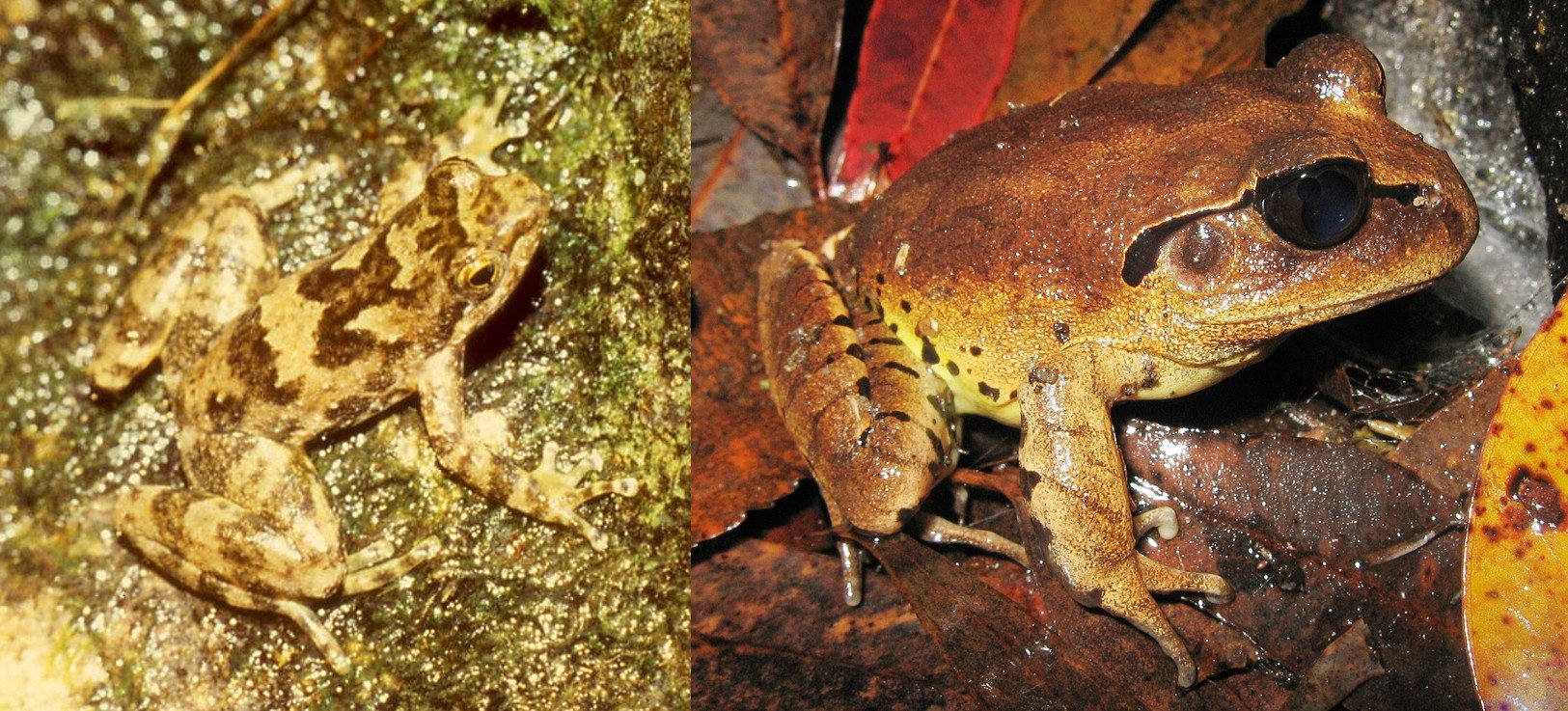
Caption: representatives of the Australian myobatrachid frog genera Taudactylus (left) and Mixophyes, species of which have undergone notable decline, demonstrably due to the impact of Bd chytrid fungus. Images: Tnarg 12345, CC BY 2.5 (original here); LiquidGhoul, public domain (original here).
For previous Tet Zoo articles on hyloids, see…
Green-boned glass frogs, monkey frogs, toothless toads, November 2007
The toads series comes to SciAm: because Africa has toads too, September 2011
20-chromosome toads, September 2011
Glassfrogs: translucent skin, green bones, arm spines, January 2013
Everybody loves glassfrogs, February 2013
African tree toads, smalltongue toads, four-digit toads, red-backed toads: yes, a whole load of obscure African toads, December 2014
Gladiatorial glassfrogs, redux, January 2015
Frogs you may not have heard of: Brazil’s Cycloramphus ‘button frogs’, January 2015
It's the Helmeted water toad… this time, with information!, January 2015
The Terrible Leaf Walker Frog, March 2017
What, If Anything, Is A Strabomantid?, January 2024
Refs – –
Cogger, H. G. 2000. Reptiles & Amphibians of Australia (Sixth Edition). New Holland Publishers, Sydney.
Darst, C. R. & Cannatella, D. C. 2004. Novel relationships among hyloid frogs inferred from 12S and 16S mitochondrial DNA sequences. Molecular Phylogenetics and Evolution 31, 462-475.
Debavay, J. M. 1993. The developmental stages of the Sphagnum frog, Kyarranus sphagnicolus Moore (Anura, Myobatrachidae). Australian Journal of Zoology 41, 151-201.
Frost, D. R., Grant, T., Faivovich, J., Bain, R. H., Haas, A., Haddad, C. F. B., De Sá, R. O., Channing, A., Wilkinson, M., Donnellan, S. C., Raxworthy, C. J., Campbell, J. A., Blotto, B. L., Moler, P., Drewes, R. C., Nussbaum, R. A., Lynch, J. D., Green, D. M. & Wheeler, W. C. 2006. The amphibian tree of life. Bulletin of the American Museum of Natural History 297, 1-370.
Malone, B. S. 1985. Status, distribution and ecology of the Baw Baw Frog (Philoria frosti). Arthur Rylah Institute Technical Report No. 36. Arthur Rylah Institute, Department of Conservation, Victoria.
Moore, J. A. 1958. A new genus and species of leptodactylid frog from Australia. American Museum Novitates 1919, 1-7.
Pounds, J. A., Bustamante, M. R., Coloma, L. A., Consuegra, J. A., Fogden, M. P. L., Foster, P. N., La Marca, E., Masters, K. L., Merino-Viteri, A., Puschendorf, R., Ron, S. R., Sánchez-Azofeifa, G. A., Still, C. J. & Young, B. E. 2006. Widespread amphibian extinctions from epidemic disease driven by global warming. Nature 439, 161-167.
Sanchiz, B. 1998. Salientia. Handbuch der Paläoherpetologie, Teil 4. Verlag Dr. Friedrick Pfeil, München.


