Among the most familiar of creatures in the entire pantheon of legend and mythology is the unicorn, an animal so ubiquitous that you won’t need me to provide a description of what it’s meant to look like.

Caption: here’s where we’re at with unicorns today. Associated with artfulness, often quirkiness and partly with young girls. Images: used under fair use.
Unicorns have pivotal roles in mythology, fantasy and fiction. But they sound just about ‘real’ enough that zoologists have long written about them and aimed to work out what they might have been based on, always assuming that there was a real animal, or perhaps more than one, at the base of the whole story. I’ve had reason to talk and write about unicorns a few times, and my sometime role as a commentator on cryptozoology, animal mythology and the history of palaeontology means that I’ve occasionally had direct interaction with art, artifacts and even fossils connected to unicorn lore. I thought it would be worth compiling my understanding of unicorns and what they’re about, so here we are.
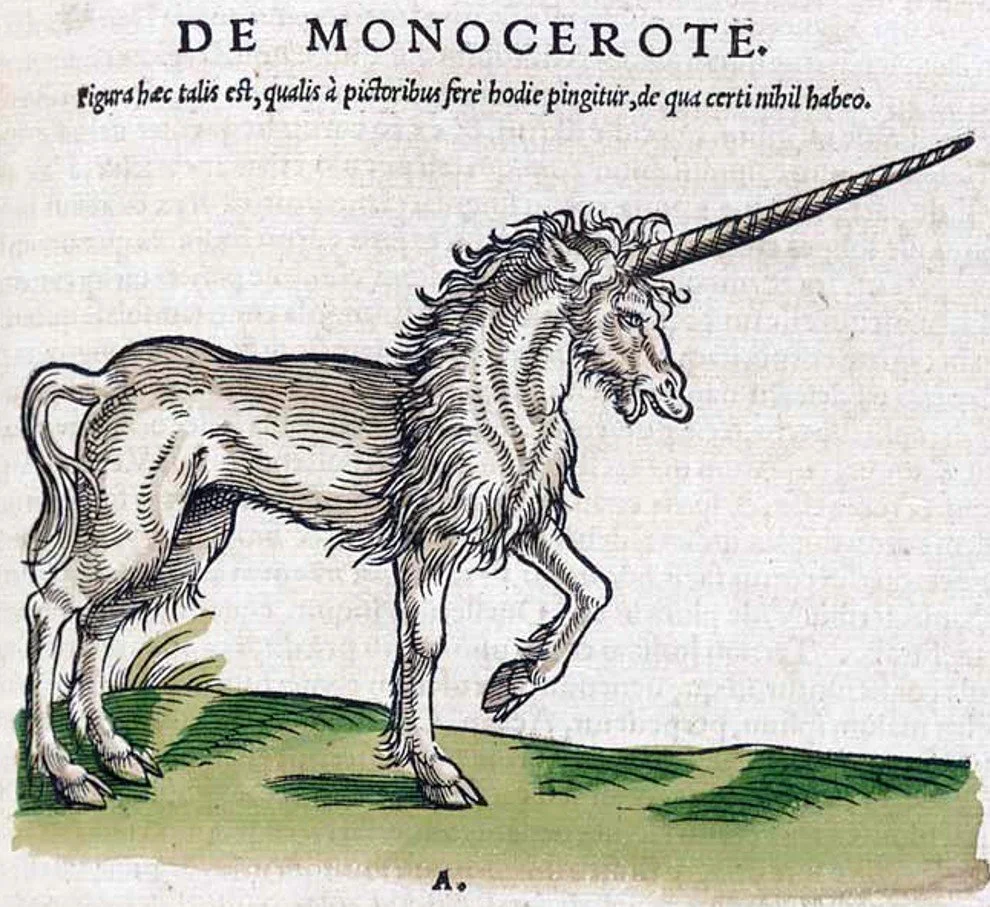
Caption: a canonical and influential image of the unicorn as imagined by Europeans from at least the 16th century onwards. This is Konrad Gesner’s image from Historiae Animalium, though this is actually the version used in Edward Topsell’s The History of Four-Footed Beasts published in 1658. Topsell translated much of Gesner’s book during his research. Image: in the public domain.
The text here was compiled from notes I’ve assembled over time. Among the primary sources I consulted were Wendt (1956), Freeman (1976) and Ley (1987).
Unicorns of the ancients. The very oldest written references to the unicorn are those made by the Greek historian and physician Ctesias, whose writings document events of the 4th and 5th centuries BCE. His 23-volume history of Persia, which also includes content on India, refers to a horned, horse-like animal with a white body, dark red head, and dark blue eyes. The horn was said to be tricoloured, being white at the base, black along its shaft, and crimson at the tip. The horn was further said to have magical properties, such that a drinking vessel made from one protected the drinker from epilepsy and toxins.
Later Greek authors mostly repeated information provided by Ctesias, as did Roman writers. In the Roman world, Pliny the Elder wrote about the unicorn of India during the 1st century AD, calling it the monoceros. It was said to have elephant-like feet, a stag’s head, a tail like a goat, and couldn’t be captured alive. The Greek writer Aelian (properly, Aelianus Tacticus), based in Rome during the 2nd century AD, also wrote about the unicorn as a denizen of India. He didn’t use the term monoceros but opined that it was known properly as the cartazanos. It’s been suggested that this is a corrupted or Greek effort to reproduce karkadann, a term used for unicorns in the Islamic world... on which, read on.
Writers of recent centuries have tended to state that these ancient references were inspired by rhinos. The Venetian merchant and writer Marco Polo, during his travels in Asia made during 1271 and 1295, wrote of his own unicorn sighting, saying that the beast is big, liked to wallow, and was “quite the opposite of what we say it is”. It’s evident that he saw a rhinoceros – presumably the Great one-horned rhino Rhinoceros unicornis – and assumed it to be the original item.
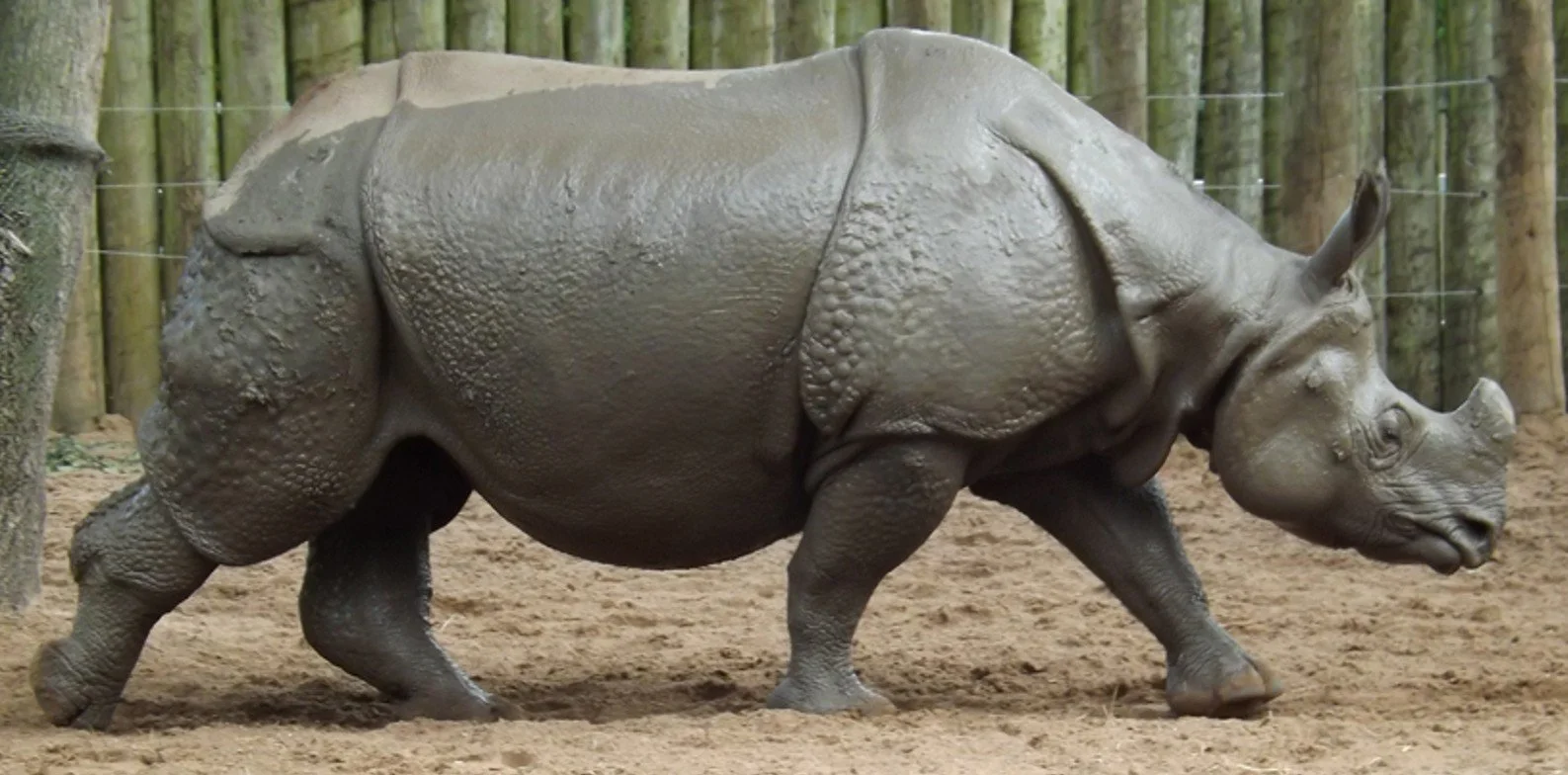
Caption: Great one-horned rhino photographed in captivity at Edinburgh Zoo, UK. I've seen this species at several zoos, virtually always doing really interesting things. Image: Darren Naish.
There’s no doubt that accounts of rhinos are connected to the unicorn myth. But it also appears, even from the writings of Ctesius, that the unicorn was mythical even to the ancients. It was an allegorical, legendary beast that combined remarkable traits and differed from normal animals in that it couldn’t be captured. Accounts and stories of particular deer, antelopes and other wild, horned mammals almost certainly fed into the idea that unicorns existed, but I reject the idea that people saw, say, Arabian oryx Oryx leucoryx, Chiru Panthalops hodgsonii or Okapi Okapia johnstoni, and based the unicorn on any one of those animals specifically.
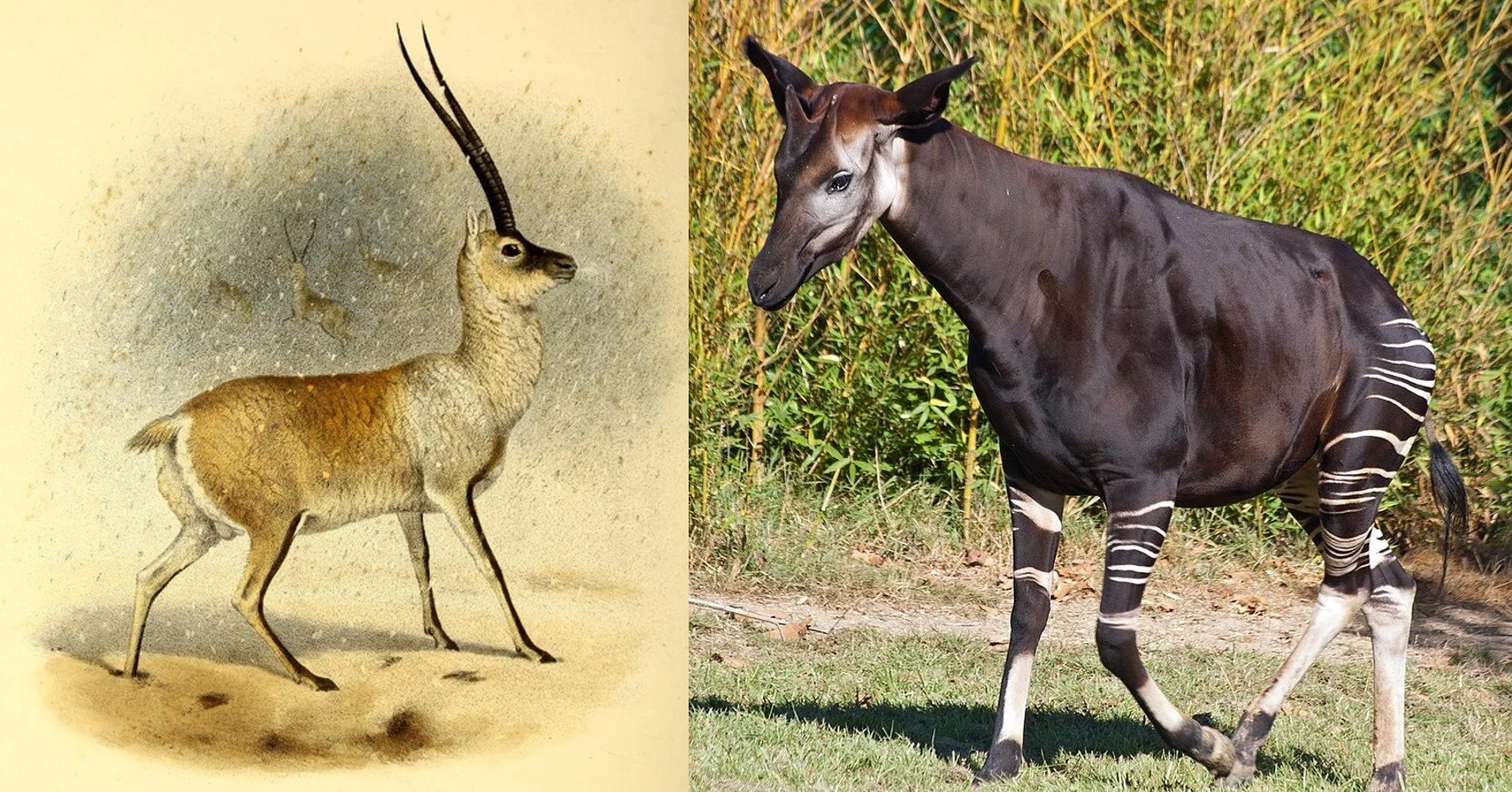
Caption: a list of modern horned mammals – including Chiru and Okapi – have been linked to unicorn tales, always precariously and via naïve euhemerism. In cases, people have suggested that conventional, two-horned animals were only seen from the side, or that a freak or injured one-horned individual was observed. Images: Philip Sclater, public domain; Daniel Jolivet, CC BY 2.0 (original here).
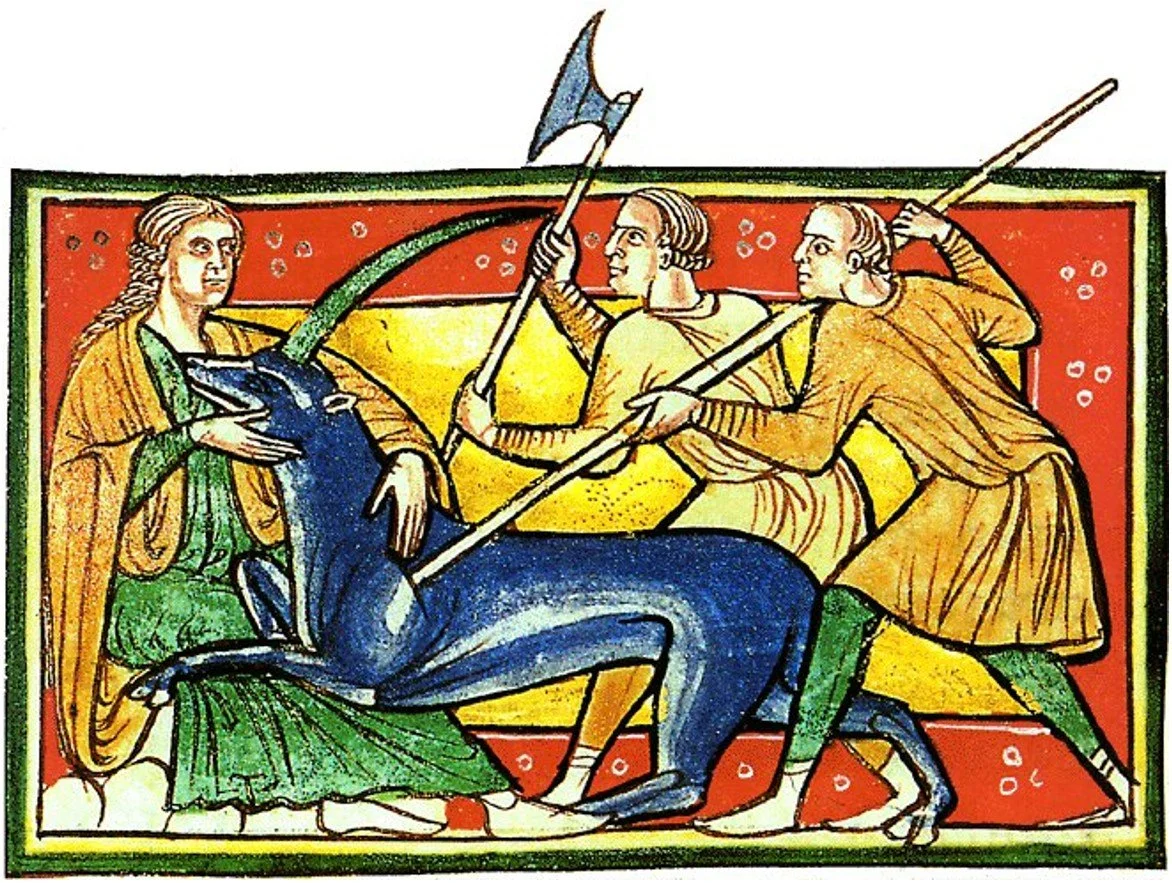
Caption: a ‘men kill a unicorn as it rests its head in the lap of a virgin’ image, this being from The Worksop Bestiary, written by an unknown author, published in 1185, and today at the Morgan Library, New York. I include it here because this sleek, dark blue unicorn was quite likely based on a description of a Sable antelope Hippotragus niger. But that doesn’t mean that the Sable antelope was necessarily important in establishing unicorn belief in the first place. Image: public domain.
A few writers have suggested that extinct animals were observed by ancient people and represent the ‘real’ original unicorn. Among these are the asymmetrically-horned bovid Tsaidamotherium and the giant rhino Elasmotherium. These animals almost certainly did not look unicorn-like at all, nor is there any reason to link them to the legendary, horse-like animal we’re been considering.
Clearly, belief in a one-horned, hoofed mammal with special powers was widely embedded in the ancient world. At the risk of repeating myself, it seems most likely that these beliefs emerged as a series of tall tales and exaggerations based on rhinos. Belief in the magical power of the unicorn’s horn – termed an alicorn – meant that objects identified as such then had great value and medicinal significance. In Europe, narwhal tusks became alicorns, hence the standard depiction of the unicorn as possessing a spiral horn, while walrus tusks served this role in the Islamic world.
By the 7th century, it was said that a unicorn – previously noted as uncatchable – could be obtained if a virgin girl should “open her lap” to it, in which case it would lay its head down, be calmed, and then be catchable. This was described by Isidore of Seville, the Hispano-Roman theologian and scholar, and became a standard piece of unicorn lore for the rest of history, often being depicted in illustrations. Again, it demonstrates the allegorical nature of the beast, relating to its wild and powerful nature but also a connection to purity and innocence.
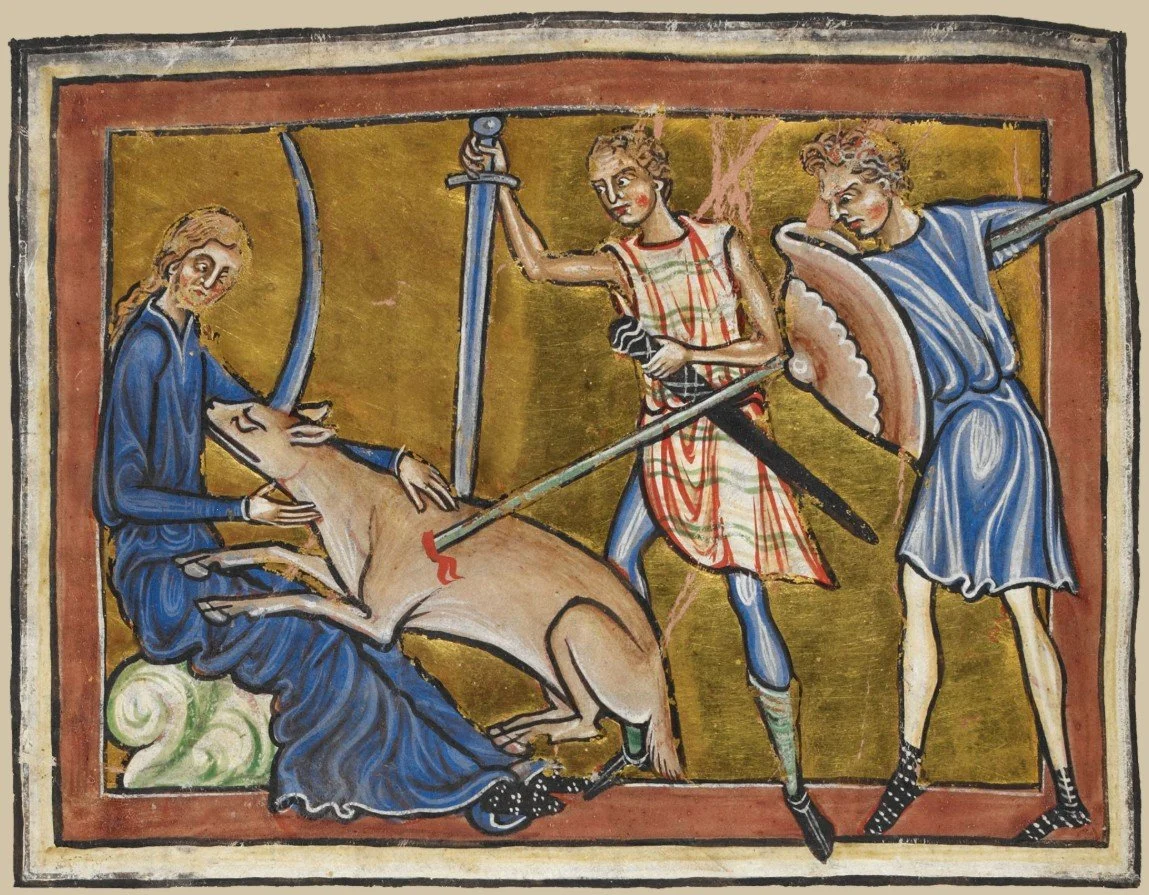
Caption: another of the many ‘men kill a unicorn as it rests its head in the lap of a virgin’ image, this one from the 13th century bestiary manuscript ‘Royal MS 12 C XIX’ held by the British Library. Damage to the figure at left creates the impression that they are bearded but they’re shown as being female in other versions of this image. Note the unusual, non-equine appearance of the unicorn. It has a non-spiralling, curved, grey horn, short snout, cloven hooves, and a short, deer-like tail. Image in public domain.
The unicorn and the re’em. An interesting aside on scholarly writings about unicorns concerns their guest appearance in the Book of Job (chapter 39, verses 9-12) in The Bible. This, of course, has been taken as providing verification of a sort that unicorns were real and known to the ancient Hebrews. However, it’s long been clear that this emerged as a translation error.
The ancient Hebrew version of the Book of Job makes reference to a horned animal known as the re’em (pronounced ru-eem), written rëem or rîmu in some versions. God, in statements delivered to Job from a whirlwind, expressed his omnipotence by listing things that he knew, or could command, and among these are his ability to make the unicorn do his bidding, despite its great strength.
This Hebrew text was then translated into Greek by the group known as the Septuagint or the Seventy, who of course didn’t know what the re’em might be. They opted to identify it as Pliny’s monoceros, a consequence being that English translations based on the Greek version then had it that this beast was the unicorn. The fact is that we can probably work out what the re’em was, since renditions of the same animal appear on the Ishtar Gate, the 8th century inner wall of Babylon in Iraq, excavated between 1904 and 1914 and then reconstructed for the Pergamon Museum in Berlin. These show that the Hebrew re’em is the Aurochs Bos primigenius, shown in profile on the gate such that only one of its horns is visible. Whether this has any connection to claims that the re’em should be identified as the monoceros, and thus as the unicorn, isn’t clear. In any case, the re’em is not the same beast as the monoceros or unicorn, and thus the unicorn is not mentioned in The Bible after all.
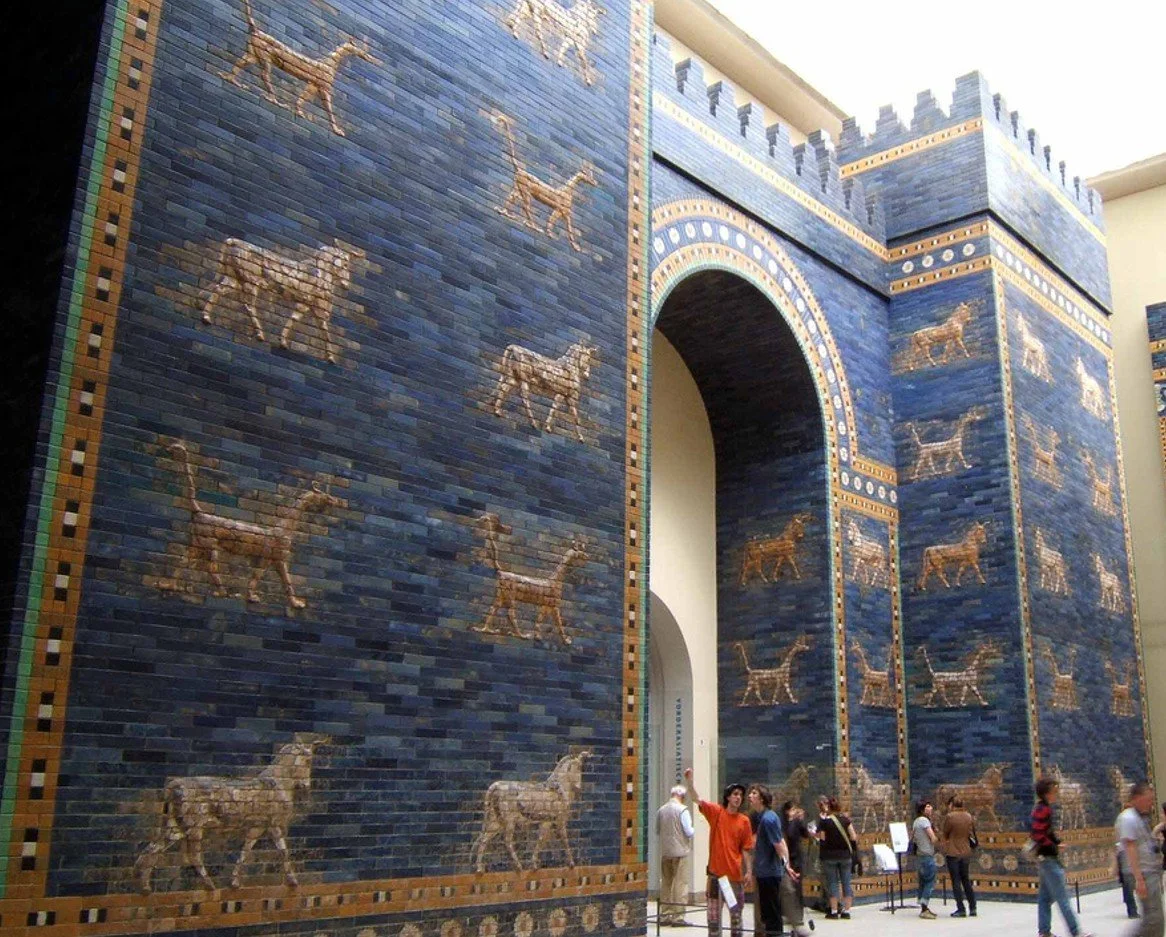
Caption: the Ishtar Gate at the Pergamon Museum. This article is about unicorns, of course, but this remarkable piece of ancient architecture is most usually discussed within the theatre of cryptozoology-adjacent prose due to its portrayal of the serpent-headed quadrupedal dragon known as the mušḫuššu, and formerly as the sirrush. I have never been on board with the wholly speculative suggestion that this has a link with the mokele-mbembe. Image: Rictor Norton, CC BY 2.0 (original here).
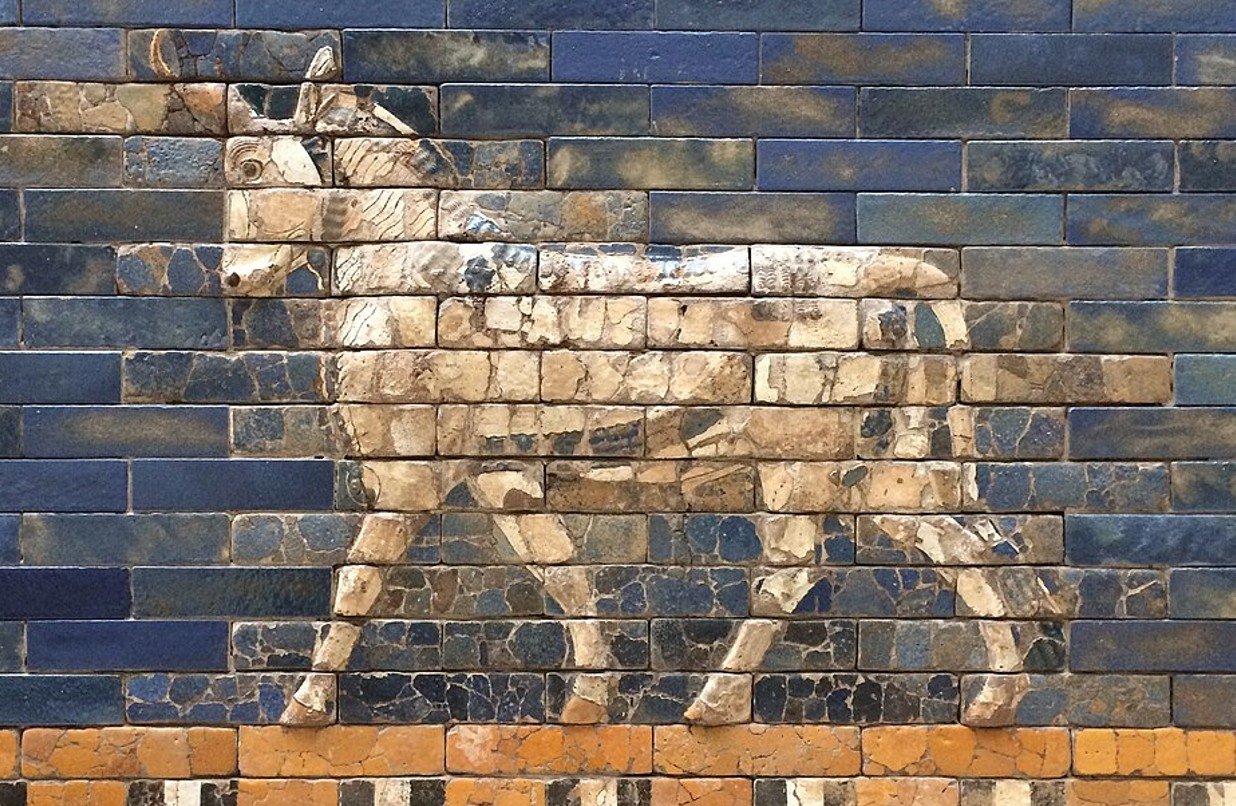
Caption: one of the aurochs shown on the gate, posed over the flower ribbon present near the bottom. Images: Jami430, CC BY-SA 4.0 (original here).
Unicorns in the Islamic world. A number of one-horned mythical animals known to Islamic writers, grouped together as the karkadann (or kargadan) and associated with Iran and India, have been connected to the unicorn story. Karkadanns are mostly antelope-like but leonine, canine and bovine variants exist, and the term ultimately became used for rhinos. Scholars and artists were aware of the possibility that rhinos might be the primary explanation, since karkadann illustrations and descriptions became successively more rhino-like. According to the writings of Al Biruni, recorded during the 10th and 11th centuries, the karkadann had the build of a buffalo, a finger-shaped upper lip, a single horn, a tail that was not especially long, a dewlap, and three hooves per limb. This description was surely made with the Great one-horned rhino Rhinoceros unicornis in mind. However, some writers fully aware of rhino-like versions of the karkadann did seemingly think that more equine-like versions existed too.
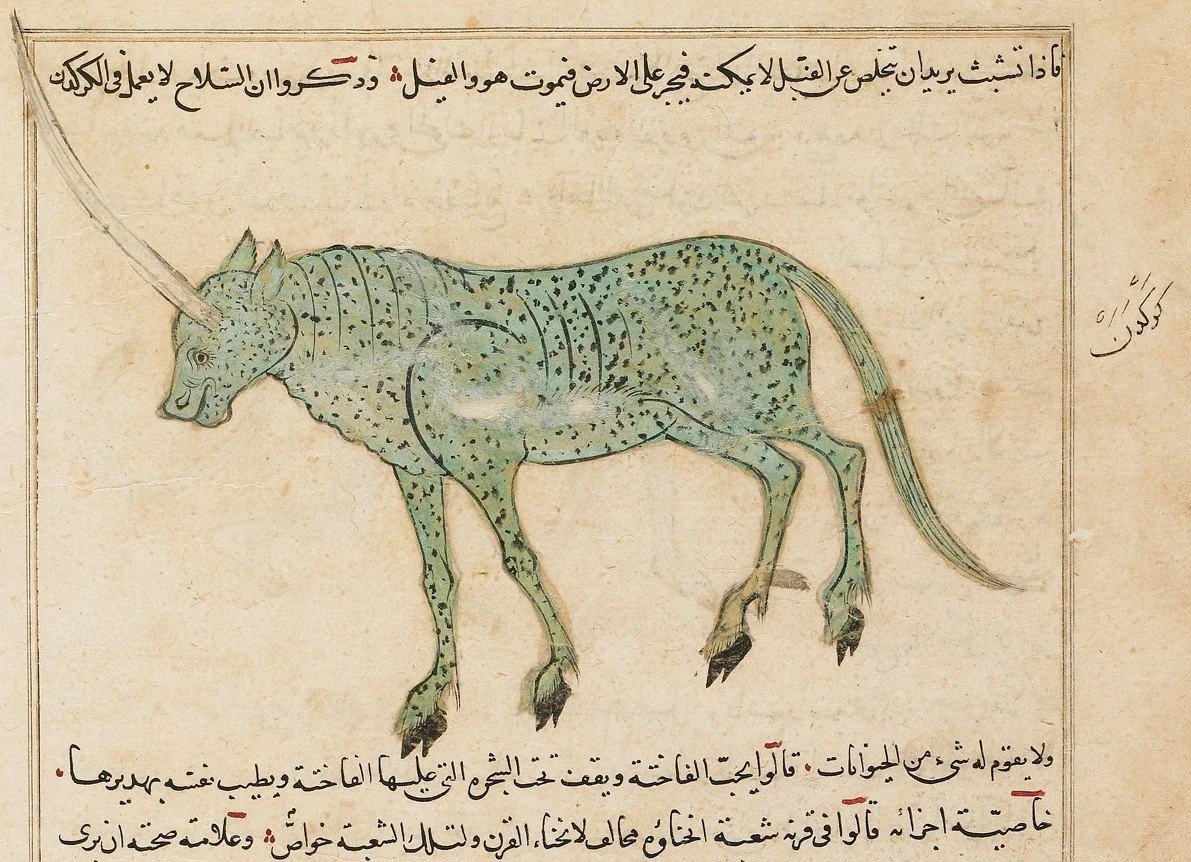
Caption: a karkadann from Zakariyya’ Muhammad Qazwini's (also known as al-Qazmini or Qazvini) manuscript Wonders of the Creation and Unique [phenomena] of the Existence, created between 1219 and 1258. The apparently naked, in part deeply creased or wrinkled, skin and unusual colour of this animal mean that it could have links to tales of rhinos. It is certainly not illustrated as being pale and beautiful as is the norm for European unicorns. The pale, gently curved, non-spiralling horn looks consistent with arguments that Islamic ‘unicorn horns’ were walrus tusks. Image: in the public domain.
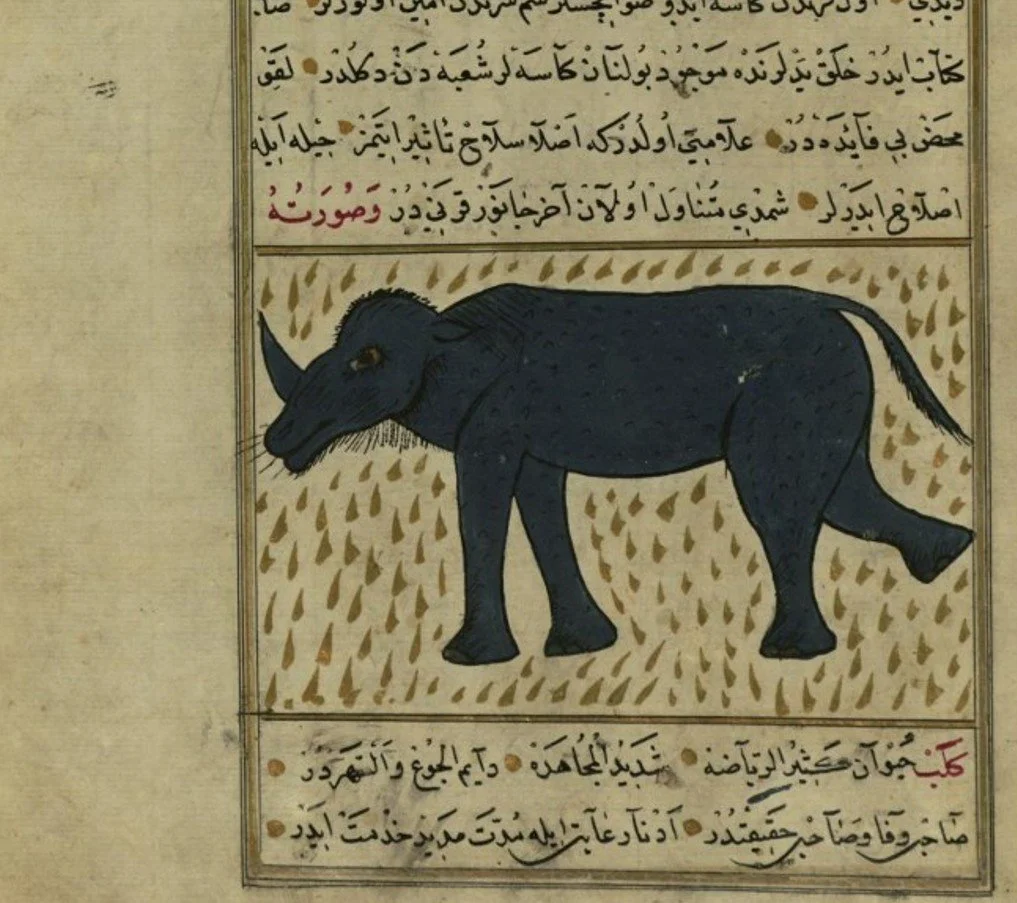
Caption: karkadann images like this one – this also is from Qazwini's Wonders of the Creation and Unique [phenomena] of the Existence – make it clear that at least some ideas about the karkadann were very much based on rhinos, most likely the Great one-horned rhino. This, clearly, is broadly accurate and shows that authors like Qazwini knew more about rhinos than Europeans did even hundreds of years later. Image in public domain.
Again, the karkadann was an allegorical beast, being both dangerous and wild (and able to kill elephants) but also beautiful and pure, with a magical horn.
The unicorn in Medieval times, and the unicorn tapestries. Though often visualised today as a white horse with a spiralling horn on its forehead, the unicorn of Medieval sources is not really horse-like: it is often cloven-hoofed, has a deer- or boar-like face with a beard, and a leonine tail. This is the ‘European mythical’ unicorn or ‘heraldic’ unicorn and is the version shown in the famous unicorn tapestries.
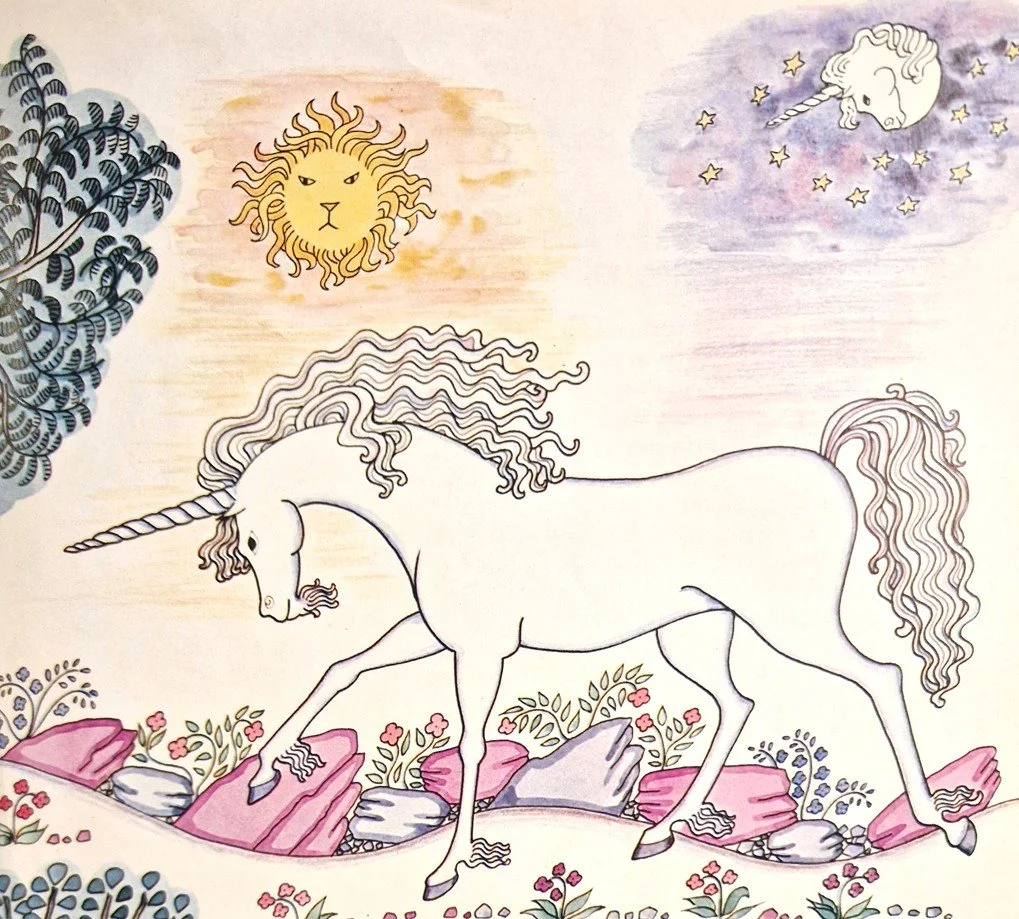
Caption: the ‘heraldic’, very European unicorn that most of us have in mind when we hear the word. It’s very white and perfectly manicured, and with a spiralling horn. This image is from the 1977 children’s book Fabulous Beasts by Richard Blythe, illustrated by Fiona French and Joanna Troughton. I blame this book for much of my fixation on monsters and cryptozoology. Image: (c) Fiona French and Joanna Troughton.
Created in The Netherlands between 1495 and 1505 for wealthy people in France, and today on show at The Cloisters Museum in New York, these show a unicorn hunt and the various stages necessary for such an event to occur. They were stolen from their original owners, the La Rouchefoucauld family, during the French Revolution, then returned, but then went missing until rediscovered in a barn during the 1850s. They were purchased by John Rockefeller in 1922 and kept at his house before he donated them to the Metropolitan Museum of Art in 1938. Some debate is attached to what the tapestries depict, since it’s been argued that they’re full of symbolism and might tell of the death and resurrection of Christ, or be an allegory of marriage.
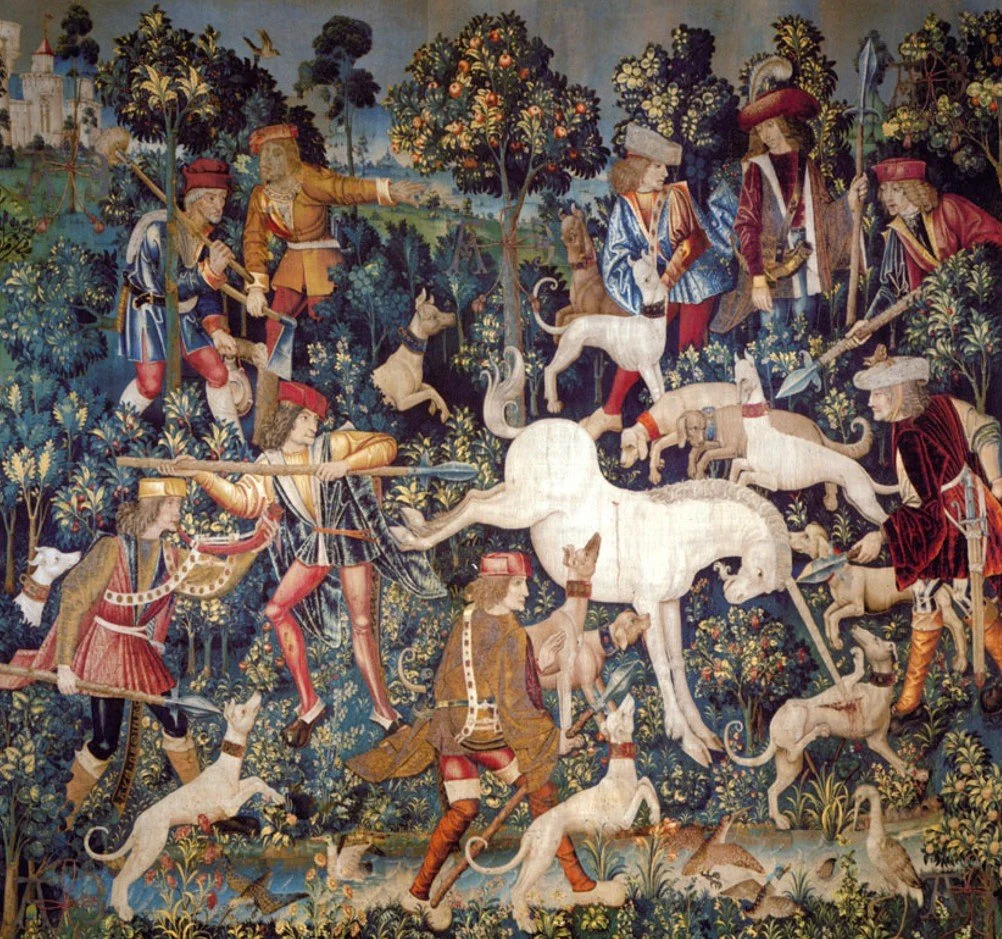
Caption: ‘The Unicorn Defends Itself’ (or ‘Himself’) tapestry from the series. The number of people and hounds involved in the hunt don’t exactly make for good odds. The unicorn tapestries incorporate wool, silk and metal threads. Image: in the public domain.
If you’ve seen the 2025 movie Death of a Unicorn you might recall that the fifth tapestry of the seven is only known from fragments, meaning that we aren’t sure what it showed. Death of a Unicorn runs with the idea that the missing section reveals unicorns to be vengeful, dangerous beasts that take aggressive action when their juveniles are captured, a fun idea but one not likely to be part of the story, sorry. I haven’t seen the original tapestries but I have seen the recreations made for display at Stirling Castle in Scotland. These include recreations of all seven so… what does the fifth one show? It depicts a maiden with a unicorn that’s being subdued by hounds.
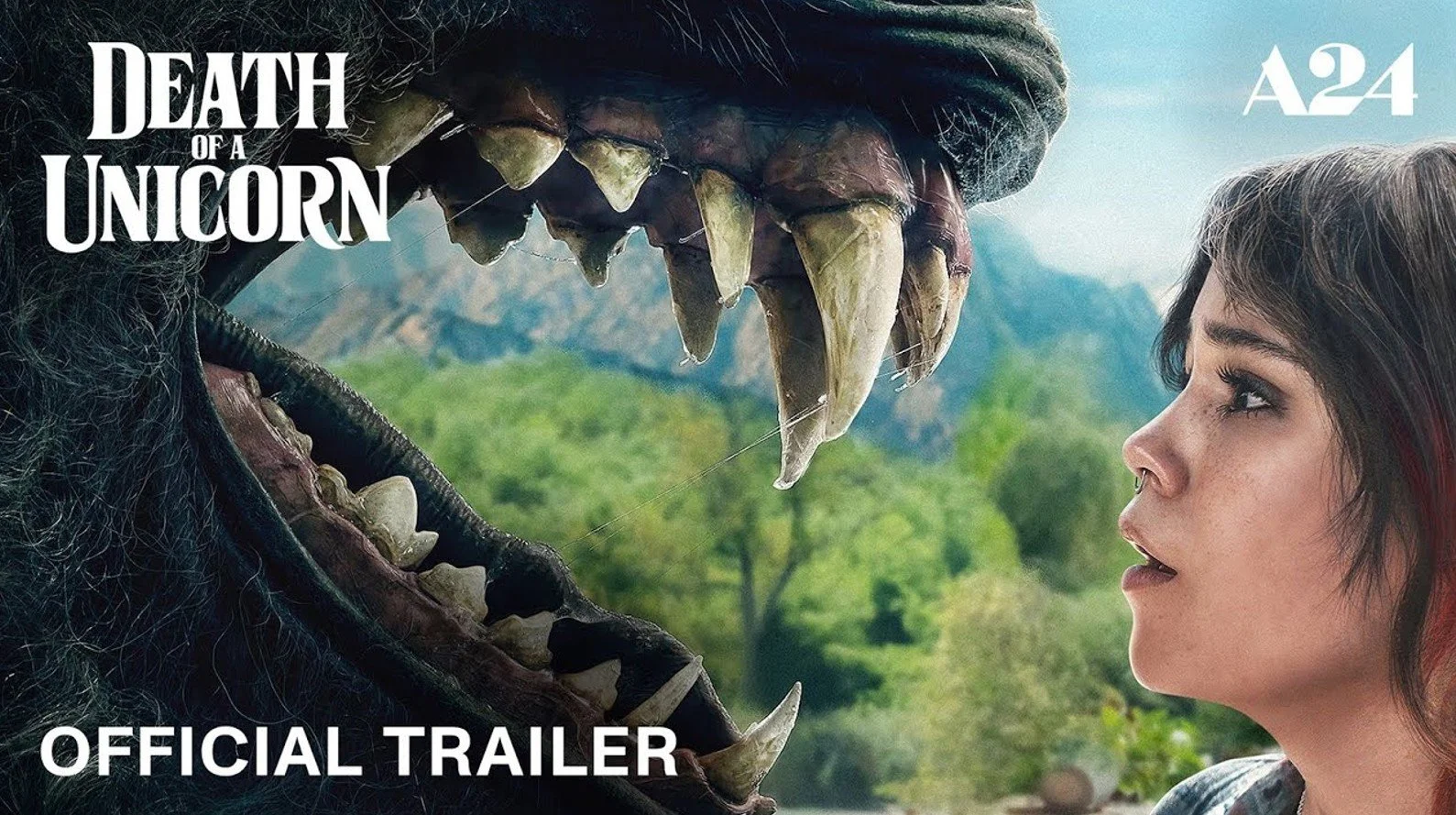
Caption:Death of a Unicorn, written and directed by Alex Scharfman and released by A24, didn’t do especially well in critical terms. But it’s worth a look if you like creature stuff, since it has an interesting portrayal of unicorns connected to some of the real-world lore discussed in this article. Image: (c) A24.
The Qilin, or Chinese unicorn. So much for unicorns of Europe and western Asia, what about those of the east? China has a unicorn of sorts, properly termed the qilin (pronounced ‘chee-lin’). However, the qilin very likely has no direct connection to the classical unicorn of Medieval Europe, to the unicorns of the Islamic world, or to the unicorns of the ancient Greeks and Romans. The qilin is a very odd-looking beast, being scaly, bearded, decked out in jewel-like colours, and with one or more branched, sometimes fleshy horns. As ever, it would be naïve to think that it’s based specifically on a single real animal, but a connection with rhinos has never really been developed, some authors instead suggesting derivation from the remarkably strange Père David’s deer or Milu Elaphurus davidianus.
An interesting aside to the qilin story concerns a connection in Ming dynasty China with giraffes. At some point (perhaps more than once), giraffes were transported from Africa to China and identified there as qilin specimens. This would mean, presumably, that people were prepared to accept the qilin as a remarkably large animal, and one absolutely different in its proportions from European and Islamic unicorns.

Caption: at left, a qilin as depicted in the Gujin Tushu Jicheng, published during the time of the Qing dynasty (c 1700-1725). At right, an incense burner from Qing dynasty times, made in the shape of a qilin. Images: in the public domain; I, BrokenSphere, CC BY-SA 3.0 (original here).
My feeling on the qilin is that it ‘evolved’ independently of the unicorns of the west and thus doesn’t have a direct connection to them, bar the fact that English-speaking people have been unable to resist giving it the same label. The same issue affects dragons: the idea of giant, over-powered beasts with scaly coverings, great claws and an ability to fly has been developed independently by cultures again and again and again, such that the world’s many different ‘dragons’ have separate origins. That, however, is an issue for another time.
For previous Tet Zoo articles on mystery and mythical creatures, and on cryptozoology, see…
Books on the Loch Ness Monster 1: Ronald Binns’s The Loch Ness Mystery Reloaded, March 2019
Books on the Loch Ness Monster 2: Gareth Williams’s A Monstrous Commotion, March 2019
Usborne’s All About Monsters, April 2019
Sea Monster Sightings and the ‘Plesiosaur Effect’, April 2019
A Review of Robert L. France’s Disentangled: Ethnozoology and Environmental Explanation of the Gloucester Sea Serpent, November 2019
The 1972 Loch Ness Monster Flipper Photos, August 2020
Morgawr and the Mary F Photos, February 2021
A Cryptozoologist’s Bibliography: Matt Bille’s Of Books and Beasts, February 2024
Nessie Point and Counterpoint; Who Owns the ‘Facts’ on the Loch Ness Monster?, November 2024
Yowies and the Marsupial Hominoid Hypothesis – Neil Frost’s Fatfoot: Encounters With A Dooligahl, February 2025
Adrian Shine's A Natural History of Sea Serpents, March 2025
Hunting Monsters is Ten Years Old, April 2026
Refs - -
Freeman, M. B. 1976. The Unicorn Tapestries. The Metropolitan Museum of Art, New York.
Ley, W. 1987. Exotic Zoology. Bonanza Books, New York.
Wendt, H. 1956. Out of Noah’s Ark. Weidenfeld and Nicolson, London.


