One of the most interesting of anuran groups – in my humble opinion – is Hyloidea, also known as Hyloides….
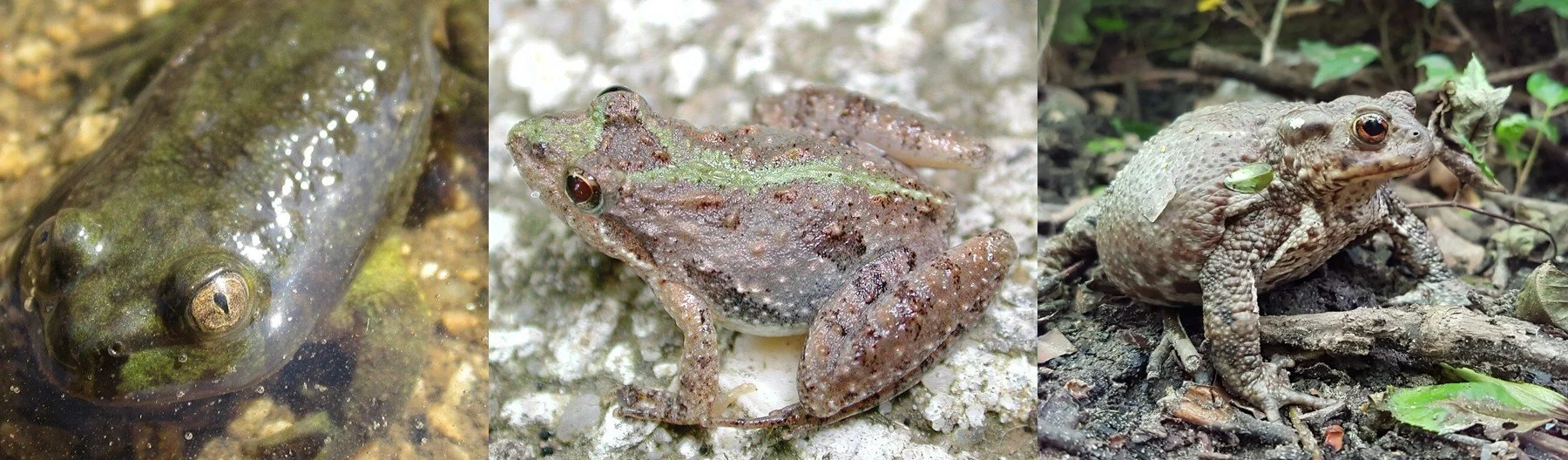
Caption: a montage of hyloid frogs relevant to this article. From left to right: a young Helmeted water frog (or toad) or Gay’s water frog Calyptocephalella gayi, an australobatrachian, Southern cricket frog Acris gryllus, a hylid, and Common toad Bufo bufo, a bufonid. Images: Asiel Olivares, CC BY 4.0 (original here); Stephen Friedt, CC BY-SA 3.0 (original here); Darren Naish.
As you might guess from the name, this is the major clade that include hylids (true treefrogs) in addition to glass frogs, true toads, poison dart frogs and so on. Large phylogenetic studies of anurans mostly do find hyloids to be a clade, though one area of disagreement concerns whether the Australo-Papuan or southern frogs, plus some associated South American taxa, should be included within the group or merely considered close to it (Frost et al. 2006, Pyron et al. 2011). I’m an advocate of the former idea: having that group within Hyloidea is (I feel) more consistent with historical usage and more useful in taxonomic terms, since it means that the great clade Neobatrachia consists of two ‘equal’ subdivisions, Hyloidea and Ranoidea. Here, we look briefly at some moderately newsy points of interest relevant to these frogs.
A quick look at australobatrachians. Having just written about myobatrachoids – the Australo-Papuan or southern frogs (go here for the article concerned) – it’s appropriate to expand a little on the fact that this group keeps being found to be part of a clade that also includes a set of South American frogs. Frost et al. (2006) named this clade Australobatrachia, a name that’s stuck as other studies have recovered the same group.
None of the non-myobatrachoid australobatrachians are well known, but the more familiar are those included within Batrachophrynidae and Calyptocephalellidae. Yes, I appreciate that these names are neither easy nor familiar. Anyway, if any association between these groups and myobatrachoids is valid, this clade surely originated in Gondwana prior to its fragmentation during the Paleogene (as is indicated by the name Australobatrachia: it means ‘southern frogs’). This is in keeping with the connection that younger hyloid groups (like toads) have with Gondwanan landmasses like South America.
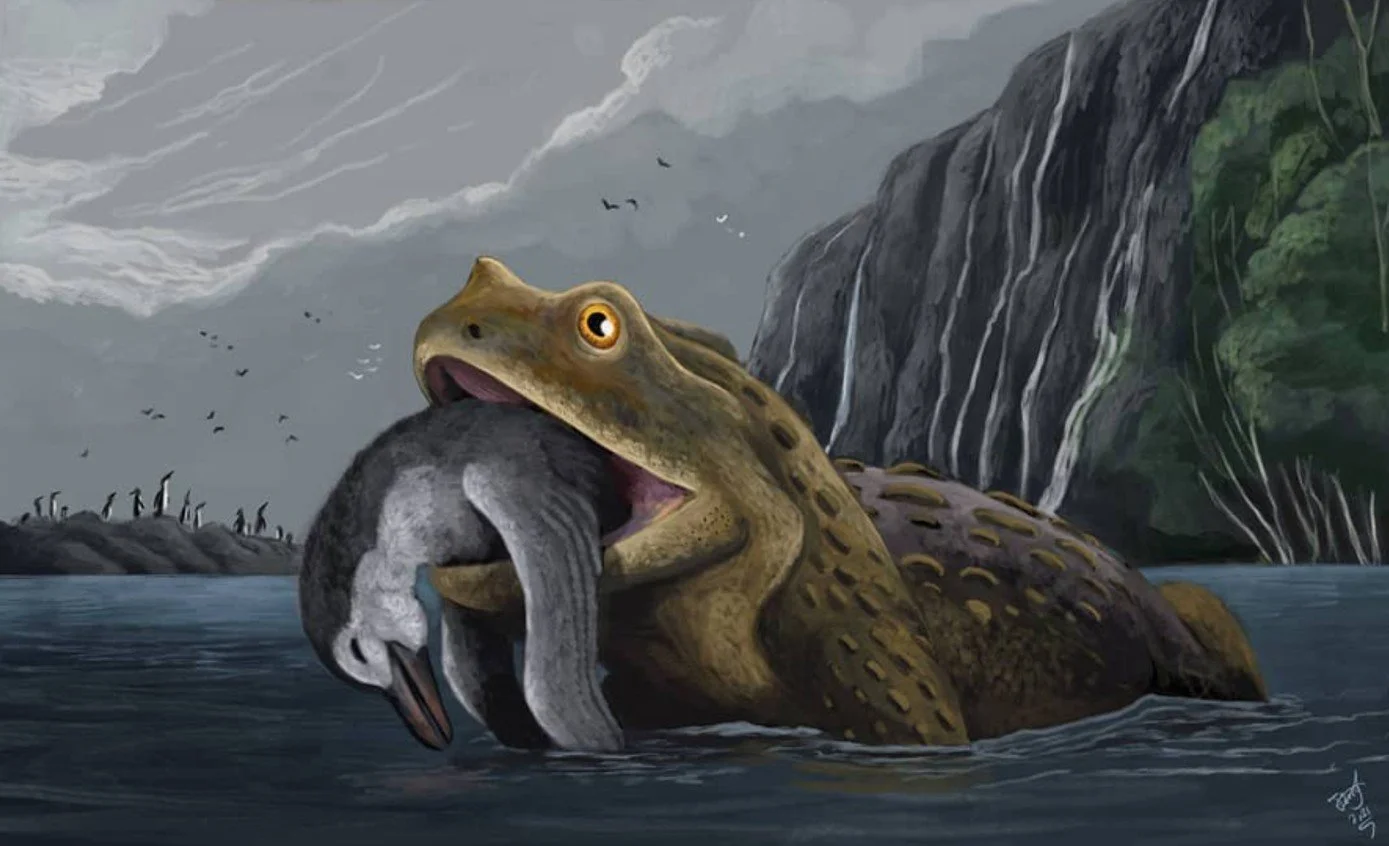
Caption: a Calyptocephalella frog about 60 cm long would have been a formidable predator. In this highly speculative reconstruction by the excellent Hodari Nundu, depicting life in Eocene Chile, this individual is wading through shallow saline water having just captured the chick of a small penguin. Frogs of several groups can endure a short time in marine conditions, in cases even swimming in the sea. Image: © Hodari Nundu.
There’s a lot to say about these frogs. My favourite is the Helmeted water frog (or toad) or Gay’s water frog Calyptocephalella gayi, a large and unusual animal that’s the only extant representative of its genus. A big Calyptocephalella can be 32 cm long SVL (snout-to-vent) and weigh around 1 kg, which is huge. But this taxon is reasonably well represented in the fossil record, with both near-complete skeletons and isolated remains taking it all the way back to the Eocene, around 45 million years ago. Some of these fossils suggest substantially greater size than even the biggest living Calyptocephalella, a Chilean Eocene humerus indicating an SVL of nearly 60 cm (Otero et al. 2014). An article devoted to Calyptocephalella was published at Tet Zoo ver 3 back in 2015 and an archived version can be found here.
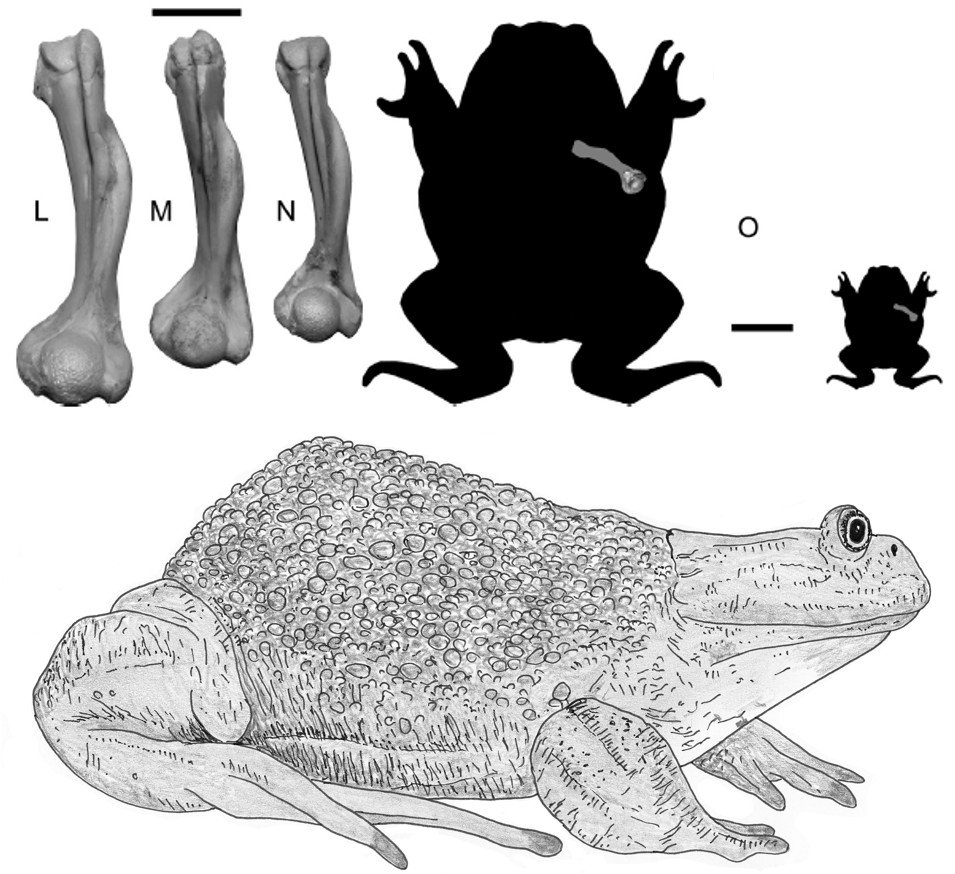
Caption: Calyptocephalella humeri from the Eocene of Chile (L-N; scale bar = 1 cm) with the silhouettes (O) showing what the exceptionally big humerus fragment SGO.PV.6546 would mean for total size, the big silhouette at left being the extrapolated outline relative to a living specimen at right. The scale bar there is 10 cm. At bottom: appearance in life of C. gayi. Images: Otero et al. (2014); Darren Naish.
A hyperossified ‘horned’ hyloid from Hungary. One of the problems with animal groups discovered via molecular techniques is that we’re then left guessing about the status of fossils, most of which don’t come associated with molecular data. In cases, though, we can find anatomical traits common to the taxa associated by DNA and then see if fossil taxa can be shoe-horned in and – if so – where.
Good news is that Lemierre et al. (2026) have just done exactly this with a set of fossil frogs, the main object of their interest being Hungarobatrachus from the Late Cretaceous of Hungary. This is a mid-sized anuran (5-8 cm SVL) with prominent posterolaterally (backwards-and-outwards) projecting processes (‘horns’, sort of) on the rear of the skull. Lemierre et al. (2026) find it to be an australobatrachian, and likewise for the Late Cretaceous frogs Cretadhefdaa from Morocco and Mariliabatrachus and Baurubatrachus from Brazil. Placement of the Gondwanan taxa within Australobatrachia makes sense. But what’s the deal with Hungarobatrachus? The standard explanation for the presence of ‘Gondwanan’ taxa within Cretaceous Europe is the ‘Atlantogean’ hypothesis, whereby transient connections between Africa and southern Europe allowed movement north, and exactly this has been suggested for Hungarobatrachus.
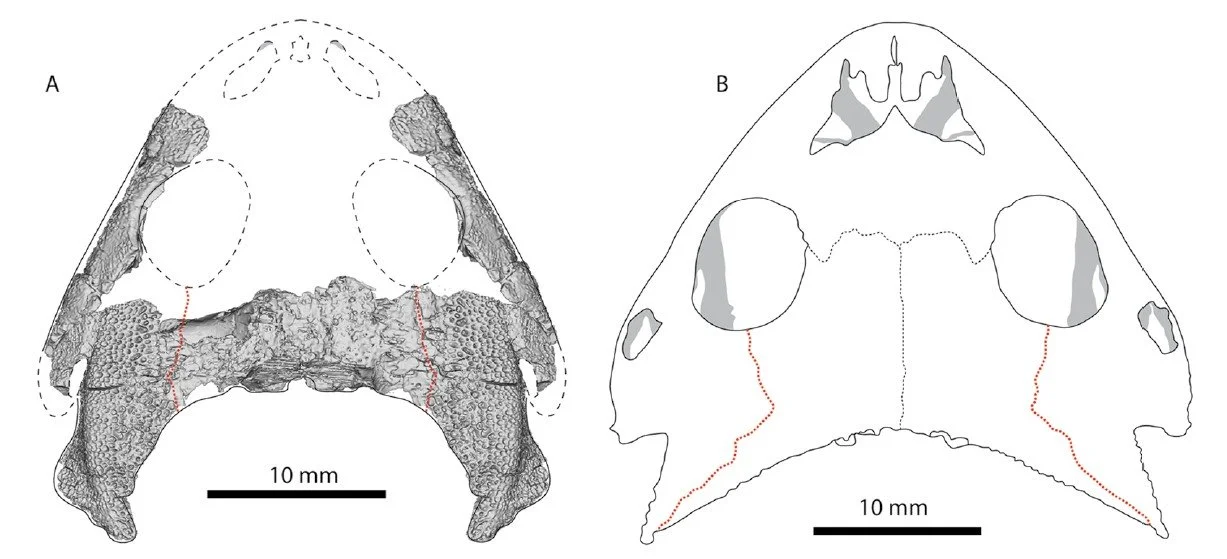
Caption: at left, the new reconstructed skull of Hungarobatrachus from the Cretaceous of Hungary provided by Lemierre et al. (2026). At right, the superficially similar skull of the extant hyloid Hemiphractus, a horned treefrog. Hungarobatrachus might be ‘horned’ and hyperossified but note that it’s not big. Image: Lemierre et al. (2026).
Terraranans. A number of lineages – and an enormous number of species – are united within a clade termed variously Terrarana, Terraranae or Brachycephaloidea. I previously wrote about them here. These are mostly small, direct-developing frogs of the South American tropics, some of which live on the forest floor while others are climbers. The numerous little frogs once all lumped together as species of Eleutherodactylus are here, as are the hundreds of species included within Pristimantis. When I last wrote about these animals at Tet Zoo in 2024 (go here), Pristimantis contained 602 recognised species. It’s now (October 2026) at 647 (data from AmphiaWeb).
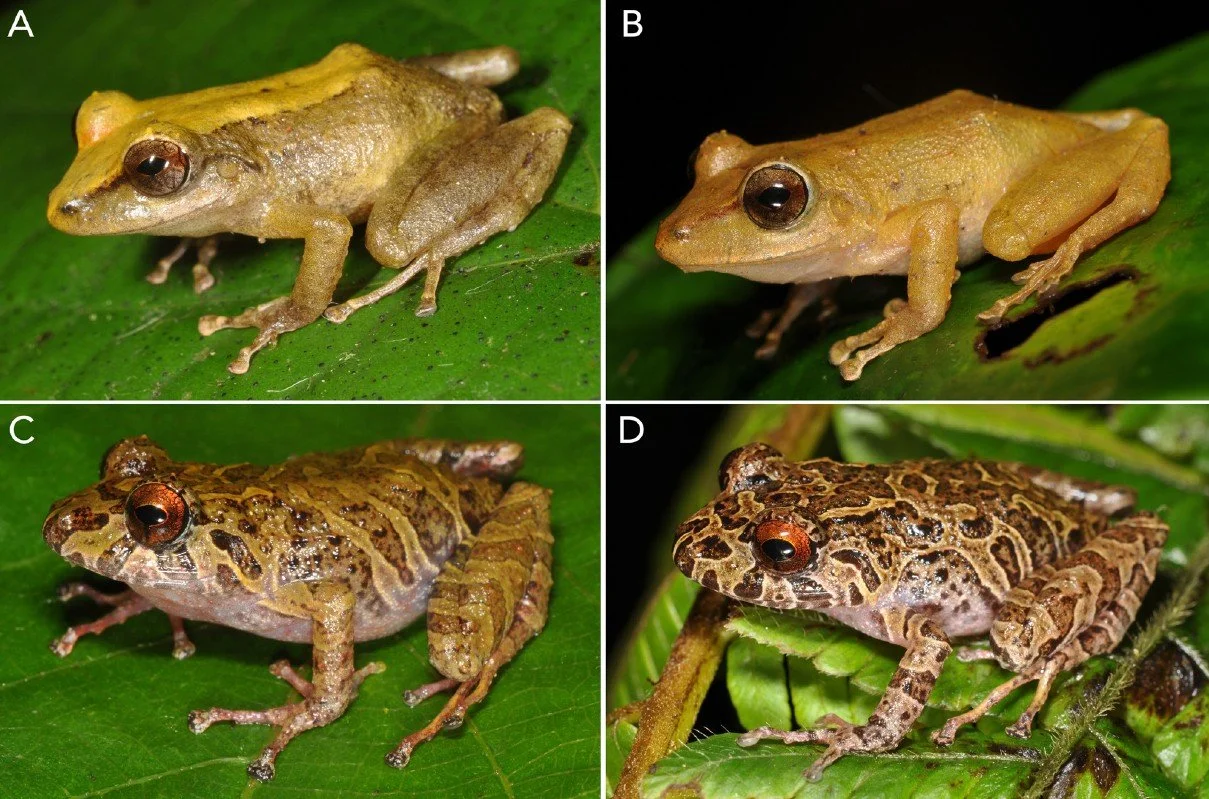
Caption: it can be a little hard to keep up to date with new Pristimantis species, since a good number are published in any one year. I chose the image here (showing two new species from the northern Cordillera Central of Colombia) because one of the species – new as of 2021 – has a fairly amusing name. A and B show Pristimantis chocolatebari; C and D show Pristimantis carylae. The former species has the name it does because a US chocolate company donated funds relevant to its conservation. Image: Rivera-Correa et al. (2021).
The taxonomy within Terrarana is complex and changes are constantly being made as new species are named and new phylogenetic results see print. More interesting for the big picture is that studies disagree on where terranurans fit within Hyloidea as a whole.
Upranking the treefrogs. The true treefrogs – the hylids – have been found in some phylogenetic studies to be outside the big hyloid clade that includes glass frogs, toads and terraranans, but closer to it than are groups like telmatobiids and cycloramphid button frogs. This puts them roughly in the ‘middle’ of hyloid phylogeny and means that they’re neither an especially old lineage nor one of the younger ones. The evolution of dedicated arboreal habits within hylids is (or was) a big deal, giving them access to a vast new ecological milieu and a set of foraging, feeding and breeding strategies utterly distinct from that of ancestral members of Hyloidea. Plenty of other frog groups have evolved arboreality, but treefrogs are just about the most specialized for it, and the most successful, there being over 1000 extant species.
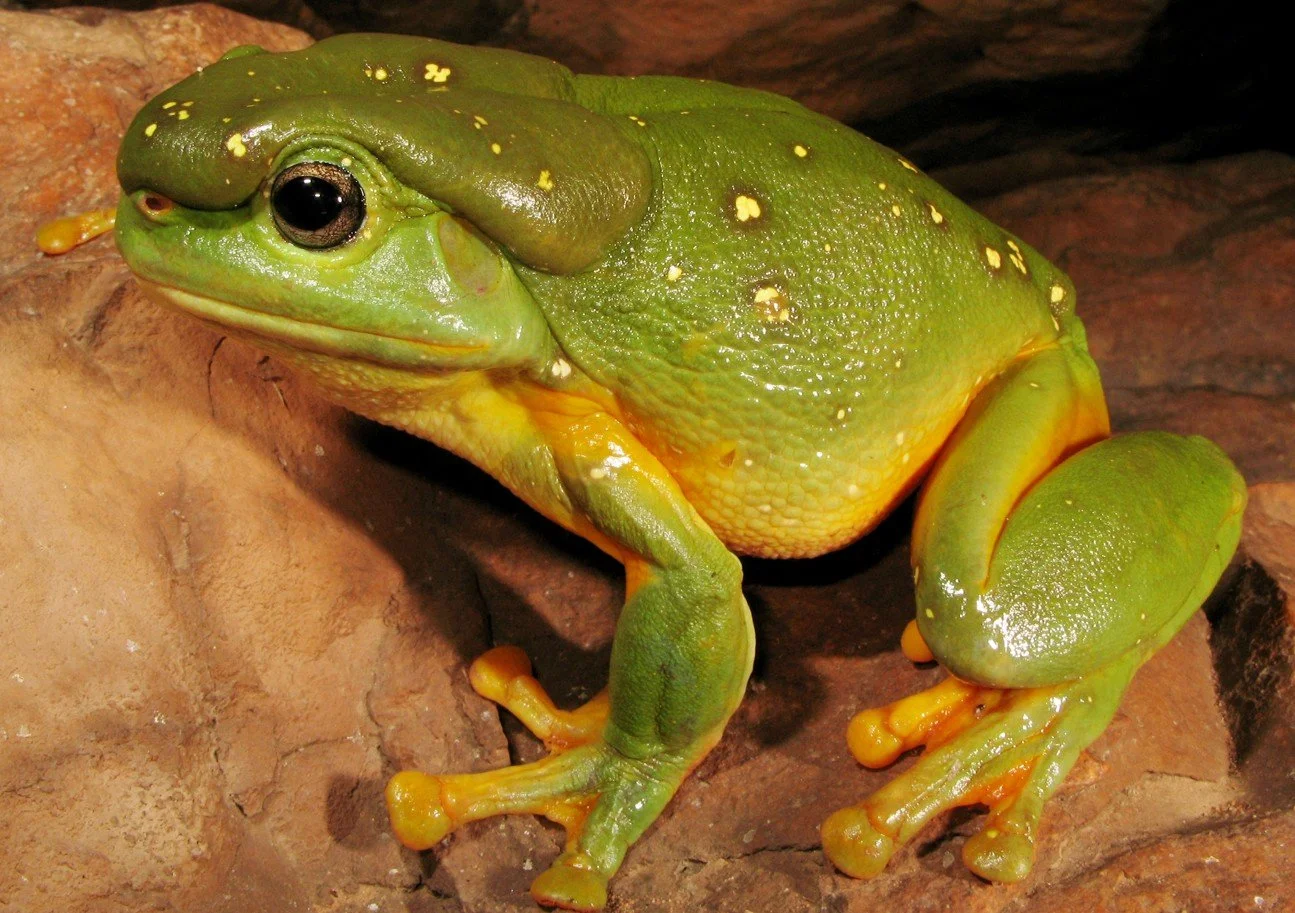
Caption: a randomly selected treefrog chosen to show how stout and magnificent some of these animals are. This is a Magnificent or Splendid treefrog Pelodryas splendida, an animal endemic to the north-west coast of Australia close to the border of Western Australia and Northern Territory. It was only recognised scientifically in 1977. Image: Evan Pickett, CC BY-SA 4.0 (original here).
In pre-2016 classifications, Hylidae was said to consist of three main clades: the widespread Hylinae (containing over 670 species), the Australasian Pelodryadinae (containing over 200 species), and the Central and South American Phyllomedusinae (containing around 60 species). The last group includes the highly modified, long-limbed monkey treefrogs and their relatives.
These three groups are ‘distinct enough’ and appear old enough, geologically speaking, to warrant recognition at the ‘family level’. Yes, compared to birds and mammals, I can’t help avoid the idea that amphibians and non-bird reptiles are ‘under-split’ in taxonomic terms. Duellman et al. (2016) acted on this point, recognising the newly up-ranked Hylidae (containing those frogs previously included in Hylinae) as the sister-group to a Pelodryadidae + Phyllomedusidae clade, the whole treefrog assemblage being given the new name Arboranae. This seems fitting given the existence of a mostly terrestrial giant hyloid clade termed Terraranae.
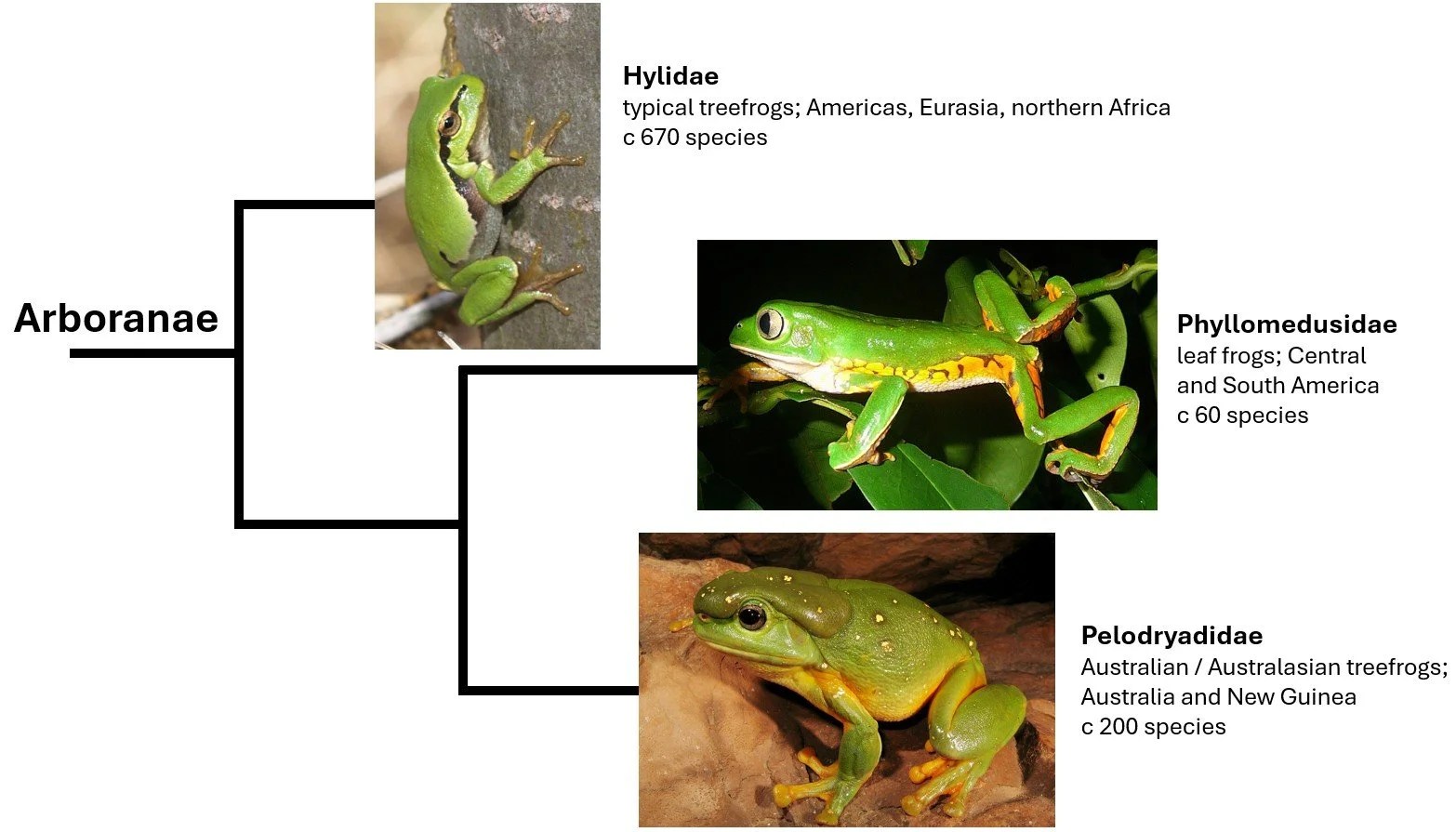
Caption: very simplified cladogram of treefrogs – now upranked to Arboranae – based on the topology and taxonomy provided by Duellman et al. (2016). Images: Hyla by RobertC1301, CC BY-SA 3.0 (original here); Phyllomedusa by Gionorossi, CC BY-SA 4.0 (original here); Pelodryas by Evan Pickett, CC BY-SA 4.0 (original here).
That’s where we’ll end. I wanted to talk about recent discoveries in toads and poison dart frogs too, but it will have to wait.
For previous Tet Zoo articles on hyloids, see…
Green-boned glass frogs, monkey frogs, toothless toads, November 2007
The toads series comes to SciAm: because Africa has toads too, September 2011
20-chromosome toads, September 2011
Glassfrogs: translucent skin, green bones, arm spines, January 2013
Everybody loves glassfrogs, February 2013
African tree toads, smalltongue toads, four-digit toads, red-backed toads: yes, a whole load of obscure African toads, December 2014
Gladiatorial glassfrogs, redux, January 2015
Frogs you may not have heard of: Brazil’s Cycloramphus ‘button frogs’, January 2015
It's the Helmeted water toad… this time, with information!, January 2015
The Terrible Leaf Walker Frog, March 2017
What, If Anything, Is A Strabomantid?, January 2024
A World Without Baw Baw Frogs?, October 2026
Refs - -
Duellman, W. E., Marion, A. B. & Blair Hedges, S. 2016. Phylogenetics, classification, and biogeography of the treefrogs (Amphibia: Anura: Arboranae). Zootaxa 4104, 1-109.
Frost, D. R., Grant, T., Faivovich, J., Bain, R. H., Haas, A., Haddad, C. F. B., De Sá, R. O., Channing, A., Wilkinson, M., Donnellan, S. C., Raxworthy, C. J., Campbell, J. A., Blotto, B. L., Moler, P., Drewes, R. C., Nussbaum, R. A., Lynch, J. D., Green, D. M. & Wheeler, W. C. 2006. The amphibian tree of life. Bulletin of the American Museum of Natural History 297, 1-370.
Lemierre, A. J., Gardner, J. D., Venczel, M., Codrea, V., Anderson, J. S. & Szentesi, Z. 2026. A frog with horns in the Late Cretaceous: new information on Hungarobatrachus szukacsi (Neobatrachia: Anura). Zoological Journal of the Linnean Society 208, zlag154.
Otero, R. A., Jimenez-Huidobro, P., Soto-Acuña, S. & Yury-Yáñez, R. E. 2014. Evidence of a giant helmeted frog (Australobatrachia, Calyptocephalellidae) from Eocene levels of the Magallanes Basin, southernmost Chile. Journal of South American Earth Sciences 55, 133-140.
Rivera-Correa, M., González-Durán, G. A., Saldarriaga-Gómez, A. M. & Duarte-Marín, S. 2021. Biodiversity in the Andean Mountains: two new rain frogs of the genus Pristimantis (Anura: Craugastoridae) from the northern Cordillera Central in Colombia. Zootaxa 5040, 334-364.


