Ever aiming to republish my squamate-themed articles from years back (specifically, from Tet Zoo ver 2), I here reproduce part of the multi-part series I released on geckos. This section is from part II, an archived version of which is here. It’s devoted to gecko eggs and eggshell, here we go…
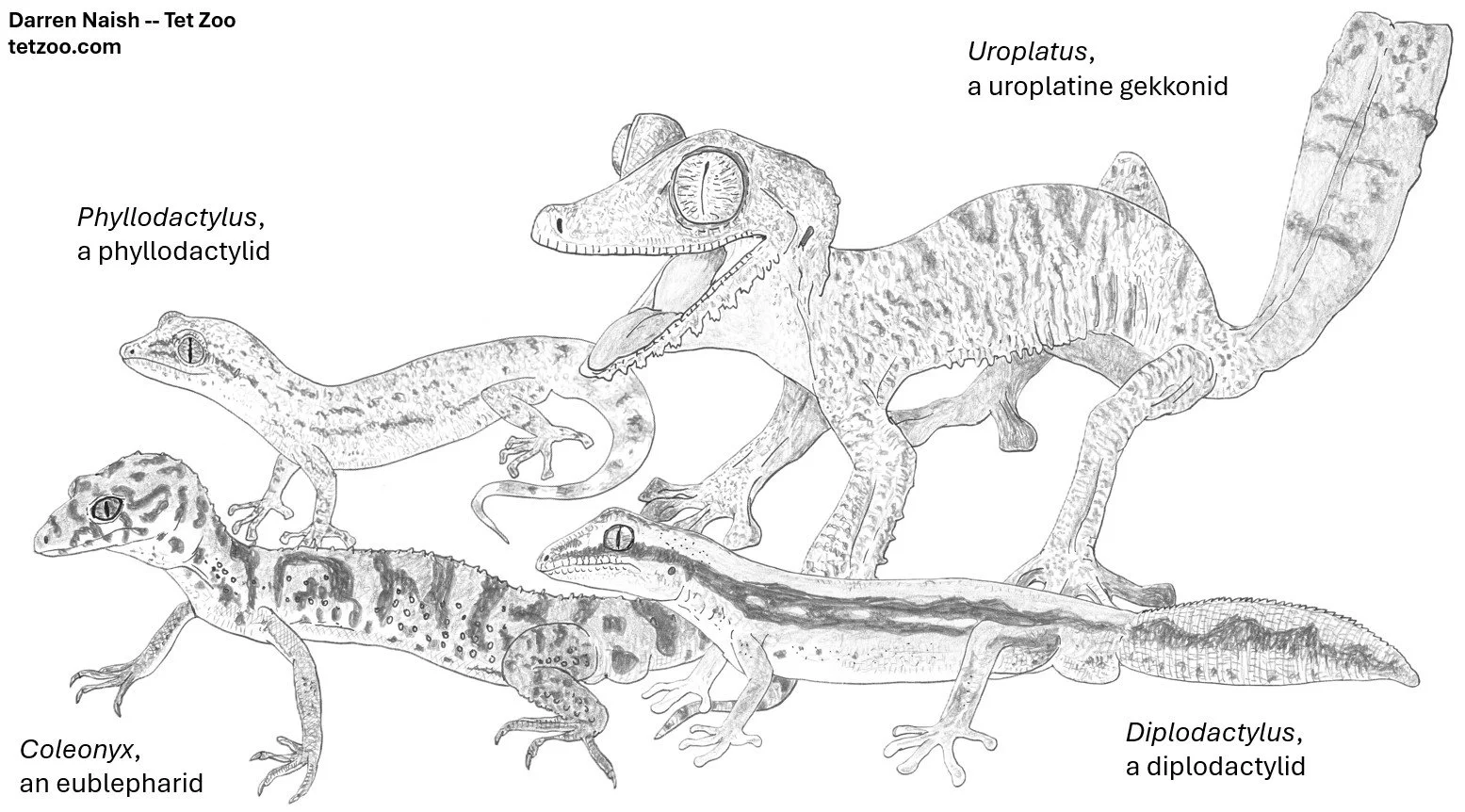
Caption: a set of geckos, represent several (but no means all) of the lineages within Gekkota. I’ve drawn a lot of geckos, and a lot of squamates overall. Image: Darren Naish.
Most gekkotan species produce just one or two white, round or oval eggs. In contrast to many other lizards, they don't exhibit parental care of any sort. The eggshell is soft and parchment-like in eublepharids, diplodactylines and pygopodids, but (once dry) hard, highly mineralised and impermeable in most gekkonids (and in the diplodactyline Eurydactyloides). While carphodactyline, diplodactyline and pygopodid eggs are elongate (including those of Eurydactyloides), those of some gekkonids (particularly larger species) are more spherical (Kratochvíl & Frynta 2005).
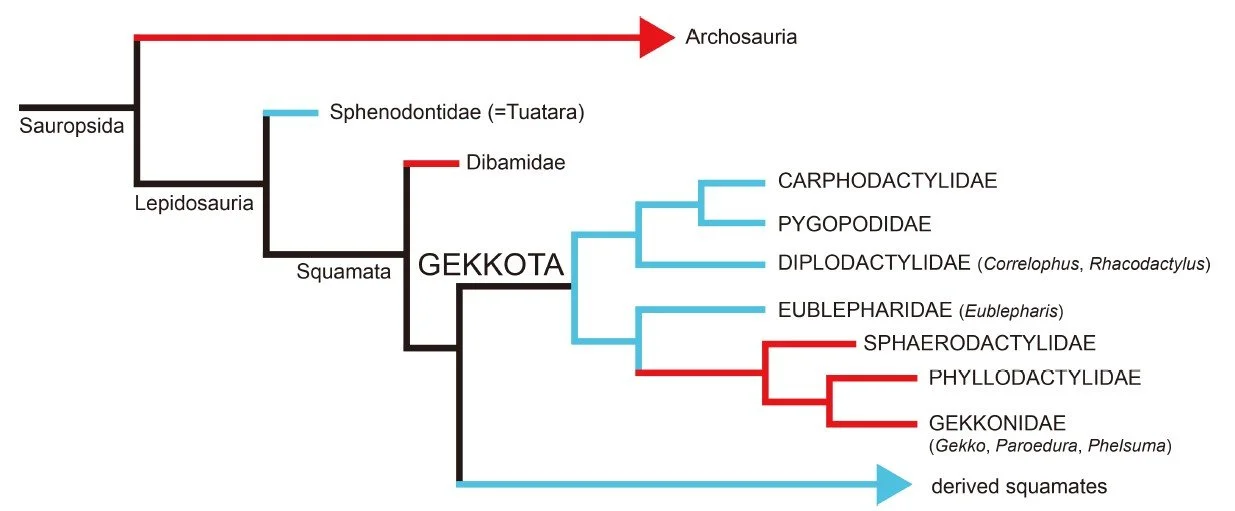
Caption: soft-shelled eggs (in blue) are the norm across squamates, but hard-shelled eggs (in red) have evolved within Gekkota. Image: Choi et al. (2018), CC BY 4.0.
Gekkonid eggs are adhesive when first laid, and stick hard to the surface they're laid on. This might be the inside of a hollow branch, under bark, on the underside of a rock or – in species that associate with humans – the side of a window-frame or cavity within a wall or roof. Females will sometimes lay communally, with as many as 186 eggs being recorded from one location.
Thanks to their mineralised shells, gekkonid eggs can withstand exposure to sea water. This feature – combined with the small size of most geckos and their habit of associating with humans – means that some species have been transported inadvertently on boats and in timber. The Pacific gecko or Common house gecko Hemidactylus frenatus occurs on islands across the Indian and Pacific Ocean, throughout tropical Asia, Australia, on St. Helena in the South Atlantic, in Somalia, and in the USA, Mexico and Panama. It's also been reported on occasion from Brazil, England and elsewhere. It's therefore become both a human commensal and an alien invader, and may in fact be responsible for out-competing, and causing the local extinction of, other gecko species (Bauer 2000). Some species (like the Mourning gecko Lepidodactylus lugubris of the Pacific region) are parthenogenetic, and this has also helped them to be good colonisers of new places. Viviparity is present in the diplodactylines Naultinus and Hoplodactylus from New Zealand, and Rhacodactylus from New Caledonia.
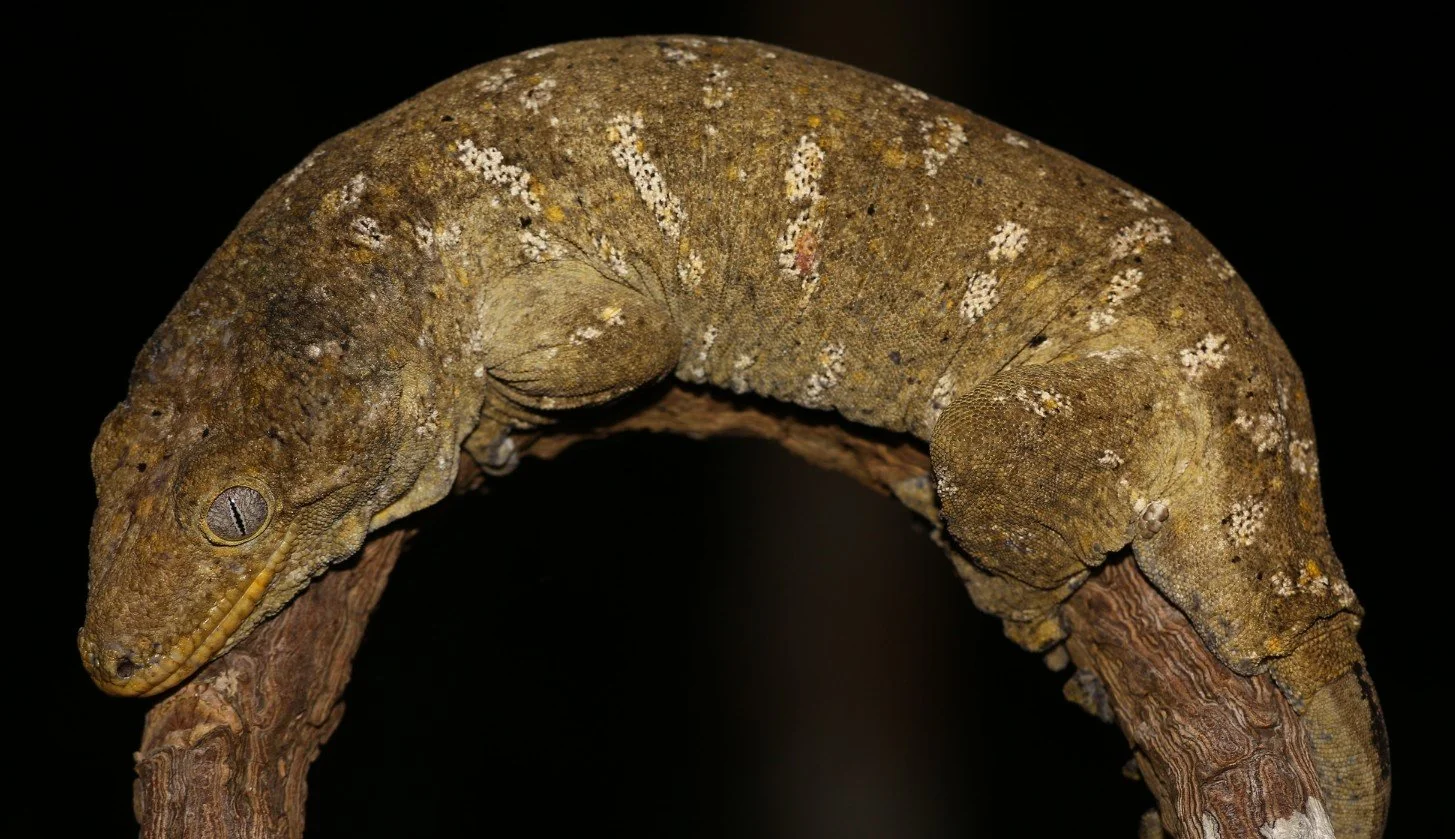
Caption: it’s somewhat ironic that Rhacodactylus (this is R. leachianus, the New Caledonian giant gecko) is, today, one of the most familiar of geckos, at least in terms of reptiles you can see in captivity. It’s a deeply unusual member of Gekkota, among the most aberrant of the whole lot. Image: Lennart Hudel, CC BY 4.0 (original here).
As just mentioned, those hard-shelled gekkonid eggs have highly mineralised shells. Animals that produce calcareous eggshells have to somehow store and mobilise the calcium they need. Female birds produce a special kind of bone (medullary bone) that acts as a calcium reservoir: it forms on the inside surfaces of their bone walls, and when the time is right, they're able to mobilise huge amounts of calcium for eggshell generation. How do geckos produce all the extra calcium they need for eggshell production? The answer seems to be that they possess special, calcium-storing sacs or pouches – called endolymphatic glands – on either side of the neck. Prior to egg-laying, these sacs enlarge and fill up with a sort of 'calcium milk'. Because some geckos have semi-translucent skin, the sacs are visible in some individuals at some times. I'm sure there must be some funky x-ray images of reproductively active female geckos out there, but I can't find any right now.
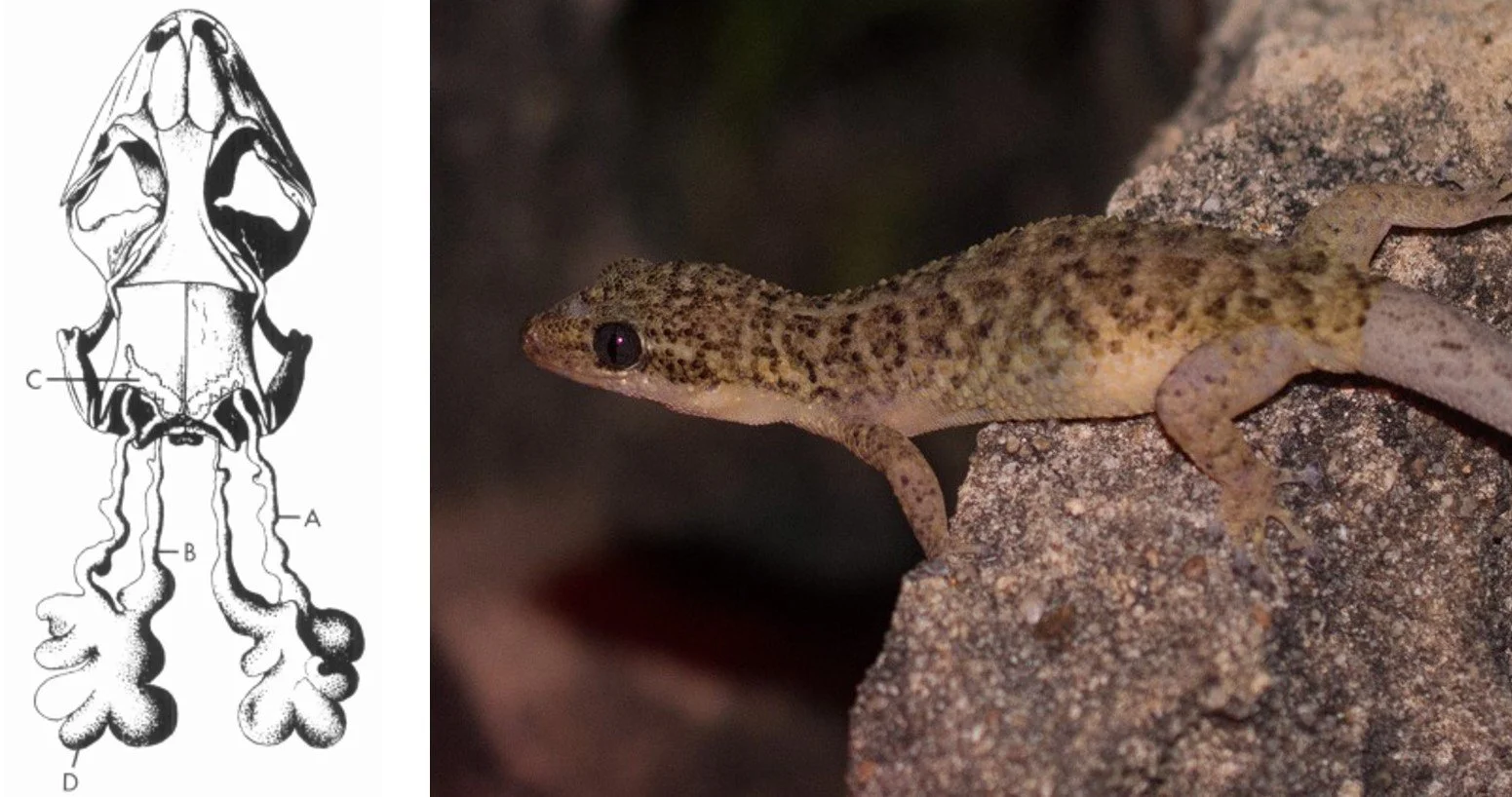
Caption: at left, diagram showing endolymphatic glands in the neck of a Phyllodactylus, from Kluge (1987). At right, a Phyllodactylus leaf-toed gecko in life; specifically, Barbados leaf-toed gecko P. pulcer. Images: Kluge (1987); dcblades, CC BY-SA 4.0 (original here).
I should point out that endolymphatic glands are not unique to gekkotans – they're actually widespead within squamates – and enlarged neck sacs are not unique either, as they're also present in such iguanians as chameleons and agamids.
I’ll stop there, but more on geckos will be shared here soon. Like I said, there’s a lot of content in the archives, ‘all’ I have to do is republish it here.
For previous Tet Zoo articles on squamates, see…
The Tet Zoo Guide to Mastigures, August 2018
The Remarkable Basilisks, May 2023
Do Lizards Really Have ‘Mite Pockets’?, March 2024
Meeting Lake Zacapu’s Garter Snake, March 2024
Ray Hoser, Number 1 Taxonomic Vandal, May 2024
The Mysterious Dibamids, May 2024
The Rehabilitation of Günther’s Black Cameroonian Snake, May 2024
Ikaheka and Other ‘Palatine Draggers’, Cryptozoic Elapid Snakes of Melanesia, June 2024
Arboreal Alligator Lizards of Mesoamerica... and Beyond!, July 2024
Grayiids: Africa Has Water Snakes Too, August 2024
Leiosaurid Lizards: South America, Land of Iguanians, November 2024
What's With All These New Chameleon Names? Chameleons, Part 1, November 2024
The Treerunners, ‘Strikingly Proportioned’ Arboreal Iguanians, March 2026
Bauer, A. M. 2000. Lizards. In Cogger, H. G., Gould, E., Forshaw, J., McKay, G. & Zweifel, R. G. (consultant eds) Encyclopedia of Animals: Mammals, Birds, Reptiles, Amphibians. Fog City Press (San Francisco), pp. 564-611.
Gamble, T., Bauer, A. M., Greenbaum, E. & Jackman, T. R. 2007. Evidence for Gondwanan vicariance in an ancient clade of gecko lizards. Journal of Biogeography 35, 88-104.
Kratochvíl, L. & Frynta, D. 2005. Egg shape and size allometry in geckos (Squamata: Gekkota), lizards with contrasting eggshell structure: why lay spherical eggs? Journal of Zoological Systematics 44, 217-222.
Kluge, A. G. 1982. Cloacal bones and sacs as evidence of gekkonid lizard relationships. Herpetologica 38, 348-355.
Kluge, A. G . 1987. Cladistic relationships in the Gekkonoidea (Squamata, Sauria). University of Michigan Museum of Zoology Miscellaneous Publications 173, 1-54.
Pianka, E. R. & Vitt, L. J. 2003. Lizards: Windows the Evolution of Diversity. University of California Press (Berkeley).
Rittenhouse, D. R. & Russell, A. P. 1998. The larynx and trachea of the barking gecko, Ptenopus garrulus maculatus (Reptilia: Gekkonidae) and their relation to vocalization. South African Journal of Zoology 33, 23-30.


