As a regular reader here, you might be familiar with the idea that we’re currently in a Golden Age of dinosaur discovery. More fossil dinosaurs are being discovered, monthly and annually, than at any other point in history, and numerous locations worldwide – even those considered well explored and well understood scientifically – continue to yield new species. Yes, new dinosaurs are found in countries like Malawi, Ecuador and Tanzania, and in Antarctica, but new dinosaurs are also found in the USA, France, Spain and the UK. This week sees the publication of yet another new dinosaur from England. I’m writing about it because I’m one of its describers.
RIP Brian Franczak (1955-2020)
The 1972 Loch Ness Monster Flipper Photos
If you’re a long-time reader of TetZoo, you’ll know that I’ve often examined and discussed the backstories to famous monster photos. And if you follow me on Twitter (I’m @TetZoo), you’ll know that I’ve lately been posting extremely long threads wherein I do likewise. It’s fun and results in lots of interaction. Today, I’m going to conduct an experiment and publish a monster-themed article here at the blog AND a threaded version of the same text at Twitter.
A Love Letter to the Common Frog
Why the World Has to Ignore David Peters and ReptileEvolution.com
The Dodo in Life
You’re already highly familiar with the Dodo Raphus cucullatus, and images of what this animal looked like in life are present in a vast number of books, popular sources and museum displays. What might not be so familiar to you is that the Dodo’s life appearance has been the subject of long-standing debate, that many familiar ideas about its appearance are very likely wrong, and that – even today – we’re uncertain about several details.
Dougal Dixon’s After Man, the Initial Pitch Document
There can’t be many visitors here who are unaware of Dougal Dixon and his 1981 book After Man (Dixon 1981), the work which effectively started the entire Speculative Zoology (or SpecZoo) movement.
The Shrews of the World
Cloudrunners and Other Cloud Rats of the Philippines
I’ve surely said on several occasions over the years that I’ve never written enough about rodents here at TetZoo. But, then, you could write about nothing BUT rodents and still not write about them enough… there are just so many of them, both in terms of numbers of species and individuals. Whatever, I’ve opted today to write about cloudrunners and other cloud rats, a group of luxuriantly furred, large, striking members of Muridae – the rat and mouse family – endemic to the Philippines.
Did Mesozoic Mammals Give Birth to Live Babies or Did They Lay Eggs?
If you know anything about mammals, you’ll know that crown-mammals – modern mammals – fall into three main groups: the viviparous marsupials and viviparous placentals (united together as therians), and the egg-laying monotremes. The fact that monotremes lay eggs is familiar to us today, but of course it was a huge surprise when first discovered. There’s a whole story there which I won’t be recounting here.
Stop Saying That There Are Too Many Sauropod Dinosaurs, Part 8 (THE LAST PART)
Stop Saying That There Are Too Many Sauropod Dinosaurs, Part 7
Welcome to part – oh my god – seven in this seemingly eternal series.
Like me, I’m sure you want it to end so I can get back to writing about the innumerable other things on the list. Yes, we’re here, once again, for another instalment in the Too Many Damn Dinosaurs (TMDD) series. If you’re new to the whole thing, go back to Part 1 and see what this is all about; if you want to see all previous parts in the series go to the bottom of the article for the links (or use the sidebar). In the most recent articles, we looked at two assumptions inherent to the TMDD contention: that sauropod populations were similar in structure to modern megamammal populations, and that sauropods and other big dinosaurs were similar to Holocene megamammals in ecology and distribution. Here, we look at a third assumption, and it’s one that just won’t die.
Stop Saying That There Are Too Many Sauropod Dinosaurs, Part 6
Oh wow, we’re at Part 6 in the Too Many Damn Dinosaurs (TMDD) series already. You’ll need to have seen at least some of the previous articles to make sense of this one: you can either follow the links below, or click through the links in the sidebar. In Part 5 we looked at the first of a series of assumptions made by those who’ve advocated the TMMD contention; namely, that Late Jurassic sauropods had a population structure similar to that of megamammals. In this article, we look at a second assumption…
Stop Saying That There Are Too Many Sauropod Dinosaurs, Part 5
If you’ve been visiting TetZoo over recent weeks, you’ll know why we’re here. Yes, we’re here to continue with the Too Many Damn Dinosaurs (TMDD) series, in which I argue that it’s wrong to argue – that is, on principle, rather on detailed evaluation of the evidence – that the world famous Late Jurassic Morrison Formation contains too many sauropods. In the previous four parts of this series we introduced the DMDD contention, we looked at the fact that Paleogene mammals are not especially relevant to the TMDD contention, and then at the fact that modern giraffes are not especially relevant to the TMDD contention either.
Stop Saying That There Are Too Many Sauropod Dinosaurs, Part 4
In the previous articles in this series (see part 1 here, part 2 here and part 3 here) we looked at the ‘too many damn dinosaurs’ (TMDD) contention, this being the claim that the Upper Jurassic Morrison Formation simply has too many sauropod dinosaurs. You’ll need to check those previous articles out before reading this one. The previous parts of the series introduce the TMDD contention and then discuss whether arguments made about Paleogene fossil mammals and modern giraffes are relevant. Here, we move on to something else.
Stop Saying That There Are Too Many Sauropod Dinosaurs, Part 3
Welcome to the third part in this lengthy series of articles, all of which are devoted to the argument that those Mesozoic faunas inhabited by multiple sauropod taxa – in particular those of the Late Jurassic Morrison Formation – have too many damn dinosaurs (TMDD!). You need to have read parts 1 and 2 for this to make sense. Those articles set up the TMDD contention, and then showed why arguments relating sauropod diversity to Paleogene mammal diversity are erroneous. In this article, we look at another mammal-based argument.
Stop Saying That There Are Too Many Sauropod Dinosaurs, Part 2
A few authors would have it that there are too many damn dinosaurs (TMDD!): that the rich sauropod assemblage of the Late Jurassic Morrison Formation of the continental western interior of the USA simply contains too many species, and that we need to wield the synonymy hammer and whack them down to some lower number. In this article and those that follow it, I’m going to argue that this view is naïve and misguided. You’ll need to have read Part 1 – the introduction – to make sense of what follows here. Ok, to business…
Stop Saying That There Are Too Many Sauropod Dinosaurs, Part 1
Professor Jenny Clack, 1947-2020
Theropod Dinosaurs of the English Wealden, Some Questions (Part 1)
I have no idea whether I’m known for being a specialist on anything. But of the several zoological subject areas I publish on, among my favourite and most revisited is the dinosaurs of the English Wealden, and in particular the theropods (that is, the predatory dinosaurs) of the English Wealden.

Caption: at left, a Wessex Formation scene, depicting Eotyrannus, a compsognathid (at lower right), a pachycephalosaurian Yaverlandia in the middle distance, and the titanosauriform ‘Angloposeidon’. I need to do some new Wealden dinosaur artwork. At right: a younger, slimmer version of this blog’s author, holding the holotype claw of Baryonyx walkeri in 2001 or thereabouts. Images: Darren Naish.
What is the Wealden? It’s a Lower Cretaceous succession – formed of sandstones, siltstones, mudstones, limestones and clays – which was deposited during the Early Cretaceous, its oldest layers being from the Berriasian (and thus about 143 million years old) and its youngest from the early Aptian (and thus about 124 million years old). The sedimentology, subdivisions and terminology of the Wealden are complicated, but all you need to know here is that the whole lot is termed the Wealden Supergroup, that it has an old section called the Hastings Group and a younger section called the Weald Clay Group – both of which crop out on the English mainland – and that there’s also a young section called the Wealden Group that mostly crops out on the Isle of Wight. Finally, you also need to know that the Wealden Group includes the Wessex and Vectis formations. Yikes, even that brief summary was complicated, sorry.
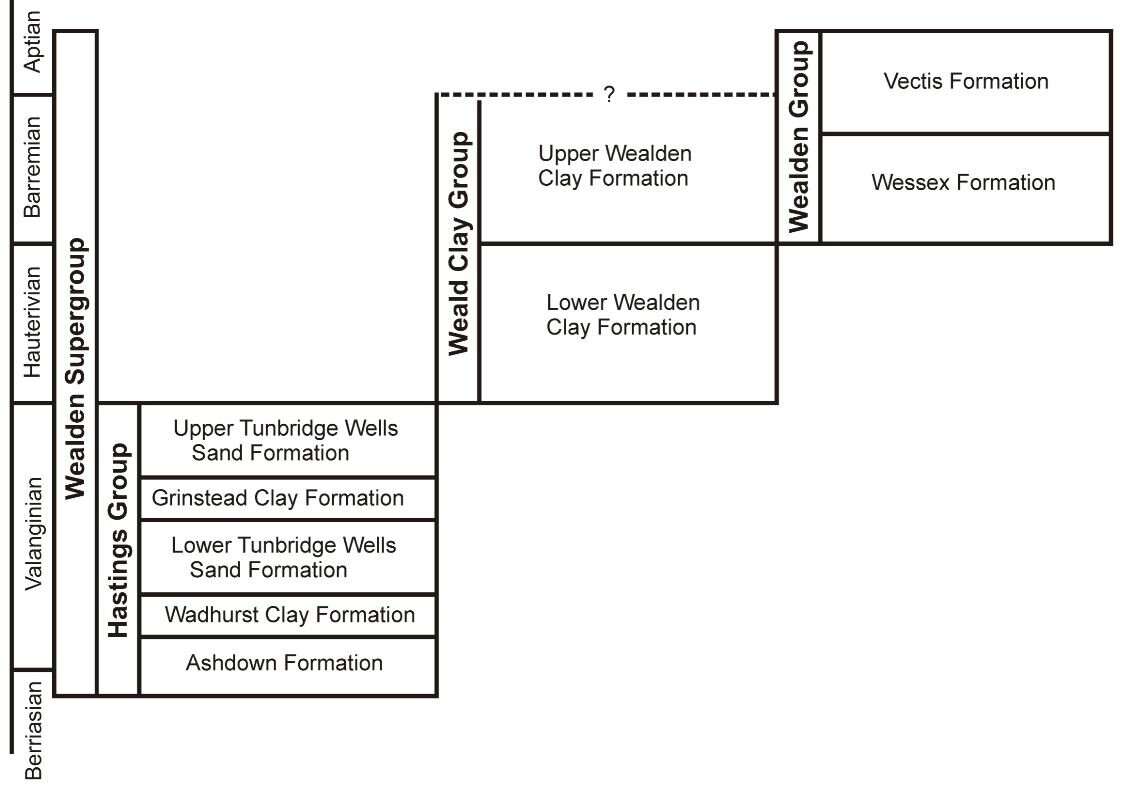
Caption: simplified stratigraphic nomenclature of the Wealden Supergroup. Note that the Hastings Group is much older than the Weald Clay and Wealden groups. The vast majority of Wealden dinosaurs come from the Wessex Formation. Image: Naish (2010).
The really interesting thing about the Wealden is that it’s highly fossiliferous, yielding everything from pollen and diatoms to dinosaurs. Wealden dinosaurs have been hugely important to our evolving understanding of these animals, in part because some of the earliest discoveries – Iguanodon, Hylaeosaurus and Hypsilophodon among them – come from the Wealden succession. Many Wealden dinosaurs have also been famously vexing, in part because they were discovered at a comparatively early stage in our knowledge, in part because their remains have been (and still are) highly incomplete, and in part because their historical taxonomy is a convoluted nightmare. Note also that the circa 20 million year duration of the Wealden means that its dinosaurs were not all contemporaries. Instead, they belonged to a series of distinct faunal assemblages. Within the last few decades, the Wealden has – focusing here on theropods alone – yielded the superstars Baryonyx, Neovenator and Eotyrannus, and its potential to give us really spectacular finds even today is affirmed by additional theropods that are yet to be published.

Caption: the Wessex Formation allosauroid Neovenator – here shown with some of its facial bones in partial x-ray – was covered here at TetZoo (ver 3) back in 2017. Our conclusions on the facial anatomy of this dinosaur (Barker et al. 2017) have since been challenged. Image: Darren Naish.
While I could say a whole lot more (I’ve co-authored a whole book on Wealden dinosaurs: Martill & Naish 2001), the point of the article here (and its follow-up, to be published later) is to provide a progress report of sorts on a few contentious or in-prep areas of Wealden theropod research. And I’ll admit right now that the topics I cover here are unashamedly based on my own research interests and projects, sorry. To work…

Caption: at left, Martill & Naish (2001) (cover art by Julian Hume). At right, Batten (2011), truly a must-have volume on Wealden palaeontology. Martill & Naish (2001) is now hard to get and only sold at ridiculous prices.
What are you, Yaverlandia? In 1923, Mr F. M.G. Abell discovered the partial skull roof of a fossil reptile at Yaverland on the Isle of Wight. Its thickened bone immediately led Watson (1930) to suggest that it might be from a pachycephalosaur. Fast forward now to the 1970s: Peter Galton – at the time, revising and redescribing all British ornithischians – took this idea and ran with it. He formally named the specimen Yaverlandia bitholus and argued that it was indeed a pachycephalosaur, the most archaic known (Galton 1971). This became the standard take on this dinosaur and the one I supported when writing Dinosaurs of the Isle of Wight in 2001 (Naish & Martill 2001).

Caption: at top, the Yaverlandia holotype in (left) ventral and (right) dorsal view. Below, the source of shame. Images: Darren Naish.
During my PhD years I was inspired to think about Yaverlandia anew, mostly because Jim Kirkland and Robert Sullivan (busy at the time with pachycephalosaurs) were pushing the idea that Galton’s identification was very likely wrong. I borrowed the specimen, produced a redescription, had the specimen CT-scanned, and photographed it to death. And I discovered a bunch of new stuff, all of which convinced me that Yaverlandia was not a pachycephalosaur at all, but a theropod. This data formed a chapter of my PhD thesis and brief summaries of my conclusions have been made here and there, including at conferences and in Naish (2011).

Caption: life reconstructions of Yaverlandia are few and far between. This one (seeming to show the animal in a quadrupedal pose: note how the artist has hidden the hand, a classic case of trying to cover up a mistake) is from the fabled Orbis part-work magazine series. I think (but can’t confirm) that the artist was Jim Channel. Image: (c) Orbis.
But the full, detailed explanation of the theropod hypothesis hasn’t yet appeared, though I promise that it will eventually (it’s a work I’m co-authoring with Andrea Cau). As is so often the case with my academic projects, I haven’t been able to make time to finish it (insert reminder about all my academic research being unfunded and done in ‘spare time’: I am not employed in academia). I should also add that a second specimen of Yaverlandia is known and also awaits writing-up. That’s a study I’m doing with Steve Sweetman.
![It’s well known in the theropod research community that the full description of this amazing fossil - the holotype of the Spanish ornithomimosaur Pelecanimimus - was done back in the 1990s [UPDATE: nope, 2004], but hasn’t seen print for a bunch of r…](https://images.squarespace-cdn.com/content/v1/510be2c1e4b0b9ef3923f158/1585002681161-29JO3RG3SRL02I363HHH/Wealden-theropod-questions-Mar-2020-Pelecanimimus-holotype-skull-1274px-250kb-Mar-2020-Darren-Naish-Tetrapod-Zoology.JPG)
Caption: it’s well known in the theropod research community that the full description of this amazing fossil – the holotype of the Spanish ornithomimosaur Pelecanimimus – was done back in the 1990s [UPDATE: nope, 2004], but hasn’t seen print for a bunch of reasons. Consequently, good information on the specimen isn’t (yet) available. Despite that, this photo has been widely shared online. I don’t know who to credit for it.
Are there ostrich dinosaurs in the Wealden or not? Back in the day, I was thrilled by the 1994 description of the remarkable multi-toothed ornithomimosaur Pelecanimimus polyodon from the Barremian Calizas de La Huérguina Formation of Spain. Not just because it’s a neat dinosaur, but because the Calizas de La Huérguina Formation has a lot in common with the Wealden: the two share a list of amphibians, mammals, lizards, crocodyliforms and dinosaurs, this rendering it plausible or likely that Pelecanimimus (or a similar taxon) might await discovery in the Wealden too (Naish et al. 2001, Naish 2002). Predicting the presence of a given group in a given faunal assemblage is a cheap and easy thing to do, and you can award yourself points for prescience and smarts if you’re proved right (even though most people will ignore your prediction), and no-one cares or notices if you never are. So, I’m not looking for a Wealden cookie here. Whatever, “where are the Wealden ornithomimosaurs?” was a question on my mind for a while.

Caption: these drawings – produced for Dino Press magazine back in 2002 – look very dated now. They’re supposed to show those smaller theropod groups confirmed for the Wealden (at top) and predicted for the Wealden but still awaiting discovery (at bottom). Images: Darren Naish.
So, I was pretty happy when – in 2014 – Ronan Allain and colleagues announced their discovery of such creatures in the Wealden. They’d discovered a new theropod in the Lower Cretaceous of France (specifically, in the Hauterivian or Barremian of Angeac in Charente, southwestern France) and had used this as a ‘Rosetta Stone’ in the interpretation of other Lower Cretaceous European theropod fossils (Allain et al. 2014). Several Wealden theropods – Valdoraptor, the Calamosaurus tibiae and Thecocoelurus among them – were ornithomimosaurs according to this study (Allain et al. 2014).

Caption: in 2014, I superimposed an ornithomimid into the Wessex Formation scene you saw above… this effort was not meant to be entirely serious (and an ornithomimid is the wrong kind of ornithomimosaur anyway). Image: Darren Naish.
I was initially enthusiastic about this proposal and thought that the authors were likely right. But as more and more information has been released on the Angeac theropod, the less like an ornithomimosaur it seems. It looks, instead, like a noasaur. Furthermore, the assorted relevant Wealden remains aren’t as similar to the bones of the Angeac animal as initially argued (Mickey Mortimer pointed this out in an article of 2014). Proper evaluation of what’s going on here will have to wait until a full description of the Angeac theropod appears in print. But if the Angeac theropod is a noasaur, the possibility that it’s close to or congeneric with one or more Wealden theropods remains a likelihood: Thecocoelurus (named for a single cervical vertebra from the Wessex Formation) looks like a noasaur vertebra (Naish 2011)... though that doesn’t necessarily mean that it is (since it also looks like an oviraptorosaur or therizinosaur vertebra in some features).

Caption: Mickey produced this image for a 2014 article at The Theropod Database (here).
To bring this round full circle, we might still be missing those predicted Wealden ornithomimosaurs.
Are there other Wealden tyrannosauroids besides Eotyrannus? Loooong-time readers of my stuff – I mean, those who’ve been visiting TetZoo since 2006 – might remember my suggestion from way back that some of the smaller theropod specimens from the Wealden are sufficiently similar to tyrannosauroids from the Lower Cretaceous of China to perhaps be additional small-bodied members of this group. I’m talking about Calamosaurus foxi (named for two cervical vertebrae), Aristosuchus pusillus (named for a partial pelvis and sacrum) and a few additional bits and pieces, including the so-called Calamosaurus tibiae (note the plural there). If these remains do belong to tyrannosauroids, they’re from taxa distinct from Eotyrannus (which everyone agrees is a tyrannosauroid).

Caption: the phylogeny I generated for my PhD thesis led me to think that Mirischia might be a tyrannosauroid… in which case Aristosuchus might also be a tyrannosauroid. This isn’t supported, however, in the in-prep Eotyrannus study I’ve co-authored with Andrea Cau. Image: Darren Naish.
I formally suggested a tyrannosauroid identity for Calamosaurus in a 2011 review of Wealden theropods (Naish 2011) but opted to keep Aristosuchus as a compsognathid on account of its similarity with Mirischia from Brazil. However, Mirischia also looks tyrannosauroid-like in some details (it has an anterodorsal concavity on the ilium) and I’ve sometimes wondered if it might also be a member of this clade. Recent results, however, do not support this possibility.

Caption: Aristosuchus pusillus is known from a sacrum and its conjoined pubic bones, which possess a notably long, narrow pubic boot (shown in ventral view in the image at bottom right). At left, we see where these bones would fit within the animal (here portrayed as a corpse; the reconstruction is dated and was produced for a conference poster I presented in 1999). Images: Darren Naish, Owen (1876).
So… Calamosaurus, are you a tyrannosauroid or not? When you only have two cervical vertebrae to go on (plus some tibiae that may or may not from the same taxon), it’s about impossible to say, and you can’t resolve things until you have better material. Like, an associated skeleton.

Caption: at left, one of the two holotype Calamosaurus foxi vertebrae in multiple views (from Naish et al. 2001). The bone is about 40 mm long in total. At right, a schematic reconstruction showing the two vertebrae in place in the cervical column of a compsognathid- or tyrannosauroid-like coelurosaur (from Naish 2002). Scale bar = 50 mm.
On that note, long-time readers might also recall my mention of a fairly good, associated skeleton of what appears to be a small Wealden tyrannosauroid. But it’s in private hands. I’ve been told by a British palaeontologist that the specimen concerned won’t be available for “this generation” of dinosaur specialists and I should simply forget about it. That’s hard, really hard.
And that’s where we’ll stop now. A second part to this article will be published soon.
For previous TetZoo articles on Wealden theropods and other dinosaurs, see (linking here to wayback machine versions due to destruction or paywalling of everything at versions 2 and 3)…
Of Becklespinax and Valdoraptor, October 2007
The world’s most amazing sauropod, November 2007
Oh no, not another new Wealden theropod!, June 2009
Concavenator: an incredible allosauroid with a weird sail (or hump)... and proto-feathers?, September 2010
The Wealden Bible: English Wealden Fossils, 2011, November 2011
Ostrich dinosaurs invade Europe! Or do they?, June 2014 (every archived version of this article lacks the original illustrations, sorry)
Refs - -
Allain, R., Vullo, R., Le Loeuff, J. & Tournepiche, J.-F. 2014. European ornithomimosaurs (Dinosauria, Theropoda): an undetected record. Geologica Acta 12, 127-135.
Galton, P. M. 1971. A primitive dome-headed dinosaur (Ornithischia: Pachycephalosauridae) from the Lower Cretaceous of England and the function of the dome of pachycephalosaurids. Journal of Paleontology 45, 40-47.
Naish. D. 2002. Thecocoelurians, calamosaurs and Europe’s largest sauropod: the latest on the Isle of Wight’s dinosaurs. Dino Press 7, 85-95.
Naish, D. 2010. Pneumaticity, the early years: Wealden Supergroup dinosaurs and the hypothesis of saurischian pneumaticity. In Moody, R. T. J., Buffetaut, E., Naish, D. & Martill, D. M. (eds) Dinosaurs and Other Extinct Saurians: A Historical Perspective. Geological Society, London, Special Publications 343, pp. 229-236.
Naish, D. 2011. Theropod dinosaurs. In Batten, D. J. (ed.) English Wealden Fossils. The Palaeontological Association (London), pp. 526-559.
Naish, D., Hutt, S. & Martill, D. M. 2001. Saurischian dinosaurs 2: Theropods. In Martill, D. M. & Naish, D. (eds) Dinosaurs of the Isle of Wight. The Palaeontological Association (London), pp. 242-309.
Naish, D. & Martill, D. M. 2001. Boneheads and horned dinosaurs. In Martill, D. M. & Naish, D. (eds) Dinosaurs of the Isle of Wight. The Palaeontological Association (London), pp. 133-146.
Owen, R. 1876. Monograph of the fossil Reptilia of the Wealden and Purbeck Formations. Supplement 7. Crocodilia (Poikilopleuron), Dinosauria (Chondrosteosaurus). Palaeontographical Society Monograph 30, 1-7.
Watson, S. 1930. Cf. Proodon [sic]. Proceedings of the Isle of Wight Natural History and Archaeology Society 1930, 60-61.


